
The digital economy has fundamentally lowered the barrier to entry for aspiring entrepreneurs. While the technical requirements for launching a website have become more accessible, the financial architecture required to build a sustainable, profitable venture remains complex. Opening a small online business is less about the “launch” and more about the strategic allocation of capital, the management of cash flow, and the optimization of revenue streams. To transition from a mere concept to a thriving digital enterprise, one must approach the process through a lens of financial discipline and strategic investment.
1. Assessing the Initial Investment: Budgeting for Your Digital Launch
One of the most common misconceptions about online businesses is that they are “free” or “low-cost” to start. While overhead is significantly lower than a traditional brick-and-mortar storefront, a successful digital launch requires a calculated initial investment. Without a clear budget, small business owners often find themselves suffering from “subscription creep”—the accumulation of numerous small monthly fees that erode margins before the first sale is even made.
Identifying Fixed vs. Variable Startup Costs
A robust financial plan begins with a clear distinction between fixed costs (expenses that remain constant regardless of sales volume) and variable costs (expenses that fluctuate based on business activity).
Fixed costs for an online business typically include domain registration, premium web hosting, and essential software subscriptions such as an Email Service Provider (ESP) or a Customer Relationship Management (CRM) tool. Variable costs, on the other hand, include inventory procurement, shipping fees, payment processing percentages, and digital advertising spend. By identifying these costs upfront, entrepreneurs can calculate their “burn rate”—the amount of money the business loses each month before reaching profitability.
The Lean Startup Methodology: Minimizing Upfront Risk
For those operating with limited capital, the Lean Startup methodology offers a financially prudent path forward. This approach emphasizes the creation of a Minimum Viable Product (MVP)—the simplest version of your offering that allows you to start generating revenue. Instead of investing thousands of dollars in a custom-coded website or massive inventory orders, lean entrepreneurs utilize “no-code” platforms and print-on-demand or dropshipping models to test market demand. This preserves capital for what truly matters in the early stages: customer acquisition and market validation.
2. Revenue Models and Pricing Strategies for Sustainable Growth
Opening an online business requires a deep understanding of how value is exchanged for currency. Your revenue model dictates your cash flow patterns, while your pricing strategy determines your long-term viability in a competitive digital landscape.
Choosing the Right Monetization Path
The structure of your income significantly impacts your financial planning. Common online revenue models include:
-
Direct Sales (E-commerce): High volume, but often involves thinner margins due to the cost of goods sold (COGS) and logistics.
-
Subscription Models: Provides predictable, recurring revenue, which is highly valued for business valuation and stability.
-
Service-Based Models: High margins with low overhead, though limited by the entrepreneur’s time.
-
Affiliate and Ad Revenue: Passive in nature but requires significant traffic volume to become a primary income source.
Selecting the right model depends on your capital availability and your desired involvement in daily operations.
Psychographics and Value-Based Pricing
Setting the right price is not merely a matter of covering costs and adding a markup; it is a strategic financial decision. Cost-plus pricing—adding a standard margin to your expenses—often leaves money on the table. Instead, successful online businesses utilize value-based pricing, which looks at the perceived worth of the solution to the customer.
Furthermore, digital entrepreneurs must account for “invisible” costs in their pricing, such as the 2.9% + $0.30 standard fee charged by payment processors like Stripe or PayPal. Failing to account for these micro-transactions can result in a 5-10% revenue leakage that quietly destroys profitability over time.
3. Managing Cash Flow and Business Capital
Cash flow is the lifeblood of any small business. It is entirely possible for an online store to be “profitable” on paper while being “bankrupt” in reality because its cash is tied up in unpaid invoices or unsold inventory. Mastering the movement of money is what separates a side hustle from a professional enterprise.
The Importance of Separating Personal and Business Finances
The first financial milestone for any new online business is the establishment of a dedicated business bank account. Mixing personal and business funds creates a “veil” that makes it impossible to accurately track ROI (Return on Investment). From a tax perspective, co-mingling funds can lead to significant legal complications and the loss of liability protection. By keeping business capital distinct, you can implement the “Profit First” system—allocating specific percentages of every dollar earned to profit, taxes, owner’s pay, and operating expenses.
Utilizing Financial Tools for Real-Time Oversight
In the fast-paced digital world, waiting until the end of the quarter to review your books is a recipe for disaster. Small business owners should leverage automated accounting software that integrates directly with their e-commerce platform and bank accounts. These tools provide real-time dashboards showing key performance indicators (KPIs) such as Gross Profit Margin, Customer Acquisition Cost (CAC), and Lifetime Value (LTV). Understanding the relationship between CAC and LTV is particularly vital; if it costs more to acquire a customer than they spend over their lifetime, the business is fundamentally unsustainable.
4. Tax Compliance and Legal Structuring for Longevity
As an online business grows, it inevitably catches the attention of regulatory and tax authorities. Proactive financial management involves setting up the business structure that offers the most favorable tax treatment while ensuring full compliance with digital commerce laws.
Selecting the Right Business Entity
The legal structure you choose—be it a Sole Proprietorship, an LLC, or an S-Corp—has profound implications for your personal financial liability and your tax obligations.
-
Sole Proprietorships are simple to set up but offer no protection for personal assets.
-
LLCs (Limited Liability Companies) provide a shield between business debts and personal wealth, making them the gold standard for most small online businesses.
-
S-Corps can offer significant savings on self-employment taxes once the business reaches a certain level of net income, usually around $50,000 to $75,000 annually.
Understanding Digital Sales Tax and Nexus
One of the most complex financial hurdles for online sellers is the concept of “Sales Tax Nexus.” In the United States and many international jurisdictions, you may be required to collect and remit sales tax not just where you live, but where your customers are located. Automated tax software is no longer a luxury but a necessity for businesses selling across state or national borders. Ignoring these obligations can result in back taxes and penalties that can easily bankrupt a small operation.
5. Scaling for Profit: Reinvesting Capital and Expanding Horizons
The final stage of opening and operating a small online business is the transition from survival to growth. Scaling requires a shift in mindset from “saving money” to “investing capital” to generate higher returns.
When to Transition from Side Hustle to Full-Time Business
Financial readiness for full-time entrepreneurship is often defined by the “Runway.” Before quitting a primary source of income, an entrepreneur should ideally have 6–12 months of personal living expenses saved, in addition to a business reserve that covers 3–6 months of operating costs. This “financial cushion” allows for better decision-making, as it removes the desperation that leads to poor strategic choices.
Calculating ROI on Marketing and Infrastructure
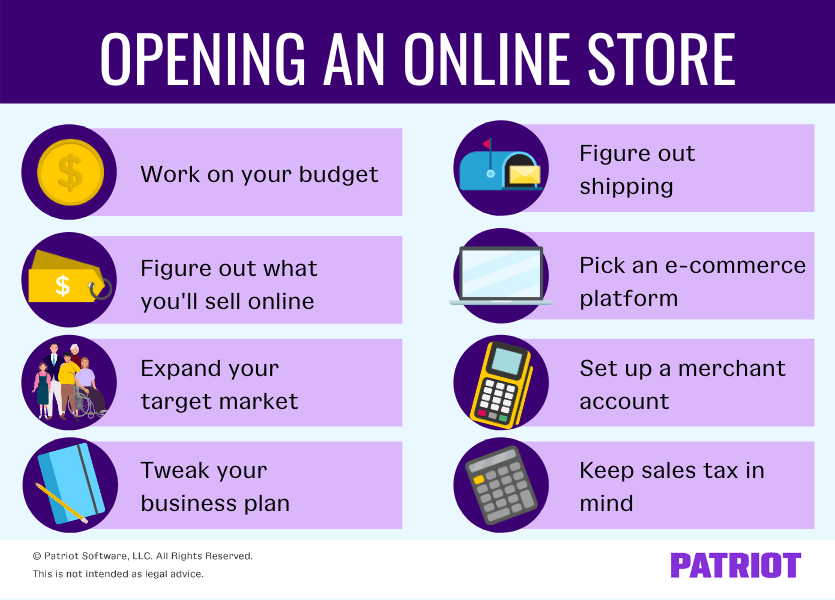
Every dollar spent on scaling should have a measurable return. When a business is ready to grow, capital is typically allocated toward paid advertising (Google Ads, Meta Ads) or infrastructure (hiring virtual assistants, upgrading software).
To scale efficiently, one must calculate the Return on Ad Spend (ROAS). If an investment of $500 in targeted ads generates $2,500 in high-margin sales, the business has a scalable financial engine. Reinvesting profits back into these high-performing channels creates a compounding effect, allowing a small online business to compete with much larger players in the digital marketplace.
Opening a small online business is a multifaceted financial journey. It begins with a lean budget, thrives on a solid revenue model, and matures through disciplined cash flow management and tax strategy. By prioritizing the “money” aspect of the business from day one, entrepreneurs ensure that their digital venture is not just an expensive hobby, but a robust financial asset capable of generating long-term wealth.
aViewFromTheCave is a participant in the Amazon Services LLC Associates Program, an affiliate advertising program designed to provide a means for sites to earn advertising fees by advertising and linking to Amazon.com. Amazon, the Amazon logo, AmazonSupply, and the AmazonSupply logo are trademarks of Amazon.com, Inc. or its affiliates. As an Amazon Associate we earn affiliate commissions from qualifying purchases.