
Embarking on an investment journey is a pivotal step towards securing your financial future. Whether you’re planning for retirement, saving for a down payment, or simply aiming to grow your wealth, choosing the right brokerage firm is paramount. Charles Schwab stands as a formidable leader in the financial services industry, offering a vast array of investment products, robust tools, and extensive educational resources designed to empower investors of all experience levels.
This comprehensive guide will walk you through everything you need to know about opening a Charles Schwab account, from understanding the benefits of choosing Schwab to navigating the application process and beginning your investment journey. We’ll delve into the various account types available, the essential information required, and provide valuable insights to help you make informed decisions as you step into the world of investing.
Why Choose Charles Schwab for Your Financial Journey?
Selecting a brokerage firm is a strategic decision that can significantly impact your investment success. Charles Schwab has cemented its reputation as a preferred choice for millions of investors due to its blend of competitive offerings, client-centric approach, and technological prowess.
A Legacy of Trust and Innovation
Established in 1971, Charles Schwab has built a long-standing legacy rooted in demystifying investing and making it accessible to individual investors. From pioneering discount brokerage services to embracing commission-free trading, Schwab has consistently innovated to reduce barriers and enhance the client experience. This history of trust and forward-thinking has cultivated a platform renowned for its reliability and commitment to investor success. Clients benefit from the security of a large, well-established institution coupled with an unwavering focus on technological advancements that simplify financial management.
Diverse Investment Offerings
One of Schwab’s most compelling attributes is the sheer breadth of its investment products. Investors gain access to a comprehensive universe of assets, allowing for robust portfolio diversification and alignment with individual financial goals. This includes:
- Stocks and Exchange-Traded Funds (ETFs): A wide selection of U.S. and international equities, along with thousands of ETFs covering various sectors, geographies, and strategies. Many ETFs are commission-free.
- Mutual Funds: Access to thousands of no-load, no-transaction-fee mutual funds, including Schwab’s proprietary funds and those from third-party providers.
- Bonds and Fixed Income: A robust bond marketplace for municipal bonds, corporate bonds, U.S. Treasuries, and other fixed-income securities.
- Options and Futures: Advanced trading capabilities for more sophisticated investors looking to leverage derivatives strategies.
- Fractional Shares (Schwab Stock Slices™): An innovative offering allowing investors to buy fractions of S&P 500 stocks with as little as $5, making high-priced stocks accessible to smaller budgets and promoting diversification.
Robust Tools, Research, and Educational Resources
Schwab equips its clients with an impressive suite of tools and resources designed to facilitate informed decision-making. Their proprietary research includes in-depth market analysis, company reports, and investment screeners that help identify opportunities. Educational content ranges from articles and webinars covering fundamental investment concepts to advanced trading strategies, ensuring investors can continuously expand their financial literacy. Furthermore, tools for financial planning, retirement calculators, and portfolio analysis empower clients to monitor their progress and adjust their strategies as needed.
Competitive Fees and Commission-Free Trading
In an increasingly competitive landscape, Schwab has remained at the forefront of offering value. The firm was an early adopter of commission-free online trading for U.S. stocks, ETFs, and options, significantly reducing the cost barrier for frequent traders and long-term investors alike. While certain specialized investments or services may incur fees, Schwab’s overall fee structure is highly competitive, contributing to higher net returns for investors.
Exceptional Customer Support
Navigating the complexities of investing can sometimes require assistance. Charles Schwab prides itself on its multi-channel customer support, offering help through phone, email, live chat, and a vast network of physical branch locations across the country. This ensures that clients can access personalized guidance and support whenever they need it, whether for technical issues, investment advice, or account inquiries.
Types of Accounts Available at Charles Schwab
Charles Schwab offers a wide array of account types designed to meet diverse financial objectives and investor profiles. Understanding the different options is crucial for selecting the account that best aligns with your specific goals.
Individual Brokerage Account
The Individual Brokerage Account is the most common and versatile option for general investing. It allows you to buy and sell a broad range of securities, including stocks, ETFs, mutual funds, and bonds. Funds held in this account are post-tax, meaning contributions are made with money on which you’ve already paid taxes, and capital gains are taxed in the year they are realized. It offers maximum flexibility in terms of contributions and withdrawals, with no age restrictions or contribution limits, making it suitable for short-term and long-term investment goals alike.
Retirement Accounts (IRAs)
For those focused on retirement planning, Schwab provides several Individual Retirement Account (IRA) options, each with distinct tax advantages:
- Traditional IRA: Contributions may be tax-deductible (depending on income and eligibility), and earnings grow tax-deferred until withdrawal in retirement. Withdrawals in retirement are taxed as ordinary income.
- Roth IRA: Contributions are made with after-tax dollars, but qualified withdrawals in retirement are entirely tax-free. This option is particularly attractive for individuals who anticipate being in a higher tax bracket in retirement.
- SEP IRA (Simplified Employee Pension) & SIMPLE IRA (Savings Incentive Match Plan for Employees): These accounts are designed for self-employed individuals and small business owners, offering higher contribution limits than Traditional or Roth IRAs, providing significant tax benefits for business owners and their employees.
Specialized Accounts
Beyond the primary investment and retirement accounts, Schwab caters to specific needs with several specialized offerings:
- Custodial Accounts (UGMA/UTMA): These accounts allow adults (custodians) to manage investments on behalf of a minor, with assets typically transferring to the child’s control upon reaching the age of majority (usually 18 or 21, depending on the state). They are often used for saving for a child’s future.
- 529 College Savings Plans: Specifically designed to help families save for qualified education expenses, these plans offer tax-advantaged growth and tax-free withdrawals when used for eligible educational costs.
- Trust Accounts: For individuals and families who require more complex estate planning, trust accounts provide a structured way to manage and distribute assets according to specific instructions.
- Business Accounts: Schwab also supports various business entities, offering brokerage accounts for corporations, partnerships, and LLCs, enabling businesses to invest their capital.
Robo-Advisors (Schwab Intelligent Portfolios®)
For investors seeking a hands-off approach, Schwab Intelligent Portfolios offers automated investing powered by sophisticated algorithms. After answering a few questions about your financial goals and risk tolerance, the robo-advisor constructs and manages a diversified portfolio of ETFs. This service is particularly appealing to new investors or those who prefer automated portfolio rebalancing and tax-loss harvesting without actively choosing individual investments. Importantly, Schwab Intelligent Portfolios offers this service with no advisory fees, setting it apart from many competitors.
The Step-by-Step Process of Opening Your Account
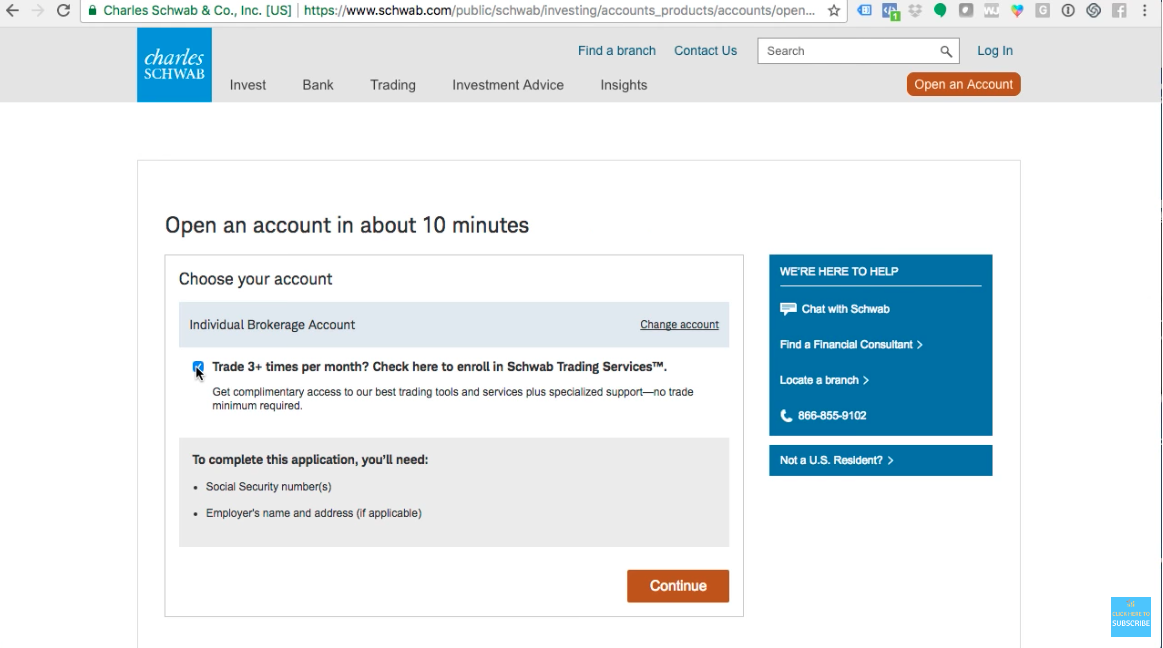
Opening an account with Charles Schwab is a streamlined and typically straightforward process, largely facilitated online. However, being prepared with the necessary information will ensure a smooth experience.
Gather Necessary Information
Before you begin the online application, it’s wise to collect the following personal and financial details. Having these readily available will prevent delays:
- Personal Identification: Full legal name, current residential address, date of birth, Social Security Number (SSN) or Tax Identification Number (TIN).
- Contact Information: Phone number and email address.
- Employment Information: Employer’s name and address, occupation, and industry.
- Financial Details: Information about your annual income, net worth, and a general understanding of your investment experience. This helps Schwab assess suitability for certain investments and provide relevant recommendations.
- Bank Account Details for Funding: The routing number and account number of your checking or savings account from which you intend to fund your Schwab account.
Online Application Walkthrough
Charles Schwab’s online application portal is user-friendly and designed to guide you through each step:
- Choose Your Account Type: Start by selecting the specific account type you wish to open (e.g., Individual Brokerage, Roth IRA, Schwab Intelligent Portfolios).
- Provide Personal Details: Fill in all the requested personal identification, contact, and employment information accurately.
- Financial Profile and Investment Experience: Complete the financial questionnaire, which asks about your income, assets, liabilities, and your comfort level with investment risk. This helps Schwab understand your financial situation and investment objectives.
- Review and Consent: Carefully review all the disclosures, terms of service, and agreements. It’s crucial to understand the implications of opening the account and the associated risks.
- Electronic Signature: Electronically sign the application to confirm your agreement and submit your application.

Funding Your New Account
Once your application is submitted, the next critical step is to fund your account. Schwab offers several convenient options:
- Electronic Funds Transfer (EFT) / ACH: This is the most common and easiest method. You can link your bank account to your new Schwab account and transfer funds electronically. This typically takes 1-3 business days for funds to settle.
- Wire Transfer: For larger amounts or faster access to funds, you can initiate a wire transfer from your bank. Wire transfers are usually processed within one business day.
- Check Deposit: You can mail a check to Schwab or deposit it electronically via the Schwab mobile app.
- Transfer an Existing Account (ACAT): If you have an investment account at another brokerage firm, you can request to transfer your assets to Schwab. This process, known as an Automated Customer Account Transfer (ACAT), allows you to move your investments in-kind without selling them, often within 5-7 business days.
Account Approval and Verification
After you submit your application and initiate funding, Schwab will review your information. This process typically involves verifying your identity and ensuring all regulatory requirements are met. In some cases, Schwab might require additional documentation (e.g., a copy of your driver’s license or a utility bill) to complete the verification process. Once approved, you’ll receive a confirmation, and your account will be fully active, ready for you to begin investing.
Navigating Your New Schwab Account and Beginning to Invest
With your Charles Schwab account successfully opened and funded, you’re now poised to take control of your financial future. Understanding how to navigate the platform and leverage its features is key to effective investing.
Getting Started with the Schwab Platform
Upon logging into your Schwab account for the first time, you’ll find a well-organized dashboard. Whether you use the desktop website or the highly-rated Schwab Mobile app, the interface is designed for intuitive access to your portfolio summary, account balances, recent activity, and investment tools. Take some time to familiarize yourself with the layout: locate your portfolio holdings, transaction history, statements, and the various navigation menus for research, trading, and account services.
Researching and Selecting Investments
Schwab excels in providing comprehensive research capabilities to help you make informed investment decisions:
- Utilizing Schwab’s Research Tools: Explore the “Research” tab to access analyst reports, stock screeners, ETF and mutual fund selectors, and market commentaries. You can filter investments based on various criteria like sector, market capitalization, dividend yield, expense ratio, and historical performance.
- Understanding Different Asset Classes: Before investing, ensure you have a basic understanding of stocks (equity), bonds (fixed income), and mutual funds/ETFs (diversified baskets of securities). Each asset class carries different risk and return characteristics.
- Building a Diversified Portfolio: Diversification is a cornerstone of sound investing. Schwab’s tools can help you analyze your current asset allocation and identify opportunities to diversify across different industries, geographies, and asset classes to mitigate risk.
Placing Your First Trade
Once you’ve identified an investment you wish to purchase, placing a trade is straightforward:
- Navigate to the “Trade” Section: Select the type of security you want to trade (e.g., Stocks & ETFs).
- Enter the Symbol: Type in the stock ticker symbol or fund symbol.
- Specify Order Details:
- Action: Buy or Sell.
- Quantity: The number of shares or units you wish to purchase.
- Order Type: Common types include:
- Market Order: Executes immediately at the best available price.
- Limit Order: Buys or sells at a specified price or better.
- Stop Order: Triggers a market order when a certain price is reached.
- Time in Force: Determines how long the order remains active (e.g., Day, Good-Til-Canceled).
- Review and Confirm: Double-check all details before confirming your trade.
Monitoring Your Investments and Performance
Effective investing is an ongoing process that requires regular monitoring:
- Portfolio Tracking: Your Schwab dashboard provides real-time updates on your portfolio’s performance, showing gains/losses, daily changes, and overall account value.
- Statements and Reports: Access monthly statements and annual tax documents easily through your online account. These provide detailed records of your transactions and holdings.
- Performance Analysis: Use Schwab’s performance tools to track how different investments are contributing to your overall returns and compare them against benchmarks.
Leveraging Schwab’s Educational Resources
For continuous growth as an investor, actively utilize Schwab’s extensive educational offerings:
- Articles and Insights: Regularly check the “Insights & Education” section for articles on market trends, investment strategies, personal finance tips, and economic analysis.
- Webinars and Courses: Participate in live or on-demand webinars and online courses that cover a range of topics from beginner basics to advanced trading techniques.
- Podcasts and Videos: Engage with Schwab’s multimedia content for convenient learning on the go.
Key Considerations for a Successful Investment Journey
Opening an account is just the beginning. A successful investment journey requires continuous planning, discipline, and periodic review. Keep these key considerations in mind as you build and manage your wealth.
Define Your Financial Goals
Before making any investment, clearly articulate what you’re saving and investing for. Are you aiming for a comfortable retirement, a child’s education, a down payment on a home, or generating passive income?
- Short-term vs. Long-term: Differentiate between goals you want to achieve in the next few years and those that are decades away. This will influence your investment choices.
- Specific and Measurable: Set concrete goals (e.g., “save $50,000 for a down payment in 5 years” instead of “save for a house”).
Understand Your Risk Tolerance
Every investment carries some level of risk. Your risk tolerance is your willingness and ability to withstand potential losses in your portfolio in exchange for higher potential returns.
- Assess Your Comfort Level: Are you comfortable with significant market fluctuations, or do you prefer more stable (though potentially lower-returning) investments?
- Time Horizon: Generally, longer time horizons allow for higher risk tolerance, as there’s more time to recover from market downturns.
- Financial Capacity: Only invest money you can afford to lose without jeopardizing your basic living expenses.
Diversification is Key
The old adage, “Don’t put all your eggs in one basket,” holds true for investing. Diversification involves spreading your investments across various asset classes, industries, and geographies to reduce overall portfolio risk.
- Asset Allocation: Determine the right mix of stocks, bonds, and cash based on your goals and risk tolerance.
- Within Asset Classes: Diversify within stocks (e.g., large-cap, small-cap, international, different sectors) and bonds (e.g., government, corporate, different maturities).
Regular Contributions and Dollar-Cost Averaging
Consistency is a powerful tool in wealth building.
- Automate Contributions: Set up automatic transfers from your bank account to your Schwab account to invest regularly, regardless of market conditions.
- Dollar-Cost Averaging: By investing a fixed amount at regular intervals, you buy more shares when prices are low and fewer when prices are high. This strategy helps reduce the impact of market volatility and can lead to a lower average cost per share over time.
Review and Rebalance Periodically
Your financial situation and market conditions are dynamic. Regularly review your portfolio and rebalance it as needed.
- Annual Check-up: At least once a year, review your investment performance, ensure your portfolio still aligns with your goals and risk tolerance, and make adjustments.
- Life Events: Major life changes (e.g., marriage, children, new job, retirement) may necessitate a review and adjustment of your investment strategy.
- Rebalancing: If one asset class has grown significantly, you might rebalance by selling some of the outperforming assets and investing in underperforming ones to restore your target allocation.
Seek Professional Guidance (If Needed)
While Schwab provides excellent self-service tools, don’t hesitate to seek professional advice if you feel overwhelmed or have complex financial needs.
- Schwab Advisors: Charles Schwab offers access to financial advisors who can provide personalized planning and investment management services.
- Independent Financial Planners: Consider consulting a Certified Financial Planner (CFP) for comprehensive financial planning that goes beyond just investments, covering taxes, insurance, and estate planning.

Conclusion
Opening a Charles Schwab account is a significant and empowering step on your financial journey. By leveraging their robust platform, diverse investment options, and extensive resources, you gain access to the tools needed to build and manage your wealth effectively. Remember that successful investing is a marathon, not a sprint. It requires patience, discipline, and a commitment to continuous learning. By setting clear financial goals, understanding your risk tolerance, diversifying your investments, and regularly reviewing your progress, you can harness the power of Charles Schwab to work towards a secure and prosperous financial future. Begin today, and take control of your financial destiny.
aViewFromTheCave is a participant in the Amazon Services LLC Associates Program, an affiliate advertising program designed to provide a means for sites to earn advertising fees by advertising and linking to Amazon.com. Amazon, the Amazon logo, AmazonSupply, and the AmazonSupply logo are trademarks of Amazon.com, Inc. or its affiliates. As an Amazon Associate we earn affiliate commissions from qualifying purchases.