
For many, tax season evokes a mixture of dread and confusion. The labyrinthine rules, the endless forms, and the looming deadlines can be overwhelming. Yet, within this complexity lies a significant opportunity: the chance to strategically manage your finances and potentially put more money back into your pocket. Maximizing your tax return isn’t about avoiding taxes—it’s about intelligently navigating the tax code to ensure you’re claiming every deduction, credit, and benefit you’re legally entitled to. It’s a proactive approach to personal and business finance that can have a substantial impact on your annual budget and long-term financial goals.

This comprehensive guide will demystify the process, offering actionable strategies to help you not just file your taxes, but truly optimize your return. We’ll explore the fundamental concepts, delve into powerful deductions and credits, and discuss year-round planning strategies that can transform tax season from a dreaded chore into a valuable financial review.
Understanding the Fundamentals of Tax Returns
Before diving into advanced strategies, a solid grasp of the basics is essential. A tax return is more than just a declaration of income; it’s a financial snapshot that determines your tax liability for the year. Understanding its components and the importance of timely, accurate preparation is the first step towards maximizing your refund or minimizing your tax due.
What is a Tax Return?
At its core, a tax return is a document filed with a tax authority (like the IRS in the United States) that reports your income, expenses, and other relevant financial information. Based on this data, the government calculates how much tax you owe. If you’ve paid more through withholdings or estimated taxes than your actual liability, you receive a refund. If you’ve paid less, you owe additional tax. The goal of maximizing your return is to strategically adjust this equation in your favor.
The Importance of Early Preparation
Procrastination is the enemy of optimization, especially when it comes to taxes. Starting early allows you ample time to gather all necessary documents, identify potential deductions and credits, and resolve any discrepancies. Rushing through the process increases the likelihood of errors, missed opportunities, and unnecessary stress. Early preparation also provides a clearer picture of your financial situation, enabling better planning for the current and upcoming tax years.
Key Documents to Gather
The foundation of an accurate and maximized tax return is comprehensive record-keeping. Before you even think about filling out a form, ensure you have all relevant documents organized and accessible. These typically include:
- Income Statements: W-2s (from employers), 1099-NEC (nonemployee compensation), 1099-MISC (miscellaneous income), 1099-INT (interest income), 1099-DIV (dividend income), K-1s (from partnerships/S-corps).
- Proof of Deductions & Credits: Receipts for medical expenses, charitable contributions, business expenses, student loan interest statements (1098-E), mortgage interest statements (1098), property tax records, child care expense records.
- Investment & Retirement Account Statements: For capital gains/losses, IRA contributions, etc.
- Identification: Social Security numbers for all individuals listed on the return.
Having these readily available will streamline the filing process and ensure you don’t overlook any valuable tax breaks.
Leveraging Deductions to Your Advantage
Deductions are financial amounts that can be subtracted from your gross income, thereby reducing your taxable income. The less taxable income you have, the less tax you owe. Understanding and diligently claiming every applicable deduction is a cornerstone of tax maximization.
Common Itemized Deductions
While many taxpayers opt for the standard deduction, itemizing can lead to greater savings if your eligible expenses exceed the standard amount. Key itemized deductions include:
- Medical and Dental Expenses: If unreimbursed medical expenses exceed 7.5% of your Adjusted Gross Income (AGI), the amount above that threshold can be deductible.
- State and Local Taxes (SALT): This includes income, sales, and property taxes, though limited to a combined total of $10,000 per household.
- Mortgage Interest: Interest paid on your home mortgage (for up to $750,000 of debt for loans originated after December 15, 2017) is typically deductible.
- Charitable Contributions: Cash contributions to qualified charities can be deducted, with limits based on your AGI. Non-cash donations also qualify.
Above-the-Line Deductions
These deductions are particularly powerful because they reduce your AGI directly, meaning they’re available even if you don’t itemize. They are often referred to as “adjustments to income.”
- IRA Contributions: Contributions to a traditional IRA can be fully or partially deductible, depending on your income and whether you’re covered by a retirement plan at work.
- Health Savings Account (HSA) Contributions: Contributions to an HSA are tax-deductible, grow tax-free, and qualified withdrawals are tax-free—making them a triple tax advantage.
- Student Loan Interest: You can deduct up to $2,500 of student loan interest paid annually, subject to income limitations.
- Self-Employment Tax: If you’re self-employed, you can deduct one-half of your self-employment taxes (Social Security and Medicare) from your gross income.
Business and Self-Employment Deductions
For freelancers, small business owners, and gig workers, the potential for deductions is expansive. Nearly any ordinary and necessary expense incurred to generate income can be deducted.
- Home Office Deduction: If you use a part of your home exclusively and regularly for business, you may qualify for this deduction (simplified option or actual expenses).
- Business Travel and Meals: Expenses for business trips, and 50% of the cost of business meals, are often deductible.
- Professional Development: Education, training, and subscriptions directly related to your trade or business.
- Equipment and Supplies: Costs for computers, software, office supplies, and other assets used in your business.
- Health Insurance Premiums: Self-employed individuals can often deduct health insurance premiums for themselves and their family.
Education-Related Deductions
Investing in education for yourself or your dependents can also yield tax benefits.
- Educator Expenses: K-12 educators can deduct up to $300 for unreimbursed classroom expenses.
Exploring Credits for Direct Tax Savings
While deductions reduce your taxable income, tax credits directly reduce the amount of tax you owe, dollar-for-dollar. This makes them significantly more valuable than deductions. A $100 deduction might save you $25 if you’re in the 25% tax bracket, but a $100 credit saves you the full $100.
Refundable vs. Non-Refundable Credits
Understanding the distinction between these two types of credits is crucial:
- Non-Refundable Credits: These can reduce your tax liability to zero, but you won’t get any money back if the credit exceeds your tax due.
- Refundable Credits: These can reduce your tax liability below zero, potentially resulting in a refund even if you didn’t pay any taxes. These are particularly powerful for lower-income individuals.
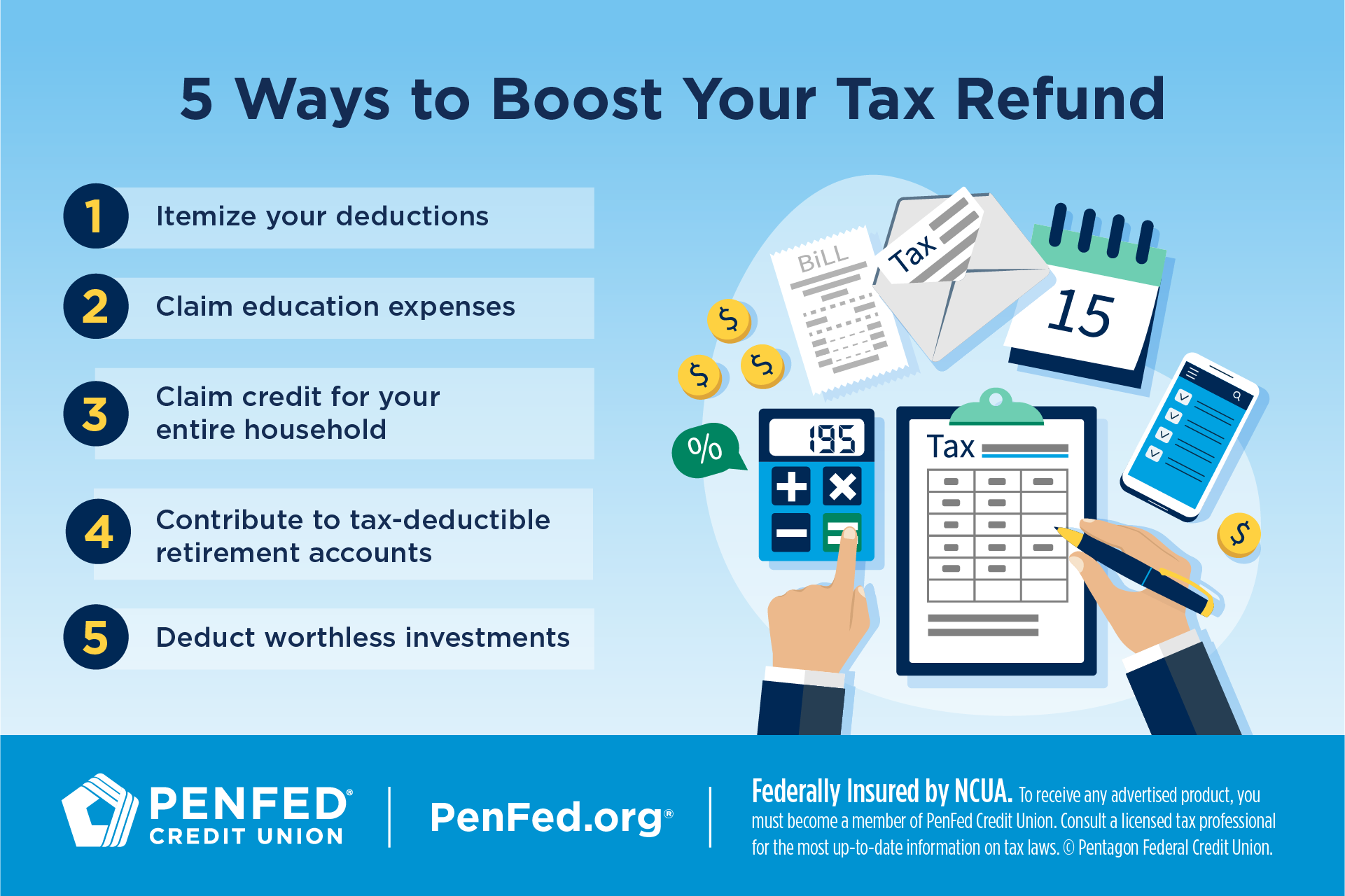
Child Tax Credit and Dependent Care Credit
- Child Tax Credit (CTC): A significant credit for families with qualifying children. While it has undergone changes, it generally provides up to a certain amount per qualifying child, with a portion often being refundable.
- Credit for Child and Dependent Care Expenses: Helps offset costs for care of a child under 13 or a dependent of any age who is physically or mentally incapable of self-care, allowing you to work or look for work.
Education Credits
Beyond deductions, specific credits can help reduce the financial burden of higher education.
- American Opportunity Tax Credit (AOTC): A partially refundable credit for qualified education expenses for eligible students pursuing a degree or other recognized education credential for the first four years of higher education.
- Lifetime Learning Credit (LLC): A non-refundable credit for qualified education expenses for courses taken towards a degree or to acquire job skills.
Earned Income Tax Credit (EITC)
The EITC is a refundable credit designed to assist low-to-moderate income working individuals and families. It’s one of the largest anti-poverty programs and can provide a substantial boost to eligible taxpayers’ refunds. Eligibility depends on income, family size, and other factors, making it crucial to check if you qualify.
Energy Efficiency and Other Niche Credits
The tax code also includes credits for specific actions, such as making energy-efficient home improvements or purchasing electric vehicles. These can change frequently, so staying informed about current tax laws is important. Examples include:
- Residential Clean Energy Credit: For homeowners who install renewable energy equipment like solar panels.
- Clean Vehicle Credits: For the purchase of new or used clean energy vehicles.
Strategic Planning Beyond the Filing Date
Maximizing your tax return isn’t a one-time annual event; it’s a year-round process that integrates seamlessly with broader financial planning. Proactive strategies can significantly enhance your tax position and overall financial well-being.
Adjusting Withholdings and Estimated Payments
Reviewing your W-4 form (for employees) or adjusting your estimated quarterly payments (for self-employed individuals) is crucial. If too much tax is withheld, you might get a large refund, but you’re essentially giving the government an interest-free loan throughout the year. If too little is withheld, you could face penalties. Aiming for a balance where you neither owe a large sum nor receive an excessive refund means you have more control over your money during the year.
Retirement Contribution Strategies
Utilizing tax-advantaged retirement accounts is one of the most effective long-term tax-saving strategies.
- Traditional vs. Roth: Contributions to a traditional 401(k) or IRA are often tax-deductible in the current year, reducing your taxable income. Roth contributions are not tax-deductible but offer tax-free withdrawals in retirement.
- Maxing Out Contributions: Aim to contribute the maximum allowed to these accounts. The tax benefits, combined with compound growth, can be immense.
- Backdoor Roth/Mega Backdoor Roth: Advanced strategies for high-income earners to contribute to Roth IRAs when direct contributions are phased out.
Tax-Loss Harvesting and Investment Planning
For investors, strategic management of your portfolio can yield significant tax benefits.
- Tax-Loss Harvesting: Selling investments at a loss to offset capital gains and potentially up to $3,000 of ordinary income. This should be done carefully to avoid the “wash-sale rule.”
- Asset Location: Placing tax-inefficient investments (like bonds or REITs) in tax-advantaged accounts (like 401(k)s or IRAs) and tax-efficient investments (like index funds) in taxable accounts.
- Qualified Dividends and Long-Term Capital Gains: These are taxed at preferential rates compared to ordinary income.
Record-Keeping Throughout the Year
The single most impactful habit for tax maximization is meticulous, ongoing record-keeping. Don’t wait until January to scramble for receipts.
- Digital Organization: Use apps or cloud storage to photograph and categorize receipts as they occur.
- Dedicated Accounts: Consider separate bank accounts or credit cards for business expenses.
- Spreadsheets: Maintain a running spreadsheet of income and expenses, categorized for easy transfer to tax forms.
Consistent record-keeping not only ensures you claim every deduction but also provides invaluable documentation if your return is ever audited.
Utilizing Professional Help and Technology
Navigating the complexities of the tax code can be daunting. Fortunately, a wealth of resources, from sophisticated software to expert human guidance, can help you maximize your return and ensure compliance.
When to Hire a Tax Professional
While tax software is excellent for straightforward returns, certain situations warrant the expertise of a Certified Public Accountant (CPA) or Enrolled Agent (EA). Consider professional help if you:
- Have complex income streams (e.g., multiple businesses, foreign income).
- Experience significant life changes (marriage, divorce, new child, home purchase).
- Are starting a new business or dissolving one.
- Have significant investments, capital gains/losses, or stock options.
- Received an audit notice.
A good tax professional can identify nuanced deductions, provide strategic advice for future tax planning, and represent you if there are issues with your return, ultimately saving you more than their fee.
Advantages of Tax Software
For the majority of taxpayers, tax preparation software offers an affordable and efficient solution.
- Guided Process: These programs walk you step-by-step through your return, asking questions to identify potential deductions and credits.
- Accuracy Checks: They perform automatic calculations and error checks, reducing the risk of mistakes.
- E-Filing: Most software allows for direct electronic filing, speeding up the refund process.
- Cost-Effective: Often significantly cheaper than a professional, especially for simpler returns.
Many options exist, from free versions for basic returns to advanced packages for more complex scenarios, making them a powerful financial tool for many.
Staying Informed on Tax Law Changes
Tax laws are not static. They are subject to annual changes, legislative reforms, and new interpretations. Staying informed about these changes is critical for effective tax planning.
- IRS Publications: The IRS website is a primary source for official information and updates.
- Financial News Outlets: Reputable financial news sources often cover significant tax changes.
- Tax Professional Communication: If you use a tax professional, they will typically keep you informed of relevant changes.
Proactively understanding how changes impact your financial situation allows you to adapt your strategies and continue maximizing your tax return year after year.

Conclusion
Maximizing your tax return is an empowering act of financial stewardship. It’s not about finding loopholes or engaging in risky behaviors, but rather about diligently understanding and applying the benefits the tax code offers. By adopting a proactive, year-round approach to financial record-keeping, strategically leveraging deductions and credits, and knowing when to seek professional or technological assistance, you can transform the annual chore of tax filing into a significant opportunity for financial gain.
The journey to a maximized tax return begins with education and consistent effort. Embrace the process, stay informed, and make informed decisions that will help you retain more of your hard-earned money, propelling you closer to your personal and business financial aspirations.
aViewFromTheCave is a participant in the Amazon Services LLC Associates Program, an affiliate advertising program designed to provide a means for sites to earn advertising fees by advertising and linking to Amazon.com. Amazon, the Amazon logo, AmazonSupply, and the AmazonSupply logo are trademarks of Amazon.com, Inc. or its affiliates. As an Amazon Associate we earn affiliate commissions from qualifying purchases.