
The journey toward financial independence often begins with a single, pivotal realization: your money should work as hard for you as you work for it. While saving money in a traditional bank account is a prudent first step, the corrosive effect of inflation means that stagnant cash often loses purchasing power over time. Investing in the stock market remains one of the most effective and accessible vehicles for wealth creation available to the average person.
However, for many beginners, the world of tickers, charts, and financial jargon can feel like an impenetrable fortress. The truth is that you do not need an MBA or a high-frequency trading desk to succeed. Success in the stock market is less about “beating the system” and more about discipline, patience, and understanding the fundamental mechanics of how equity works. This guide will walk you through the essential steps to transition from a saver to an investor.

Understanding the Fundamentals of the Stock Market
Before committing your hard-earned capital, it is crucial to understand exactly what happens when you “buy a stock.” At its core, the stock market is a marketplace where ownership in public companies is traded between buyers and sellers.
What is a Stock?
A stock, also known as equity, represents a fractional ownership interest in a corporation. When you purchase a share of a company, you are essentially buying a small piece of that business’s assets and its future earnings. If the company grows and becomes more profitable, your shares typically increase in value. Conversely, if the company struggles, the value of your shares may decrease. Some companies also distribute a portion of their profits to shareholders in the form of dividends, providing a stream of passive income.
How the Market Functions
Stocks are traded on exchanges, such as the New York Stock Exchange (NYSE) or the Nasdaq. In the digital age, these exchanges operate through complex computer networks. The price of a stock is determined by supply and demand. If more people want to buy a stock (demand) than sell it (supply), the price goes up. This demand is usually driven by investor sentiment, quarterly earnings reports, economic data, and broader geopolitical events.
Risk vs. Reward
The fundamental law of investing is the relationship between risk and reward. Stocks are generally considered riskier than bonds or savings accounts because their prices can be volatile in the short term. However, they also offer significantly higher potential returns over the long term. As a beginner, your goal is not to avoid risk entirely—which is impossible—but to manage it through diversification and a long-term perspective.
Preparing Your Finances for Investment
Investing should never be done in a vacuum. Before you buy your first share, you must ensure that your personal financial “house” is in order. Jumping into the market while under financial duress can lead to panicked decisions and realized losses.
High-Interest Debt Management
Before investing, look at your debt profile. If you have high-interest debt, such as credit card balances with interest rates ranging from 18% to 25%, your priority should be paying that off first. It is mathematically counterproductive to chase a 7% to 10% average annual return in the stock market while paying 20% interest to a bank. Clearing high-interest debt provides a “guaranteed return” equal to the interest rate you are no longer paying.
Building an Emergency Fund
The stock market is a long-term game. You should never invest money that you might need for basic living expenses in the next three to five years. An emergency fund—typically three to six months of living expenses held in a high-yield savings account—acts as a buffer. It ensures that if you lose your job or face an unexpected medical bill, you won’t be forced to sell your stocks during a market downturn to cover your costs.
Defining Your Investment Goals
Are you investing for retirement forty years from now, or are you saving for a house down payment in five years? Your “time horizon” dictates your strategy. A longer time horizon allows you to take more risks because you have time to recover from market dips. A shorter horizon requires a more conservative approach. Understanding your “why” helps you stay the course when the market inevitably gets bumpy.
Choosing an Investment Account and Brokerage
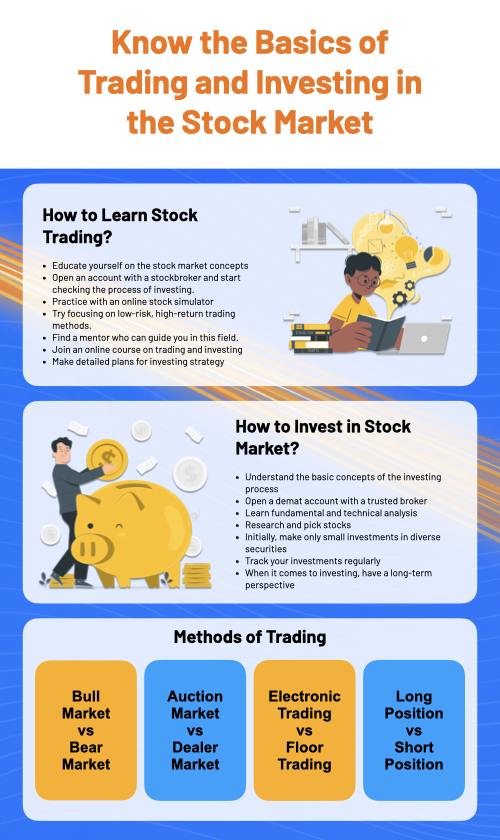
Once your finances are stable, you need a gateway to the market. This is where brokerage accounts come into play. In the modern era, opening an account is as simple as downloading an app or visiting a website.
Standard Brokerage vs. Retirement Accounts
You have two primary choices: a taxable brokerage account or a tax-advantaged retirement account (like an IRA or a 401(k)).
- Taxable Accounts: These offer the most flexibility. You can deposit and withdraw money at any time, but you will pay taxes on your capital gains and dividends.
- Retirement Accounts: These offer significant tax breaks. For example, a Roth IRA allows your investments to grow tax-free, and withdrawals in retirement are also tax-free. However, there are limits on how much you can contribute and penalties for early withdrawal. For most beginners, maximizing tax-advantaged accounts is the smartest first step.
Comparing Online Trading Platforms
The “brokerage wars” of recent years have been a win for consumers. Most major platforms, such as Fidelity, Charles Schwab, and Vanguard, now offer zero-commission trades on stocks and ETFs. When choosing a platform, look for a user-friendly interface, robust educational resources, and reliable customer service. Avoid platforms that “gamify” investing or encourage frequent, speculative trading, as this behavior often leads to poor long-term results for beginners.
Fee Structures and Minimum Deposits
While many brokers have eliminated trading commissions, they may still charge for other services. Be aware of “expense ratios” on funds (the annual fee the fund takes to manage the money) and any account maintenance fees. Many brokers now have $0 minimums to open an account, meaning you can start with as little as $10 or $50 via fractional shares.
Building Your Portfolio: Selecting Assets
With an account funded, it is time to choose what to buy. This is where many beginners get overwhelmed. The key is to keep it simple and avoid the temptation to “pick the next Apple or Tesla.”
Individual Stocks vs. ETFs and Mutual Funds
- Individual Stocks: This involves buying shares of a specific company. While potentially lucrative, it requires deep research and carries high risk. If that one company fails, you lose your investment.
- ETFs and Mutual Funds: These are “baskets” of hundreds or thousands of different stocks. By buying one share of an S&P 500 ETF, you are instantly buying a tiny slice of the 500 largest companies in the US. For beginners, these are generally the best choice because they provide instant diversification.
The Power of Diversification
Diversification is the only “free lunch” in investing. It means spreading your money across different sectors (Tech, Healthcare, Energy) and even different geographies (US, International, Emerging Markets). If one sector performs poorly, another may perform well, smoothing out your returns over time. An “Index Fund” strategy is the most common way for beginners to achieve this.
Growth vs. Value Investing
As you research, you will hear about “Growth” and “Value” styles. Growth stocks are companies expected to grow at a rate significantly above the average for the market (often tech companies). Value stocks are companies that appear to be trading for less than their intrinsic worth (often established companies with steady dividends). A balanced portfolio usually contains a mix of both.
Long-Term Strategies for Success
The final hurdle in your investment journey is not a technical one, but a psychological one. The stock market is a test of temperament more than intelligence.
Dollar-Cost Averaging (DCA)
One of the most effective strategies for beginners is Dollar-Cost Averaging. This involves investing a fixed amount of money at regular intervals (e.g., $200 every payday), regardless of whether the market is up or down. This removes the “emotion” of trying to time the market. When prices are high, your $200 buys fewer shares; when prices are low, your $200 buys more shares. Over time, this lowers your average cost per share.
The Importance of Rebalancing
Over time, some of your investments will grow faster than others, which can shift your intended risk level. For example, if your goal was 80% stocks and 20% bonds, a big year in the stock market might leave you at 90% stocks. Rebalancing—selling a bit of what has grown and buying more of what has lagged—once a year ensures you stay on track with your risk tolerance.

The Psychological Aspect: Staying the Course
The biggest mistake beginners make is “panic selling.” When the news reports a market crash, the instinct is to sell to “save” what is left. Historically, the market has recovered from every single downturn it has ever faced. Successful investors understand that market “red days” are simply part of the process. If you have a diversified portfolio and a long-term horizon, the best thing to do during a downturn is often nothing at all.
Investing in stocks is a marathon, not a sprint. By starting early, keeping costs low, and staying diversified, you harness the power of compound interest—the “eighth wonder of the world.” The goal is not to get rich overnight, but to build a sustainable financial future that provides security and freedom for years to come.
aViewFromTheCave is a participant in the Amazon Services LLC Associates Program, an affiliate advertising program designed to provide a means for sites to earn advertising fees by advertising and linking to Amazon.com. Amazon, the Amazon logo, AmazonSupply, and the AmazonSupply logo are trademarks of Amazon.com, Inc. or its affiliates. As an Amazon Associate we earn affiliate commissions from qualifying purchases.