
In the realm of personal and business finance, the ability to calculate and interpret percentage increase is more than just a mathematical exercise; it is a fundamental skill for survival and success. Whether you are tracking the growth of a stock portfolio, analyzing year-over-year business revenue, or negotiating a salary raise, understanding the mechanics of growth allows you to make data-driven decisions. Percentage increase provides a universal language for comparison, stripping away absolute values to reveal the true rate of momentum.
This guide explores the intricacies of percentage increase within the “Money” niche, moving from basic calculations to sophisticated financial applications that can help you optimize your wealth-building strategy.
Understanding the Core Formula: The Foundation of Financial Literacy
Before diving into complex investment strategies, one must master the basic arithmetic of growth. In finance, we often deal with “Old Values” (the principal or initial investment) and “New Values” (the current market value or ending balance).
The Step-by-Step Calculation Process
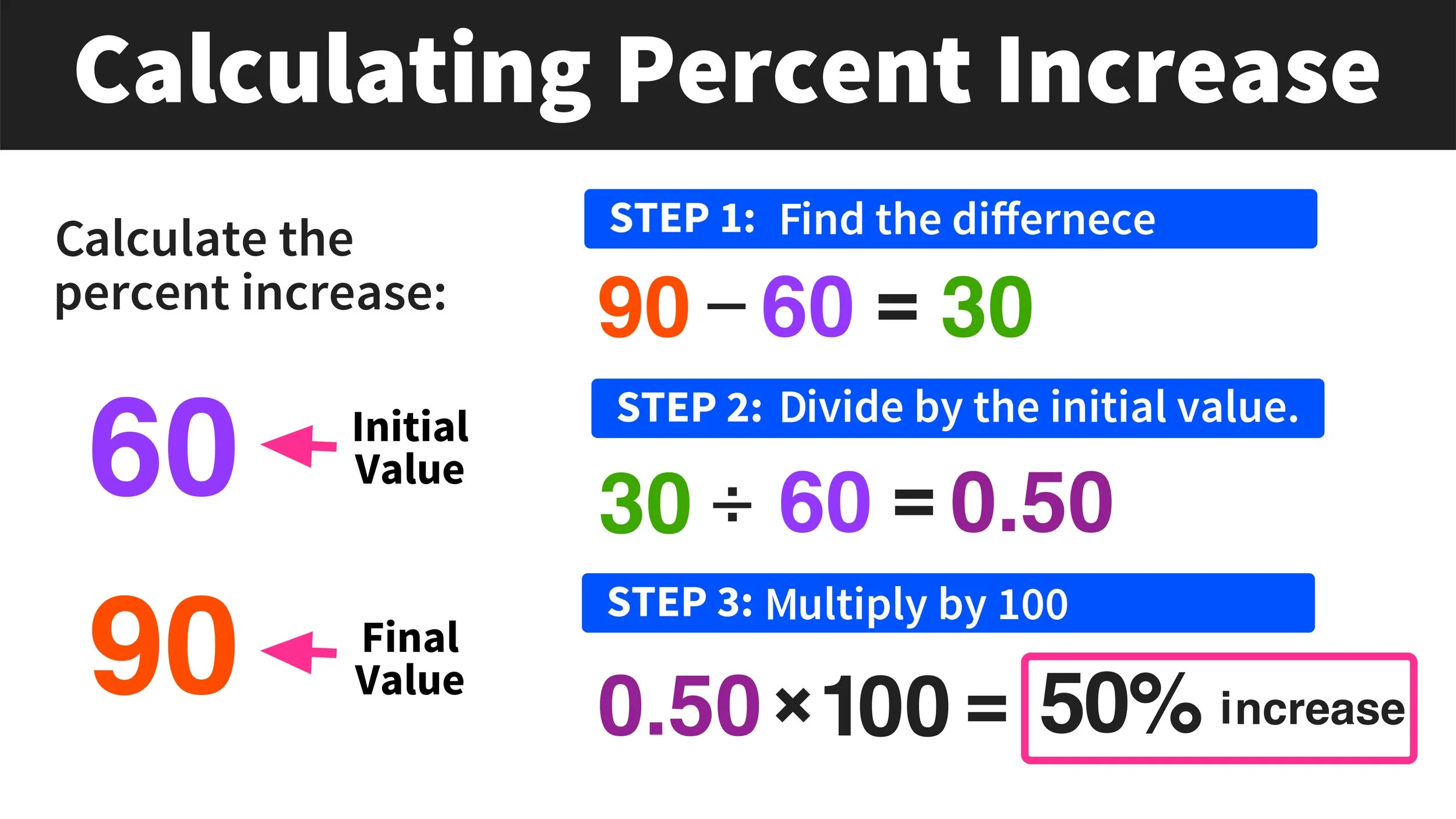
The formula for percentage increase is straightforward but requires precision. To find the percentage increase between two values, follow these three steps:
- Find the Difference: Subtract the original value from the new value. (New Value – Old Value = Increase)
- Divide by the Original: Divide that increase by the original value. (Increase / Old Value)
- Convert to Percentage: Multiply the result by 100.
Example: If you bought a share of a company for $150 and it is now worth $180, the calculation would be:
($180 – $150) = $30.
$30 / $150 = 0.2.
0.2 * 100 = 20%.
Your investment has seen a 20% increase.
Common Pitfalls: Percent vs. Percentage Points
A frequent mistake in financial reporting is confusing “percent increase” with “percentage points.” If an interest rate moves from 3% to 4%, it has increased by one percentage point. However, the percentage increase of the rate itself is actually 33.3% (1 divided by 3). Distinguishing between these two is vital when reading central bank reports or loan agreements, as the economic implications of each are vastly different.
Percentage Increase in Investing: Measuring Portfolio Performance
For investors, percentage increase is the primary metric for Return on Investment (ROI). It allows for a “level playing field” comparison between different asset classes. You might compare a $5,000 gain in Bitcoin to a $5,000 gain in a Blue Chip stock, but without knowing the initial capital deployed, the raw dollar amount tells you nothing about the efficiency of the investment.
Tracking Capital Gains and Asset Appreciation
Capital appreciation is the increase in the market price of an asset. By focusing on percentage increase, investors can determine which sectors of their portfolio are “over-performing” or “under-performing” relative to a benchmark, such as the S&P 500. If the market increased by 10% over a year, but your portfolio only increased by 5%, you have a quantitative basis to re-evaluate your strategy.
Compounding and the Rule of 72
Percentage increase becomes incredibly powerful when viewed through the lens of compounding. Compounding occurs when the percentage increase of one period is applied to the new, higher total of the previous period.
To quickly estimate how long it will take for an investment to double based on a steady percentage increase, financiers use the “Rule of 72.” By dividing 72 by your annual percentage growth rate, you find the approximate number of years required to 100% increase (double) your money. For instance, an 8% annual return will double your wealth in approximately 9 years (72 / 8 = 9).
Real vs. Nominal Returns: Factoring in Inflation
In money management, a 5% increase in your bank account doesn’t always mean you are 5% wealthier. You must subtract the rate of inflation to find your “real” percentage increase. If your portfolio grows by 7% but inflation is at 4%, your real purchasing power has only increased by 3%. Understanding this distinction is crucial for long-term retirement planning and wealth preservation.
Business Finance: Driving Revenue and Profitability Growth
For entrepreneurs and corporate executives, percentage increase is the pulse of the company. It is used to set Key Performance Indicators (KPIs) and report to stakeholders.
Year-over-Year (YoY) Growth Analysis
YoY growth is the most common way to measure business success. By comparing the revenue of Q3 this year to Q3 last year, businesses can account for seasonality. A toy retailer might see a 500% increase in revenue from November to December, but that is expected. The true test of health is whether this December’s revenue represents a percentage increase over last December’s revenue.
Margin Improvement and Cost Efficiency
Growth isn’t just about making more money; it’s about keeping more of it. Businesses use percentage increase to track “Margin Expansion.” If a company increases its revenue by 10% but its operating costs only increase by 2%, the company is becoming more efficient. Tracking the percentage increase in “Gross Margin” helps a business owner understand if they are gaining leverage over their suppliers or improving their internal processes.
Personal Income: Negotiating and Valuing Your Worth
Percentage increase plays a pivotal role in career trajectory and personal cash flow management. When you receive a job offer or a performance review, the numbers are often presented in percentages.
Calculating the Real Impact of a Salary Raise
When negotiating a raise, always think in percentages. A $5,000 raise means something very different to someone earning $40,000 (a 12.5% increase) than it does to someone earning $150,000 (a 3.3% increase).
By calculating the percentage increase of a new offer, you can better weigh it against the increased cost of living or a longer commute. Furthermore, presenting your accomplishments in percentages—such as “I increased department efficiency by 15%”—carries more weight in a boardroom than vague qualitative statements.
Side Hustle Scalability: Tracking Growth Trends
For those pursuing online income or side hustles, tracking the monthly percentage increase of your “Net Profit” is essential to determine if the venture is worth your time. If your side hustle revenue is growing at a consistent 20% month-over-month rate, you are looking at an exponential growth curve that may eventually justify quitting your 9-to-5 job.
Strategic Tools for Managing Financial Growth
Manually calculating every change in your financial life is tedious and prone to error. Professional money managers rely on digital tools to automate these calculations.
Excel and Spreadsheet Automation
Spreadsheets are the backbone of financial analysis. To calculate percentage increase in Google Sheets or Microsoft Excel, you would use a simple formula. If your “Old Value” is in cell A1 and your “New Value” is in cell B1, the formula would be:
=(B1-A1)/A1
Then, you simply click the “Percent” button in the formatting toolbar. This allows you to track hundreds of data points simultaneously, from dividend growth to monthly utility bill fluctuations.
Financial Planning Software and Dashboards
Modern fintech apps and wealth management platforms (like Personal Capital, Mint, or Bloomberg Terminal) provide real-time dashboards that visualize percentage increases. These tools often use “Time-Weighted Return” (TWR) to calculate percentage growth, which accounts for the timing of when you added or withdrew money from an account. This provides a more accurate picture of your investment performance than a simple “New minus Old” calculation.

Conclusion: The Strategic Advantage of Percentages
Mastering the “how” of percentage increase is the first step toward financial mastery. By shifting your focus from absolute dollars to percentage growth, you gain a clearer perspective on the velocity of your wealth. It allows you to compare a small savings account to a large brokerage account, a local startup to a global corporation, and your current self to your past financial standing.
In the world of money, those who understand the math of growth are the ones who can replicate it. Whether you are cutting costs by a certain percentage to increase your savings rate or aiming for a specific percentage gain in the stock market, these numbers are the roadmap to your financial freedom. Use them wisely, calculate them often, and let the power of percentage increase work in your favor.
aViewFromTheCave is a participant in the Amazon Services LLC Associates Program, an affiliate advertising program designed to provide a means for sites to earn advertising fees by advertising and linking to Amazon.com. Amazon, the Amazon logo, AmazonSupply, and the AmazonSupply logo are trademarks of Amazon.com, Inc. or its affiliates. As an Amazon Associate we earn affiliate commissions from qualifying purchases.