
Facing a tax bill you can’t immediately pay can be a daunting experience. The Internal Revenue Service (IRS) is often perceived as an immutable monolith, but in reality, they offer several pathways for taxpayers to address their obligations and avoid severe penalties. Understanding how to secure a payment plan with the IRS is a critical piece of financial literacy for anyone dealing with tax debt. This guide, firmly rooted in the “Money” category of personal and business finance, will demystify the process, outline your options, and provide actionable steps to resolve your tax liabilities responsibly.
Understanding IRS Tax Debt and Its Implications
Owing money to the IRS is a situation many individuals and businesses find themselves in, often due to unforeseen circumstances, miscalculations, or simply a lack of funds. Ignoring the problem, however, is never a viable solution. The IRS is a powerful collection agency, and unaddressed tax debt can lead to significant financial and personal distress.
Why You Might Owe the IRS
Tax debt can arise from a multitude of scenarios. For individuals, common culprits include insufficient withholding from paychecks, unexpected income from investments or contract work that wasn’t properly accounted for, or missed estimated tax payments. Life changes such as job loss, divorce, or medical emergencies can also deplete savings intended for tax payments. For businesses, errors in payroll tax deposits, unexpected dips in revenue, or mismanaging quarterly estimated taxes are frequent causes. Sometimes, taxpayers simply underestimate their tax liability for the year, leading to a surprise bill at tax season. Regardless of the reason, the first step is always to acknowledge the debt and understand its origin.
The Consequences of Unpaid Taxes
The IRS is not shy about enforcing collection actions. Failure to pay your taxes on time or arrange a payment plan can trigger a cascade of penalties and interest, making the original debt even larger.
-
Penalties: The IRS imposes penalties for failure to file, failure to pay, and for underpayment of estimated tax. These can add up quickly.
-
Interest: Interest accrues on unpaid taxes, including any penalties, starting from the original due date of the tax. This interest rate can change quarterly.
-
Tax Liens: A federal tax lien is the government’s legal claim against your property when you neglect or fail to pay a tax debt. It can attach to all your current and future property, including real estate, personal property, and financial assets, making it difficult to sell or borrow against them.
-
Tax Levies: A levy is a legal seizure of your property to satisfy a tax debt. The IRS can levy your bank accounts, wages, retirement accounts, or even physical property like cars or real estate. This is a much more aggressive collection action than a lien.
-
Passport Revocation: For seriously delinquent tax debt (generally over $59,000, adjusted for inflation), the State Department may deny your passport application or revoke your existing passport.
The Importance of Proactive Engagement
The most critical takeaway for anyone with tax debt is the necessity of proactive engagement. The IRS is generally more amenable to working with taxpayers who come forward and demonstrate a willingness to resolve their obligations. Ignoring notices or delaying communication only escalates the problem, leading to harsher penalties and more aggressive collection tactics. Reaching out and exploring payment options shows good faith and can prevent the IRS from taking more severe actions that could significantly disrupt your financial life.
Exploring Your IRS Payment Plan Options
The IRS offers several distinct programs designed to help taxpayers manage their tax debt. Each option has specific eligibility criteria and implications, making it crucial to understand which one best suits your financial situation.
Short-Term Payment Plan (STPP)
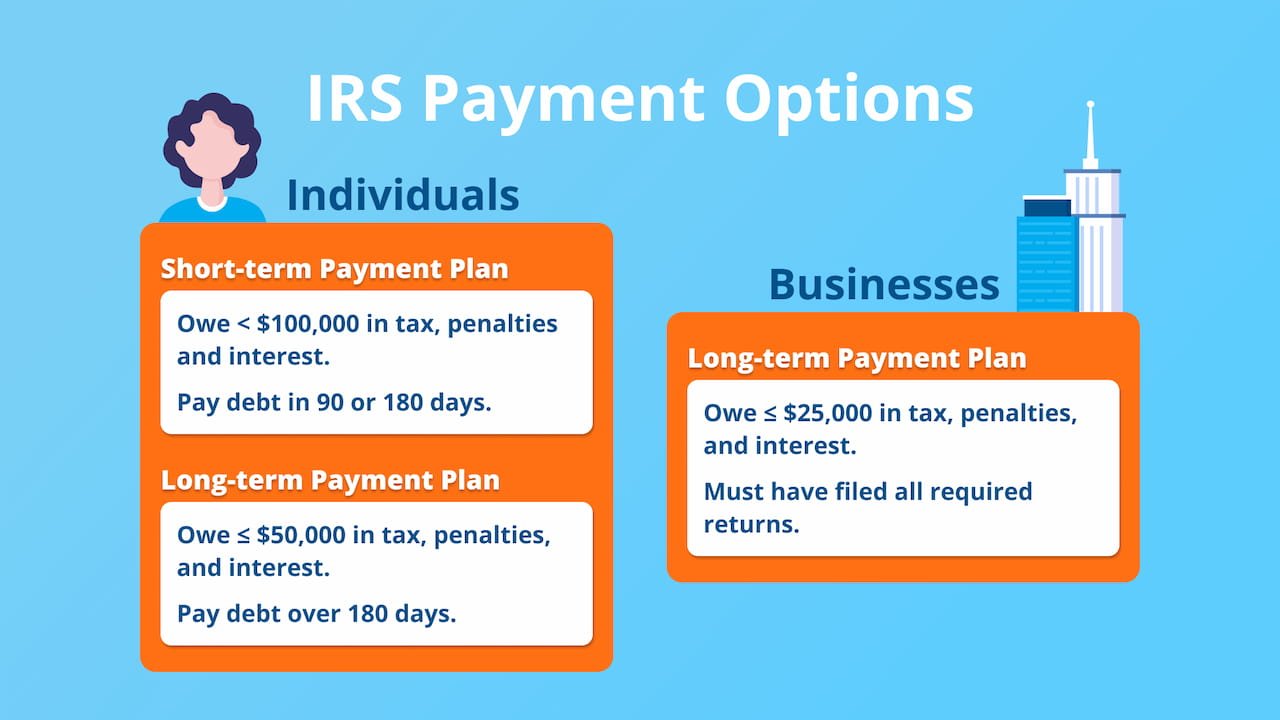
If you anticipate being able to pay off your tax liability within a short period, typically 180 days or less, a Short-Term Payment Plan might be suitable. This option allows you to extend the time to pay your tax in full. While you will still incur interest and penalties, a STPP can help you avoid more severe collection actions. It’s ideal for those who are temporarily short on funds but expect a lump sum payment, such as a bonus or an inheritance, soon. You can often request this plan directly over the phone with the IRS or through your IRS online account.
Installment Agreement (IA)
An Installment Agreement allows you to make monthly payments for up to 72 months (6 years). This is arguably the most common and accessible payment plan for taxpayers who cannot pay their tax liability in full.
-
Guaranteed Installment Agreement: If you owe $10,000 or less (not including penalties and interest) and meet certain other criteria (e.g., filed all required returns, paid all taxes for the prior 5 years), the IRS must grant you an installment agreement.
-
Streamlined Installment Agreement: This is available for individuals who owe a combined total of $50,000 or less in tax, penalties, and interest, or businesses that owe $25,000 or less in tax, penalties, and interest, and can pay it off within 72 months. It typically does not require a detailed financial statement (Form 433-A/B). You can usually apply online or via Form 9465.
-
Non-Streamlined/Complex Installment Agreement: For debts exceeding the streamlined thresholds, or if you can’t pay within 72 months (which requires IRS approval), the IRS will require a comprehensive review of your financial situation using Form 433-A (for individuals) or Form 433-B (for businesses). This involves detailing your income, expenses, and assets to determine your ability to pay. The IRS will then calculate a reasonable monthly payment based on your disposable income.
While an Installment Agreement is in effect, interest and penalties continue to accrue, but typically at a lower rate than if no arrangement were made. It also prevents the IRS from pursuing aggressive collection actions like levies.
Offer in Compromise (OIC)
An Offer in Compromise (OIC) allows certain taxpayers to resolve their tax liability with the IRS for a lower amount than they originally owe. The IRS considers an OIC when there’s “doubt as to collectibility,” meaning they believe you cannot pay the full amount of tax due. An OIC is a complex and often lengthy process, and the IRS generally accepts only a fraction of the offers submitted.
-
Eligibility Criteria: To qualify for an OIC, you must generally have filed all required tax returns, made all required estimated tax payments, and not be in an open bankruptcy proceeding. The IRS evaluates your ability to pay based on your income, expenses, asset equity, and future earning potential.
-
The “Doubt as to Collectibility” Standard: The IRS uses a specific formula to determine a “reasonable collection potential” (RCP), which is the most they believe they could collect from you. If your offer is close to or exceeds this RCP, it might be accepted.
-
Application Process: The application involves Form 656, Offer in Compromise, along with detailed financial disclosure forms (Form 433-A OIC for individuals or 433-B OIC for businesses). There is also an application fee (currently $205, though low-income taxpayers may be exempt) and an initial payment requirement unless specific conditions are met.
An OIC is a serious undertaking and is usually considered a last resort after other payment options have been ruled out. It’s often advisable to seek professional help when pursuing an OIC.
Currently Not Collectible (CNC) Status
If the IRS determines that you truly cannot afford to pay any of your tax debt due to financial hardship, they may place your account in “Currently Not Collectible” (CNC) status. This is a temporary solution; it means the IRS will temporarily stop collection efforts, but the debt does not go away. Interest and penalties will continue to accrue, and the IRS will periodically review your financial situation to see if your ability to pay has improved. This status buys you time but requires continuous communication and transparency with the IRS about your financial difficulties. To qualify, you will need to provide detailed financial information, similar to an OIC or a non-streamlined installment agreement.
The Application Process: Step-by-Step Guidance
Applying for an IRS payment plan requires diligence and attention to detail. The specific forms and documentation needed will vary depending on the type of plan you are seeking.
Gathering Necessary Documentation
Before you even begin the application process, organize your financial records. This will streamline the application and ensure you can accurately represent your financial situation.
-
Tax Returns: Copies of all your filed federal tax returns for recent years (typically the last 3-6 years).
-
Income Proof: Pay stubs, W-2s, 1099s, bank statements, profit and loss statements (for businesses).
-
Expense Records: Utility bills, rent/mortgage statements, credit card statements, loan payments, medical expenses, food and transportation costs.
-
Asset Information: Bank account statements, investment account statements, property deeds, vehicle titles, retirement account statements.
-
Debt Information: Loan agreements, credit card statements, and any other outstanding liabilities.
Having these documents readily available will save you time and potential headaches during the application process.

How to Apply for an Installment Agreement
For an Installment Agreement, the process is relatively straightforward, especially for streamlined agreements.
-
File All Required Returns: You must be current with all your tax filings. The IRS will not approve a payment plan if you have unfiled tax returns.
-
Determine Eligibility: Check if your debt falls within the streamlined thresholds ($50,000 for individuals, $25,000 for businesses, including penalties and interest).
-
Choose Your Application Method:
-
Online: For eligible taxpayers, applying for an Installment Agreement online through the IRS website (IRS.gov/OPA) is often the quickest method.
-
Form 9465: If you can’t apply online, you can submit Form 9465, Installment Agreement Request, with your tax return or mail it separately. This form is for requesting an IA for taxes you can’t pay immediately.
-
Phone: You can also call the IRS directly at the number provided on your tax notice or 1-800-829-1040 (individuals) or 1-800-829-4933 (businesses).
-
-
For Non-Streamlined Agreements: If your debt exceeds the streamlined limits, you will also need to complete and submit Form 433-A (individuals) or Form 433-B (businesses), Collection Information Statement, detailing your income, expenses, and assets. The IRS will use this information to determine a reasonable monthly payment.
The Offer in Compromise Application
Applying for an OIC is a much more involved process, requiring meticulous documentation and financial disclosure.
-
Review the OIC Booklet (Form 656-B): This provides detailed instructions and eligibility requirements.
-
Complete Forms:
-
Form 656, Offer in Compromise: This is the core of your offer.
-
Form 433-A (OIC) or 433-B (OIC), Collection Information Statement: These forms provide an in-depth look at your financial situation. Be prepared to provide exhaustive documentation supporting every line item.
-
-
Calculate Your Reasonable Collection Potential (RCP): The IRS will do this, but it’s beneficial for you to estimate it beforehand to ensure your offer is realistic.
-
Include Payment and Application Fee: Unless you meet low-income exceptions, you must include a $205 application fee and an initial payment (either a lump sum payment or the first of five monthly payments, depending on your offer type).
-
Mail Your Application: Send your completed application and supporting documents to the IRS address specified in the OIC instructions.
The IRS will assign an OIC specialist to review your case, which can take several months. They may request additional information or clarification.
Communicating with the IRS
Effective communication with the IRS is paramount.
-
Be Responsive: Respond promptly to all IRS notices and requests for information.
-
Be Truthful: Always provide accurate and complete information. Misrepresentation can lead to severe penalties.
-
Keep Records: Maintain copies of all correspondence, forms submitted, and payment confirmations.
-
Be Patient and Persistent: The IRS bureaucracy can be slow. Patience is key, but don’t hesitate to follow up if you haven’t heard back within the expected timeframe.
Maintaining Your Payment Plan and Avoiding Default
Securing a payment plan is only half the battle; maintaining it is crucial to avoid defaulting and facing renewed collection actions.
Adhering to Payment Schedules
Once an agreement is in place, consistent and timely payments are non-negotiable. Missing payments, even one, can put your entire agreement at risk. Set up automatic payments if possible, or mark payment due dates prominently on your calendar.
Filing Future Tax Returns On Time
A fundamental condition for almost all IRS payment plans is that you must remain compliant with all future tax obligations. This means filing all your required federal tax returns on time, even if you can’t pay the full amount due for that new tax year. Failure to file can immediately trigger a default on your existing payment plan.
Paying Future Tax Liabilities
In addition to filing on time, you must also pay any new tax liabilities as they come due. This includes estimated taxes for self-employment income or adjusting your withholding to ensure you don’t accrue new tax debt. The goal is to prevent the existing debt from growing and to avoid creating new debt while you’re still working to resolve the old.
What Happens if You Default
If you default on your payment plan – by missing payments, failing to file future returns, or not paying new tax liabilities – the IRS will typically send you a notice of default. This notice will explain what needs to be done to reinstate the agreement, often requiring you to catch up on missed payments and pay new liabilities. If you cannot rectify the default, the IRS can terminate the agreement and resume collection actions, including liens and levies, potentially without further notice. It’s critical to re-engage with the IRS immediately if you find yourself in default or anticipate falling into default.
When to Seek Professional Assistance
While many taxpayers can navigate the IRS payment plan process on their own, certain situations warrant the expertise of a tax professional.
The Role of Tax Professionals
Tax professionals specializing in IRS tax resolution include:
-
Certified Public Accountants (CPAs): Licensed accountants who can assist with tax planning, preparation, and representation before the IRS.
-
Enrolled Agents (EAs): Federally licensed tax practitioners who specialize in taxation and have unlimited rights to represent taxpayers before the IRS.
-
Tax Attorneys: Lawyers specializing in tax law, particularly useful for complex cases, appeals, or tax court disputes.
These professionals possess in-depth knowledge of tax law, IRS procedures, and negotiation tactics that can be invaluable.
Benefits of Expert Guidance
Hiring a tax professional offers several distinct advantages:
-
Navigating Complexity: The tax code and IRS procedures can be incredibly complex. A professional can help you understand your options, complete forms accurately, and avoid costly mistakes.
-
Negotiation Skills: Experienced professionals often have a better understanding of what the IRS expects and how to negotiate favorable terms, particularly for Offers in Compromise or complex installment agreements.
-
Reducing Stress: Dealing with the IRS can be highly stressful. A professional can act as an intermediary, handling communications and paperwork, allowing you to focus on your financial recovery.
-
Ensuring Compliance: They can help ensure you meet all ongoing requirements of your payment plan and stay compliant with future tax obligations.

Choosing the Right Professional
When selecting a tax professional, consider their:
-
Credentials: Ensure they are properly licensed (CPA, EA, or attorney).
-
Experience: Look for someone with a proven track record in IRS tax resolution and similar cases to yours.
-
Specialization: Some professionals specialize in specific areas like OICs or payroll tax issues.
-
Communication: Choose someone who communicates clearly, explains complex concepts simply, and keeps you informed.
-
Fees: Understand their fee structure upfront.
Facing tax debt can be overwhelming, but with the right information and a proactive approach, obtaining an IRS payment plan is an achievable goal. By understanding your options, diligently completing the application process, and adhering to the terms of your agreement, you can navigate your tax debt responsibly and regain control of your financial future. Remember, the IRS is ultimately interested in collecting the taxes owed, and they provide these pathways as a means to achieve that while offering taxpayers a chance to resolve their issues.
aViewFromTheCave is a participant in the Amazon Services LLC Associates Program, an affiliate advertising program designed to provide a means for sites to earn advertising fees by advertising and linking to Amazon.com. Amazon, the Amazon logo, AmazonSupply, and the AmazonSupply logo are trademarks of Amazon.com, Inc. or its affiliates. As an Amazon Associate we earn affiliate commissions from qualifying purchases.