
The Foundational Role of Percentages in Finance
Percentages are an indispensable tool in the world of finance, serving as a universal language for understanding and comparing financial data. From personal budgeting and investing to business analysis and economic reporting, a solid grasp of how to calculate and interpret percentages is fundamental to making informed financial decisions. At its core, a percentage represents a portion of a whole expressed as a fraction of 100. This standardized representation allows for straightforward comparisons, whether you’re evaluating the interest rate on a loan, the return on an investment, a discount on a purchase, or a company’s profit margin. Without the ability to find and understand percentages, navigating the complexities of modern finance would be significantly more challenging, leading to missed opportunities and potentially costly errors.
Understanding the Basics: What is a Percent?
A percent, denoted by the symbol “%,” literally means “per hundred” or “out of one hundred.” It’s a way to express a number as a fraction of 100. For instance, 25% means 25 out of 100, which can also be written as the fraction 25/100 or the decimal 0.25. Understanding these interconversions is crucial for practical financial calculations:
-
Fraction to Decimal to Percent: To convert a fraction (e.g., 1/4) to a decimal, divide the numerator by the denominator (1 ÷ 4 = 0.25). To convert the decimal to a percentage, multiply by 100 (0.25 × 100 = 25%) and add the percent symbol.
-
Percent to Decimal to Fraction: To convert a percentage (e.g., 75%) to a decimal, divide by 100 (75 ÷ 100 = 0.75). To convert the decimal to a fraction, write the decimal as a fraction with a denominator of 100 (75/100) and simplify (3/4).
These basic conversions are the bedrock upon which all more complex financial percentage calculations are built.
Core Methods for Calculating Percentages
Regardless of the financial scenario, most percentage calculations fall into one of three core methods. Mastering these will equip you to tackle a vast array of financial problems.
Finding a Percentage of a Number
This is perhaps the most common application, used when you know the total amount and a percentage, and you want to find the specific portion that percentage represents.
Formula: Part = (Percent / 100) × Whole
Examples in Finance:
-
Calculating Discounts: Imagine a shirt priced at $60 is on sale for 25% off. To find the discount amount, you calculate 25% of $60:
(25 / 100) × 60 = 0.25 × 60 = $15.
The discount is $15, so the final price is $60 – $15 = $45.
-
Calculating Sales Tax: If you buy an item for $120 and the sales tax rate is 7%, how much tax will you pay?
(7 / 100) × 120 = 0.07 × 120 = $8.40.
The sales tax is $8.40, making the total cost $120 + $8.40 = $128.40.
-
Calculating Simple Interest: If you invest $1,000 at a simple interest rate of 5% per year, how much interest do you earn in one year?
(5 / 100) × 1,000 = 0.05 × 1,000 = $50.
You earn $50 in interest for that year.
Finding What Percentage One Number is of Another
This method is used when you have two numbers and want to express the relationship between them as a percentage. It’s crucial for performance analysis and ratio calculations.
Formula: Percent = (Part / Whole) × 100
Examples in Finance:
-
Determining Profit Margin: A business makes a profit of $20,000 on total sales revenue of $100,000. What is the profit margin?
(20,000 / 100,000) × 100 = 0.20 × 100 = 20%.
The profit margin is 20%.
-
Calculating Budget Allocation: If your monthly income is $4,000 and you spend $1,200 on rent, what percentage of your income goes to rent?
(1,200 / 4,000) × 100 = 0.30 × 100 = 30%.
30% of your income is allocated to rent.
-
Return on Investment (ROI): You invest $5,000 in stocks and sell them for $5,750, making a gain of $750. What is your ROI?
(750 / 5,000) × 100 = 0.15 × 100 = 15%.
Your return on investment is 15%.
Finding the Original Whole When Given a Part and a Percentage
This scenario arises when you know a specific portion of an amount and what percentage it represents, and you need to work backward to find the total original amount.
Formula: Whole = Part / (Percent / 100)
Examples in Finance:
-
Reversing a Discount: You saved $30 on a new gadget, and this saving represented a 20% discount. What was the original price of the gadget?
Whole = 30 / (20 / 100) = 30 / 0.20 = $150.
The original price of the gadget was $150.

-
Calculating Total Income from a Portion: If 15% of your income is allocated to savings, and that amount is $600, what is your total monthly income?
Whole = 600 / (15 / 100) = 600 / 0.15 = $4,000.
Your total monthly income is $4,000.
Advanced Applications and Common Financial Scenarios
Beyond the basic calculations, percentages are integral to understanding more complex financial dynamics and decision-making.
Percentage Increase and Decrease
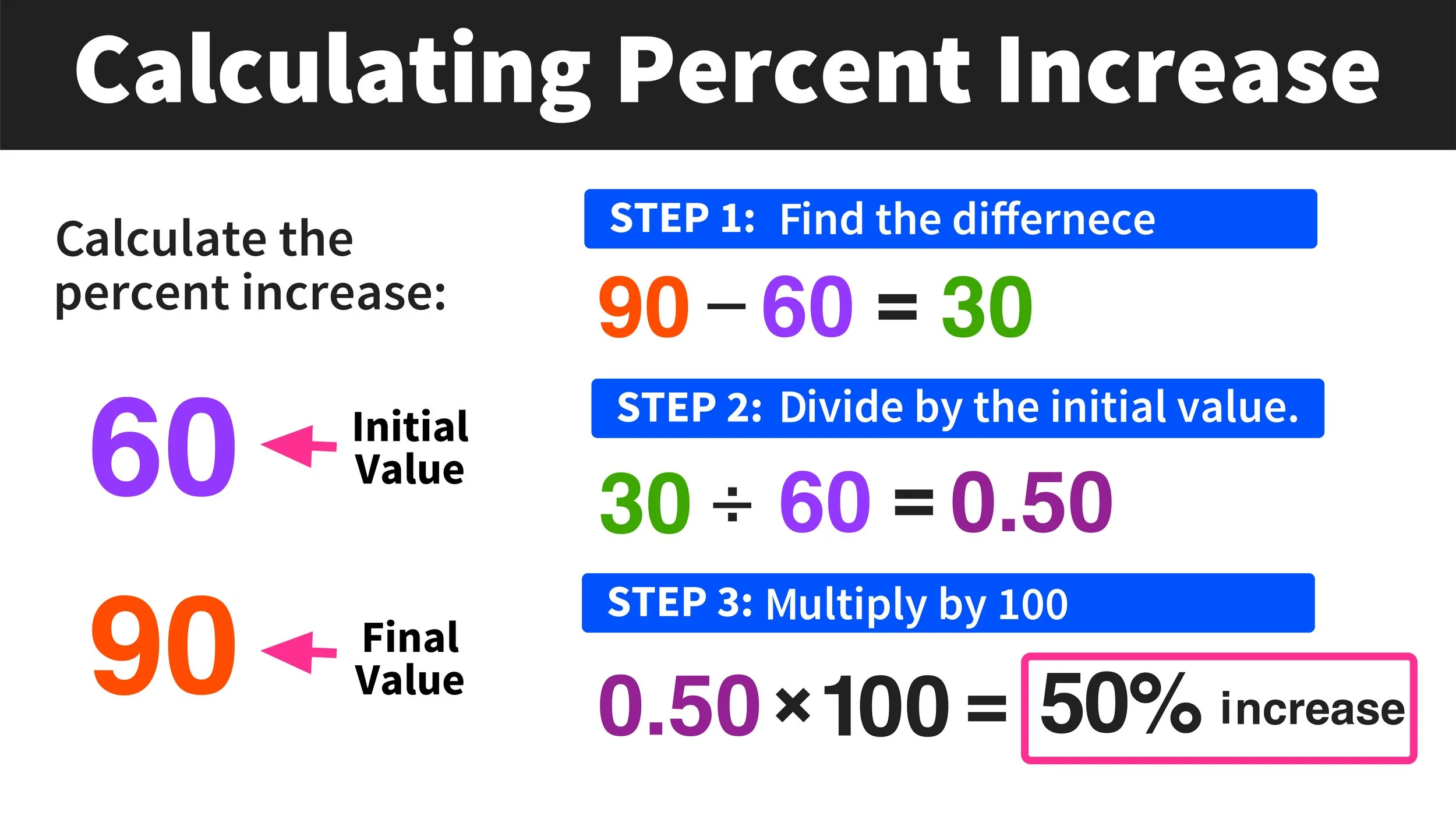
Financial growth and decline are almost always expressed in percentages. This method helps assess changes over time.
Formula: Percentage Change = ((New Value – Old Value) / Old Value) × 100
Examples in Finance:
-
Portfolio Growth: Your investment portfolio was worth $10,000 at the start of the year and grew to $11,500 by year-end.
((11,500 – 10,000) / 10,000) × 100 = (1,500 / 10,000) × 100 = 0.15 × 100 = 15%.
Your portfolio experienced a 15% increase.
-
Inflation Rate: If a basket of goods cost $1,000 last year and $1,030 this year, what’s the inflation rate?
((1,030 – 1,000) / 1,000) × 100 = (30 / 1,000) × 100 = 0.03 × 100 = 3%.
The inflation rate is 3%.
Understanding Compound Interest and Growth Rates
Many financial instruments, especially savings accounts, loans, and investments, involve compound interest, where interest is earned not only on the initial principal but also on the accumulated interest from previous periods. Understanding this exponential growth is critical.
-
Annual Percentage Rate (APR) vs. Annual Percentage Yield (APY): APR is the annual rate charged for borrowing or earned by an investment, without compounding. APY takes into account the effect of compounding interest, providing a more accurate picture of the actual annual return. For example, a credit card might advertise a 19% APR, but due to monthly compounding, the effective rate paid might be slightly higher.
-
Impact on Savings and Debt: A small percentage difference in compound interest rates can lead to vastly different outcomes over time. For savings, higher APY means greater wealth accumulation. For debt, a higher APR with frequent compounding means much higher total costs.
Financial Ratios and Key Performance Indicators (KPIs)
Businesses and personal finance managers use percentages extensively in ratios and KPIs to evaluate performance, health, and efficiency.
-
Profitability Ratios:
-
Gross Profit Margin: (Gross Profit / Revenue) × 100. Indicates how much profit a company makes after covering the direct costs of goods sold.
-
Net Profit Margin: (Net Profit / Revenue) × 100. Shows the percentage of revenue left after all expenses, including taxes, are deducted.
-
-
Debt-to-Income Ratio (DTI): (Total Monthly Debt Payments / Gross Monthly Income) × 100. A critical metric for lenders to assess an individual’s borrowing capacity.
-
Savings Rate: (Monthly Savings / Monthly Income) × 100. A key indicator of personal financial health and progress toward financial goals.
Practical Tips for Mastering Percentages in Finance
Developing proficiency with percentages is a continuous process that yields significant financial benefits.
Leverage Digital Tools
While mental math and manual calculations are helpful for quick checks, for accuracy and efficiency, especially with larger numbers or complex scenarios, digital tools are invaluable.
-
Spreadsheets (Excel, Google Sheets): These are powerful tools for managing personal budgets, tracking investments, and performing business calculations. They allow you to set up formulas once and apply them to changing data, greatly simplifying repetitive percentage calculations.
-
Financial Calculators: Dedicated financial calculators (or apps) are designed to handle complex calculations like loan amortization, compound interest, and future value projections.
-
Budgeting and Investing Apps: Many personal finance apps automatically calculate percentages for your spending categories, investment returns, and savings rates, offering clear insights without manual effort.
Practice and Real-World Application
The best way to solidify your understanding is through consistent practice and by applying these concepts to your own financial life.
-
Analyze Financial Statements: Regularly review your bank statements, credit card bills, investment account statements, and pay stubs. Try to calculate the percentages mentioned (e.g., interest paid, allocation of deductions, investment gains/losses).
-
Evaluate Sales and Promotions: Before making a purchase, quickly calculate the actual dollar savings from a percentage discount or compare different percentage-based offers.
-
Understand Loan and Investment Offers: When presented with loan rates or investment returns, ensure you understand what the percentages truly mean for your money, considering factors like compounding.
Avoid Common Pitfalls
Even those familiar with percentages can make mistakes. Being aware of common errors can save you from miscalculations.
-
Ignoring the Base Value: Always be clear about the “whole” or “base” value from which a percentage is being calculated. A 10% increase from $100 is different from a 10% increase from $1,000.
-
Confusing Percentage Points and Percentage Change: If an interest rate goes from 4% to 5%, that’s a 1 percentage point increase, but a 25% percentage change increase ((5-4)/4 * 100). The distinction is crucial in financial discussions.
-
Not Accounting for Compounding: Simple interest and compound interest behave very differently over time. Always determine if compounding is a factor, especially with long-term savings or debt.
Mastering how to find and interpret percentages is not just a mathematical skill; it’s a fundamental financial literacy tool that empowers individuals and businesses to make sound, data-driven decisions that impact their financial well-being and growth.
aViewFromTheCave is a participant in the Amazon Services LLC Associates Program, an affiliate advertising program designed to provide a means for sites to earn advertising fees by advertising and linking to Amazon.com. Amazon, the Amazon logo, AmazonSupply, and the AmazonSupply logo are trademarks of Amazon.com, Inc. or its affiliates. As an Amazon Associate we earn affiliate commissions from qualifying purchases.