
Understanding the annual interest rate is a cornerstone of sound financial literacy, impacting everything from your savings growth to the total cost of your loans. Whether you’re a first-time homebuyer comparing mortgage offers, a student evaluating loan options, or an investor assessing potential returns, knowing how to accurately determine the annual interest rate is indispensable. This guide delves into the mechanisms, calculations, and critical considerations surrounding annual interest rates, empowering you to make informed financial decisions. It’s not just about crunching numbers; it’s about grasping the true cost of borrowing and the genuine yield of your investments, fostering a more secure and prosperous financial future.

Understanding Annual Interest Rates: Why They Matter
The annual interest rate (AIR) is a percentage that represents the cost of borrowing money or the return on an investment over a year. It’s a fundamental metric that dictates how much you’ll pay above the principal amount for a loan, or how much your money will grow in a savings account or investment. Ignoring or misunderstanding this rate can lead to significant financial missteps, such as overpaying for debt or missing out on substantial investment gains.
Defining Annual Interest Rate (AIR/APR)
At its core, the annual interest rate is the rate charged or paid for the use of money for a full year. However, the terminology can vary slightly, and it’s crucial to distinguish between them.
- Annual Interest Rate (AIR): Often used broadly, it represents the simple interest rate applied annually.
- Annual Percentage Rate (APR): This term is particularly common in lending (e.g., mortgages, credit cards, auto loans) and represents the true annual cost of a loan. It includes not only the nominal interest rate but also any additional fees or charges associated with the loan, such as origination fees or discount points, spread out over the life of the loan. This makes APR a more comprehensive measure of the cost of borrowing than the simple interest rate alone.
- Effective Annual Rate (EAR) or Annual Equivalent Rate (AER): This rate takes into account the effect of compounding interest over a year. If interest is compounded more frequently than annually (e.g., monthly, quarterly), the effective rate will be higher than the stated nominal or annual percentage rate. EAR provides the most accurate picture of the actual annual return on an investment or the actual annual cost of a loan when compounding is considered.
The Impact on Your Finances
The annual interest rate directly influences your financial health in profound ways:
- For Borrowers: A higher interest rate means higher monthly payments and a greater total cost over the life of the loan. Even a seemingly small difference in APR can translate into thousands of dollars in extra payments for long-term loans like mortgages. Understanding and comparing APRs allows you to choose the most cost-effective borrowing option.
- For Savers and Investors: A higher interest rate on savings accounts, certificates of deposit (CDs), or investments means your money grows faster. The power of compounding, especially over long periods, can significantly amplify your wealth. A robust understanding of interest rates helps you identify accounts and investments that offer competitive returns.
- Budgeting and Financial Planning: Knowing your interest rates is crucial for accurate budgeting. It helps you anticipate loan payments and project investment growth, enabling more realistic financial planning for short-term goals and long-term aspirations like retirement.
Differentiating Simple vs. Compound Interest
The distinction between simple and compound interest is fundamental to understanding how interest rates work:
- Simple Interest: Calculated only on the principal amount of a loan or investment. It’s a straightforward calculation:
Interest = Principal × Rate × Time. Simple interest is less common for long-term loans or savings but can be found in some short-term loans. - Compound Interest: Calculated on the initial principal and also on the accumulated interest from previous periods. This “interest on interest” effect is why compound interest is often called the “eighth wonder of the world.” For investors, it means exponential growth; for borrowers, it means the potential for debt to spiral if not managed carefully. The frequency of compounding (daily, monthly, quarterly, annually) significantly impacts the total interest accrued.
Calculating Annual Interest Rate for Loans and Credit
Calculating the annual interest rate varies depending on the type of loan and whether the rate is simple, APR, or effective. Each calculation serves to provide clarity on the true cost of borrowing.
Simple Interest Loans: The Basic Formula
For simple interest loans, where interest is only calculated on the original principal, the formula is straightforward. If you know the interest amount, principal, and time, you can find the rate.
Formula to find the Rate:
Rate = (Interest Paid / Principal) / Time
Where:
Interest Paidis the total interest accrued.Principalis the initial amount borrowed.Timeis the loan duration in years (or a fraction of a year).
Example: You borrow $1,000 and pay back $1,050 after one year.
Interest Paid = $50
Principal = $1,000
Time = 1 year
Rate = ($50 / $1,000) / 1 = 0.05 or 5%
If the time is in months, divide the months by 12 to get the fraction of a year. For example, 6 months would be 6/12 = 0.5 years.
Annual Percentage Rate (APR) for Credit Cards and Mortgages
Calculating APR is more complex because it factors in additional fees and the loan term. Lenders are legally required to disclose the APR for most consumer loans.
- Credit Cards: Credit cards typically have a stated APR, which is often a variable rate tied to an index like the prime rate. The calculation for the effective rate can get tricky due to varying balances and payment schedules, but the advertised APR is your starting point for comparing offers.
- Mortgages: For mortgages, the APR includes the nominal interest rate plus other charges like points, broker fees, and certain closing costs. While the formula to derive APR is complex (often requiring financial calculators or software), you typically receive an APR disclosure from the lender. This disclosure is crucial for comparing different mortgage offers because it presents a more accurate overall cost than just the nominal interest rate. A lower APR generally means a cheaper loan.
To find the APR, one would typically use a financial calculator or spreadsheet function that can account for all costs over the loan term. The goal is to find the interest rate that equates the present value of all payments to the loan amount minus upfront fees.
Effective Annual Rate (EAR) and Compounding Frequency
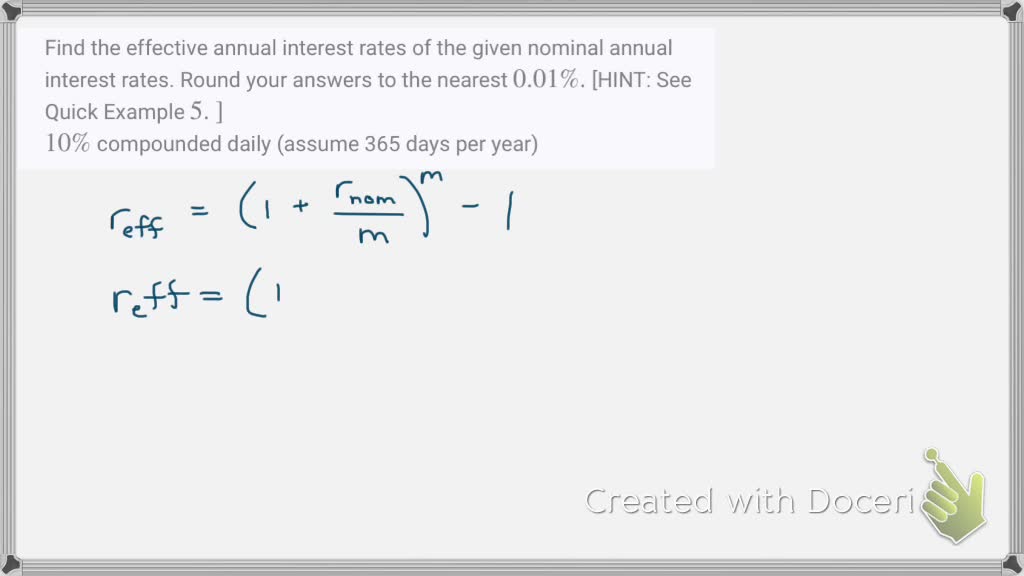
When interest is compounded more frequently than annually, the actual rate you pay (or earn) is higher than the stated nominal annual rate. The Effective Annual Rate (EAR) accounts for this.
Formula for EAR:
EAR = (1 + (Nominal Rate / Number of Compounding Periods))^Number of Compounding Periods - 1
Where:
Nominal Rateis the stated annual interest rate (e.g., 0.05 for 5%).Number of Compounding Periodsis how many times per year the interest is compounded (e.g., 12 for monthly, 4 for quarterly).
Example: A loan has a nominal annual rate of 6% compounded monthly.
Nominal Rate = 0.06
Number of Compounding Periods = 12
EAR = (1 + (0.06 / 12))^12 - 1
EAR = (1 + 0.005)^12 - 1
EAR = (1.005)^12 - 1
EAR = 1.061677 - 1
EAR = 0.061677 or approximately 6.17%
This means that a 6% loan compounded monthly is effectively costing you 6.17% annually. Understanding EAR is crucial for making accurate comparisons between financial products with different compounding frequencies.
Determining Annual Interest Rate for Investments and Savings
Just as interest rates impact the cost of borrowing, they also dictate the growth of your savings and investments. Calculating and understanding these rates is vital for optimizing your wealth accumulation strategies.
Savings Accounts and Certificates of Deposit (CDs)

For basic savings vehicles, the interest rate is usually explicitly stated by the financial institution. However, it’s essential to look beyond the nominal rate to the Annual Percentage Yield (APY) for savings accounts and CDs.
- Annual Percentage Yield (APY): Similar to EAR, APY reflects the total amount of interest earned on an account over a year, taking into account the effect of compounding. Banks are required to disclose the APY for interest-bearing accounts. If a bank advertises a 1% interest rate compounded monthly, the APY will be slightly higher than 1% due to the compounding effect. Always compare APYs, not just the nominal interest rates, when choosing savings accounts or CDs.
To find the APY given a nominal rate and compounding frequency, you use the same formula as the EAR. For instance, a 1% nominal rate compounded monthly has an APY of:
APY = (1 + (0.01 / 12))^12 - 1 ≈ 1.005%
Investment Returns and Yields
When it comes to investments like bonds, mutual funds, or stocks, the concept of an “annual interest rate” broadens to “annual return” or “yield.”
- Bonds: Bonds have a stated coupon rate, which is the interest rate the issuer pays on the bond’s face value. However, the Yield to Maturity (YTM) is a more comprehensive measure, representing the total return an investor can expect to receive if they hold the bond until it matures. YTM takes into account the bond’s current market price, par value, coupon interest rate, and time to maturity. Calculating YTM typically requires financial calculators or software due to its iterative nature.
- Mutual Funds/ETFs: For funds that primarily hold bonds, the “yield” (e.g., SEC Yield) indicates the income generated by the fund’s holdings over a specific period, annualized. For equity funds, the focus shifts to total return, which includes capital appreciation and dividends, expressed as an annualized percentage.
- Stocks: Stocks don’t have an “interest rate” in the traditional sense, but some pay dividends. The Dividend Yield is calculated as
Annual Dividends Per Share / Stock Price Per Share. This represents the income return on your investment, separate from any capital gains.
The Power of Compounding in Investments
The true magic of long-term investing lies in compound interest. Reinvesting earnings (dividends, interest payments, capital gains) allows your investment to grow exponentially over time. Even small differences in annual return, when compounded over decades, can lead to vastly different outcomes for your total wealth. Understanding this principle encourages early and consistent investing, making the annual interest rate (or return) a critical driver of your financial future.
Tools and Resources for Calculating Interest Rates
While understanding the formulas is essential, relying solely on manual calculations for complex scenarios can be time-consuming and prone to error. Fortunately, numerous tools and resources can simplify the process of finding and comparing annual interest rates.
Online Calculators and Financial Software
The internet is replete with free interest rate calculators. These tools allow you to input various parameters (principal, rate, time, compounding frequency, additional fees) to quickly determine:
- Loan Payments: Calculate monthly payments for mortgages, auto loans, and personal loans.
- Loan Amortization: See how much interest versus principal you pay over the life of a loan.
- Savings Growth: Project how your savings will grow over time with a given interest rate and contribution schedule.
- APR/EAR/APY: Many calculators are specifically designed to compute these rates when given the underlying components.
Popular sources for these calculators include financial news websites, bank websites, and dedicated personal finance platforms.
For more sophisticated analysis, dedicated financial software (like Quicken or Mint for personal finance) or professional investment platforms often include built-in calculators and analytical tools that can handle intricate interest rate scenarios and investment performance tracking.
Spreadsheet Functions (e.g., RATE, EFFECT)
Spreadsheets like Microsoft Excel or Google Sheets are incredibly powerful for financial calculations, offering dedicated functions to determine interest rates and related metrics.
RATEFunction: This function is used to calculate the interest rate per period of an annuity. You can use it to find the interest rate of a loan if you know the number of periods, payment per period, present value (loan amount), and future value (usually 0 for loans).RATE(nper, pmt, pv, [fv], [type], [guess])- Example: To find the monthly rate of a loan with 60 payments of $200 for a $9,000 principal:
RATE(60, -200, 9000). Multiply the result by 12 to get the annual rate.
EFFECTFunction: This function returns the effective annual interest rate given the nominal annual interest rate and the number of compounding periods per year.EFFECT(nominal_rate, npery)- Example:
EFFECT(0.06, 12)would give you the effective annual rate for a 6% nominal rate compounded monthly.
NOMINALFunction: This is the inverse ofEFFECT, returning the nominal annual interest rate given the effective rate and the number of compounding periods.NOMINAL(effect_rate, npery)
Mastering these spreadsheet functions can provide immense flexibility for complex financial modeling and analysis without needing specialized financial software.
Consulting Financial Professionals
For particularly complex financial products, large investments, or intricate loan structures, consulting a financial advisor, mortgage broker, or accountant can be invaluable. These professionals have the expertise and tools to:
- Accurately calculate and interpret various interest rates.
- Explain the implications of different rates on your specific financial situation.
- Help you compare options and negotiate better terms.
- Provide strategic advice on managing debt and optimizing investment returns based on interest rate environments.
While self-reliance is good, recognizing when to seek expert guidance ensures you’re making the most informed decisions possible, especially when significant sums of money are involved.
Factors Influencing Annual Interest Rates
Annual interest rates are not static; they are dynamic figures influenced by a myriad of economic, market, and individual factors. Understanding these drivers provides a broader context for why rates fluctuate and how they might impact your borrowing and saving decisions.
Economic Conditions and Central Bank Policies
The overall economic climate plays a monumental role in setting interest rates.
- Inflation: When inflation is high, lenders demand higher interest rates to compensate for the eroding purchasing power of future repayment. Central banks often raise benchmark interest rates to combat inflation.
- Economic Growth: During periods of strong economic growth, there’s often higher demand for credit, which can push interest rates up. Conversely, during economic downturns, central banks may lower rates to stimulate borrowing and investment.
- Central Bank (e.g., Federal Reserve) Monetary Policy: The most significant influence on interest rates comes from central banks. By adjusting their target federal funds rate (in the U.S.), central banks directly impact the cost of borrowing for commercial banks, which, in turn, influences the rates they offer to consumers and businesses for loans, mortgages, and savings accounts. A higher federal funds rate generally leads to higher interest rates across the economy.
Borrower’s Creditworthiness
For individual consumers and businesses seeking loans, their creditworthiness is a primary determinant of the interest rate they are offered.
- Credit Score: A higher credit score (e.g., FICO score) indicates a lower risk of default to lenders. Consequently, borrowers with excellent credit scores typically qualify for lower interest rates on loans and credit cards.
- Debt-to-Income Ratio (DTI): This ratio compares your monthly debt payments to your gross monthly income. A lower DTI suggests you have more disposable income to manage new debt, making you a less risky borrower and potentially qualifying you for better rates.
- Loan-to-Value Ratio (LTV): Particularly relevant for secured loans like mortgages and auto loans, LTV compares the loan amount to the appraised value of the asset. A lower LTV (meaning a larger down payment) indicates less risk for the lender and can lead to more favorable interest rates.
Loan Term and Type
The characteristics of the loan itself also significantly affect the annual interest rate.
- Loan Term (Duration): Longer-term loans (e.g., 30-year mortgages) often carry slightly higher interest rates than shorter-term loans (e.g., 15-year mortgages). This is because lenders face greater uncertainty and risk over a longer period, requiring additional compensation.
- Loan Type:
- Secured vs. Unsecured: Secured loans (e.g., mortgages, auto loans) that are backed by collateral generally have lower interest rates than unsecured loans (e.g., personal loans, credit cards) because the collateral reduces the lender’s risk.
- Fixed vs. Variable Rates: Fixed-rate loans maintain the same interest rate throughout the loan term, offering predictability. Variable-rate loans (e.g., adjustable-rate mortgages – ARMs) have rates that can fluctuate based on an underlying index. Variable rates often start lower than fixed rates but carry the risk of increasing over time.
- Conforming vs. Jumbo Loans: For mortgages, conforming loans (which meet specific criteria for size and terms) typically have lower rates than jumbo loans (which exceed conforming limits) due to the higher risk associated with larger loan amounts.
By understanding these influencing factors, individuals and businesses can better anticipate rate movements, strategize their borrowing and investing, and position themselves to secure the most advantageous terms available in the market. The annual interest rate is more than just a number; it’s a reflection of economic forces, personal financial health, and the specifics of the financial product itself.
aViewFromTheCave is a participant in the Amazon Services LLC Associates Program, an affiliate advertising program designed to provide a means for sites to earn advertising fees by advertising and linking to Amazon.com. Amazon, the Amazon logo, AmazonSupply, and the AmazonSupply logo are trademarks of Amazon.com, Inc. or its affiliates. As an Amazon Associate we earn affiliate commissions from qualifying purchases.