
In the world of finance, numbers are more than just figures on a page; they are the pulse of your economic health. Whether you are tracking the performance of a stock portfolio, measuring the growth of a side hustle, or evaluating the impact of inflation on your purchasing power, understanding how to calculate percentage increase is a fundamental skill. It transforms raw data into actionable insights, allowing you to see the true velocity of your wealth accumulation.
Percentage increase provides a standardized way to express how much a value has grown relative to its starting point. Without this metric, comparing a $100 gain on a $1,000 investment to a $100 gain on a $10,000 investment would be misleading. In this guide, we will explore the mathematical formula for percentage increase through the lens of personal and business finance, ensuring you can navigate your financial journey with mathematical precision.
The Fundamental Formula for Financial Growth
Before diving into complex spreadsheets and financial models, one must master the basic arithmetic of growth. The percentage increase formula is the bedrock of financial analysis, used by everyone from retail investors to corporate CFOs to determine “Return on Investment” (ROI) and “Year-Over-Year” (YoY) performance.
The Step-by-Step Calculation
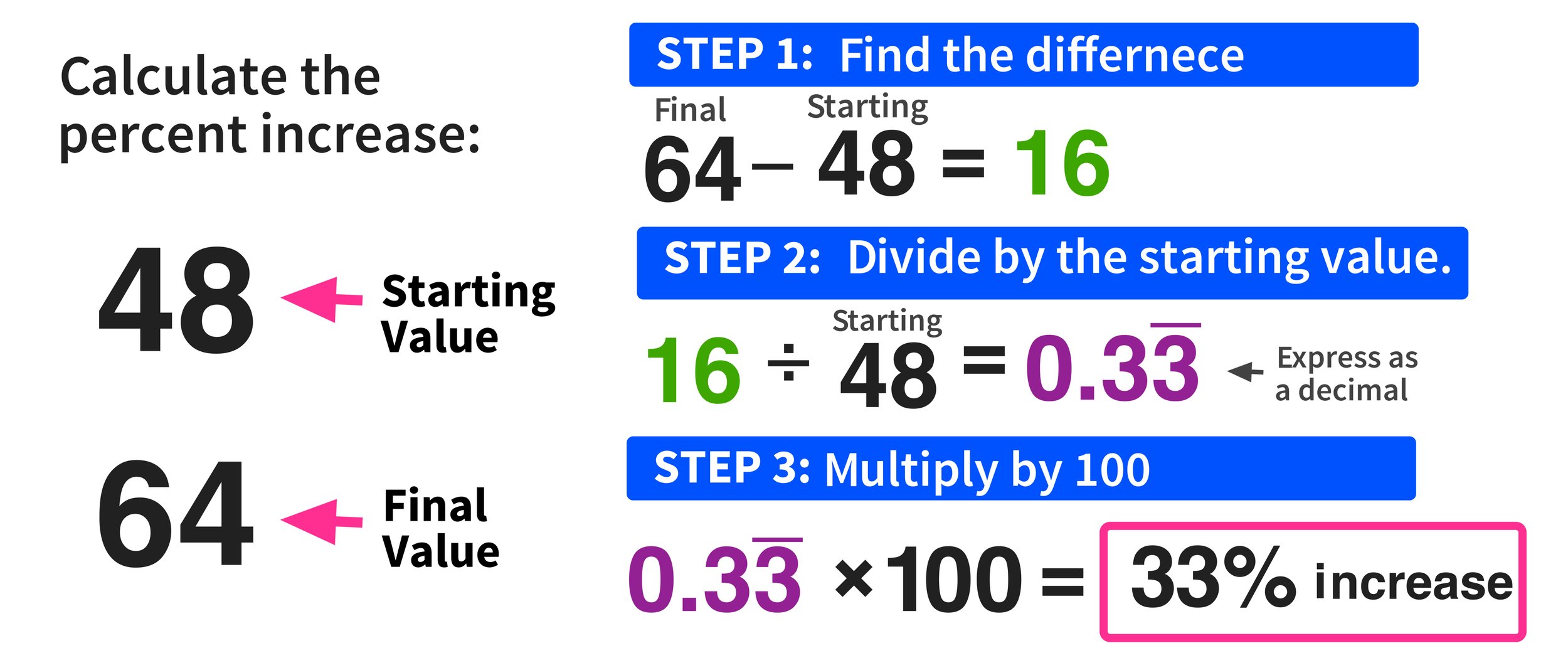
To find the percentage increase between two numbers, you follow a three-step process.
- Subtract the original value (the “old” number) from the new value (the “new” number). This gives you the absolute increase.
- Divide that increase by the original value. This gives you the growth expressed as a decimal.
- Multiply the result by 100. This converts the decimal into a percentage.
Mathematically, the formula looks like this:
Percentage Increase = [(New Value – Old Value) / Old Value] × 100
Real-World Example: Tracking Stock Performance
Imagine you purchased shares in an Exchange-Traded Fund (ETF) last year for $150 per share. Today, the market price for that same ETF is $195. To understand your gain in percentage terms, you would apply the formula:
- Subtract: $195 – $150 = $45 (The absolute dollar gain).
- Divide: $45 / $150 = 0.3.
- Multiply: 0.3 × 100 = 30%.
In this scenario, your investment has grown by 30%. While the $45 gain is good to know, the 30% figure allows you to compare this investment’s performance against other benchmarks, such as the S&P 500 or a high-yield savings account.
Applying Percentage Increase to Business Performance
For entrepreneurs and business owners, percentage increase is the primary metric for measuring scalability and health. It is not enough to know that your revenue is “up”; you must know the rate at which it is rising to determine if your business strategy is sustainable.
Measuring Revenue and Profitability
In business finance, percentage increase is frequently used to track gross revenue growth. If your business earned $50,000 in Q1 and $65,000 in Q2, your percentage increase is 30%. However, savvy business owners also apply this to their profit margins.
If your costs increase by 10% but your revenue only increases by 5%, your business is technically growing in size but shrinking in efficiency. Calculating the percentage increase of your expenses versus your income is a critical exercise in “Financial Hygiene.” It helps you identify “bracket creep” in your overhead costs before they erode your bottom line.
Understanding Year-Over-Year (YoY) and Month-Over-Month (MoM) Growth
Financial reporting relies heavily on periodic comparisons. “Year-Over-Year” growth compares a specific timeframe with the same timeframe from the previous year (e.g., December 2022 vs. December 2023). This is particularly important for businesses with seasonal fluctuations.
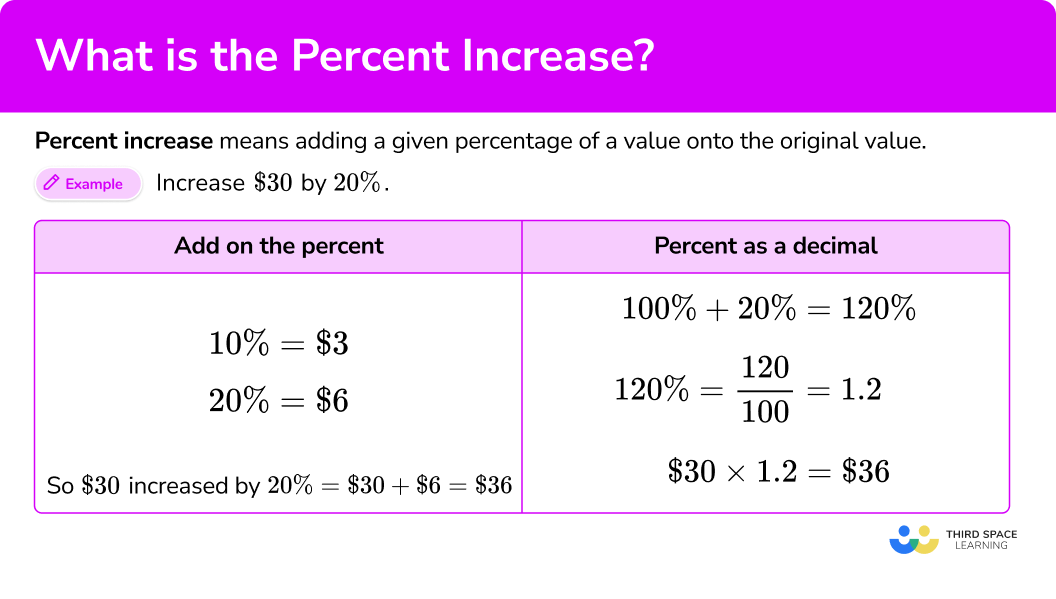
A retail store might see a 200% increase in sales in December compared to November (Month-Over-Month), which sounds impressive. However, if their YoY growth for December is only 2%, it indicates that the business is stagnant compared to the previous holiday season. By calculating percentage increases across these different time horizons, business leaders can filter out seasonal “noise” and see the true trajectory of their enterprise.
Personal Finance: Tracking Your Wealth and Purchasing Power
On an individual level, mastering percentage calculations is the key to achieving financial independence. It allows you to move beyond “vibes-based” budgeting and into data-driven wealth management.
Net Worth Growth and Budgeting
Your net worth is the sum of all your assets minus your liabilities. Tracking the percentage increase of your net worth annually is perhaps the most motivating metric in personal finance. In the early stages of a career, a $5,000 increase in net worth might represent a 50% jump. As your wealth grows, maintaining a high percentage increase becomes more challenging, requiring more sophisticated investing strategies.
Similarly, when evaluating a salary offer or a raise, looking at the percentage increase is vital. If you receive a $5,000 raise on a $50,000 salary, that is a 10% increase. If you receive the same $5,000 raise on a $100,000 salary, it is only a 5% increase. Understanding this allows you to negotiate more effectively, ensuring that your income growth outpaces your cost of living.
The Impact of Inflation and Interest Rates
Inflation is essentially the percentage increase in the price of goods and services over time. If the Consumer Price Index (CPI) shows an inflation rate of 4%, and your savings account is only offering a 2% interest rate, your “real” wealth is actually decreasing.
By calculating the percentage increase of your expenses (like rent, groceries, and fuel), you can adjust your budget and investment contributions to ensure your purchasing power is protected. If you find that your grocery bill has increased from $400 to $500 a month (a 25% increase), you can proactively look for ways to optimize your spending or increase your side hustle income to bridge the gap.
Advanced Financial Tools for Percentage Analysis
While the manual formula is essential for understanding the underlying logic, modern financial management often requires handling large datasets. Utilizing tools can automate these calculations, reducing human error and saving time.
Leveraging Excel and Google Sheets
For anyone serious about their money, spreadsheets are indispensable. To calculate percentage increase in Excel, you don’t need to do the math yourself; you simply need to input the right formula into a cell.
If your “Old Value” is in cell A2 and your “New Value” is in cell B2, you would type:
=(B2-A2)/A2
After hitting enter, you can click the “Percent Style” button in the formatting toolbar to display the result as a percentage. This tool is incredibly powerful for tracking a monthly budget or a diverse portfolio of cryptocurrencies and stocks, as you can drag the formula down to calculate growth across hundreds of rows instantly.
Online Financial Calculators and Apps
In the era of FinTech, many budgeting apps (like YNAB or Mint) and investment platforms (like Vanguard or Robinhood) perform these calculations automatically. However, knowing how to do it yourself allows you to verify the data provided by these apps.
Furthermore, specialized online financial calculators can help with “Compound Annual Growth Rate” (CAGR), which is a more advanced version of percentage increase. CAGR calculates the mean annual growth rate of an investment over a specified period longer than one year, assuming the profits were reinvested at the end of each year. This is the gold standard for comparing the long-term performance of different asset classes, such as real estate versus the stock market.

Conclusion: Why Mastering This Metric Leads to Financial Literacy
At its core, finding the percentage increase between two numbers is about context. In the realm of money, context is everything. A $1,000 profit is relative; a 10% profit is universal. By mastering this simple calculation, you gain the ability to strip away the confusion of raw numbers and see the underlying trends that define your financial success.
Whether you are an entrepreneur aiming for double-digit revenue growth, an investor seeking to outperform the market, or an individual trying to stay ahead of inflation, the percentage increase formula is your most reliable compass. It provides a clear, objective measure of progress, helping you make informed decisions that lead to long-term prosperity. Remember, wealth is not just about how much you have; it’s about how fast and how consistently you are growing what you have.
aViewFromTheCave is a participant in the Amazon Services LLC Associates Program, an affiliate advertising program designed to provide a means for sites to earn advertising fees by advertising and linking to Amazon.com. Amazon, the Amazon logo, AmazonSupply, and the AmazonSupply logo are trademarks of Amazon.com, Inc. or its affiliates. As an Amazon Associate we earn affiliate commissions from qualifying purchases.