
In the complex world of finance, numbers speak volumes, but it’s often the relationships between these numbers that truly reveal their story. Understanding how to find the percent of a number is not just a mathematical exercise; it’s a fundamental skill that underpins almost every financial decision, from managing personal budgets and evaluating investment returns to dissecting business profit margins and deciphering loan interest rates. Without a firm grasp of percentages, navigating the financial landscape is akin to sailing without a compass.
This guide aims to demystify the art of percentage calculation, rooting each explanation firmly in real-world financial contexts. We’ll explore the core methods, illustrate their practical applications, and equip you with the insights needed to make informed, data-driven financial choices. Whether you’re a budding investor, a meticulous budgeter, or a business professional, mastering percentages is your pathway to greater financial control and understanding.

The Indispensable Role of Percentages in Personal and Business Finance
Percentages are more than just fractions expressed differently; they are a universal language that simplifies comparisons and quantifies change across diverse financial scenarios. Their utility spans the entire spectrum of financial activity, making them an indispensable tool for individuals and corporations alike.
What Exactly is a Percentage? A Financial Definition
At its core, “percent” (derived from the Latin “per centum”) means “per hundred” or “out of one hundred.” When we talk about 1%, we are referring to 1 part out of 100 equal parts of a whole. In financial terms, if you have $100 and you calculate 1% of it, you get $1. This foundational understanding is critical because it establishes a standardized way to express proportions, regardless of the absolute size of the numbers involved.
Consider a simple example: a 5% interest rate. This means for every $100 borrowed or invested, $5 will be paid or earned as interest over a specified period. This common base (out of 100) allows for direct comparison between different rates, discounts, or growth figures, providing clarity where raw numbers might obscure the true impact. Without this standardization, comparing a $5 discount on a $100 item with a $50 discount on a $1000 item would require more mental gymnastics to determine which offers a better relative deal. Percentages instantly reveal that both are 5% discounts, making them equally attractive in relative terms.
Why Percentage Fluency is a Financial Superpower
The ability to confidently calculate and interpret percentages empowers individuals and businesses to make smarter financial decisions. For personal finance, it’s essential for budgeting, where you might allocate a certain percentage of your income to housing, savings, or entertainment. It’s crucial for understanding how much you’re saving during a sale, how much interest you’ll pay on a loan, or what portion of your paycheck goes towards taxes.
In the business realm, percentages are vital for analyzing performance. Companies use them to calculate profit margins, assess market share, track revenue growth, determine return on investment (ROI), and manage operational expenses. A slight increase in a profit margin percentage, for example, can signify significant financial health improvements. Similarly, investors rely on percentage changes to track stock performance, bond yields, and portfolio diversification. Mastery of percentages transforms complex financial data into actionable insights, providing a clear picture of financial health, growth, and potential risks, thereby elevating one’s financial literacy to a strategic advantage.
Core Methods for Calculating “Percent Of” in Financial Contexts
Understanding the fundamental percentage calculations is the bedrock of financial literacy. While the mathematical principles remain constant, their application in financial scenarios makes them particularly relevant and powerful. Here, we break down the three primary methods for finding the percent of a number, tailored for financial use cases.
Method 1: Finding a Percentage of a Number (The “Discount” or “Interest” Method)
This is perhaps the most common percentage calculation you’ll encounter in daily financial life. It answers questions like, “What is 20% of $150?” or “How much interest will I earn on $10,000 at 3%?”
The Formula:
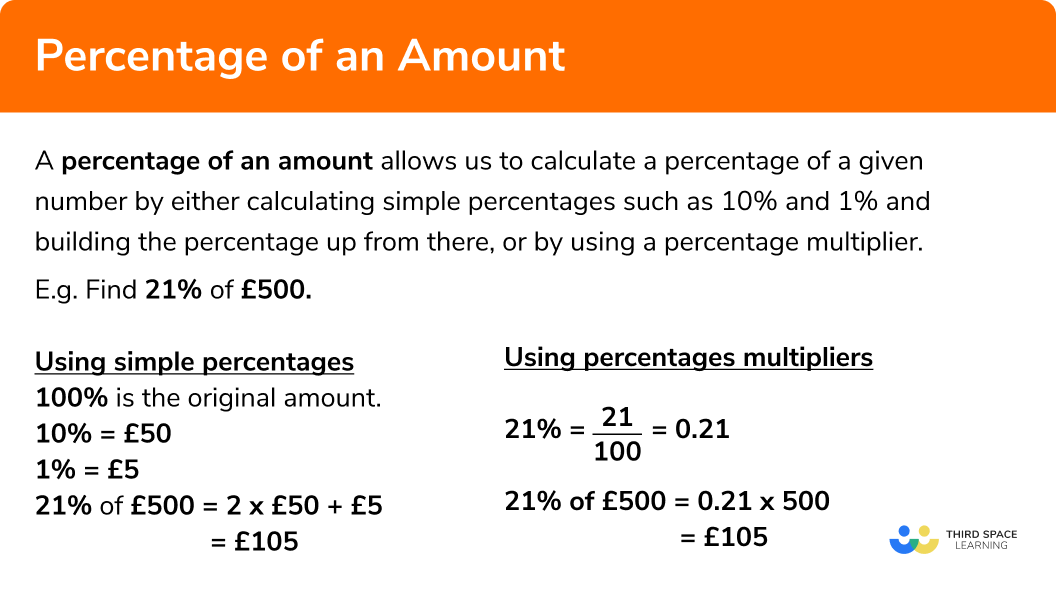
To find a percentage of a number, you convert the percentage to a decimal and multiply it by the whole number.
Amount = (Percentage / 100) * Whole Number
Example 1: Calculating a Discount
Imagine a jacket is priced at $200, and there’s a 15% discount. How much money do you save?
- Convert 15% to a decimal: 15 / 100 = 0.15
- Multiply by the whole number (original price): 0.15 * $200 = $30
You save $30. The final price would be $200 – $30 = $170.
Example 2: Calculating Simple Interest Earned
You have $10,000 in a savings account that offers a 3% annual interest rate. How much interest will you earn in one year?
- Convert 3% to a decimal: 3 / 100 = 0.03
- Multiply by the principal amount: 0.03 * $10,000 = $300
You will earn $300 in interest for that year.
Method 2: Determining What Percentage One Number Is of Another (The “Budget Allocation” or “Profit Margin” Method)
This method helps you understand the proportion of one value relative to a larger whole, often expressed as a percentage. It answers questions like, “What percentage of my income goes to rent?” or “What is our profit margin on this product?”
The Formula:
To find what percentage one number is of another, you divide the “part” by the “whole” and then multiply by 100.
Percentage = (Part / Whole) * 100
Example 1: Analyzing Budget Allocation
Your monthly income is $4,000, and your rent is $1,200. What percentage of your income goes to rent?
- Divide the part (rent) by the whole (income): $1,200 / $4,000 = 0.3
- Multiply by 100 to get the percentage: 0.3 * 100 = 30%
30% of your monthly income is allocated to rent.
Example 2: Calculating Profit Margin
A product costs your business $50 to make and sells for $80. What is your gross profit margin percentage?
- First, calculate the profit: $80 (selling price) – $50 (cost) = $30
- Divide the profit (part) by the selling price (whole): $30 / $80 = 0.375
- Multiply by 100 to get the percentage: 0.375 * 100 = 37.5%
Your gross profit margin is 37.5%.
Method 3: Calculating Percentage Increase or Decrease (The “Investment Growth” or “Expense Reduction” Method)
This method quantifies the relative change between two values over time, a crucial metric for tracking financial growth, decline, or efficiency improvements. It answers questions such as, “How much did my investment grow?” or “By what percentage did our expenses decrease?”
The Formula:
Percentage Change = ((New Value - Original Value) / Original Value) * 100
A positive result indicates an increase, while a negative result indicates a decrease.
Example 1: Tracking Investment Growth
Your investment portfolio was valued at $10,000 at the start of the year and grew to $12,500 by the end of the year. What is the percentage increase?
- Subtract the original value from the new value: $12,500 – $10,000 = $2,500
- Divide the difference by the original value: $2,500 / $10,000 = 0.25
- Multiply by 100: 0.25 * 100 = 25%
Your investment portfolio increased by 25%.
Example 2: Analyzing Expense Reduction
Last quarter, your business expenses were $5,000. This quarter, through cost-cutting measures, they dropped to $4,500. What is the percentage decrease?
- Subtract the original value from the new value: $4,500 – $5,000 = -$500
- Divide the difference by the original value: -$500 / $5,000 = -0.1
- Multiply by 100: -0.1 * 100 = -10%
Your business expenses decreased by 10%. (The negative sign indicates a decrease).
Practical Financial Applications: Real-World Scenarios Demystified
The theoretical understanding of percentage calculations gains profound significance when applied to the myriad financial situations we encounter daily. From personal spending to business analysis, percentages offer a standardized way to interpret and act on financial data.
Navigating Sales and Discounts: Saving Money Smartly
One of the most common applications of percentages is in retail, where discounts and sales abound. Being able to quickly calculate percentages allows you to determine the true value of a deal.
- Calculating Sale Price: If an item is $80 with a 25% discount, you calculate 25% of $80 (0.25 * $80 = $20) and subtract it from the original price ($80 – $20 = $60).
- Comparing Deals: When faced with “30% off” versus “buy one, get one 50% off,” percentage calculations help you determine which offers the best savings for your specific needs. Layered discounts, such as “20% off plus an additional 10% off the discounted price,” require sequential percentage calculations to find the final price accurately.
Understanding Loan Interest and Investment Returns: Growing Your Wealth
Percentages are the language of borrowing and investing.
- Loan Interest: Whether it’s a mortgage, car loan, or credit card, interest rates are expressed as percentages. Understanding how to calculate the interest on a principal amount helps you gauge the true cost of borrowing. For example, a 6% annual interest rate on a $200,000 mortgage implies $12,000 in interest per year, before considering compounding.
- Investment Returns: Investors constantly use percentages to measure the performance of their portfolios. Return on Investment (ROI) is typically expressed as a percentage, indicating the efficiency of an investment. If you invest $5,000 and it grows to $5,500, your ROI is 10%, a clear metric for evaluating success.
Budgeting and Expense Analysis: Taking Control of Your Cash Flow
Effective personal and business budgeting relies heavily on percentages to allocate resources and analyze spending patterns.
- Income Allocation: Many financial strategies, like the 50/30/20 rule (50% for needs, 30% for wants, 20% for savings/debt repayment), are built around percentage-based income allocation. Calculating these percentages helps you stick to your financial goals.
- Expense Breakdown: By expressing each expense category (e.g., groceries, utilities, transportation) as a percentage of your total monthly income or expenditure, you gain a clear visual of where your money is truly going. This facilitates identifying areas for potential savings or re-prioritization.
Taxes and Commissions: Essential Business and Personal Calculations
Percentages are integral to understanding tax obligations and commission structures.
- Sales Tax: When purchasing goods, sales tax is calculated as a percentage of the item’s price. If a product is $50 and the sales tax is 8%, you’ll pay an additional $4 (0.08 * $50).
- Income Tax: While more complex with brackets, the basic concept of “taxable income” is subjected to varying percentage rates. Understanding these percentages helps in estimating your tax liability.
- Commissions: Sales professionals, real estate agents, and brokers often earn a percentage of the sales they facilitate. Knowing how to calculate commission based on a percentage rate is vital for income projection and negotiation. For instance, a 5% commission on a $300,000 house sale yields $15,000.
Enhancing Accuracy: Tools and Best Practices for Financial Percentage Calculations
While the fundamental formulas are straightforward, real-world financial calculations can involve larger numbers, multiple steps, and the need for precision. Leveraging the right tools and adopting best practices can significantly enhance the accuracy and efficiency of your percentage calculations.
Leveraging Digital Calculators and Spreadsheets
The era of manual, error-prone calculations is largely behind us thanks to readily available digital tools.
- Basic Digital Calculators: For simple, on-the-spot percentage calculations (like a discount at a store or a quick tip), a smartphone calculator or a dedicated scientific calculator is invaluable. Most have a dedicated “%” button, but understanding the underlying formula helps confirm its function. For example, to find 20% of 150, you can type “150 * 20 %” or “150 * 0.20”.
- Spreadsheets (Excel, Google Sheets): For more complex financial modeling, budgeting, and tracking, spreadsheets are indispensable. They allow you to set up formulas that automatically update, minimizing manual errors.
- To find a percentage of a number:
=(A1*B1)where A1 contains the whole number and B1 contains the percentage as a decimal (e.g., 0.20 for 20%). - To find what percentage one number is of another:
=(A1/B1)*100where A1 is the part and B1 is the whole. - To calculate percentage change:
=((A2-A1)/A1)*100where A2 is the new value and A1 is the original value.
Spreadsheets not only perform calculations but also offer powerful visualization tools (charts and graphs) that bring financial percentages to life, making trends and allocations immediately apparent.
- To find a percentage of a number:
Common Pitfalls and How to Avoid Them
Even with tools, misinterpreting or misapplying percentage concepts can lead to significant financial errors.
- Confusing the “Part” and the “Whole”: A frequent mistake is dividing by the wrong number. When calculating a profit margin, for example, is the profit a percentage of the cost or the selling price? Typically, it’s the selling price. Always clearly identify what you are comparing to.
- Incorrectly Calculating Percentage Change: Remember, percentage change is always relative to the original value. A common error is using the new value as the denominator. Also, be mindful of situations where a decrease might be followed by an increase – a 10% decrease followed by a 10% increase does not bring you back to the original value (e.g., $100 – 10% = $90; $90 + 10% = $99).
- Rounding Errors: While seemingly minor, aggressive rounding, especially in multi-step calculations or with large sums of money, can lead to substantial inaccuracies. It’s often best to carry more decimal places through intermediate steps and round only the final result to the appropriate precision (e.g., two decimal places for currency).
- Misinterpreting “Percentage Points” vs. “Percentage Change”: If an interest rate increases from 4% to 5%, that’s an increase of 1 percentage point. However, it’s a 25% percentage change ((5-4)/4 * 100). Differentiating these is crucial for accurate financial analysis.

The Power of Estimation: Quick Mental Math
While precision is paramount for formal financial reporting, the ability to quickly estimate percentages can be a powerful mental tool for everyday decision-making.
- Using 10% as a Benchmark: To find 10% of any number, simply move the decimal one place to the left (e.g., 10% of $250 is $25). From this, you can easily derive 5% (half of 10%), 20% (double 10%), or 1% (10% of 10%).
- Breaking Down Complex Percentages: To find 18% of $300, you can think of it as 10% ($30) + 5% ($15) + 3% ($9), totaling $54. This mental shortcut allows for rapid approximations, useful when evaluating sales, tips, or quick budget checks without immediate access to a calculator.
Mastering these tools and best practices ensures not only accuracy but also confidence in your financial percentage calculations, making you a more astute consumer, investor, and financial manager.
Understanding how to find the percent of a number is far more than a basic math skill; it’s a critical component of financial literacy that empowers you to decode the numbers that govern our economic lives. From discerning the true cost of a loan to celebrating the growth of an investment, percentages provide clarity, context, and control. By mastering the core methods and applying them judiciously within financial contexts, you unlock a deeper understanding of your money, paving the way for more informed decisions and greater financial independence. Embrace percentages not as a challenge, but as a superpower in your financial toolkit.
aViewFromTheCave is a participant in the Amazon Services LLC Associates Program, an affiliate advertising program designed to provide a means for sites to earn advertising fees by advertising and linking to Amazon.com. Amazon, the Amazon logo, AmazonSupply, and the AmazonSupply logo are trademarks of Amazon.com, Inc. or its affiliates. As an Amazon Associate we earn affiliate commissions from qualifying purchases.