
In the intricate world of personal finance, every dollar counts. Whether you’re a diligent budgeter, an astute investor, or simply someone looking to make informed purchasing decisions, understanding how to calculate a percentage off a price is an indispensable skill. It’s more than just a math problem; it’s a critical tool for maximizing your savings, making strategic purchases, and ultimately, taking greater control over your financial well-being. From navigating sales events and clearance racks to evaluating service bundles and investment fees, the ability to quickly and accurately determine the true cost of an item or service after a discount empowers you to spend smarter, save more, and avoid buyer’s remorse.

This guide delves into the practical art of discount calculation, demystifying percentages and providing clear, actionable steps you can apply in your daily life. We’ll explore various methods, tackle advanced scenarios, and illustrate how this fundamental financial literacy contributes significantly to a healthier personal balance sheet. By the end, you’ll not only know how to find a percent off a price but also why mastering this skill is crucial for any financially savvy individual.
The Fundamentals of Discount Calculation
Before diving into the mechanics, it’s essential to grasp the foundational concepts that underpin all discount calculations. A solid understanding here will make the subsequent steps intuitive and reinforce why this skill is so valuable in managing your money.
Understanding Percentages: A Quick Refresher
A percentage literally means “per hundred.” It’s a way of expressing a number as a fraction of 100. For example, 25% means 25 out of 100, or 25/100, which can also be written as a decimal, 0.25. When dealing with discounts, the percentage represents a portion of the original price that will be subtracted.
In personal finance, percentages are ubiquitous. They appear in interest rates, tax rates, investment returns, and, of course, discounts. Being comfortable converting percentages to decimals (by dividing by 100) is the first step in most financial calculations, including finding a percent off a price. This simple conversion allows you to perform multiplication, which is the core operation for calculating discount amounts.
Identifying Key Variables: Original Price and Discount Percentage
Every discount calculation revolves around two primary pieces of information:
-
The Original Price (or List Price): This is the full price of the item or service before any discounts are applied. It’s the baseline from which the savings will be calculated. In financial planning, understanding the original cost is crucial for assessing the real value proposition of a discount.
-
The Discount Percentage: This is the rate at which the original price is reduced, expressed as a percentage (e.g., 10%, 20%, 50%). This figure tells you what proportion of the original price you’ll save.
Without both these variables, it’s impossible to accurately determine the final price or the amount saved. Always ensure you have these clear before attempting any calculations, as misidentifying them can lead to incorrect financial assessments and potentially overspending.
Why This Skill Matters for Your Wallet
Mastering discount calculations extends far beyond simply getting a good deal on a new shirt. For your personal finance, it means:
-
Accurate Budgeting: Knowing the final price helps you allocate funds correctly and prevents overshooting your spending limits.
-
Maximizing Savings: You can quickly compare deals and identify which offer genuinely provides the best value, ensuring you’re not leaving money on the table.
-
Avoiding Overspending: Marketing often frames discounts in exciting ways. Being able to calculate the exact saving helps you distinguish between a genuine bargain and a clever trick to encourage impulse buying.
-
Informed Decision-Making: Whether it’s negotiating a price, evaluating a bundled service, or understanding a promotional offer, this skill empowers you to make financially sound choices rather than relying on guesswork.
-
Financial Literacy: It builds confidence in handling numbers and improves your overall understanding of how money works in the marketplace. This is a foundational element of robust personal finance management.
Step-by-Step Guide to Calculating Percent Off
Now that we’ve established the foundation, let’s walk through the practical methods for calculating percent off. There are generally two primary approaches, both leading to the same correct answer, but one might be more intuitive for you.
Method 1: Calculating the Discount Amount First
This method involves two distinct steps: first finding the dollar amount of the discount, and then subtracting that from the original price to get the final cost.
Step 1: Convert the Percentage to a Decimal.
Divide the discount percentage by 100.
Example: For a 25% discount, 25 / 100 = 0.25
Step 2: Calculate the Discount Amount.
Multiply the original price by the decimal form of the discount percentage.
*Example: Original price $80, 25% discount. Discount amount = $80 * 0.25 = $20*
Step 3: Subtract the Discount Amount from the Original Price.
This will give you the final price you will pay.
Example: Final price = $80 – $20 = $60
This method is often preferred by those who like to see the exact dollar amount they are saving, which can be highly motivating from a personal finance perspective. It clearly isolates the “savings” component.
Method 2: Directly Finding the Final Price
This method is more streamlined, calculating the final price in a single operation after an initial setup. It focuses on finding the percentage you still have to pay.
Step 1: Determine the Percentage You Still Have to Pay.
Subtract the discount percentage from 100%.
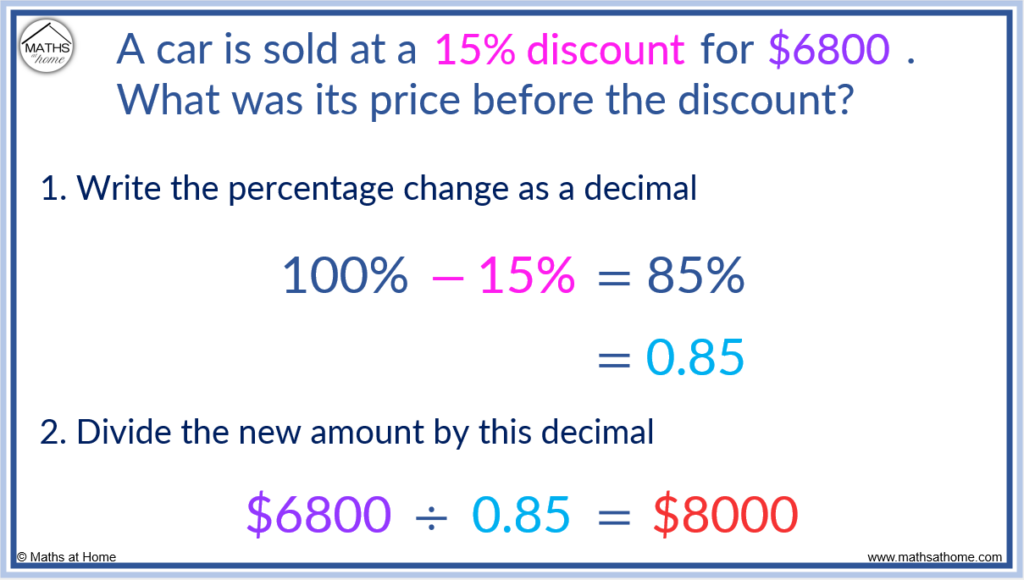
Example: For a 25% discount, 100% – 25% = 75% (This is the percentage of the original price you will still pay).
Step 2: Convert This Remaining Percentage to a Decimal.
Divide the result from Step 1 by 100.
Example: 75% / 100 = 0.75
Step 3: Multiply the Original Price by This Decimal.
This will directly give you the final price.
*Example: Original price $80. Final price = $80 * 0.75 = $60*
This method is efficient and can be quicker for mental calculations once you’re comfortable with it. It directly answers the question, “What is the final cost?”
Practical Examples: Apparel, Electronics, and Groceries
Let’s apply these methods to real-world financial scenarios:
-
Apparel: You want to buy a jacket originally priced at $120. It’s on sale for 30% off.
-
Method 1: Discount amount = $120 * 0.30 = $36. Final price = $120 – $36 = $84.
-
Method 2: You pay 70% (100%-30%). Final price = $120 * 0.70 = $84.
-
-
Electronics: A new gadget costs $499.99, and you have a coupon for 15% off.
-
Method 1: Discount amount = $499.99 * 0.15 = $75.00 (rounded). Final price = $499.99 – $75.00 = $424.99.
-
Method 2: You pay 85% (100%-15%). Final price = $499.99 * 0.85 = $424.99.
-
-
Groceries: Your total grocery bill is $75.50, and you have a loyalty discount of 5% off the total.
-
Method 1: Discount amount = $75.50 * 0.05 = $3.78 (rounded). Final price = $75.50 – $3.78 = $71.72.
-
Method 2: You pay 95% (100%-5%). Final price = $75.50 * 0.95 = $71.72.
-

These examples highlight the versatility of these calculations across different spending categories, making it a universal tool for personal finance.
Advanced Scenarios and Common Pitfalls
While the basic calculations are straightforward, the real world of commerce often presents more complex discount scenarios. Understanding these nuances is crucial for truly mastering your financial expenditures.
Multiple Discounts: Stacking and Sequencing
One of the most common complexities is when multiple discounts are offered. This typically happens in two ways:
-
“Stackable” Discounts: When multiple discounts can be applied to the same item. The key here is the order of application. Generally, percentage-off discounts are applied to the reduced price, not the original price after the first discount.
-
Example: An item is $100. It’s 20% off, plus an additional 10% off for loyalty members.
-
First discount: $100 * 0.20 = $20. Price after first discount = $100 – $20 = $80.
-
Second discount (on reduced price): $80 * 0.10 = $8. Final price = $80 – $8 = $72.
-
Important Note: It’s not 30% off ($100 * 0.30 = $30, leading to a $70 price), because the second discount applies to the already discounted price. This is a common misunderstanding that can lead to overestimating savings.
-
-
-
“Non-Stackable” or “Choose Your Own” Discounts: Where you must pick only one discount. This requires calculating each scenario separately to identify the best financial outcome.
Always read the fine print of promotions to understand how multiple discounts interact. This vigilance protects your budget and ensures you capture the maximum possible savings.
Sales Tax and Other Additional Costs
The calculated final price from a discount is almost never the absolute final amount you’ll pay. Most purchases are subject to sales tax, which is calculated after all discounts have been applied. Other costs might include shipping fees, service charges, or environmental levies.
-
Example: Item is $84 after discounts, with a 7% sales tax.
-
Sales tax amount = $84 * 0.07 = $5.88.
-
Total out-of-pocket cost = $84 + $5.88 = $89.88.
-
Neglecting these additional costs can throw off your budget and lead to unexpected expenses. For comprehensive personal finance planning, always factor in all potential charges when evaluating a purchase, not just the discounted price.
Avoiding “Phantom” Discounts and Marketing Tricks
Marketers are adept at using psychology to make deals seem more attractive than they are. “Phantom” discounts might involve:
-
Inflated Original Prices: An item might be listed with an artificially high “original price” to make the discount seem more substantial. Researching comparable products can help uncover this.
-
“Up To” Discounts: “Up to 50% off!” often means only a few select items are at the maximum discount, while most are at a much lower percentage.
-
Minimum Spend Requirements: A 20% off coupon that requires a minimum purchase of $100 might lead you to buy things you don’t need, effectively negating the savings.
A financially savvy consumer understands that the actual amount saved and the final price paid are the only metrics that matter. Always perform your own calculations and evaluate whether the purchase truly aligns with your financial goals and needs, rather than being swayed by perceived savings.
Leveraging Discount Knowledge for Smarter Financial Decisions
The ultimate goal of understanding percent-off calculations is to transform this mathematical skill into a powerful tool for better personal financial management.
Budgeting with Discounts in Mind
Effective budgeting isn’t just about tracking expenses; it’s about optimizing them. When you’re proficient at calculating discounts, you can:
-
Allocate More Accurately: Instead of budgeting for the full price of an anticipated purchase, you can budget for the expected discounted price, freeing up funds for other priorities or savings goals.
-
Plan for Sales: Knowing how much you can save during specific sales events (like Black Friday or seasonal clearances) allows you to strategically delay non-urgent purchases, leading to significant savings over time.
-
Reallocate Savings: When you save money through discounts, you have the opportunity to direct those “found” funds towards debt reduction, an emergency fund, or investment, accelerating your financial progress.
Integrating discount awareness into your budgeting process turns a reactive spending plan into a proactive savings strategy.
Strategic Shopping: When to Buy and When to Wait
Strategic shopping is a cornerstone of intelligent personal finance. It involves more than just buying what’s on sale; it’s about understanding the life cycle of products and promotions.
-
Seasonal Sales: Recognize patterns of seasonal discounts for clothing, electronics, and home goods.
-
End-of-Season Clearances: These often offer the steepest discounts as retailers make way for new inventory.
-
Price History Research: Utilize online tools to track the price history of items you intend to buy. This can reveal whether a current “deal” is genuinely good or if it frequently drops lower.
-
Needs vs. Wants: A deep discount on something you don’t need is still a waste of money. Apply the calculation to items that genuinely fulfill a need or a pre-planned want within your budget.
By combining your discount calculation skills with market awareness, you transition from being a reactive consumer to a strategic financial planner who optimizes every purchase.
Empowering Your Personal Finance Through Informed Purchases
Ultimately, the ability to find a percent off a price is an empowerment tool. It transforms you from a passive recipient of advertised prices into an active participant in your financial destiny. Every time you correctly calculate a discount, you’re not just saving money; you’re exercising financial muscle, building confidence, and reinforcing good money habits.
This skill transcends simple shopping. It applies to evaluating:
-
Investment Fees: Understanding percentages helps you grasp the true cost of management fees on your investments.
-
Loan Interest Rates: While more complex, the fundamental understanding of percentages is key to comprehending how interest accumulates.
-
Service Bundles: Assessing if a bundled service truly offers a discount compared to purchasing components separately.
By consistently applying these principles, you foster a mindset of financial vigilance and prudence that permeates all areas of your personal finance, leading to greater wealth accumulation and financial security over the long term.
Conclusion
Mastering how to find a percent off a price is far more than a simple arithmetic exercise; it’s a foundational pillar of sound personal finance. By understanding the basics of percentages, employing systematic calculation methods, and navigating the complexities of multiple discounts and hidden costs, you equip yourself with the knowledge to make smarter, more informed purchasing decisions.
This skill empowers you to budget more effectively, shop strategically, and avoid common marketing traps that can lead to unnecessary spending. In a world where every dollar matters, the ability to accurately assess the true cost of goods and services after discounts translates directly into real savings, providing you with greater control over your financial resources and paving the way for a more secure and prosperous financial future. Embrace this essential financial literacy, and watch your savings grow.
aViewFromTheCave is a participant in the Amazon Services LLC Associates Program, an affiliate advertising program designed to provide a means for sites to earn advertising fees by advertising and linking to Amazon.com. Amazon, the Amazon logo, AmazonSupply, and the AmazonSupply logo are trademarks of Amazon.com, Inc. or its affiliates. As an Amazon Associate we earn affiliate commissions from qualifying purchases.