
Navigating the complexities of Social Security Disability benefits can often feel like deciphering a secret code. For individuals facing disabling medical conditions that prevent them from working, understanding how these benefits are calculated is not merely academic—it’s essential for financial stability and future planning. Social Security Disability Insurance (SSDI) and Supplemental Security Income (SSI) are vital programs designed to provide a financial lifeline, but their calculation methods differ significantly, rooted in an individual’s work history, earnings, and financial need. This guide aims to demystify the process, offering a clear, professional, and insightful look into how your Social Security Disability benefits are figured, ensuring you can approach this critical aspect of your financial well-being with confidence and clarity.

Understanding the Foundations of Disability Benefits
Before delving into the specifics of benefit calculation, it’s crucial to distinguish between the two primary types of Social Security Disability benefits and their fundamental eligibility requirements. These distinctions dictate not only if you qualify but also how your potential benefit amount will be determined.
Defining SSDI vs. SSI: Two Distinct Paths
The Social Security Administration (SSA) administers two main disability programs, each serving a different purpose and with unique eligibility criteria that profoundly impact benefit calculation:
-
Social Security Disability Insurance (SSDI): This program is designed for individuals who have worked and paid Social Security taxes for a sufficient period. Think of it as an insurance policy you’ve paid into throughout your working life. Your eligibility and benefit amount are directly tied to your earnings record and the work credits you’ve accumulated. SSDI is not means-tested for income or assets, meaning your current financial resources (other than earned income) generally do not affect eligibility or the benefit amount.
-
Supplemental Security Income (SSI): In contrast, SSI is a needs-based program that provides financial assistance to disabled adults and children, as well as those aged 65 or older, who have limited income and resources. You do not need a work history to qualify for SSI. Because it is a means-tested program, your income, assets, and living arrangements directly influence both your eligibility and the amount of benefit you receive. SSI is funded by general U.S. Treasury funds, not by Social Security taxes.
Understanding which program you might qualify for is the first critical step in figuring your potential benefits, as the calculation methodologies diverge sharply from this point.
Eligibility Basics: Work Credits and Medical Condition
Regardless of whether you’re applying for SSDI or SSI, meeting the SSA’s strict definition of disability is paramount. To be considered disabled, you must have a medical condition that prevents you from engaging in any “substantial gainful activity” (SGA) and is expected to last for at least 12 months or result in death. Beyond the medical criteria, each program has specific non-medical eligibility requirements:
-
SSDI Work Credits: To qualify for SSDI, you must have accumulated a sufficient number of Social Security “work credits.” These credits are earned by working and paying Social Security taxes. The number of credits required depends on your age when you become disabled. For instance, most adults need 40 credits, with 20 of those earned in the last 10 years ending with the year you become disabled. Younger workers may qualify with fewer credits. Each year, the amount of earnings needed to earn one credit changes; in 2024, you earn one credit for every $1,730 in earnings, up to a maximum of four credits per year.
-
SSI Income and Resource Limits: For SSI, the focus is on financial need. Your countable income and resources (assets) must fall below certain limits. In 2024, the federal benefit rate (FBR) is $943 per month for an individual and $1,415 for a couple. However, many states supplement this federal amount. Your countable income is calculated after certain exclusions (e.g., a portion of earned income, some government benefits), and your countable resources (e.g., cash, bank accounts, stocks, bonds) generally cannot exceed $2,000 for an individual or $3,000 for a couple (with exceptions for your home and one vehicle).
Meeting these foundational requirements is the gateway to benefit eligibility. Once established, the next step involves calculating the actual benefit amount.
Key Factors Influencing Your SSDI Benefit Amount
For SSDI, the benefit amount is highly personalized, reflecting an individual’s unique earnings history. It’s not a fixed amount but rather a calculation based on how much you’ve contributed to the Social Security system over your working life.
Your Average Indexed Monthly Earnings (AIME)
The cornerstone of your SSDI benefit calculation is your Average Indexed Monthly Earnings (AIME). This figure represents your average earnings over your most productive working years, adjusted for inflation. The SSA doesn’t just take a simple average; it “indexes” your past earnings to account for changes in general wage levels over time. This indexing ensures that your past earnings are compared to current economic standards, giving them a more realistic value.
Here’s a simplified breakdown of how AIME is determined:
-
Earnings Record: The SSA reviews your entire earnings record, going back to 1951 or when you started working, whichever is later.
-
Indexing: Your earnings from past years are adjusted upward to reflect the change in average wages since the year they were earned. Earnings from the most recent years (usually the year you become disabled and the two preceding years) are typically not indexed because current wage levels are already relatively up-to-date.
-
“Drop-Out” Years: For disability benefit calculations, the SSA typically takes your highest 35 years of indexed earnings. However, for disability, they “drop out” a certain number of low-earning or no-earning years, depending on your age at disability onset. For example, if you become disabled at age 31 or older, generally your highest earning years from your full earnings record are selected, and five years are dropped from the calculation, resulting in the calculation being based on 30 years of earnings. Younger workers have fewer drop-out years.
-
AIME Calculation: The sum of these indexed earnings from the remaining years is then divided by the total number of months in those years to arrive at your Average Indexed Monthly Earnings.
The higher your AIME, the higher your potential SSDI benefit.
The Primary Insurance Amount (PIA) Formula
Once your AIME is calculated, the SSA applies a specific formula to determine your Primary Insurance Amount (PIA). Your PIA is the base amount of your monthly Social Security benefit before any adjustments. It’s the amount you would receive if you started collecting retirement benefits at your full retirement age, or in the case of disability, the amount you’ll receive monthly.
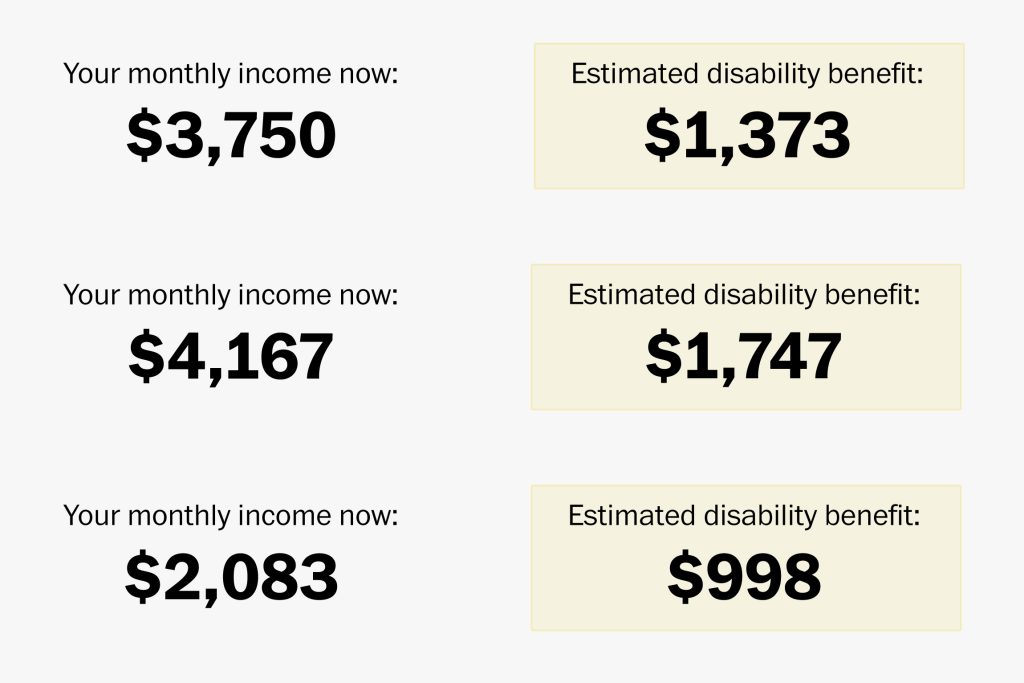
The PIA formula is progressive, meaning it replaces a higher percentage of earnings for lower-income workers than for higher-income workers. It uses a series of “bend points” that change annually. For example, in 2024, the PIA formula for someone who first becomes eligible for benefits is:
-
90% of the first $1,174 of AIME, plus
-
32% of AIME over $1,174 up to $7,078, plus
-
15% of AIME over $7,078.
These bend points ensure that individuals with lower lifetime earnings receive a proportionally larger benefit relative to their contributions, reflecting a core principle of social insurance. Your PIA is essentially your full monthly SSDI benefit.
Maximum and Minimum Benefit Limits
While your AIME and PIA formula determine your specific benefit, there are also overall maximum and, in some cases, minimum limits to consider:
-
Maximum Family Benefit: If you have dependents (e.g., minor children, a spouse caring for a minor child) who also qualify for benefits based on your earnings record, there’s a limit to the total amount that can be paid to your family. This “family maximum” is typically between 150% and 180% of your PIA. If the sum of individual benefits exceeds this limit, each individual benefit (except yours) will be proportionally reduced.
-
Minimum Benefit: While there isn’t a strict “minimum” SSDI benefit in the same way there is an SSI minimum, the progressive nature of the PIA formula ensures that even those with lower lifetime earnings receive a meaningful benefit.
-
Maximum Individual Benefit: There’s also a maximum monthly SSDI benefit, which correlates with the maximum taxable earnings each year. For instance, a worker becoming disabled in 2024 cannot receive more than a certain amount, regardless of how high their AIME is. This caps the benefit for very high earners.
A Step-by-Step Guide to Estimating Your Benefits
While the SSA performs the precise calculations, you can get a very good estimate of your potential SSDI benefits well in advance. Proactive estimation is a critical component of sound financial planning, especially when facing a potential disability.
Accessing Your Social Security Statement
The most reliable and easiest way to estimate your SSDI benefits is by reviewing your official Social Security Statement. This statement provides a personalized estimate of your potential benefits, including disability benefits, based on your actual earnings record.
-
Online Account: The easiest way to access your statement is by creating a “my Social Security” account on the SSA’s official website (www.ssa.gov). Once logged in, you can view your full earnings history, estimated retirement benefits, and crucial for this context, your estimated disability benefits.
-
Mail: You can also request a paper copy of your Social Security Statement be mailed to you, though this takes longer. The SSA automatically mails statements to individuals over certain ages who do not have an online account.

Your Social Security Statement will list your estimated monthly disability benefit if you were to become disabled now. This figure is calculated using the methods described above and is the most accurate estimate you can get without a formal application.
Using Online Calculators and Tools
Beyond your official statement, several online calculators can help you estimate benefits, though they are often less precise without your full earnings record.
-
SSA’s Benefit Calculators: The SSA website offers various calculators, including a Retirement Estimator that can sometimes give you a sense of your PIA, which is the basis for disability. However, the “my Social Security” account provides a direct disability estimate, making other calculators less necessary for this specific purpose.
-
Third-Party Estimators: Many financial planning websites offer Social Security benefit calculators. While useful for general planning, always exercise caution with third-party tools. Ensure they source their data correctly and clarify that their estimates are not official. They often require you to input detailed earnings history, which is typically found on your Social Security Statement.
These tools are best used to supplement the information from your official statement or for exploring “what-if” scenarios, such as how different earning patterns might affect future benefits.
Understanding the SSI Benefit Calculation
For SSI, the calculation is much simpler but revolves around your income and resources.
-
Federal Benefit Rate (FBR): The SSA sets a base FBR, which is the maximum federal SSI payment for an individual or couple. In 2024, it’s $943 for an individual.
-
Countable Income: The SSA assesses all your income (earned, unearned, in-kind) and applies specific exclusions. For example, the first $20 of most unearned income and the first $65 of earned income plus half the remainder are typically disregarded.
-
State Supplements: Many states provide a supplementary payment in addition to the federal SSI benefit. This amount varies significantly by state and can depend on your living arrangements.
-
Benefit Reduction: Your SSI benefit is then reduced dollar-for-dollar by your “countable income.” If your countable income exceeds the FBR (plus any state supplement), you may not be eligible for SSI.
Because SSI is needs-based, the exact amount can fluctuate monthly based on changes in your income, resources, and living situation.
Navigating the Application Process and Beyond
Understanding how benefits are figured is one thing; successfully applying for and managing them is another. The process can be lengthy and challenging, underscoring the importance of preparation and vigilance.
The Importance of Medical Documentation
For both SSDI and SSI, the cornerstone of a successful application is comprehensive and compelling medical documentation. The SSA’s determination of disability hinges on objective medical evidence.
-
Comprehensive Records: Gather all relevant medical records, including doctor’s notes, hospital stays, diagnostic test results (X-rays, MRIs, lab tests), treatment plans, and medication lists.
-
Treating Physician’s Support: A detailed statement from your treating physician(s) explaining your diagnosis, symptoms, functional limitations, and prognosis is invaluable. This statement should clearly articulate why your condition prevents you from performing work-related activities.
-
Consistency: Ensure consistency across all your medical documentation and statements. Discrepancies can raise red flags for the SSA adjudicators.
What Happens After Approval: COLA and Taxes
Once approved for disability benefits, your financial planning considerations continue:
-
Cost-of-Living Adjustments (COLA): Social Security benefits, including SSDI and SSI, are typically adjusted annually to keep pace with inflation through a Cost-of-Living Adjustment. This means your benefit amount may increase slightly each year.
-
Taxation of Benefits: A portion of your Social Security disability benefits may be taxable if your combined income (adjusted gross income + non-taxable interest + one-half of your Social Security benefits) exceeds certain thresholds. For 2024, these thresholds are $25,000 for individuals and $32,000 for those filing jointly.
-
Medicare and Medicaid: SSDI recipients typically become eligible for Medicare after a 24-month waiting period from their entitlement date. SSI recipients, on the other hand, are usually eligible for Medicaid immediately, depending on their state’s rules.
Seeking Professional Guidance
Given the complexities of disability law and the significant financial implications, seeking professional guidance can be highly beneficial.
-
Disability Attorneys or Advocates: An experienced disability attorney or advocate can help you navigate the application process, gather medical evidence, represent you in appeals, and ensure your case is presented optimally. They typically work on a contingency basis, meaning they only get paid if you win your case.
-
Financial Planners: A financial planner specializing in disability or special needs planning can help you integrate your disability benefits into a broader financial strategy, addressing issues like budgeting, managing other income sources, and long-term financial security.
-
SSA Representatives: While they cannot provide legal advice, SSA representatives can offer information about the application process, forms, and general program rules.
Common Misconceptions and Important Considerations
Dispelling common myths and being aware of critical nuances is essential for anyone figuring Social Security Disability benefits.
The Difference Between Expected Retirement and Disability Benefits
Many mistakenly assume their disability benefit will be the same as their full retirement benefit. While your disability benefit is based on your PIA (the same amount you would receive at full retirement age), the number of years used in the AIME calculation for disability is often fewer than for retirement. This can sometimes result in a disability benefit that is slightly different from the retirement estimate shown on your statement, especially if you had significant earnings later in your career. Your “full retirement age” does not apply to disability benefits in the same way, as you are getting benefits early due to an inability to work.
Impact of Other Income and Resources (Especially for SSI)
For SSI recipients, even small changes in income, assets, or living arrangements can directly impact their monthly benefit. This includes things like:
-
Earned Income: While certain amounts are disregarded, working can reduce or eliminate SSI benefits.
-
Unearned Income: Pensions, unemployment benefits, or even gifts can reduce SSI benefits.
-
In-Kind Support and Maintenance: If someone else pays for your food or shelter, the value of that “in-kind” support can be considered income and reduce your SSI.
-
Spousal or Parental Income/Resources: If you live with a spouse or, if you’re a child, with parents, their income and resources may be “deemed” to you, potentially affecting your SSI eligibility or benefit amount.
For SSDI, earned income above the Substantial Gainful Activity (SGA) limit will typically lead to cessation of benefits, as it indicates you are no longer “disabled” by SSA standards. However, unearned income or assets do not affect SSDI.
Work Incentives and Returning to Work
The SSA offers various “Work Incentives” programs for both SSDI and SSI recipients designed to encourage and support efforts to return to work without immediately losing benefits and health coverage. These include:
-
Trial Work Period (SSDI): Allows SSDI recipients to test their ability to work for at least nine months, earning above a certain threshold, without losing benefits.
-
Extended Period of Eligibility (SSDI): After the Trial Work Period, you can continue to receive benefits for up to 36 months for any month your earnings are below the SGA level.
-
Plan to Achieve Self-Support (PASS) (SSI): Allows SSI recipients to set aside money and resources for a specific work goal, without those funds counting against their SSI limits.
-
Continued Medicaid/Medicare: Programs exist to allow beneficiaries to retain their health coverage even as their earnings increase.
Understanding these provisions is crucial for anyone considering a return to work, ensuring they do so strategically and do not inadvertently jeopardize their financial security.
Figuring Social Security Disability benefits is a critical financial exercise. By understanding the program distinctions, calculation methodologies, and potential influences on your benefit amount, you can proactively plan and navigate the system. Whether reviewing your Social Security Statement, understanding the nuances of AIME and PIA, or being aware of SSI’s income limits, a clear grasp of these financial principles empowers you to secure the support you are entitled to during a challenging time.
aViewFromTheCave is a participant in the Amazon Services LLC Associates Program, an affiliate advertising program designed to provide a means for sites to earn advertising fees by advertising and linking to Amazon.com. Amazon, the Amazon logo, AmazonSupply, and the AmazonSupply logo are trademarks of Amazon.com, Inc. or its affiliates. As an Amazon Associate we earn affiliate commissions from qualifying purchases.