
Understanding how to calculate a price increase percentage is a fundamental skill that empowers individuals and businesses alike. In an economy characterized by fluctuating markets, inflation, and dynamic pricing strategies, the ability to quantify changes in cost is indispensable. Whether you’re tracking your household budget, analyzing business expenditures, negotiating contracts, or simply trying to make sense of your grocery bill, grasping this calculation provides clarity and control. This article delves into the straightforward methodology behind figuring out a price increase percentage, explores its profound implications across personal and business finance, and offers insights into leveraging this knowledge for smarter financial decisions.
The Fundamental Formula: Unpacking Percentage Increase
At its core, calculating a price increase percentage is about determining the relative change between an old price and a new, higher price, expressed as a proportion of the original. This simple mathematical operation reveals not just how much a price has gone up, but by what proportion it has increased, offering a more meaningful context than a raw dollar figure alone.
The Basic Calculation: Step-by-Step
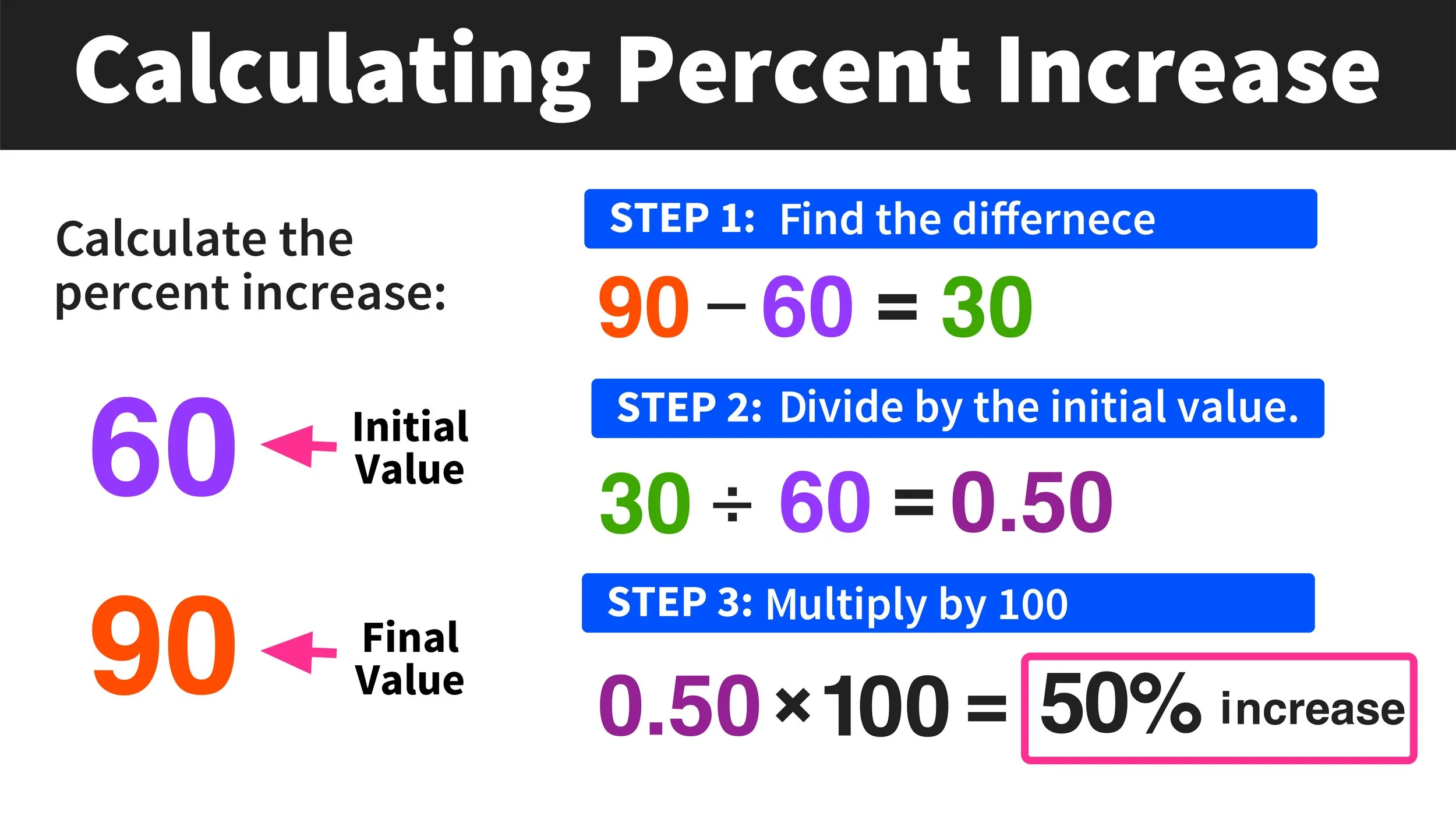
The formula for calculating a percentage increase is as follows:
Percentage Increase = ((New Price – Old Price) / Old Price) * 100
Let’s break down each component of this formula:
-
Find the Difference: Subtract the “Old Price” (the original, lower price) from the “New Price” (the current, higher price). This gives you the absolute amount of the increase.
-
Divide by the Old Price: Take that difference and divide it by the “Old Price.” This step determines the increase as a decimal fraction relative to the original price.
-
Multiply by 100: To convert this decimal into a percentage, multiply the result by 100.
The outcome is a percentage value that instantly communicates the magnitude of the price hike. A 10% increase means the item now costs 10% more than it did originally, irrespective of its starting price.
Illustrative Examples: Personal & Business Contexts
To solidify this understanding, let’s look at practical scenarios from both personal and business finance.
Personal Finance Example:
Imagine your favorite coffee shop raises the price of your daily latte.
-
Old Price: $4.00
-
New Price: $4.50
-
Difference: $4.50 – $4.00 = $0.50
-
Divide by Old Price: $0.50 / $4.00 = 0.125
-
Multiply by 100: 0.125 * 100 = 12.5%
The price of your latte has increased by 12.5%. This might prompt you to consider brewing coffee at home or adjusting your daily budget.
Business Finance Example:
A manufacturing company experiences an increase in the cost of raw materials for a key product.
-
Old Cost per unit of raw material: $25.00
-
New Cost per unit of raw material: $28.75
-
Difference: $28.75 – $25.00 = $3.75
-
Divide by Old Cost: $3.75 / $25.00 = 0.15
-
Multiply by 100: 0.15 * 100 = 15%
The raw material cost has increased by 15%. This significant jump will directly impact the company’s profit margins if not addressed, potentially requiring a review of their product pricing or a search for alternative suppliers.
These examples highlight the universality and utility of the percentage increase calculation across diverse financial situations.
Why Understanding Price Increases Matters
Beyond the mere mechanics of calculation, comprehending price increases is vital for informed decision-making. It acts as a critical barometer for economic health, personal financial resilience, and business sustainability.
For Personal Finance: Budgeting and Consumer Awareness
For individuals and households, monitoring price increases is foundational to effective personal finance management. Inflation, which is essentially a broad measure of price increases across an economy, erodes purchasing power. By knowing how much specific goods and services are increasing in price, you can:
-
Adjust Your Budget: If the cost of essentials like groceries, utilities, or fuel rises significantly, your existing budget may no longer be sustainable. Calculating these increases allows you to proactively adjust spending in other areas or seek ways to increase income.
-
Make Informed Spending Decisions: Faced with a product whose price has surged, you can decide if the value still justifies the cost, if there are cheaper alternatives, or if you can postpone the purchase.
-
Negotiate Better Deals: Understanding market price trends and historical increases can give you leverage in negotiations for larger purchases like cars, homes, or even services.
-
Evaluate Investments: The real return on investments is always measured against inflation. If your investments aren’t growing faster than the rate of price increases, your purchasing power might actually be diminishing.
For Businesses: Pricing Strategy and Profitability
For businesses, calculating price increases—both those they incur and those they might need to implement—is central to maintaining profitability and competitive advantage.
-
Cost Management: Businesses constantly face rising costs for labor, raw materials, shipping, and utilities. Accurately quantifying these increases allows them to assess their impact on production costs and overall margins.
-
Pricing Decisions: When input costs rise, businesses often need to pass some of those increases on to customers. Calculating the percentage increase helps determine appropriate new pricing points that cover costs without alienating customers or losing market share.
-
Profitability Analysis: Understanding the percentage increase in selling prices versus the percentage increase in costs is crucial for analyzing profit margins. Are your prices keeping pace with rising operational expenses?
-
Strategic Planning: Long-term business planning, including forecasting and capital expenditure decisions, relies on projections of future costs and revenues, heavily influenced by anticipated price changes.
-
Competitive Analysis: Observing how competitors adjust their prices in response to market shifts can provide insights into their cost structures and market positioning.
Economic Indicators: Inflation and Purchasing Power
On a broader scale, aggregated price increases form the basis of key economic indicators, most notably inflation. Governments and central banks closely monitor inflation rates to guide monetary policy, interest rate decisions, and overall economic strategy.
-
Inflation Measurement: Institutions like the Bureau of Labor Statistics (BLS) in the U.S. use complex methodologies to track the average change in prices paid by urban consumers for a basket of consumer goods and services, resulting in the Consumer Price Index (CPI). Understanding individual price increases helps to demystify these broader economic figures.
-
Purchasing Power: As prices rise, the purchasing power of money decreases. A dollar today buys less than it did yesterday if prices have increased. This concept is fundamental to understanding economic well-being and the real value of wages and savings.
-
Wage Negotiations: Employees often demand wage increases that at least match the rate of inflation to maintain their standard of living. Knowing the percentage increase in the cost of living provides a concrete basis for these discussions.
Common Scenarios and Nuances
While the basic formula remains consistent, applying it effectively requires an understanding of various contexts and potential pitfalls. Not all price changes are created equal, and discerning the true nature of an increase is key to accurate analysis.
Single Item vs. Basket of Goods
The calculation is straightforward for a single item. However, in real life, consumers and businesses deal with multiple items simultaneously.
-
Single Item: If a specific product goes from $10 to $12, that’s a 20% increase for that item.
-
Basket of Goods: When analyzing overall spending, you might be looking at a “basket” of goods, like your weekly grocery bill or a business’s total office supplies expenditure. To calculate the percentage increase for a basket, you would compare the total cost of the basket at one point in time to its total cost at another point. For instance, if your average weekly grocery bill was $150 last year and is $175 this year for roughly the same items, that’s an overall increase of ((175-150)/150)*100 = 16.67%. This is how inflation is broadly measured. It’s crucial that the composition of the basket remains as consistent as possible for an accurate comparison.
Incremental vs. Sudden Jumps
Price increases can manifest in different patterns:
-
Incremental Increases: These are small, gradual rises over time, often designed to be less noticeable to consumers. For example, a subscription service might raise its price by $1 per year. While individually small, cumulative incremental increases can add up significantly over several years. Calculating the overall percentage increase from the original price to the current price helps reveal the true long-term impact.
-
Sudden Jumps: These are abrupt, significant increases, often in response to supply chain disruptions, commodity price spikes, or new taxes. These are typically more noticeable and can provoke stronger consumer or business reactions. Analyzing these jumps helps in identifying the immediate impact and potential need for rapid adjustments.
The Role of Sales and Discounts
When calculating price increases, it’s critical to consider the context of sales and discounts:
-
Temporary vs. Permanent Prices: Always use the regular, non-sale price for your “Old Price” and “New Price” to get an accurate reading of the actual price increase. If you compare a sale price from last year to a non-sale price this year, the perceived increase will be artificially inflated.
-
Phantom Increases: Sometimes, retailers might increase the “regular” price of an item but then frequently put it on “sale” for a price similar to its old regular price. While technically the listed price increased, the practical cost to a savvy consumer might not have changed much if they always bought it on sale. However, for those who don’t, the increase is very real.
Being mindful of these nuances ensures that your percentage increase calculations provide a truly representative picture of cost changes.
Advanced Considerations & Impact Analysis
Moving beyond the basic calculation, understanding the deeper implications of price increases requires considering additional factors that influence their real-world impact on individuals and businesses.
Accounting for Inflation and Real vs. Nominal Increases
One of the most crucial distinctions in financial analysis is between nominal and real values.
-
Nominal Price Increase: This is the straightforward percentage increase we’ve discussed – the raw percentage change in price without adjusting for inflation. If a product goes from $10 to $11, that’s a nominal 10% increase.
-
Real Price Increase: This adjusts the nominal increase for inflation, reflecting the true increase in price relative to the general purchasing power of money. If a product increases by 10% nominally, but general inflation was 5% during the same period, the real price increase is approximately 5% (10% – 5%). In other words, the product became 5% more expensive relative to everything else. Calculating real increases provides a clearer picture of whether an item is becoming genuinely more expensive or simply keeping pace with broader economic trends. This is particularly important for long-term financial planning and investment analysis.
Impact on Purchasing Power and Lifestyle
Price increases directly impact the purchasing power of consumers and the operational costs of businesses.
-
Consumer Lifestyle: Persistent price increases, especially in essential categories like food, housing, and energy, can significantly reduce discretionary income. This forces consumers to make difficult choices, cut back on non-essentials, or seek ways to increase their income, potentially leading to a decline in their standard of living.
-
Business Viability: For businesses, unchecked increases in input costs without corresponding adjustments in pricing or efficiency can quickly erode profit margins, making operations unsustainable. This can lead to reduced investment, job cuts, or even business closures. Conversely, effectively managing cost increases and strategically adjusting prices can ensure continued profitability and growth.
Strategic Responses for Consumers and Businesses
Equipped with the knowledge of how to calculate and interpret price increases, both consumers and businesses can formulate strategic responses.
For Consumers:
-
Budget Re-evaluation: Regularly review and adjust budgets based on observed price increases in key spending categories.
-
Comparison Shopping: Actively compare prices across different brands and retailers, utilizing online tools and apps to find the best value.
-
Bulk Buying/Sales: Purchase non-perishable items in bulk when prices are favorable or during sales to mitigate future increases.
-
Substitute Goods: Explore cheaper substitute goods or services if a preferred option becomes too expensive.
-
Advocacy/Negotiation: For significant purchases or recurring services, don’t hesitate to negotiate or seek better terms.
For Businesses:
-
Cost Control: Implement rigorous cost-cutting measures, optimize supply chains, and negotiate better terms with suppliers.
-
Strategic Pricing: Implement dynamic pricing models, consider tiered pricing, or adjust pricing only when necessary and justified by value.
-
Efficiency Improvements: Invest in technology and processes that improve operational efficiency to offset rising input costs.
-
Product Innovation: Develop new products or services that offer higher value or appeal to different market segments, allowing for new pricing strategies.
-
Hedging: For businesses heavily reliant on volatile commodities, consider hedging strategies to lock in prices and mitigate future increases.
By proactively analyzing and responding to price increases, individuals can safeguard their financial well-being, and businesses can maintain their competitive edge and profitability in an ever-changing economic landscape. The simple act of figuring out a price increase percentage thus transforms into a powerful tool for financial empowerment and strategic planning.
aViewFromTheCave is a participant in the Amazon Services LLC Associates Program, an affiliate advertising program designed to provide a means for sites to earn advertising fees by advertising and linking to Amazon.com. Amazon, the Amazon logo, AmazonSupply, and the AmazonSupply logo are trademarks of Amazon.com, Inc. or its affiliates. As an Amazon Associate we earn affiliate commissions from qualifying purchases.