
Understanding your monthly loan payment is a cornerstone of sound financial management, whether you’re navigating a mortgage, an auto loan, student debt, or a personal loan. Far from being a mere number provided by a lender, this figure dictates a significant portion of your budget, influences your saving capacity, and impacts your long-term financial health. Dissecting how this payment is calculated empowers you to make informed decisions, negotiate better terms, and ultimately take control of your financial destiny. This article will demystify the process, breaking down the core components, exploring calculation methods, and highlighting the tools available to ensure you’re always in the know.
The Fundamentals of Loan Payments: Deconstructing the Elements
Before you can calculate anything, it’s crucial to understand the building blocks that constitute every loan payment. These elements interact in a complex dance to determine the exact amount you owe each month.
Principal: The Core Amount Borrowed
The principal is the initial sum of money you borrow from a lender. If you take out a $20,000 car loan, your principal is $20,000. It’s the face value of the debt, before any interest or fees are applied. Over the life of your loan, a portion of each monthly payment goes towards reducing this principal amount, a process known as amortization. The goal, ultimately, is to pay the principal down to zero.
Interest Rate: The Cost of Borrowing
The interest rate is arguably the most critical factor influencing your monthly payment. It’s the percentage charged by the lender for the privilege of borrowing their money. Expressed as an annual percentage rate (APR), this rate determines how much extra you’ll pay on top of the principal. A higher interest rate means a more expensive loan and, consequently, higher monthly payments for the same principal and term. Interest can be fixed (stays the same throughout the loan) or variable (fluctuates with market rates). Understanding the difference and its implications is vital for financial planning.
Loan Term: The Repayment Horizon
The loan term, also known as the repayment period, is the length of time you have to repay the loan in full, typically expressed in months or years. Common terms for mortgages might be 15 or 30 years, while auto loans are often 3 to 7 years. The loan term has a direct inverse relationship with your monthly payment: a longer term generally results in lower monthly payments but a higher total interest paid over the life of the loan. Conversely, a shorter term means higher monthly payments but less overall interest. Balancing affordability with total cost is a key consideration when choosing a loan term.
Amortization: The Repayment Schedule Unveiled
Amortization is the process of gradually paying off a debt over time through a series of regular, typically equal, payments. Each payment is divided into two parts: one portion covers the interest accrued since the last payment, and the remaining portion goes towards reducing the principal balance. Early in an amortizing loan (like a mortgage), a larger percentage of your payment goes towards interest. As the principal balance decreases over time, a larger percentage of your payment is allocated to the principal. An amortization schedule is a detailed table showing each payment, how much goes to interest, how much to principal, and the remaining balance. It offers full transparency into your repayment journey.
Manual Calculation Methods: Understanding the Math Behind Your Money
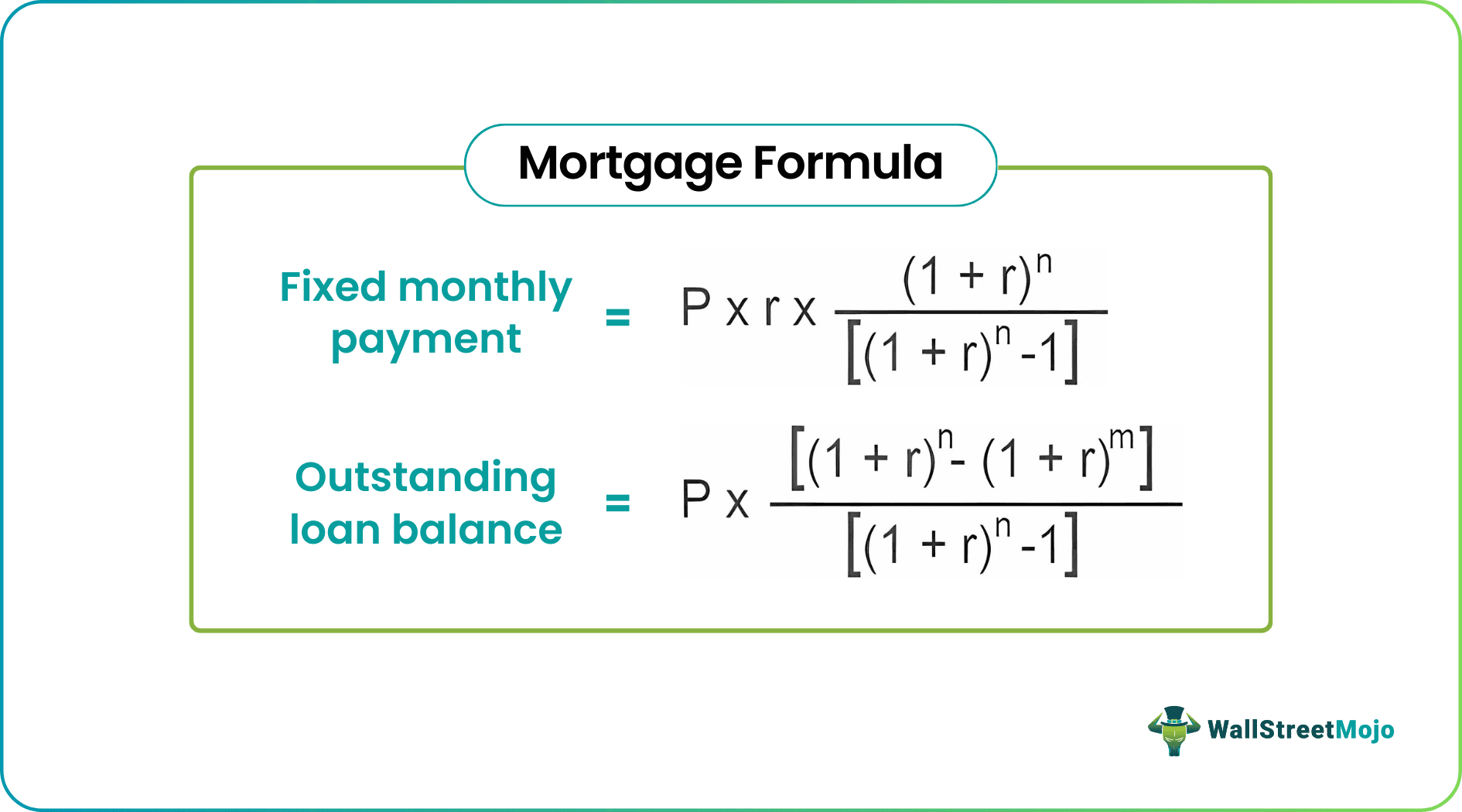
While modern tools simplify the process, understanding the underlying mathematical formula for loan payments provides invaluable insight and helps you verify figures. The standard formula for an amortizing loan payment is:
$M = P [ i(1 + i)^n ] / [ (1 + i)^n – 1]$
Where:
- M = Monthly Payment
- P = Principal Loan Amount
- i = Monthly Interest Rate (Annual Rate / 12)
- n = Total Number of Payments (Loan Term in Years * 12)
Step-by-Step Walkthrough with an Example
Let’s apply this formula to a hypothetical scenario:
Imagine you take out a personal loan for $10,000 (P) with an annual interest rate of 6% (APR) over a 5-year term.
-
Calculate the Monthly Interest Rate (i):
- Annual Rate = 6% = 0.06
- Monthly Rate (i) = 0.06 / 12 = 0.005
-
Calculate the Total Number of Payments (n):
- Loan Term = 5 years
- Total Payments (n) = 5 years * 12 months/year = 60 months
-
Plug the values into the formula:
-
$M = 10,000 [ 0.005(1 + 0.005)^{60} ] / [ (1 + 0.005)^{60} – 1]$
-
First, calculate $(1 + 0.005)^{60}$: $(1.005)^{60} approx 1.34885$
-
Now substitute back into the formula:
- $M = 10,000 [ 0.005 * 1.34885 ] / [ 1.34885 – 1]$
- $M = 10,000 [ 0.00674425 ] / [ 0.34885]$
- $M = 67.4425 / 0.34885$
- $M approx 193.33$
-
So, your estimated monthly payment would be approximately $193.33.
Limitations of Manual Calculations for Complex Scenarios
While useful for understanding the mechanics, manual calculations can be cumbersome and prone to error, especially for large, long-term loans with numerous payments. Factors like compounding frequency (daily vs. monthly), exact day count conventions, and varying interest rates can add layers of complexity that are difficult to manage manually. For most real-world applications, digital tools offer superior accuracy and efficiency.
Leveraging Digital Tools: Efficiency and Accuracy at Your Fingertips
In the digital age, calculating loan payments is often a matter of a few clicks. A range of tools is available, catering to different levels of detail and user preference.
Online Loan Calculators: Quick and User-Friendly Solutions
The easiest and most common way to calculate loan payments is through online loan calculators. Virtually every bank, financial institution, and personal finance website offers these free tools. You simply input the principal amount, interest rate, and loan term, and the calculator instantly provides the monthly payment, often accompanied by an amortization schedule and total interest paid. These are perfect for quick estimates and comparing different loan scenarios on the fly. Many even allow for extra payments or down payments to be factored in.

Spreadsheet Software (Excel/Google Sheets): Customization and In-depth Analysis
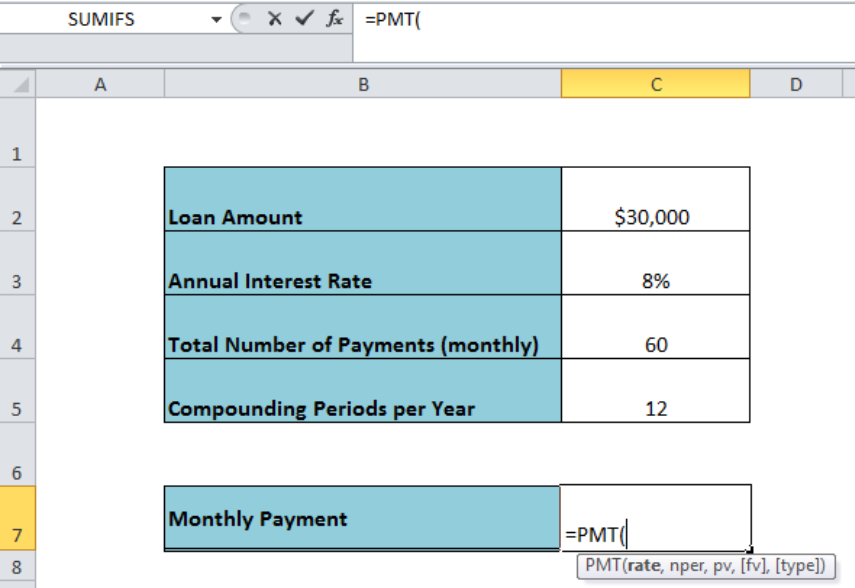
For those who desire more control and analytical power, spreadsheet software like Microsoft Excel or Google Sheets is an invaluable asset. Using built-in functions like PMT (for payment), IPMT (for interest payment), and PPMT (for principal payment), you can create highly customized loan amortization schedules.
The PMT function syntax is: PMT(rate, nper, pv, [fv], [type])
rate: The interest rate per period (e.g., APR/12).nper: The total number of payments (e.g., loan term in years * 12).pv: The present value, or the principal amount of the loan.fv: [optional] The future value, or a cash balance you want to attain after the last payment (defaults to 0).type: [optional] When payments are due (0 for end of period, 1 for beginning of period; defaults to 0).
Using our previous example ($10,000 loan, 6% APR, 60 months):
=PMT(0.06/12, 60, -10000) would yield approximately $193.33.
Spreadsheets allow you to model various scenarios, such as the impact of extra payments, interest rate changes, or different down payments, offering a dynamic and powerful way to manage your loan information.
Banking Apps and Financial Software: Integrated Solutions
Many banking applications and comprehensive financial planning software (e.g., Quicken, Mint) now include integrated loan calculators and debt management features. These tools often link directly to your accounts, providing real-time balances and sometimes even projecting the impact of early payments directly within your personalized financial dashboard. This integration offers convenience and a holistic view of your financial landscape, making it easier to track progress and plan strategically.
Beyond the Basics: Factors Influencing Your Monthly Payment
While principal, interest rate, and loan term are the core components, several other factors can subtly or significantly impact your effective monthly outlay, especially with larger loans like mortgages.
Variable vs. Fixed Interest Rates: What to Expect
A fixed-rate loan maintains the same interest rate throughout the entire loan term, providing predictable monthly payments. This stability is excellent for budgeting and offers protection against rising interest rates.
A variable-rate loan (or adjustable-rate mortgage, ARM) has an interest rate that can change periodically based on a benchmark index. While it might start with a lower rate, your monthly payments can increase or decrease over time. Understanding the caps (maximum increase) and frequency of adjustments is crucial to assessing your risk tolerance and potential future payment obligations.
Escrow Accounts: Property Taxes and Insurance (for Mortgages)
For mortgages, your monthly payment often includes more than just principal and interest. Lenders typically require an escrow account to collect funds for property taxes and homeowners’ insurance premiums. A portion of your monthly payment is funneled into this account, and the lender pays these annual bills on your behalf. This makes budgeting easier but means your “loan payment” includes these additional costs, which can fluctuate annually based on assessment and premium changes.
Additional Fees and Charges: Hidden Costs
Beyond the principal and interest, loans can come with various fees that might be rolled into the loan amount or paid upfront. These can include:
- Origination fees: Charged by the lender for processing the loan.
- Application fees: For processing your loan application.
- Closing costs: For mortgages, these include a range of fees for appraisal, title search, legal services, etc.
- Late payment fees: Penalties for missing payment deadlines.
- Prepayment penalties: Fees for paying off your loan early (less common today but still exist).
While not directly part of the monthly principal and interest calculation, these fees contribute to the overall cost of the loan and can sometimes be factored into the loan amount, subtly increasing your principal and thus your monthly payment.
Prepayment Penalties and Options
Some loan agreements include a prepayment penalty clause, which charges a fee if you pay off the loan entirely or make significant extra payments before the term ends. This is less common in personal loans and standard mortgages but can appear in certain types of loans. Always check your loan agreement for such clauses. Conversely, many lenders encourage early repayment without penalties, which can save you a substantial amount in interest over the loan’s life.
Practical Strategies for Managing and Optimizing Your Payments
Knowing how to calculate your payments is just the first step. The true power lies in using this knowledge to manage and potentially optimize your financial obligations.
Understanding Your Loan Agreement
The loan agreement (or promissory note) is the definitive document outlining all terms and conditions of your loan. It specifies the principal, interest rate, term, payment schedule, fees, and any prepayment clauses. Always read it thoroughly before signing. If anything is unclear, ask your lender for clarification. This document is your roadmap to understanding your commitment.
Strategies for Lowering Payments (Refinancing, Debt Consolidation)
If your current monthly payments are a strain, there are strategies to explore:
- Refinancing: This involves taking out a new loan to pay off an existing one, often at a lower interest rate or with a longer term, resulting in lower monthly payments. Ensure the savings outweigh any new fees.
- Debt Consolidation: Combining multiple debts (like credit card balances) into a single new loan, often with a lower overall interest rate and a single, more manageable monthly payment.
- Negotiating with Lender: In certain hardship situations, some lenders may be willing to temporarily adjust payment terms or offer forbearance.
The Benefits of Overpaying
If your budget allows, making extra payments towards your principal can significantly reduce the total interest paid and shorten the loan term. Even small, consistent extra payments can have a dramatic impact over time. Before overpaying, ensure your loan doesn’t have prepayment penalties, and specify that extra funds should be applied directly to the principal.
Conclusion
Understanding how your monthly loan payment is calculated transforms you from a passive borrower into an empowered financial manager. By grasping the roles of principal, interest, and term, and leveraging the manual and digital tools available, you gain the clarity needed to budget effectively, compare loan offers intelligently, and make strategic decisions that align with your financial goals. Take the time to understand your loans, and you’ll unlock greater control over your money and your future.
aViewFromTheCave is a participant in the Amazon Services LLC Associates Program, an affiliate advertising program designed to provide a means for sites to earn advertising fees by advertising and linking to Amazon.com. Amazon, the Amazon logo, AmazonSupply, and the AmazonSupply logo are trademarks of Amazon.com, Inc. or its affiliates. As an Amazon Associate we earn affiliate commissions from qualifying purchases.