
Understanding how to calculate a percent increase is a fundamental skill in the world of personal and business finance. Whether you’re tracking investment growth, evaluating a salary offer, analyzing sales figures, or managing your household budget, this mathematical tool provides crucial insight into change and performance. It allows individuals and organizations to quantify progress, identify trends, and make informed decisions, moving beyond mere absolute figures to grasp proportional shifts.
Understanding the Importance of Percent Increase in Finance
In financial contexts, raw numbers often tell only part of the story. A gain of $1,000 might seem significant, but its true meaning depends on the original value. Is it a $1,000 increase on a $100 investment (a massive 900% gain) or a $1,000 increase on a $1,000,000 portfolio (a mere 0.1% gain)? Percent increase provides this essential context, standardizing change into a universally comparable metric.
For individuals, calculating percent increase is vital for:
- Salary Negotiations: Knowing the percentage increase of your last raise or a new job offer helps you compare opportunities effectively and understand your purchasing power adjustments.
- Investment Performance: It’s the standard for measuring returns on stocks, bonds, real estate, and other assets, allowing you to gauge the effectiveness of your investment strategies.
- Budgeting: Identifying percentage increases in expenses like groceries, utilities, or housing helps you anticipate financial pressures and adjust your budget proactively.
For businesses, it’s a cornerstone of financial analysis and strategic planning:
- Revenue and Profit Growth: Tracking year-over-year or quarter-over-quarter percentage increases in sales or net income is a key indicator of a company’s health and expansion.
- Cost Management: Monitoring percent increases in operational costs helps businesses identify areas for efficiency improvements and cost reduction.
- Market Share: Understanding how a company’s sales growth compares to the overall market’s growth allows for an assessment of market share changes.
Without the ability to calculate and interpret percent increases, financial analysis remains superficial, making strategic planning and performance evaluation challenging.
The Core Formula: Step-by-Step Calculation
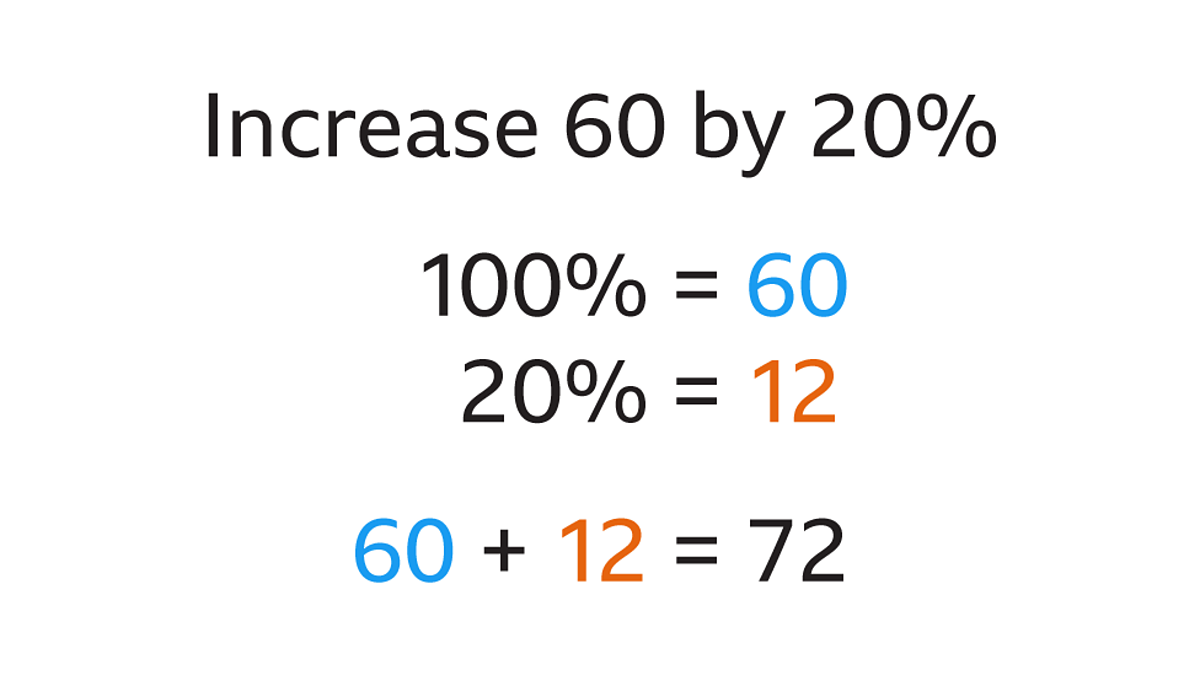
The formula for calculating a percent increase is straightforward and relies on two primary values: an original (or old) value and a new (or current) value.
The general formula is:
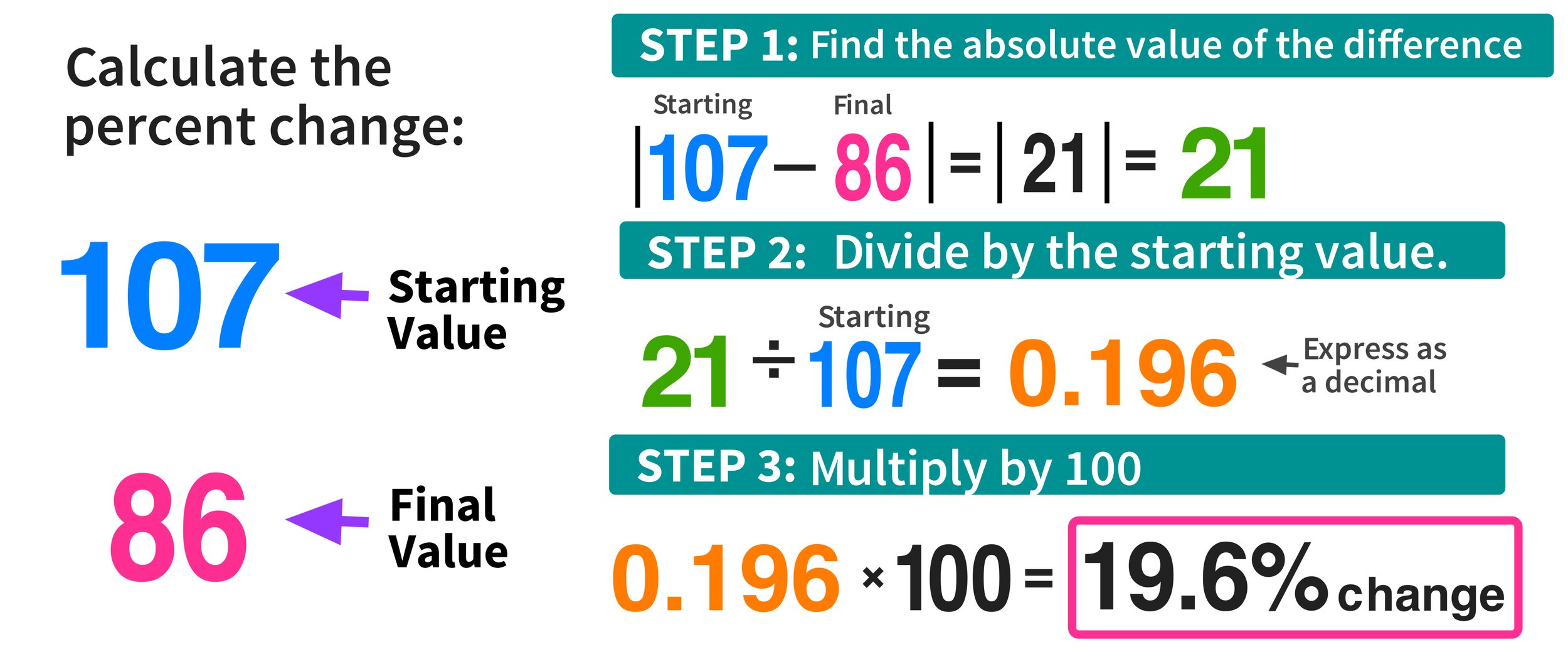
Percent Increase = ((New Value - Old Value) / Old Value) * 100
Let’s break this down into digestible steps with an example.
Step 1: Identify the Old (Original) Value
This is the starting point, the baseline against which you are measuring the increase. It represents the value before the change occurred.
- Example: You bought a stock for $50 per share. This is your Old Value.
Step 2: Identify the New (Current) Value
This is the ending point, the value after the change has occurred.
- Example: The stock price later rose to $65 per share. This is your New Value.
Step 3: Calculate the Absolute Change
The first step in the actual calculation is to determine the absolute difference between the new and old values. This tells you the raw amount of the increase.
- Formula:
Absolute Change = New Value - Old Value - Example:
$65 (New Value) - $50 (Old Value) = $15 (Absolute Change)- This means the stock increased by $15.
Step 4: Divide the Absolute Change by the Old Value
Now, you need to express that absolute change as a proportion of the original value. This will give you a decimal.
- Formula:
Proportionate Change = Absolute Change / Old Value- Or,
Proportionate Change = (New Value - Old Value) / Old Value
- Or,
- Example:
$15 (Absolute Change) / $50 (Old Value) = 0.3- This means the stock increased by 0.3 times its original value.
Step 5: Convert to a Percentage
Finally, to express this proportionate change as a percentage, multiply the result from Step 4 by 100.
- Formula:
Percent Increase = Proportionate Change * 100- Or,
Percent Increase = ((New Value - Old Value) / Old Value) * 100
- Or,
- Example:
0.3 * 100 = 30%- Therefore, the stock experienced a 30% increase.
This systematic approach ensures accuracy and clarity when calculating any percent increase.

Practical Applications in Personal Finance
The ability to calculate a percent increase isn’t just an academic exercise; it’s a critical tool for managing and improving your personal financial health.
Tracking Investment Growth
For many, investments are a primary driver of long-term wealth accumulation.
- Stocks and Mutual Funds: If you invested $10,000 in a mutual fund and it grew to $11,500 over a year, your percent increase is
(($11,500 - $10,000) / $10,000) * 100 = 15%. This tells you your annual return rate, allowing you to compare it against benchmarks or other investments. - Real Estate: You bought a house for $300,000 and it’s now valued at $345,000. That’s a
(($345,000 - $300,000) / $300,000) * 100 = 15%increase in value, providing a clear picture of your equity growth. - Compounding Effect: Understanding percent increase is vital for grasping the power of compound interest. A seemingly small annual percentage gain, when applied repeatedly over decades, can lead to substantial wealth growth.
Analyzing Salary and Income Changes
Your income is your most powerful financial asset.
- Negotiating Raises: If your current salary is $60,000 and you want a $65,000 salary, you’re asking for a
(($65,000 - $60,000) / $60,000) * 100 = 8.33%increase. Knowing this percentage helps you frame your request and understand its impact. - Impact of Inflation: The cost of living typically increases each year due to inflation. If your salary increased by 3% but inflation was 4%, your real purchasing power actually decreased by 1%. Comparing your salary increase percentage to the inflation rate is crucial for maintaining your standard of living.
- Side Hustle Revenue: Tracking month-over-month or year-over-year percent increases in income from a side business helps you gauge its growth trajectory and identify successful strategies.
Budgeting and Expense Management
Effective budgeting isn’t just about knowing what you spend; it’s about understanding how your spending changes.
- Identifying Rising Costs: If your average monthly grocery bill went from $400 to $460, that’s a
(($460 - $400) / $400) * 100 = 15%increase. This signals a need to adjust your budget or find ways to reduce costs. - Saving Rate Increases: If you increased your monthly savings from $500 to $600, you achieved a
(($600 - $500) / $500) * 100 = 20%increase in your saving rate, a commendable financial step. - Debt Repayment: Tracking the percent decrease in your outstanding debt can be a powerful motivator and a clear indicator of progress.
Business Finance and Growth Metrics
For businesses, percent increase calculations are fundamental to assessing performance, making strategic decisions, and reporting to stakeholders. They provide a standardized way to compare different aspects of the business over time.
Revenue and Sales Growth
This is perhaps the most widely watched metric for any business.
- Quarter-over-Quarter (QoQ) / Year-over-Year (YoY) Growth: A company reporting $1 million in sales last year and $1.2 million this year has experienced a
(($1.2M - $1M) / $1M) * 100 = 20%revenue growth. This percentage indicates the rate at which the business is expanding. - Evaluating Business Performance: Consistent positive percentage increases in revenue are often a sign of a healthy, growing business. Conversely, slowing or negative growth rates can signal underlying problems.
- Market Share: By comparing a company’s sales growth percentage to the overall market growth percentage, businesses can determine if they are gaining, maintaining, or losing market share.
Profit Margin Improvement
Beyond just increasing revenue, businesses strive to increase profitability.
- Gross Profit/Net Profit Increases: If a business’s net profit increased from $200,000 to $250,000, that’s a
(($250,000 - $200,000) / $200,000) * 100 = 25%increase in profitability. This is a strong indicator of improved operational efficiency or pricing power. - Cost Control: A reduction in a specific cost as a percentage of revenue can be a significant achievement, showing improved cost management.
Customer Acquisition Cost (CAC) and Lifetime Value (LTV) Analysis
These are critical metrics for marketing and sales departments.
- CAC Efficiency: If the cost to acquire a new customer decreased from $100 to $80, that’s a
(($80 - $100) / $100) * 100 = -20%(a 20% decrease), indicating improved marketing efficiency. - LTV Growth: An increase in the lifetime value of a customer (e.g., from $500 to $600) represents a
(($600 - $500) / $500) * 100 = 20%growth, signifying better customer retention or increased spending per customer.
Common Pitfalls and Advanced Considerations
While the percent increase formula is simple, its application can sometimes lead to misinterpretations or require more sophisticated techniques.
The ‘Starting at Zero’ Issue
A critical scenario occurs when the “Old Value” is zero. Mathematically, division by zero is undefined.
- Example: If a business had 0 customers last year and gained 100 customers this year, you cannot calculate a percent increase using the standard formula. Instead, you would simply state the absolute increase (100 customers) and acknowledge that it’s an infinite percentage increase from zero, or describe it as “growth from a non-existent base.”
- Implication: Always ensure your old value is a positive number when applying the formula.
Base Value Matters
Always ensure you are using the correct “Old Value” as the denominator. This can be particularly confusing when dealing with consecutive changes.
- Example: If an item increased by 10%, then increased again by 10% of the new value, the total increase is not 20%. If it started at $100, a 10% increase makes it $110. A subsequent 10% increase on $110 makes it $121. The total percent increase from the original $100 is
(($121 - $100) / $100) * 100 = 21%. - Percentage Points vs. Percent Increase: Be careful to distinguish between a “percentage point” increase and a “percent increase.” If a company’s market share goes from 10% to 12%, that’s a 2 percentage point increase, but a
((12% - 10%) / 10%) * 100 = 20%percent increase in market share.
Annualized Growth Rates
For investments or business performance spanning multiple periods, a simple percent increase might not capture the full picture due to compounding.
- Compound Annual Growth Rate (CAGR): This metric is used to smooth out volatility and show the average annual growth rate over a specified period longer than one year, assuming the profits are reinvested. The formula is
CAGR = ((Ending Value / Beginning Value)^(1 / Number of Years)) - 1. This provides a more accurate representation of sustained growth.
Inflation Adjustment
When evaluating financial increases over time, especially in personal finance, it’s often crucial to consider inflation.
- Real vs. Nominal Increases: A “nominal” percent increase is the raw, unadjusted percentage. A “real” percent increase accounts for inflation, showing how much your purchasing power has actually grown. If your investment increased by 10% (nominal) but inflation was 3%, your real increase in purchasing power was only about 7%.
Mastering the calculation and interpretation of percent increases empowers you to gain deeper insights into your financial landscape, enabling more strategic decisions for both personal wealth management and business prosperity.
aViewFromTheCave is a participant in the Amazon Services LLC Associates Program, an affiliate advertising program designed to provide a means for sites to earn advertising fees by advertising and linking to Amazon.com. Amazon, the Amazon logo, AmazonSupply, and the AmazonSupply logo are trademarks of Amazon.com, Inc. or its affiliates. As an Amazon Associate we earn affiliate commissions from qualifying purchases.