
Embarking on the journey to purchase a new or used vehicle is an exciting prospect for many. However, beneath the allure of a shiny new car lies a significant financial commitment: the auto loan. Understanding how to accurately figure auto loan payments is not just about knowing your monthly outlay; it’s about grasping the underlying financial mechanics, making informed decisions, and ultimately saving money over the life of the loan. This guide will demystify the process, empowering you with the knowledge and tools to confidently navigate the world of automotive financing.
Understanding the Fundamentals of Auto Loans
Before diving into calculations, it’s crucial to understand the foundational elements that constitute an auto loan. Each component plays a pivotal role in determining your monthly payment and the overall cost of borrowing.
Key Components of an Auto Loan
At its core, an auto loan is a type of installment loan where you borrow a sum of money to purchase a vehicle and agree to pay it back over a set period, along with interest. The three primary components are:
-
Principal Amount: This is the actual amount of money you are borrowing. It’s typically the purchase price of the car minus any down payment, trade-in value, and sometimes taxes or fees that are rolled into the loan. A larger principal inherently leads to higher payments and more interest paid over the loan term.
-
Interest Rate (APR): The Annual Percentage Rate (APR) is the cost of borrowing money, expressed as a percentage of the principal. It includes not only the interest rate but also certain fees charged by the lender. A lower APR means less money paid in interest over the life of the loan, significantly reducing your total cost. Your credit score, the current market rates, and the lender’s policies heavily influence the APR you qualify for.
-
Loan Term (Duration): This refers to the length of time, usually expressed in months (e.g., 36, 48, 60, 72, or even 84 months), over which you agree to repay the loan. The loan term directly impacts your monthly payment. A longer term results in lower monthly payments but typically means you pay more in total interest due to the extended period the principal is outstanding. Conversely, a shorter term leads to higher monthly payments but less total interest.
The Impact of Each Variable
Each of these variables is interconnected, and a change in one will inevitably affect the others, particularly your monthly payment and the total cost of the loan.
-
How principal affects payments: Directly proportional. A higher principal means a higher payment, assuming all other factors remain constant. Reducing your principal through a larger down payment or a valuable trade-in is one of the most effective ways to lower your monthly costs.
-
The power of the interest rate: Even a small difference in the interest rate can have a substantial impact over the life of a loan. For instance, a 1% difference on a $30,000 loan over 60 months can translate to hundreds, if not thousands, of dollars in interest savings. This underscores the importance of shopping around for the best possible APR.
-
Longer vs. Shorter Loan Terms: While a longer loan term offers the immediate gratification of lower monthly payments, it’s a double-edged sword. You’ll often pay significantly more in total interest. Shorter terms, though requiring higher monthly outlays, result in less overall interest paid and a quicker path to car ownership. Balancing affordability with total cost is key here.
Manual Calculation Methods for Auto Loan Payments
While financial calculators and software have made calculating loan payments incredibly simple, understanding the underlying formula provides a deeper insight into how your payments are structured. It’s an empowering piece of financial literacy.
The Basic Amortization Formula Explained
The standard formula used to calculate a fixed monthly loan payment for a fully amortizing loan (meaning the principal and interest are paid off completely by the end of the term) is:
M = P [ i(1 + i)^n ] / [ (1 + i)^n – 1]
Where:
-
M= Your monthly loan payment -
P= The principal loan amount (the amount you borrowed) -
i= Your monthly interest rate (your annual interest rate divided by 12) -
n= The total number of payments (your loan term in years multiplied by 12)
Let’s break down the components and perform a step-by-step example:
Example:
Suppose you borrow $25,000 for a car at an annual interest rate of 6% over a 60-month (5-year) term.
-
Calculate
P: $25,000 -
Calculate
i: Annual rate is 6%, so monthly rate is 6% / 12 = 0.06 / 12 = 0.005 -
Calculate
n: 60 months -
Substitute into the formula:
M = 25000 [ 0.005(1 + 0.005)^60 ] / [ (1 + 0.005)^60 – 1]-
First, calculate
(1 + 0.005)^60:(1.005)^60≈ 1.34885 -
Now, calculate the numerator:
25000 * [ 0.005 * 1.34885 ]=25000 * 0.00674425≈168.60625 -
Next, calculate the denominator:
[ 1.34885 – 1 ]=0.34885 -
Finally, divide the numerator by the denominator:
M = 168.60625 / 0.34885≈483.29
-
So, your estimated monthly payment would be approximately $483.29.
Practical Application and Limitations
Manually calculating loan payments provides a solid grasp of how the variables interact. It’s particularly useful for:
-
Verifying lender quotes: You can double-check the figures provided by financial institutions.
-
Back-of-the-envelope estimates: When you’re just starting to explore car options and want a quick sense of potential payments without firing up a tool.
-
Educational purposes: To truly understand the mechanics of compound interest and amortization.
However, manual calculation, especially for more complex scenarios, can be tedious and prone to error. It doesn’t easily account for factors like extra payments, varying payment schedules (bi-weekly vs. monthly), or the impact of rolling in additional fees. For precision and convenience, leveraging digital tools is often the better approach.
Leveraging Financial Tools for Accuracy
In today’s digital age, relying solely on manual calculations is often unnecessary and inefficient. A variety of financial tools are readily available to provide instant, accurate auto loan payment calculations, offering much more than just a single monthly payment figure.
Online Auto Loan Calculators

Online auto loan calculators are arguably the most popular and accessible tools for estimating payments. Found on virtually every lender’s website, financial news sites, and personal finance blogs, they offer a quick and effective way to run scenarios.
-
How they work: You simply input the principal loan amount, interest rate (APR), and loan term. The calculator instantly processes these inputs using the same amortization formula discussed earlier and displays your estimated monthly payment.
-
Advantages:
-
Speed and Accuracy: Get instant results without the need for manual math.
-
“What-If” Scenarios: Easily adjust variables like the down payment, interest rate, or term to see how they impact your monthly payment. This is invaluable for budgeting and making purchasing decisions.
-
Detailed Breakdowns: Many advanced calculators show not only the monthly payment but also the total interest paid, total cost of the loan, and even a simple amortization schedule.
-
Additional Features: Some calculators allow you to factor in trade-in values, sales tax, registration fees, and even the impact of making extra payments.
-
-
Recommended features to look for: Seek out calculators that allow for a down payment input, a trade-in value, and ideally, an option to add sales tax and other fees to get the most realistic picture of your loan. Some even offer dynamic charts showing how interest accrues over time.
Spreadsheet Software (Excel/Google Sheets)
For those who prefer a more hands-on approach or need to integrate loan calculations into a broader personal finance spreadsheet, software like Microsoft Excel or Google Sheets offers powerful built-in financial functions.
-
Using built-in financial functions (PMT function): The
PMTfunction is specifically designed to calculate the payment for a loan based on constant payments and a constant interest rate.The syntax is
=PMT(rate, nper, pv, [fv], [type])-
rate: The interest rate per period (e.g., APR/12 for monthly payments). -
nper: The total number of payments for the loan (e.g., loan term in years * 12). -
pv: The present value, or the total amount that a series of future payments is worth now; also known as the principal. -
[fv]: Optional. The future value, or a cash balance you want to attain after the last payment is made. If omitted, it defaults to 0 (meaning the loan is fully paid off). -
[type]: Optional. Indicates when payments are due (0 for end of period, 1 for beginning of period). Defaults to 0.
Example using Excel/Google Sheets:
If you borrow $25,000 at 6% APR over 60 months:
=PMT(0.06/12, 60, -25000)The result will be
$483.29. (Note: Thepvis entered as a negative value because it’s an outflow of cash from the lender, an inflow to you. The PMT function returns a negative value for the payment, representing an outflow from you). -
-
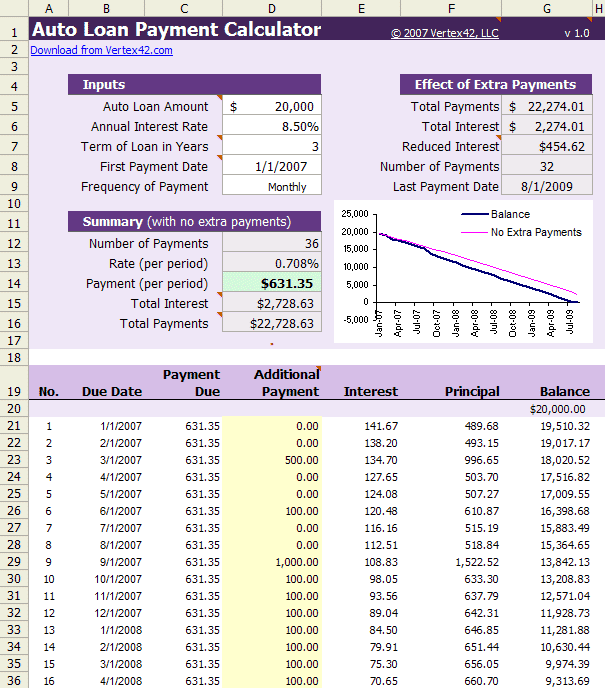
Building a simple loan amortization schedule: Beyond just the monthly payment, you can use a spreadsheet to create a full amortization schedule. This table breaks down each payment into how much goes towards interest and how much towards the principal, showing the remaining balance after each payment. This is incredibly insightful for understanding how your principal decreases over time and how much interest you’re truly paying.
-
Benefits for personal financial tracking: Integrating your auto loan into a personal finance spreadsheet allows for holistic financial planning. You can track your actual payments, model the impact of extra payments, and see how your auto loan fits into your overall budget and debt repayment strategy.
Beyond the Monthly Payment: A Holistic View
While the monthly payment is a critical figure, it tells only part of the story. A truly comprehensive understanding of your auto loan involves looking at the bigger picture—the total cost, additional expenses, and strategies to minimize your financial burden.
Total Cost of the Loan
Focusing solely on the monthly payment can be misleading. A longer loan term, while offering lower monthly payments, often results in significantly more interest paid over the life of the loan.
-
Calculating total interest paid: To figure out the total interest, simply multiply your monthly payment by the total number of payments (
M * n) and then subtract the original principal amount (P).Using our previous example of $483.29/month for 60 months on a $25,000 loan:
Total paid =
$483.29 * 60 = $28,997.40Total interest =
$28,997.40 - $25,000 = $3,997.40This figure reveals the true cost of borrowing and helps you compare different loan offers more effectively.
-
Understanding the true cost of ownership: Beyond the loan itself, the true cost of owning a vehicle includes insurance, fuel, maintenance, and depreciation. Factor these into your overall budget to ensure your car is genuinely affordable.
The Role of Down Payments and Trade-ins
These two factors significantly influence your loan by reducing the principal amount you need to borrow.
-
Reducing the principal and interest: A larger down payment or a valuable trade-in directly lowers the principal. A smaller principal means smaller monthly payments and, crucially, less interest accrues over the loan term. It also builds immediate equity in your vehicle.
-
Impact on monthly payments and total cost: Even a modest down payment can reduce your monthly payment considerably and shave off a significant amount of total interest, especially for longer loan terms. It also demonstrates financial stability to lenders, potentially qualifying you for a better APR.
Understanding Additional Costs
The price tag on the car and the loan payment are not the only financial considerations. There are several other costs that, if not budgeted for, can strain your finances.
-
Taxes, registration fees: Sales tax on the vehicle purchase, annual registration fees, and license plate fees are mandatory and can add hundreds or even thousands to your initial outlay. In some cases, these can be rolled into the loan, increasing your principal.
-
Insurance considerations: When you finance a car, lenders typically require you to carry full coverage insurance (collision and comprehensive) to protect their asset. This is often more expensive than liability-only insurance and must be factored into your monthly budget. Get insurance quotes before finalizing your car purchase.
-
Extended warranties and add-ons: Dealerships often offer extended warranties, GAP insurance, paint protection, and other add-ons. While some may offer value, many are high-profit items for the dealership. Carefully evaluate if these are necessary and if their cost justifies the benefit, especially if they are rolled into your loan, where they will also accrue interest.
Strategies for Managing and Optimizing Your Auto Loan
Once you’ve secured an auto loan, your financial journey doesn’t end there. Proactive management can lead to significant savings and a faster path to debt freedom.
Refinancing Options
Refinancing involves taking out a new loan to pay off your existing auto loan, ideally with better terms.
-
When and why to refinance: Consider refinancing if interest rates have dropped since you took out your original loan, if your credit score has significantly improved, or if you want to change your loan term (either shorten it to pay less interest or lengthen it for lower monthly payments).
-
Benefits (lower rates, shorter terms): A lower interest rate means less total interest paid. A shorter term can save you substantial interest, while a longer term (if carefully considered) can free up cash flow if you’re struggling with high monthly payments. Always calculate the total cost for both options.
Making Extra Payments
Even small additional payments can dramatically reduce the total cost of your loan.
-
How it reduces interest and accelerates payoff: Any extra payment beyond your minimum monthly amount goes directly towards reducing your principal balance. Because interest is calculated on the remaining principal, a reduced principal means less interest accrues each month. This accelerates your payoff date and saves you a significant amount in interest over time.
-
Bi-weekly payment strategies: Instead of making one monthly payment, consider paying half of your monthly payment every two weeks. Since there are 26 bi-weekly periods in a year, this strategy results in you making an extra full monthly payment each year without feeling a significant pinch, effectively shortening your loan term and saving interest.

Maintaining Good Credit
Your credit score is a powerful determinant of the interest rates you qualify for, not just on auto loans, but across all types of credit.
-
Impact on future interest rates: A higher credit score signals lower risk to lenders, allowing you to secure lower APRs on future loans and credit products. This translates directly into substantial savings.
-
Financial health and auto loans: Consistently making on-time payments on your auto loan is an excellent way to build and maintain a strong credit history. This positive financial behavior can open doors to better lending terms for mortgages, personal loans, and credit cards down the line, reinforcing your overall financial health.
Understanding how to figure auto loan payments is a fundamental skill for responsible car ownership. By familiarizing yourself with the key components, utilizing available financial tools, and adopting strategic management techniques, you can transform a potentially daunting financial commitment into a manageable and even advantageous aspect of your personal finance journey. Remember, an informed borrower is an empowered borrower, capable of making decisions that lead to significant savings and peace of mind.
aViewFromTheCave is a participant in the Amazon Services LLC Associates Program, an affiliate advertising program designed to provide a means for sites to earn advertising fees by advertising and linking to Amazon.com. Amazon, the Amazon logo, AmazonSupply, and the AmazonSupply logo are trademarks of Amazon.com, Inc. or its affiliates. As an Amazon Associate we earn affiliate commissions from qualifying purchases.