
In the intricate world of finance, where every decision can impact your personal wealth, business profitability, or investment portfolio, mastering the art of percentage calculation is not merely a mathematical exercise—it’s a foundational skill for financial literacy and empowerment. From understanding the discount on a new purchase to dissecting complex investment returns, percentages are the universal language that translates raw numbers into actionable insights. This guide aims to demystify percentage calculations, presenting clear methods and illustrating their indispensable applications across personal finance, investing, business operations, and online income strategies.
The Core Concept: Understanding Percentages in Finance
At its heart, a percentage is simply a way of expressing a number as a fraction of 100. The word “percent” itself is derived from the Latin per centum, meaning “by the hundred.” When we talk about percentages in a financial context, we are invariably discussing a portion or share of a whole amount, whether that whole is your monthly income, a company’s total revenue, or the principal of a loan.

What Exactly is a Percentage?
Imagine you earn $5,000 per month. If you allocate $1,000 to housing, you’ve dedicated a portion of your income to rent. To express this portion as a percentage, you’re asking: “What share of my total income does housing consume, if my total income were divided into 100 equal parts?” This concept of relating a part to a whole is fundamental. It allows for standardized comparison, making it easy to contrast your housing expenditure with a friend’s, even if their income is vastly different, or to compare your investment’s growth against a market benchmark. It’s a powerful tool for scaling and understanding relative value. Without percentages, financial comparisons would be clunky and far less intuitive, often requiring direct, absolute comparisons that lack context. For instance, knowing a business generated an additional $50,000 in profit is less insightful than knowing it represents a 15% increase in profit margin—the latter tells you about efficiency and growth rate relative to its size.
Why Financial Literacy Demands Percentage Mastery
The financial landscape is saturated with percentages. Interest rates on savings accounts, mortgages, and credit cards are all expressed as percentages. Sales tax, income tax brackets, and capital gains tax are defined by percentage rates. Investment returns, portfolio allocations, and expense ratios for mutual funds are communicated using percentages. Discounts, markups, and profit margins in business are universally understood this way.
A solid grasp of percentages enables you to:
- Budget Effectively: Allocate a percentage of your income to different spending categories (e.g., 50% needs, 30% wants, 20% savings).
- Evaluate Debts and Savings: Understand the true cost of borrowing or the potential growth of your savings with compound interest.
- Analyze Investments: Compare the performance of different assets and calculate your return on investment (ROI).
- Make Informed Purchasing Decisions: Quickly determine the savings from a sale or the impact of sales tax.
- Understand Economic Indicators: Interpret inflation rates, GDP growth, and unemployment figures.
- Negotiate and Plan: From salary negotiations (a 5% raise) to business pricing strategies (20% markup), percentages are key.
Without this fundamental understanding, navigating these financial elements becomes akin to trying to read a map without knowing the compass directions—you might make progress, but you’ll often be lost or inefficient.
Fundamental Methods for Calculating Percentages
While calculators and software have simplified the mechanics, understanding the underlying calculations is crucial for financial intuition and verifying results. There are several primary methods to figure a percentage of a number, each serving slightly different applications or mental shortcuts.
Method 1: The Decimal Conversion Approach
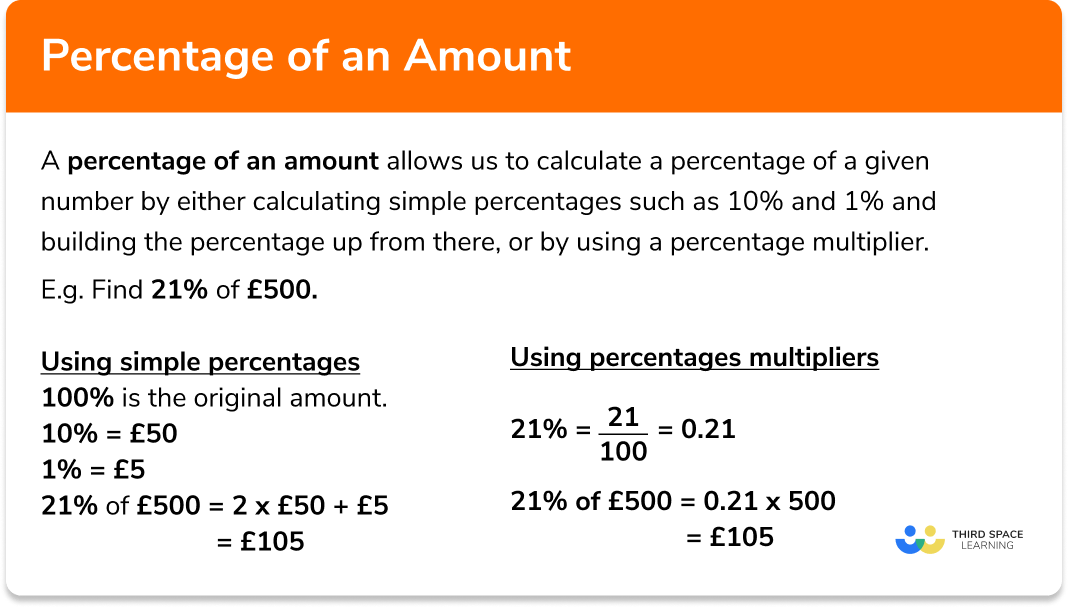
This is arguably the most common and straightforward method. It involves converting the percentage into its decimal equivalent and then multiplying it by the number you’re working with.
Steps:
- Convert the percentage to a decimal: Divide the percentage by 100. (e.g., 25% becomes 0.25; 7% becomes 0.07; 120% becomes 1.20).
- Multiply: Multiply the decimal by the number you want to find the percentage of.
Example: Calculating Sales Tax or a Discount
Let’s say you’re buying a new laptop for $1,200, and the sales tax is 8%.
- Convert 8% to a decimal: 8 ÷ 100 = 0.08.
- Multiply the decimal by the laptop price: 0.08 × $1,200 = $96.
The sales tax is $96. Your total cost would be $1,200 + $96 = $1,296.
Alternatively, if a shirt priced at $50 is on sale for 30% off:
- Convert 30% to a decimal: 30 ÷ 100 = 0.30.
- Calculate the discount amount: 0.30 × $50 = $15.
- Subtract the discount from the original price: $50 – $15 = $35.
The shirt costs $35 after the discount.
This method is robust and applicable to almost any percentage calculation in finance, from figuring out the interest on a loan payment to determining commission earnings.
Method 2: The Fractional Understanding
This method leverages common fractional equivalents of percentages for quicker mental calculations or estimations. While not every percentage has a simple fractional equivalent, many do, and recognizing them can significantly speed up financial estimations.
Common Equivalents:
- 10% = 1/10
- 20% = 1/5
- 25% = 1/4
- 50% = 1/2
- 75% = 3/4
- 33.33% ≈ 1/3
Steps:
- Identify a simple fractional equivalent: If applicable, convert the percentage to a fraction.
- Multiply: Multiply the fraction by the number.
Example: Estimating Investment Returns or Budget Allocations
Suppose you have an investment portfolio worth $10,000, and it grew by 20% this year.
- Recognize that 20% is 1/5.
- Calculate 1/5 of $10,000: (1/5) × $10,000 = $2,000.
Your portfolio grew by $2,000.
Or, if you want to allocate 25% of your $4,000 monthly income to savings:
- Recognize that 25% is 1/4.
- Calculate 1/4 of $4,000: (1/4) × $4,000 = $1,000.
You should save $1,000 per month.
This method is particularly useful for quick mental checks or when exact figures aren’t immediately necessary, allowing for rapid assessment of financial scenarios.
Method 3: Using Proportions (Finding What Percentage One Number Is of Another)
Sometimes, instead of finding a percentage of a number, you need to find what percentage one number is of another. This is essential for calculating financial ratios, budget adherence, or performance metrics.
Formula: (Part / Whole) × 100%
Steps:
- Divide the “part” by the “whole.”
- Multiply the result by 100 to express it as a percentage.
Example: Determining a Target Savings Goal or Expense Ratio
You earned $60,000 last year and saved $9,000. What percentage of your income did you save?
- Divide the part (savings) by the whole (income): $9,000 / $60,000 = 0.15.
- Multiply by 100: 0.15 × 100 = 15%.
You saved 15% of your income.
In a business context, if a product costs $20 to manufacture and sells for $50, what is the profit margin (as a percentage of the selling price)?
- First, find the profit: $50 – $20 = $30.
- Then, apply the formula (Profit / Selling Price) × 100%: ($30 / $50) × 100% = 0.60 × 100% = 60%.
The profit margin is 60%.
This proportional method is critical for financial analysis, allowing you to derive meaningful performance indicators from raw data.
Practical Applications in Personal Finance and Investing
The ability to calculate percentages unlocks a deeper understanding and greater control over your personal financial journey.
Budgeting and Expense Management
Effective budgeting is about allocating your income wisely. The 50/30/20 rule (50% for needs, 30% for wants, 20% for savings and debt repayment) is a popular example of a percentage-based budgeting strategy. If your monthly take-home pay is $4,500, you can quickly determine:
- Needs: 50% of $4,500 = 0.50 × $4,500 = $2,250
- Wants: 30% of $4,500 = 0.30 × $4,500 = $1,350
- Savings/Debt: 20% of $4,500 = 0.20 × $4,500 = $900
This allows you to categorize and track your spending against these targets, ensuring financial discipline. Similarly, understanding what percentage each expense category (e.g., groceries, entertainment, transportation) represents of your total spending helps identify areas for potential savings.
Understanding Interest Rates
Interest rates are the backbone of both debt and savings. Whether you’re paying interest on a loan or earning interest on your savings, it’s always expressed as a percentage.
- Credit Cards: A credit card with an 18% Annual Percentage Rate (APR) means you’re charged 18% of your outstanding balance annually, typically broken down monthly. If your average monthly balance is $1,000, your annual interest would be 0.18 × $1,000 = $180 (excluding compounding effects for simplicity here).
- Savings Accounts: A savings account offering a 0.5% Annual Percentage Yield (APY) means you’ll earn 0.5% of your balance over a year. On $10,000, that’s 0.005 × $10,000 = $50.
- Mortgages: Mortgage interest payments are complex due to amortization schedules, but the core calculation of the interest portion of each payment relies on a percentage of the remaining principal balance.
Mastering these calculations allows you to compare financial products, understand the true cost of borrowing, and project the growth of your savings.
Analyzing Investment Returns
For investors, percentages are indispensable for evaluating performance.
- Return on Investment (ROI): Calculated as ((Current Value – Original Cost) / Original Cost) × 100%. If you invested $1,000 in a stock that is now worth $1,200, your ROI is (($1,200 – $1,000) / $1,000) × 100% = ($200 / $1,000) × 100% = 20%.
- Portfolio Allocation: You might decide to allocate 60% of your portfolio to stocks and 40% to bonds. If your total portfolio is $50,000, that means $30,000 in stocks and $20,000 in bonds. Regular rebalancing ensures these percentages are maintained.
- Expense Ratios: Mutual funds and ETFs charge annual fees expressed as an expense ratio, typically a small percentage (e.g., 0.5%). This percentage directly reduces your returns, highlighting the importance of understanding its impact.
Navigating Sales, Discounts, and Rebates
This is perhaps the most visible application of percentages in daily life for consumers. A “25% off” sale is meaningless without the ability to calculate the exact monetary saving. Knowing how to calculate the final price after a discount, or how much you actually save, empowers smarter purchasing decisions and helps you spot genuine bargains from deceptive marketing. It’s also vital for understanding cashback rewards and other percentage-based loyalty programs.
Leveraging Percentages for Business and Income Growth
Beyond personal finance, percentages are the lifeblood of business analysis, strategic planning, and performance measurement, crucial for entrepreneurs, online income generators, and side hustlers alike.
Profit Margins and Markup
For any business, understanding profit margins is critical to sustainability and growth.
- Gross Profit Margin: (Gross Profit / Revenue) × 100%. If a product sells for $100 and costs $40 to produce, the gross profit is $60. The gross profit margin is ($60 / $100) × 100% = 60%. This tells you the profitability of your core product.
- Net Profit Margin: (Net Profit / Revenue) × 100%. This accounts for all expenses, providing a comprehensive view of a business’s overall profitability.
- Markup: Used to determine selling price from cost. If you want a 50% markup on a product that costs you $20, you calculate 50% of $20 ($10), then add it to the cost to get a selling price of $30. This ensures you cover costs and achieve desired profitability.
These percentages guide pricing strategies, cost control efforts, and overall business health assessments.
Commission Structures and Sales Performance
Many online income models, such as affiliate marketing, direct sales, or even some side hustles, operate on commission—a percentage of a sale’s value.
- If you earn a 15% commission on a $200 product sale, your earnings are 0.15 × $200 = $30.
- Sales targets are often set as percentage increases over previous periods (e.g., “increase sales by 10%”). Tracking actual performance against these percentage goals is key to evaluating success and motivating teams.
For freelancers and consultants, understanding what percentage of revenue is allocated to different operational costs (e.g., software subscriptions, marketing) versus personal take-home pay is vital for business and personal financial planning.
Tracking Business Growth and KPIs
Key Performance Indicators (KPIs) are often expressed as percentages, providing a snapshot of business health and progress.
- Website Conversion Rate: (Number of Conversions / Number of Visitors) × 100%. If 50 out of 1,000 website visitors make a purchase, your conversion rate is (50 / 1,000) × 100% = 5%. Improving this percentage is a core goal for e-commerce and online businesses.
- Customer Retention Rate: The percentage of customers a business retains over a given period.
- Market Share: Your company’s sales as a percentage of the total sales in your market.
These percentages allow businesses to set benchmarks, identify areas for improvement, and communicate performance concisely to stakeholders.
Financial Ratios and Business Valuation
More advanced business finance relies heavily on percentages through financial ratios. Ratios like debt-to-equity, current ratio, and return on assets are calculated using percentages to assess a company’s liquidity, solvency, and efficiency. Investors and analysts use these percentage-based ratios to compare companies within an industry and make informed investment decisions, forming the bedrock of equity research and business valuation.
Common Pitfalls and Advanced Considerations
While the fundamentals are straightforward, a few nuances in percentage calculations are critical for advanced financial understanding.
The Difference Between Percentage Point and Percentage Change
This is a common area of confusion, particularly in financial news.
- Percentage Point: Refers to the absolute difference between two percentages. If an interest rate increases from 5% to 7%, it’s a 2 percentage point increase.
- Percentage Change: Refers to the relative change. An increase from 5% to 7% is a ((7-5)/5) × 100% = 40% percentage increase.
Misinterpreting this difference can lead to significant misunderstandings of financial news and market movements.
Compound Interest: The Power of Percentages Over Time
Compound interest is the “interest on interest” and is where percentages truly unleash their power over time, whether for good (investments) or ill (debt). If you earn 5% interest annually, and that interest is added to your principal, the next year you earn 5% on a larger sum. This exponential growth makes percentages a critical factor in long-term financial planning, retirement savings, and understanding the true cost of long-term debt.
Using Financial Tools and Calculators
While understanding the manual calculation is paramount for intuition, for complex or repetitive tasks, leveraging financial calculators, spreadsheet software (like Excel or Google Sheets), or dedicated financial apps is efficient and accurate. These tools can automate percentage calculations, especially for scenarios like loan amortization, investment projections, and detailed budget tracking, freeing you to focus on analysis and decision-making rather than manual computation.

Conclusion
Figuring a percentage of a number is far more than a simple arithmetic task; it is a fundamental skill that underpins financial literacy across all aspects of life. From managing your household budget and evaluating investment opportunities to driving business growth and understanding economic trends, percentages provide the indispensable framework for quantitative analysis. By mastering the core methods—decimal conversion, fractional understanding, and proportional calculation—and applying them diligently to your financial decisions, you empower yourself with the clarity and foresight needed to navigate the money landscape with confidence, make informed choices, and ultimately, achieve your financial aspirations. Embrace percentages as your trusted companion on the journey to financial empowerment.
aViewFromTheCave is a participant in the Amazon Services LLC Associates Program, an affiliate advertising program designed to provide a means for sites to earn advertising fees by advertising and linking to Amazon.com. Amazon, the Amazon logo, AmazonSupply, and the AmazonSupply logo are trademarks of Amazon.com, Inc. or its affiliates. As an Amazon Associate we earn affiliate commissions from qualifying purchases.