
In a world increasingly driven by data and numbers, understanding percentages is not merely an academic exercise; it is an indispensable life skill, particularly within the realm of finance. From personal budgeting and smart shopping to savvy investing and robust business planning, percentages serve as the universal language through which financial information is communicated and understood. Ignoring their significance is akin to navigating a complex financial landscape without a map. This article will demystify percentages, providing you with a comprehensive guide to understanding, calculating, and applying them effectively across various financial scenarios, empowering you to make more informed and strategic monetary decisions.

The Fundamentals of Percentage: More Than Just a Number
At its core, a percentage is a way of expressing a number as a fraction of 100. The term “percentage” is derived from “per cent,” meaning “per hundred.” It provides a standardized way to compare parts of different wholes by converting them into a common base of 100. This standardization is incredibly powerful, allowing us to easily grasp proportions, changes, and shares without needing to know the original total figures, making it a cornerstone of financial communication.
What Exactly is a Percentage?
A percentage (%) represents a proportion or a fraction where the denominator is always 100. For instance, 25% simply means 25 out of 100, or 25/100. This simple concept allows us to express relationships clearly. Instead of saying “you saved 10 dollars on a 50-dollar item,” which requires understanding the base amount, stating “you saved 20%” immediately conveys the proportion of savings relative to the original price, regardless of the actual price. This clarity is why percentages are so pervasive in financial reports, news, and daily transactions.
The Basic Conversions: Decimals and Fractions
To effectively work with percentages, you must be able to convert them into decimals and fractions, and vice versa. These conversions are the foundational steps for any calculation involving percentages.
- Percentage to Decimal: To convert a percentage to a decimal, simply divide by 100 (or move the decimal point two places to the left).
- Example: 75% = 75 / 100 = 0.75
- Example: 5.2% = 5.2 / 100 = 0.052
- Decimal to Percentage: To convert a decimal to a percentage, multiply by 100 (or move the decimal point two places to the right and add the ‘%’ symbol).
- Example: 0.6 = 0.6 * 100 = 60%
- Example: 1.25 = 1.25 * 100 = 125%
- Percentage to Fraction: To convert a percentage to a fraction, place the percentage value over 100 and simplify if possible.
- Example: 40% = 40/100 = 2/5
- Example: 12.5% = 12.5/100 = 125/1000 = 1/8
These conversions are crucial because most percentage calculations in finance are performed using their decimal equivalents.
The Core Formula: Part / Whole x 100
At the heart of calculating a percentage lies a simple yet powerful formula. If you want to find what percentage one number (the ‘part’) is of another number (the ‘whole’), the formula is:
Percentage = (Part / Whole) * 100
Let’s illustrate with a financial example:
If you earned a profit of $200 on an investment of $1000:
Profit percentage = (200 / 1000) * 100 = 0.2 * 100 = 20%.
This fundamental formula is the bedrock for calculating everything from discounts and interest rates to profit margins and market share.
Everyday Financial Applications: Where Percentages Come Alive
Percentages are not abstract mathematical concepts confined to textbooks; they are integral to nearly every financial interaction we have, influencing our spending, saving, and investment decisions daily.
Understanding Discounts and Sales
One of the most common applications of percentages in daily life is in understanding discounts and sales. Whether it’s “25% off all electronics” or “buy one get one 50% off,” knowing how to quickly calculate these savings can significantly impact your budget.
To calculate a discount:
- Convert the percentage discount to a decimal.
- Multiply the original price by the decimal discount to find the savings amount.
- Subtract the savings amount from the original price to get the final sale price.
Example: A laptop originally priced at $800 is 15% off.
Discount amount = 0.15 * $800 = $120.
Sale price = $800 – $120 = $680.
Understanding this empowers you to verify deals and assess true value, preventing overspending on perceived bargains.
Demystifying Interest Rates (Loans, Savings, Credit Cards)
Interest rates are perhaps the most financially impactful application of percentages. They dictate how much you pay to borrow money (loans, credit cards) and how much you earn on your savings (savings accounts, investments).
- Simple Interest: Calculated only on the principal amount.
- Formula: Interest = Principal * Rate * Time (where Rate is in decimal form)
- Example: A $1,000 loan at 5% simple interest for 3 years accrues $1,000 * 0.05 * 3 = $150 in interest.
- Compound Interest: Interest calculated on the initial principal and on the accumulated interest from previous periods. This is often called “interest on interest” and is a powerful force for wealth accumulation (or debt escalation).
- Financial products often quote an Annual Percentage Rate (APR) for borrowing and Annual Percentage Yield (APY) for savings, which account for compounding effects, providing a more accurate representation of the total cost or return. Understanding these percentages is vital for choosing the right credit card, loan, or savings vehicle.
Navigating Taxes and Gratuities
Taxes and tips are two more common scenarios where percentage calculations are a daily necessity.
- Sales Tax: Added as a percentage of the purchase price.
- Example: An item costs $50, and the sales tax is 8%. Tax amount = $50 * 0.08 = $4. Total cost = $50 + $4 = $54.
- Income Tax: Calculated based on a percentage of your taxable income, often in progressive tax brackets. While complex, understanding the basic concept of tax rates as percentages is key to estimating your take-home pay.
- Gratuities (Tips): Typically a percentage of the bill total.
- Example: For a $75 restaurant bill, a 15% tip would be $75 * 0.15 = $11.25. Total payment = $75 + $11.25 = $86.25.
Proficiency here ensures you budget accurately and avoid unpleasant surprises in your spending.
Analyzing Investment Returns and Growth
For investors, percentages are the primary metric for evaluating performance.
- Return on Investment (ROI): Measures the profitability of an investment.
- Formula: ROI = ((Current Value of Investment – Original Cost) / Original Cost) * 100
- Example: You invest $10,000, and it grows to $12,000. ROI = (($12,000 – $10,000) / $10,000) * 100 = ($2,000 / $10,000) * 100 = 20%.
- Portfolio Growth: Often expressed as an annual percentage gain or loss.
- Dividend Yield: The annual dividend payment per share, expressed as a percentage of the share’s current market price.
These percentage metrics allow investors to compare different investment opportunities, track the growth of their wealth, and make informed decisions about where to allocate their capital.
Percentages in Business and Income Generation
Beyond personal finance, percentages are absolutely critical for anyone involved in business, entrepreneurship, or looking to maximize their income. They are the language of profitability, performance, and market standing.
Calculating Profit Margins and Markups
For any business, understanding profitability is paramount, and percentages provide the clearest picture.
- Gross Profit Margin: Measures how much revenue is left after accounting for the cost of goods sold (COGS).
- Formula: Gross Profit Margin = ((Revenue – COGS) / Revenue) * 100
- Example: If a product sells for $100 and costs $40 to produce, Gross Profit Margin = (($100 – $40) / $100) * 100 = 60%.
- Net Profit Margin: Represents the percentage of revenue left after all expenses (COGS, operating expenses, taxes, interest) have been deducted. It’s a key indicator of a company’s overall profitability.
- Markup: The percentage added to the cost of a product to determine its selling price.
- Formula: Markup Percentage = ((Selling Price – Cost) / Cost) * 100
These percentages are essential for setting prices, managing costs, and assessing the financial health of a business.
Commission Structures and Performance Bonuses
Many income streams are directly tied to percentages. Sales professionals, real estate agents, and financial advisors often earn a percentage of the sales they generate or the assets they manage.
- Commission: A percentage of a sale or transaction value.
- Example: A salesperson earns a 10% commission on a $5,000 sale, resulting in $500 in earnings.
- Performance Bonuses: Employees might receive a bonus calculated as a percentage of their annual salary or based on meeting certain performance targets.
Understanding how these percentages are calculated is crucial for negotiating compensation, setting income goals, and evaluating the potential earning power of various career paths or side hustles.
Understanding Market Share and Business Growth
Businesses use percentages extensively to gauge their position in the market and track their expansion.
- Market Share: The percentage of total sales in an industry generated by a particular company.
- Example: If the total market for a product is $1 billion, and Company X sells $200 million worth, its market share is 20%. This metric helps assess competitive standing.
- Growth Rates: Often expressed as a percentage increase in revenue, customer base, or profit over a specific period (e.g., “annual revenue grew by 15%”). These growth percentages are vital for investors and business owners alike, signaling expansion and potential.
Budgeting and Expense Ratios
For personal finance and business, percentages are indispensable tools for budgeting and financial analysis.
- Budgeting Allocation: Many financial advisors recommend allocating your income by percentages (e.g., the 50/30/20 rule: 50% for needs, 30% for wants, 20% for savings/debt). This method simplifies budgeting and makes it adaptable to varying income levels.
- Expense Ratios: In business, analyzing expenses as a percentage of revenue (e.g., marketing expenses are 5% of sales) helps identify areas of inefficiency or excessive spending. Similarly, investment funds have expense ratios, which are annual fees charged as a percentage of the assets managed. Lower expense ratios mean more of your money stays invested.
Common Pitfalls and Advanced Percentage Concepts
While the basics are straightforward, certain percentage concepts can be tricky, leading to common misinterpretations that can have significant financial consequences.
The Difference Between Percentage Change and Percentage Point Change
This is a frequently misunderstood distinction, particularly in financial news reporting.
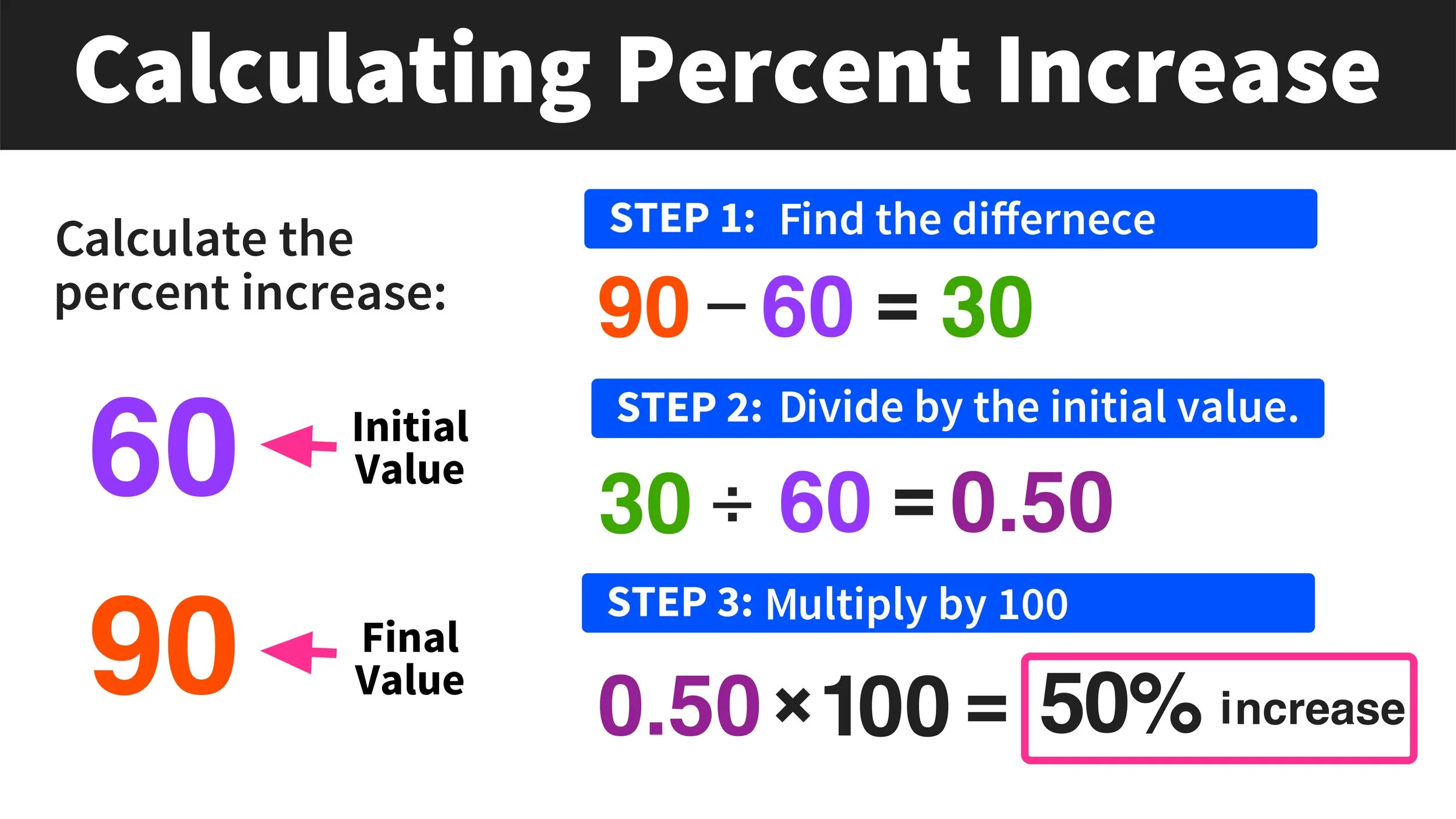
- Percentage Change: Refers to the relative change between an old value and a new value, expressed as a percentage of the old value.
- Formula: Percentage Change = ((New Value – Old Value) / Old Value) * 100
- Example: An interest rate increases from 4% to 5%. The percentage change is ((5 – 4) / 4) * 100 = (1 / 4) * 100 = 25%.
- Percentage Point Change: Refers to the absolute difference between two percentage values.
- Example: An interest rate increases from 4% to 5%. This is a 1 percentage point increase.
Confusing these two can lead to drastically different understandings of financial shifts, especially in areas like inflation, interest rates, or market volatility. A 1 percentage point increase in interest rates might sound small, but if it represents a 25% percentage change in the rate you’re paying, the impact on loan costs can be substantial.
Understanding Compounding Effects
We touched on compound interest, but the concept of compounding applies broadly. Small percentage changes, applied repeatedly over time, can lead to surprisingly large overall effects. This is the magic behind long-term investing (“the eighth wonder of the world,” according to Einstein) and the danger of persistent high-interest debt. Even a seemingly small annual percentage gain on an investment, when compounded over decades, can result in significant wealth accumulation. Conversely, a small percentage fee or interest rate on debt, compounded, can lead to a substantial financial burden.
Avoiding Misinterpretations: Context is Key
A percentage alone rarely tells the whole story. Always consider the base value from which the percentage is derived.
- Example: A 100% growth in profit sounds incredible, but if the initial profit was only $10, it’s just a $10 increase. A 5% growth on a $1 billion revenue, however, is a $50 million increase. The percentage is the same, but the absolute impact is vastly different.
- Example: A 50% chance of rain vs. a 50% chance of winning the lottery. The contexts, and therefore the implications, are entirely distinct.
Always seek to understand the ‘whole’ when interpreting a ‘part’ expressed as a percentage, especially in financial news and analysis.

Conclusion
The ability to “do percentage” is far more than a basic math skill; it is a fundamental pillar of financial literacy. From dissecting personal finances like discounts and interest rates to navigating the complexities of business profit margins, investment returns, and market dynamics, percentages provide the indispensable framework for informed decision-making. By mastering the core concepts, understanding common applications, and being aware of potential pitfalls, you equip yourself with the tools to confidently analyze financial information, optimize your spending and saving, strategically manage investments, and ultimately take greater control of your monetary future. Embrace the power of percentages, and unlock a clearer, more insightful path to financial success.
aViewFromTheCave is a participant in the Amazon Services LLC Associates Program, an affiliate advertising program designed to provide a means for sites to earn advertising fees by advertising and linking to Amazon.com. Amazon, the Amazon logo, AmazonSupply, and the AmazonSupply logo are trademarks of Amazon.com, Inc. or its affiliates. As an Amazon Associate we earn affiliate commissions from qualifying purchases.