
In the intricate world of finance, where numbers dictate opportunity, risk, and value, few concepts are as universally applied and critically important as percentages. From calculating a discount on a new purchase to understanding the annual percentage yield (APY) on your savings, or deciphering investment returns and loan interest, percentages are the silent language that underpins nearly every financial transaction and decision. Yet, for many, the mere mention of “percentages” can evoke a sense of trepidation, a relic of forgotten math classes.
This article aims to demystify percentages, transforming them from an intimidating mathematical hurdle into an accessible and powerful tool for financial empowerment. We will explore what percentages are, how to perform essential calculations, and crucially, how to apply this knowledge to navigate the complexities of personal finance, investing, business, and everyday consumer choices. Mastering percentages isn’t just about arithmetic; it’s about gaining a sharper lens through which to view, understand, and control your financial world.
The Foundation of Financial Literacy: Understanding Percentages
Before diving into the practical applications, it’s vital to establish a firm understanding of what a percentage truly represents and why it holds such a pivotal position in the financial landscape.
What Exactly is a Percentage?
At its core, a percentage is simply a way of expressing a number or a ratio as a fraction of 100. The term “percent” comes from the Latin “per centum,” meaning “by the hundred.” When you see a percentage, say 25%, it means 25 out of 100, or 25/100, which can also be written as the decimal 0.25. It’s a standardized way to compare parts to a whole, making different quantities or values easily comparable regardless of their original scale.
This standardization is incredibly powerful. Instead of saying you saved $10 out of $500, and your friend saved $5 out of $100, expressing these as percentages (2% and 5% respectively) immediately clarifies who saved a larger proportion of their income. This consistent “out of 100” framework is why percentages are so pervasive and indispensable.
Why Percentages are Indispensable in Finance
In the realm of money, percentages provide context, allow for meaningful comparisons, and simplify complex financial data. Without them, understanding financial health, growth, or cost would be significantly more challenging.
- Standardization: They allow for a universal comparison across different scales. A 7% return on a $1,000 investment can be directly compared to a 7% return on a $100,000 investment.
- Clarity in Change: They clearly illustrate changes over time, whether it’s a 3% inflation rate, a 10% increase in stock value, or a 5% reduction in expenses.
- Decision Making: From evaluating mortgage rates to comparing investment opportunities or understanding sales discounts, percentages inform critical financial decisions.
- Performance Metrics: Businesses use percentages for profit margins, growth rates, market share, and conversion rates, providing crucial insights into performance.
- Transparency: They are used in disclosures for interest rates (APR), fees, and financial product specifications, aiming to provide consumers with clear, comparable information.
In essence, percentages translate raw numbers into actionable insights, empowering individuals and businesses to make informed financial choices.
Essential Percentage Calculations for Everyday Money Management
Mastering a few fundamental percentage calculations will equip you to tackle most financial scenarios with confidence. Let’s break down the core operations.
Calculating a Percentage of a Number (Discounts, Taxes, Tips)
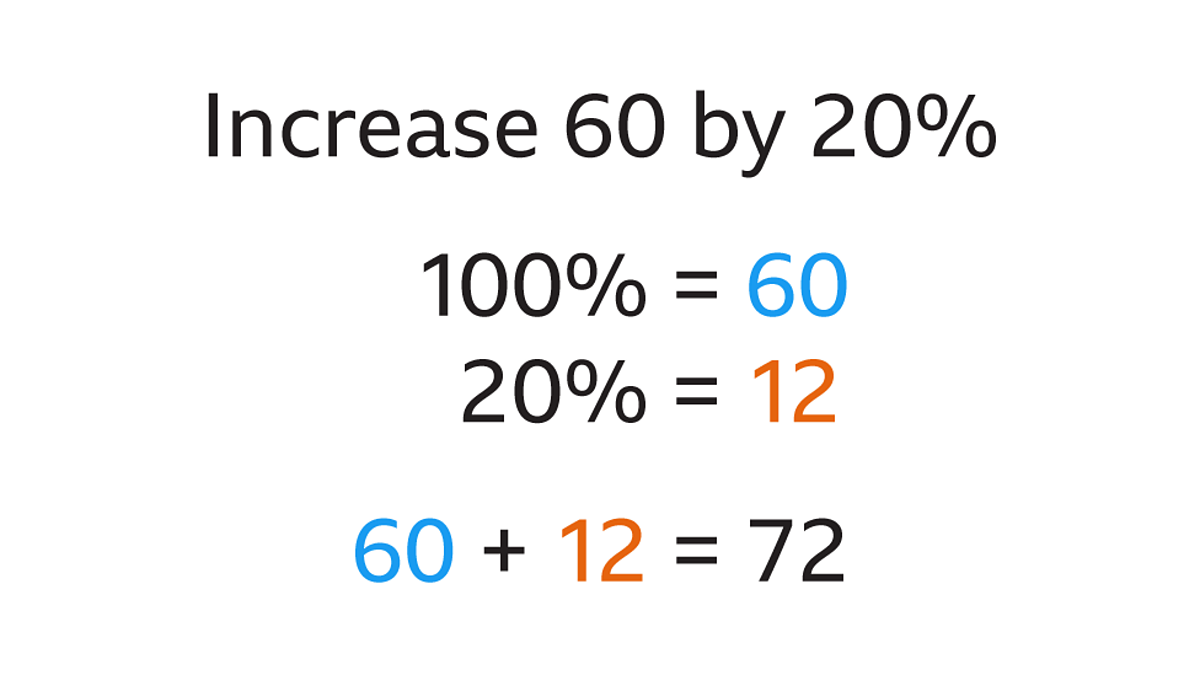
This is perhaps the most common percentage calculation you’ll encounter. Whether it’s a sales discount, calculating sales tax, or figuring out a tip, the process is the same: convert the percentage to a decimal and multiply by the number.
Formula: Percentage (as decimal) × Whole Number = Part
Example 1 (Discount): A shirt costs $50, and there’s a 20% discount.
- Convert 20% to a decimal: 20 / 100 = 0.20
- Calculate the discount amount: 0.20 × $50 = $10
- Final price: $50 – $10 = $40
Example 2 (Sales Tax): You buy an item for $100, and the sales tax is 8%.
- Convert 8% to a decimal: 8 / 100 = 0.08
- Calculate the tax amount: 0.08 × $100 = $8
- Total cost: $100 + $8 = $108
Expressing a Part as a Percentage of a Whole (Budget Allocation, Portfolio Mix)
This calculation helps you understand the proportion a smaller value represents within a larger total. It’s invaluable for analyzing budgets, understanding asset allocation, or determining market share.
Formula: (Part / Whole) × 100 = Percentage
Example 1 (Budget Allocation): You spend $300 on groceries from a monthly income of $2,500. What percentage of your income goes to groceries?
- Divide the part by the whole: $300 / $2,500 = 0.12
- Multiply by 100 to get the percentage: 0.12 × 100 = 12%
- So, 12% of your income goes to groceries.
Example 2 (Portfolio Mix): Your investment portfolio is worth $10,000, and $3,500 of that is in tech stocks. What percentage of your portfolio is in tech stocks?
- $3,500 / $10,000 = 0.35
- 0.35 × 100 = 35%
- 35% of your portfolio is in tech stocks.
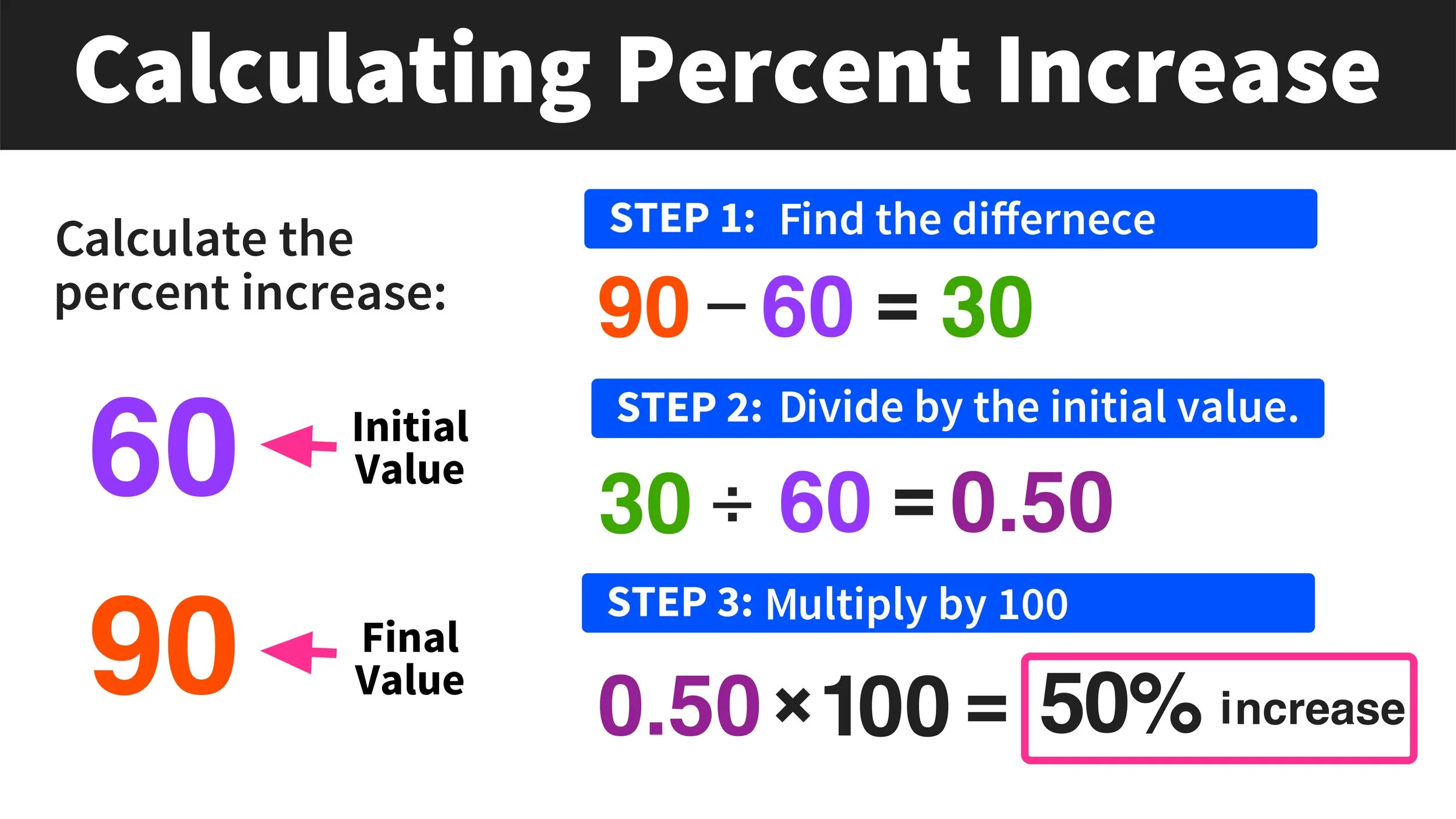
Navigating Percentage Increases and Decreases (Investment Growth, Inflation)
Understanding percentage changes is crucial for tracking financial performance, such as investment growth, inflation rates, or salary adjustments.

Formula for Percentage Change: ((New Value - Old Value) / Old Value) × 100 = Percentage Change
Example 1 (Investment Growth): Your stock was worth $120 last year and is now worth $135. What is the percentage increase?
- Change in value: $135 – $120 = $15
- Divide by the old value: $15 / $120 = 0.125
- Multiply by 100: 0.125 × 100 = 12.5% increase
Example 2 (Value Decrease): A car purchased for $30,000 is now valued at $27,000. What is the percentage decrease?
- Change in value: $27,000 – $30,000 = -$3,000
- Divide by the old value: -$3,000 / $30,000 = -0.10
- Multiply by 100: -0.10 × 100 = -10% decrease (or a 10% depreciation)
Unlocking the Original Value: Reverse Percentages
Sometimes you know the final value after a percentage change and need to find the original value. This is particularly useful when dealing with prices that include tax or have been discounted, and you want to find the pre-tax or original price.
Formula:
- After a percentage increase:
Original Value = New Value / (1 + Percentage Increase as decimal) - After a percentage decrease:
Original Value = New Value / (1 - Percentage Decrease as decimal)
Example 1 (Finding Original Price Before Tax): An item costs $108 including 8% sales tax. What was the price before tax?
- Tax percentage as decimal: 0.08
- Original Value = $108 / (1 + 0.08) = $108 / 1.08 = $100
- The price before tax was $100.
Example 2 (Finding Original Price Before Discount): You bought an item for $40 after a 20% discount. What was the original price?
- Discount percentage as decimal: 0.20
- Original Value = $40 / (1 – 0.20) = $40 / 0.80 = $50
- The original price was $50.
Percentages in Action: Key Financial Applications
With the basic calculations under your belt, let’s explore how percentages are dynamically applied across various facets of personal and business finance, profoundly impacting decisions and outcomes.
Personal Finance & Budgeting: Optimizing Your Cash Flow
Percentages are the backbone of effective personal finance.
- Budgeting Rules: The 50/30/20 rule (50% needs, 30% wants, 20% savings/debt repayment) is a prime example of using percentages to allocate income.
- Savings Rates: Setting a goal to save 10% or 15% of each paycheck helps ensure consistent wealth accumulation.
- Debt-to-Income Ratio: Lenders use this percentage to assess your ability to manage monthly payments and repay debts, heavily influencing loan approvals.
- Expense Analysis: Understanding that 25% of your discretionary spending goes to dining out can prompt adjustments.
Investing & Wealth Building: Decoding Returns and Risk
For investors, percentages are indispensable for evaluating opportunities and managing risk.
- Return on Investment (ROI): Measures the profitability of an investment, expressed as a percentage of the initial cost.
- Compound Interest: The concept of “interest on interest” is fundamentally a percentage calculation, demonstrating exponential growth over time.
- Portfolio Allocation: Deciding to put 60% of your portfolio in stocks, 30% in bonds, and 10% in cash is a percentage-based strategy for diversification.
- Market Fluctuations: Daily news reports on stock market performance are almost always expressed as percentage changes (e.g., “The S&P 500 gained 1.2% today”).
Loans, Debt & Credit: Understanding the True Cost
When borrowing money, percentages reveal the actual cost.
- Annual Percentage Rate (APR): The yearly rate of interest charged on loans, credit cards, and mortgages. It allows for direct comparison between different lending products.
- Interest Payments: Every loan payment involves calculating a percentage of the outstanding principal.
- Credit Utilization Ratio: A key factor in credit scores, this is the percentage of your total available credit that you are currently using. Keeping it low (e.g., below 30%) is generally recommended.
Business Finance & Entrepreneurship: Driving Profit and Growth
For businesses, percentages are vital metrics for performance, strategy, and profitability.
- Profit Margins: Gross profit margin, operating profit margin, and net profit margin are crucial percentages that indicate a company’s profitability.
- Revenue Growth Rate: Shows how much a company’s revenue has increased over a period, a key indicator for investors.
- Market Share: The percentage of total sales in an industry generated by a particular company.
- Sales Commissions: Often calculated as a percentage of sales revenue, motivating sales teams.
- Operating Expenses: Expressing expenses as a percentage of revenue helps manage costs efficiently.
Mastering Percentages with Tools and Best Practices
While the calculations are straightforward, accuracy and understanding the context are key to truly mastering percentages for financial gain.
Leveraging Calculators and Spreadsheets for Accuracy
In today’s digital age, manual calculations are rarely necessary.
- Basic Calculators: Most modern calculators have a “%” button, simplifying common operations. Understanding how it works for your specific calculator is useful.
- Smartphone Apps: Numerous financial calculator apps can handle complex percentage-based scenarios like loan amortization or investment growth.
- Spreadsheets (Excel, Google Sheets): These are powerful tools for financial analysis. They allow you to set up formulas once and apply them across large datasets, minimizing errors and enabling complex modeling (e.g., calculating compound interest over decades, building detailed budgets). Learning basic percentage functions in a spreadsheet is a highly valuable skill.
Common Pitfalls to Avoid in Percentage Calculations
Even simple percentage calculations can lead to errors if care is not taken.
- Decimal Conversion: The most frequent mistake is forgetting to convert percentages to decimals (e.g., using 20 instead of 0.20 when multiplying).
- Base Value Confusion: When calculating percentage change, always ensure you’re dividing by the original or old value, not the new one.
- Percentage Points vs. Percent Change: A subtle but important distinction. If an interest rate goes from 5% to 7%, that’s a 2 percentage point increase, but a 40% percentage increase ((7-5)/5 * 100).
- Compounding Errors: Be mindful when percentages apply over multiple periods or to subsequent calculations. A 10% increase followed by a 10% decrease does not return you to the original value (e.g., $100 + 10% = $110; $110 – 10% = $99).
Developing a Percentage Mindset for Smarter Financial Decisions
Beyond the mechanics, cultivating a “percentage mindset” is what truly unlocks financial acumen.
- Question Everything: When presented with a financial figure, ask: “What percentage is that of the total?” or “What’s the percentage change?” This contextualizes information.
- Compare Proportions: Instead of just looking at absolute numbers, focus on proportions. Is saving $50 a month good? It is if it’s 20% of your income; less so if it’s 1%.
- Estimate and Verify: Before using a calculator, try to estimate the percentage to gauge the reasonableness of the actual answer. This helps catch gross errors.
- Long-Term Perspective: Understand how small percentage changes (like interest rates or inflation) can have massive cumulative impacts over years.
In conclusion, “how to do a percentage” isn’t merely a mathematical exercise; it’s a critical component of financial fluency. By understanding what percentages represent, mastering the core calculations, and applying this knowledge across personal finance, investing, and business, you gain unparalleled clarity and control over your financial destiny. Embracing the power of percentages means making smarter choices, mitigating risks, and ultimately, building a more secure and prosperous future.
aViewFromTheCave is a participant in the Amazon Services LLC Associates Program, an affiliate advertising program designed to provide a means for sites to earn advertising fees by advertising and linking to Amazon.com. Amazon, the Amazon logo, AmazonSupply, and the AmazonSupply logo are trademarks of Amazon.com, Inc. or its affiliates. As an Amazon Associate we earn affiliate commissions from qualifying purchases.