
In the dynamic world of personal and business finance, understanding change is paramount. Whether you’re tracking your investment portfolio, analyzing a company’s sales figures, or meticulously managing your monthly budget, the ability to quantify shifts – especially downward ones – provides crucial insights. Percentage decrease is a fundamental financial metric that allows us to express a reduction in a value relative to its original amount. It’s not just a mathematical concept; it’s a powerful analytical tool that helps individuals and organizations make informed decisions, identify trends, and strategize for future financial health.
Ignoring the subtle or significant signals a percentage decrease can offer is akin to navigating a financial landscape blindfolded. A drop in market value, a dip in sales, or a reduction in income, when framed as a percentage, gains context and allows for direct comparison across different scales. This article will demystify the process of calculating percentage decrease, illustrate its diverse applications across personal and business finance, and reveal how leveraging this metric can empower you to achieve greater financial clarity and control.
The Core Formula: Understanding the Basics
At its heart, calculating a percentage decrease is a straightforward process, yet its simplicity belies its immense utility in financial analysis. Grasping the underlying formula is the first step towards effectively applying this tool to your financial scenarios.
Defining Key Terms
Before diving into the calculation, let’s establish the key components:
- Original Value (Initial Value): This is the starting point, the baseline figure before any reduction occurred. In finance, this could be your initial investment, last quarter’s revenue, or your previous month’s expenditure.
- New Value (Final Value): This is the value after the decrease has taken place. It represents the updated figure following a financial event or period.
- Decrease (Amount of Change): This is the absolute difference between the original value and the new value. It tells you how much the value has gone down in absolute terms.
- Percentage Decrease: This expresses the decrease as a proportion of the original value, presented as a percentage. It provides a standardized way to measure the relative impact of the reduction.
Step-by-Step Calculation
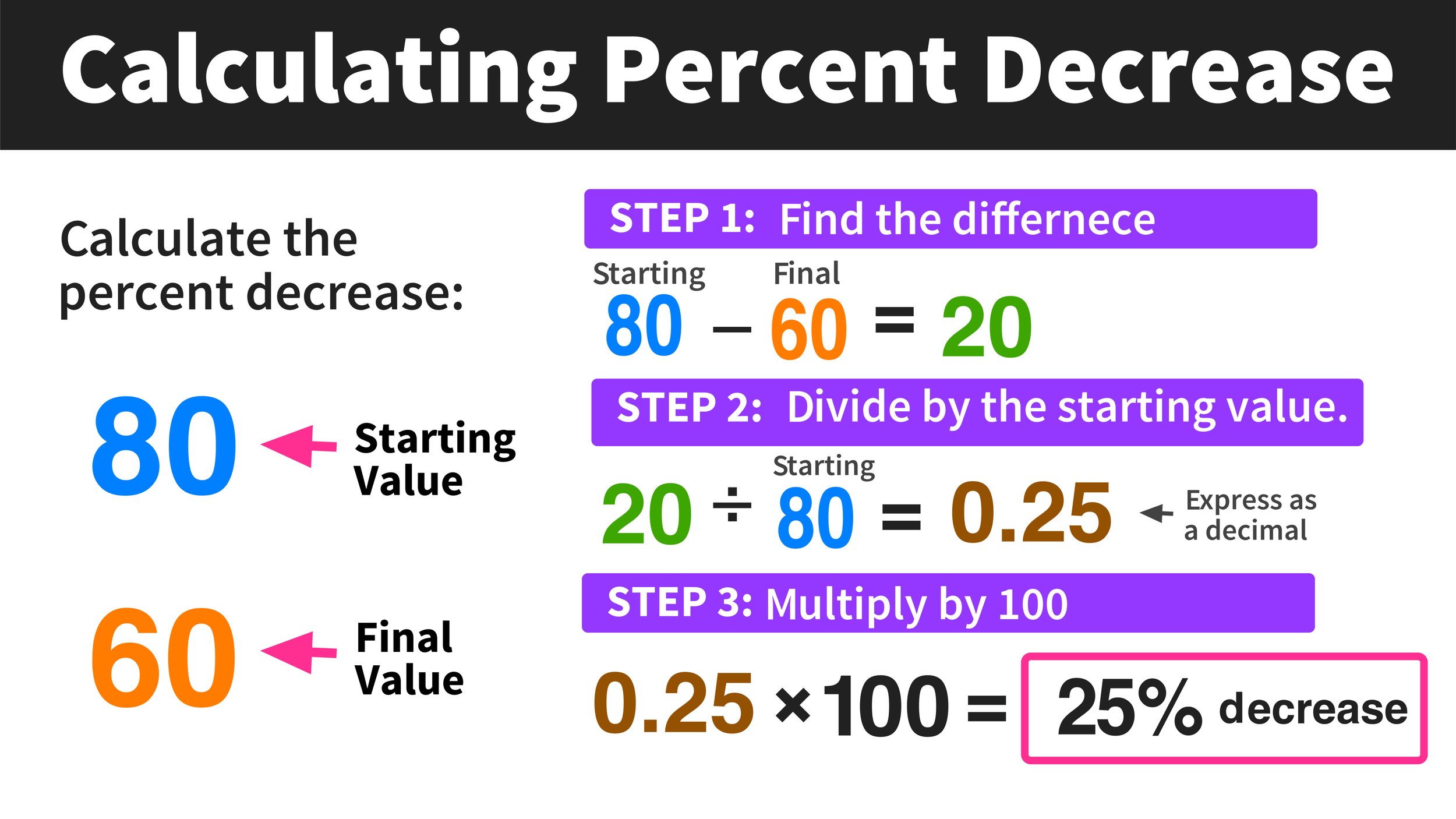
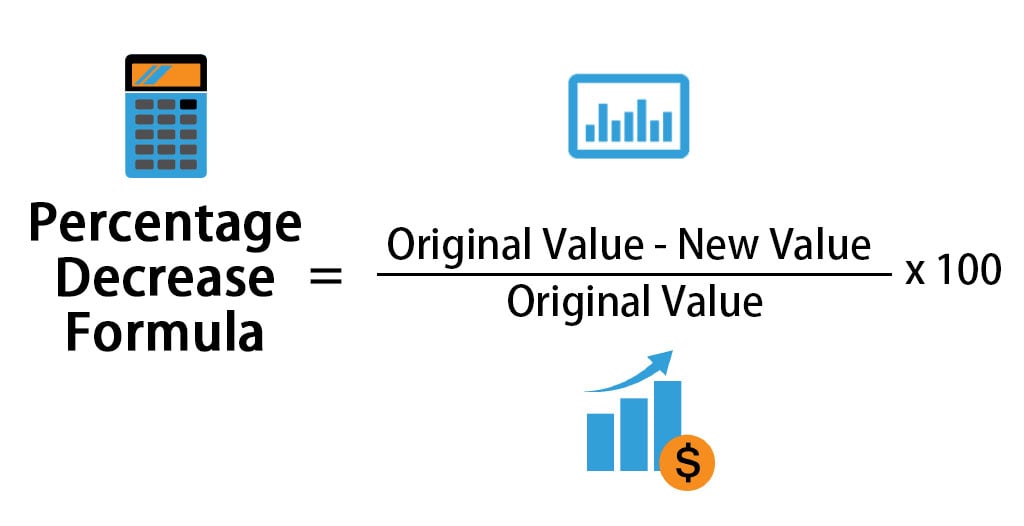
The formula for percentage decrease is elegant and efficient:
Percentage Decrease = [(Original Value – New Value) / Original Value] * 100%
Let’s walk through an example relevant to personal finance:
Imagine you purchased shares of a company for $50 per share. Due to market fluctuations, the price of these shares drops to $45 per share.
- Identify the Original Value: $50
- Identify the New Value: $45
- Calculate the Decrease (Original Value – New Value): $50 – $45 = $5
- Divide the Decrease by the Original Value: $5 / $50 = 0.1
- Multiply by 100 to express as a percentage: 0.1 * 100% = 10%
Therefore, the share price experienced a 10% decrease. This simple calculation provides a much clearer picture of the magnitude of the loss compared to just knowing the $5 absolute drop.
Common Pitfalls and How to Avoid Them
While the formula is simple, certain errors can lead to incorrect results and skewed financial interpretations:
- Confusing Original and New Values: Always ensure the original value is the denominator. Swapping them will result in an incorrect calculation, potentially showing a gain instead of a loss, or vice-versa.
- Forgetting to Multiply by 100: The intermediate step (e.g., 0.1 in our example) is a decimal fraction. To express it as a percentage, you must multiply by 100. Forgetting this step will yield an incorrect scale for your analysis.
- Rounding Errors: When dealing with complex financial data, be mindful of rounding. Round too early, and your final percentage might be inaccurate. It’s often best to carry more decimal places through the calculation and round only the final percentage to a reasonable number of decimal points (e.g., two decimal places for currency percentages).
- Lack of Context: A percentage decrease, while informative, should always be interpreted within its broader financial context. A 1% decrease in a multi-billion-dollar fund is a significant amount, whereas a 10% decrease in a $100 personal expense might be less impactful. Understand the scale of the original value.
Practical Applications in Personal Finance
For individuals, understanding percentage decrease is not just an academic exercise; it’s a vital skill for managing personal wealth, budgeting effectively, and achieving financial goals. It empowers you to objectively assess your financial standing and react proactively.
Tracking Investment Performance
One of the most immediate applications of percentage decrease is in monitoring your investments. The stock market is inherently volatile, and understanding the extent of downturns is crucial for managing risk and making informed buy/sell decisions.
- Portfolio Value: If your investment portfolio drops from $100,000 to $92,000, calculating the 8% decrease immediately quantifies the impact of market corrections or individual asset underperformance. This allows you to compare the loss against benchmarks or your personal risk tolerance.
- Individual Stock/Fund Performance: An individual stock might drop from $75 to $60. The 20% decrease highlights a more significant proportional loss than just the $15 absolute drop, helping you decide whether to hold, sell, or average down.
- Cryptocurrency Fluctuations: Given the extreme volatility of cryptocurrencies, a token dropping from $1,000 to $700 represents a 30% decrease, which is critical information for traders and long-term holders alike.
Analyzing Budget Fluctuations
Budgeting is about managing income and expenses. Percentage decrease can signal positive trends (reduced expenses) or potential issues (reduced income).
- Expense Reduction: You might actively try to cut down on discretionary spending. If your entertainment budget decreased from $300 to $210, you’ve achieved a 30% reduction, a clear indicator of successful budgeting efforts.
- Income Reduction: A decrease in your side hustle income from $800 to $650 (a 18.75% decrease) might prompt you to explore new opportunities or adjust your overall financial plan to compensate for the shortfall.
- Debt Reduction: While typically you’d celebrate a decrease in the amount owed, you might also look at how much your interest rate decreased (if variable) or how much your monthly payment decreased due to refinancing or principal payments. A loan balance decreasing from $20,000 to $18,000 signifies a 10% reduction in principal, a tangible sign of progress towards becoming debt-free.
Evaluating Debt Reduction Progress
Beyond just tracking the outstanding balance, percentage decrease can be a powerful motivator in debt management. Seeing a 5% or 10% decrease in your total debt load provides concrete evidence that your strategies are working. This applies to credit card balances, personal loans, or even mortgages, making the often-long journey of debt repayment feel more manageable and rewarding.
Business Finance and Strategic Insights
In the corporate world, percentage decrease is an indispensable tool for financial analysts, business owners, and managers. It provides the lens through which performance is evaluated, strategic adjustments are made, and future growth is planned.
Monitoring Sales and Revenue Trends
A decrease in sales or revenue is often the first red flag indicating underlying business challenges. Percentage decrease quantifies this alarm, allowing for prompt investigation and remedial action.
- Quarterly Sales Reports: If a company’s revenue falls from $1 million in Q1 to $900,000 in Q2, that 10% decrease is a significant metric that demands attention. Is it seasonal? Is it due to market competition? A product recall?
- Customer Churn: While not a direct decrease in a financial value, understanding the percentage decrease in your active customer base can directly correlate to future revenue decreases. If your active subscriber base decreases by 5% over a period, it’s a critical indicator of customer dissatisfaction or competitive pressures.
- Product Line Performance: Analyzing a specific product’s sales decrease by 15% might trigger a review of its marketing strategy, pricing, or even lead to its discontinuation if the trend is irreversible.
Assessing Cost Reductions and Efficiency
Not all percentage decreases are negative. A decrease in operating costs or production expenses is often a highly desirable outcome, reflecting improved efficiency and profitability.
- Manufacturing Costs: If new automation reduces the cost to produce a unit from $10 to $8, that’s a 20% cost reduction, directly boosting profit margins.
- Overhead Expenses: Successfully negotiating lower rents or finding more economical suppliers, leading to a 5% decrease in administrative expenses, directly contributes to the bottom line.
- Employee Turnover: A decrease in the percentage of employee turnover can lead to significant cost savings in recruitment and training, positively impacting operational efficiency.
Impact on Profitability and Margins
Ultimately, many business decisions aim to enhance profitability. Percentage decrease plays a crucial role in understanding how various factors affect profit margins.
- Gross Profit Margin: If the gross profit margin decreases from 40% to 35% (a decrease of 5 percentage points, but also a relative decrease of (0.40-0.35)/0.40 = 12.5% in the margin itself), it signals that either revenue has fallen faster than costs, or costs have risen faster than revenue.
- Net Income: A decrease in net income from one period to another, expressed as a percentage, provides a clear picture of the company’s overall financial health and operational effectiveness. For example, a 25% decrease in net income indicates a substantial impact on shareholder value.
Leveraging Percentage Decrease for Better Decision-Making
Beyond the raw calculation, the true power of percentage decrease lies in its ability to inform and guide strategic financial decisions, whether personal or corporate.
Identifying Areas for Improvement
Consistently observing undesirable percentage decreases (e.g., in income, sales, or investment value) acts as an alert system. It prompts you to:
- Personal Finance: Review your spending habits, seek additional income streams, or re-evaluate your investment strategy if specific areas are consistently underperforming.
- Business Finance: Investigate declining sales channels, identify inefficient processes leading to increased costs, or reassess pricing strategies in response to market share decreases.
Setting Realistic Financial Goals
Understanding past financial fluctuations, particularly decreases, allows for more grounded and achievable goal setting.
- Investment Goals: If your portfolio has historically experienced a 15% decrease during market corrections, you can factor this into your financial planning, ensuring you have adequate emergency funds or a diversified portfolio to mitigate future risks.
- Budgeting Goals: Knowing that a specific expense category tends to decrease by X% during certain months helps you allocate funds more precisely and set realistic saving targets.
- Business Growth Projections: Analyzing historical decreases during economic downturns enables businesses to build more resilient financial models and set conservative yet ambitious growth targets.

Communicating Financial Changes Effectively
Percentage decrease is a universal language in finance, providing clarity and context when discussing financial performance.
- Reporting to Stakeholders: Presenting a “10% decrease in operating costs” is far more impactful and easier to understand than merely stating a dollar amount, as it provides a proportional measure of the efficiency gains.
- Internal Discussions: When addressing employees about a revenue downturn, explaining a “15% decrease in quarterly sales” provides a tangible metric for everyone to understand the challenge and rally towards solutions.
- Personal Financial Reviews: When discussing your financial health with an advisor or family members, stating that your “debt load decreased by 20% this year” clearly articulates your progress and commitment.
In conclusion, the ability to accurately determine and interpret percentage decrease is an indispensable skill in any financial toolkit. From managing your household budget and navigating investment markets to steering a multi-million-dollar enterprise, this simple calculation offers profound insights into financial performance. It transforms raw numbers into actionable intelligence, empowering you to identify challenges, celebrate successes, set achievable goals, and ultimately make smarter, more confident financial decisions. Embrace the power of percentage decrease, and unlock a deeper understanding of your financial world.
aViewFromTheCave is a participant in the Amazon Services LLC Associates Program, an affiliate advertising program designed to provide a means for sites to earn advertising fees by advertising and linking to Amazon.com. Amazon, the Amazon logo, AmazonSupply, and the AmazonSupply logo are trademarks of Amazon.com, Inc. or its affiliates. As an Amazon Associate we earn affiliate commissions from qualifying purchases.