
In the rapidly evolving landscape of personal finance, the ability to move capital seamlessly between physical and digital realms is no longer a luxury—it is a necessity. Cash App, developed by Block, Inc., has transcended its original purpose as a simple peer-to-peer (P2P) payment service to become a robust financial tool. For many, it serves as a primary transaction account, a gateway to equity investing, and even a platform for cryptocurrency management.
However, the utility of any financial tool is predicated on your ability to fund it. Understanding how to deposit money on Cash App efficiently is the foundational step in mastering this digital ecosystem. Whether you are transitioning from traditional banking, managing physical currency, or optimizing your paycheck delivery, this guide provides a professional deep dive into the various methodologies of funding your Cash App balance.
The Digital Pipeline: Linking Traditional Banking Infrastructure
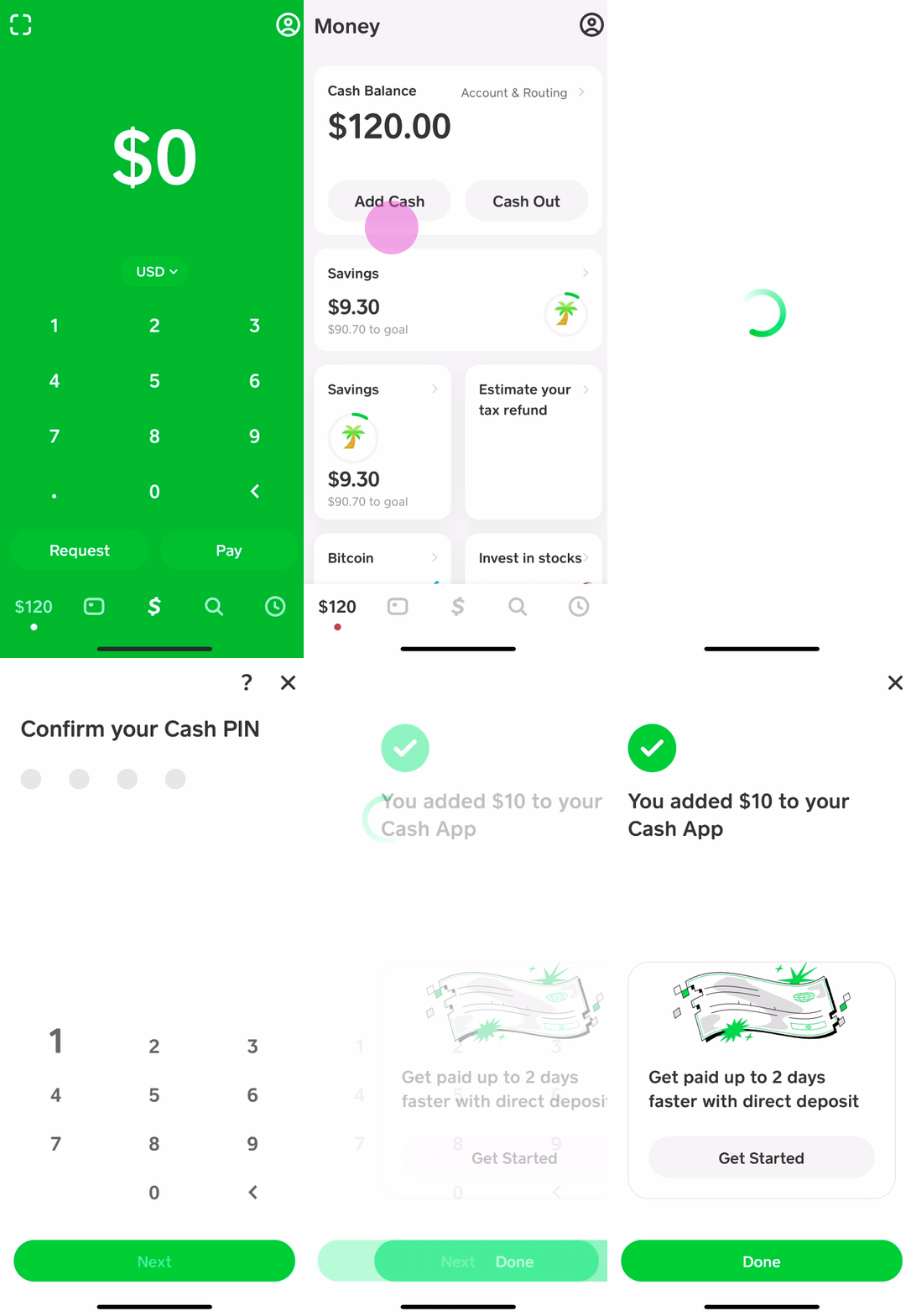
The most common and streamlined method for depositing funds into Cash App is through the integration of existing traditional financial accounts. This creates a “digital bridge,” allowing for the fluid movement of capital from legacy institutions to your mobile wallet.
Connecting Your Debit Card and Bank Account
To initiate a transfer, you must first establish a link. Cash App utilizes encrypted protocols to connect to your bank, typically requiring a debit card for “Instant” transfers or a linked bank account via Plaid for standard movements.
- The Linking Process: Within the app, navigate to the “Banking” or “Money” tab. By selecting “Link Bank,” you will be prompted to enter your debit card information.
- Standard vs. Instant Deposits: When you pull money from a linked bank account into Cash App, it is usually treated as an “Add Cash” transaction. While transferring out of Cash App can incur fees for speed, depositing money into the app from your bank is typically free and occurs within seconds or up to three business days depending on the underlying ACH network speed.
Managing Multiple Funding Sources
From a personal finance strategy perspective, it is wise to understand the hierarchy of your funding sources. While you can link a credit card to Cash App, it is important to note that sending money via credit card often incurs a 3% processing fee. For those looking to maximize their “Money” management efficiency, sticking to debit cards or direct bank transfers is the most cost-effective way to maintain liquidity without eroding your principal through service charges.
Bridging the Physical-Digital Divide: Paper Money Deposits
One of the most innovative features of Cash App is its ability to serve the “underbanked” or those who deal frequently in physical currency. The “Paper Money” deposit feature allows users to convert physical bills into digital balances at thousands of retail locations across the United States.
Navigating the Retail Deposit Network
Cash App has partnered with major national retailers—including Walgreens, 7-Eleven, Walmart, and Family Dollar—to act as physical deposit points. This turns a neighborhood convenience store into a functional teller window.
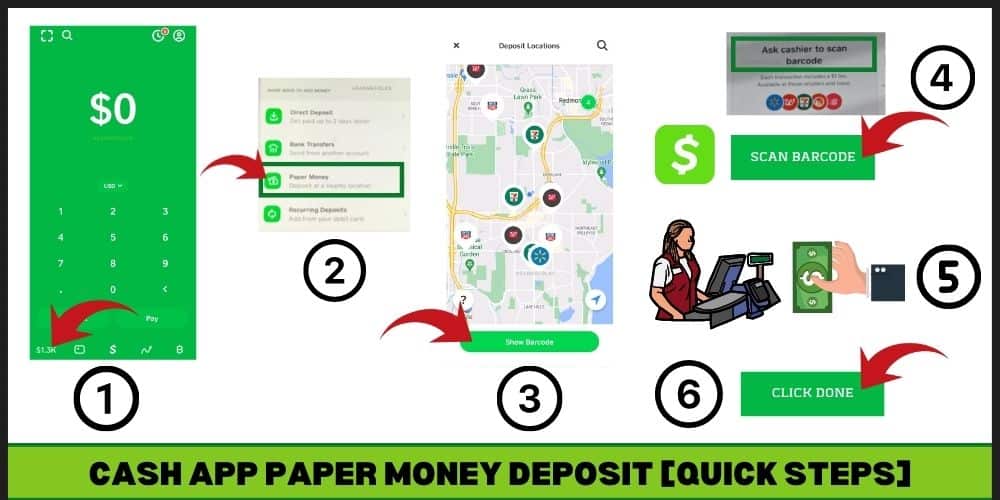
- Locating a Deposit Point: Users can open the “Money” tab and select “Paper Money.” This launches an interactive map showing nearby participating merchants.
- The Barcode System: Once at the location, you generate a unique barcode within the app. The cashier scans this code, takes your physical cash, and the transaction is processed.
Fees, Limits, and Financial Considerations
While convenient, paper money deposits come with specific parameters that a savvy financial manager must account for. Most retailers charge a nominal fee (standardly $1) per transaction for this service. Furthermore, there are institutional limits—typically $500 per transaction, $1,000 per seven days, and $4,000 per 30 days. For those utilizing Cash App as a primary business tool or a side-hustle repository, tracking these limits is essential for maintaining consistent cash flow.
Optimizing Income Streams: Direct Deposit and P2P Inflows
For many users, “depositing” money isn’t just about moving existing savings; it’s about capturing new income. Cash App functions similarly to a traditional bank account by providing users with dedicated routing and account numbers.
Setting Up Direct Deposit for Paychecks
By utilizing the provided routing and account numbers (offered through Cash App’s partner banks, such as Lincoln Savings Bank or Wells Fargo), you can have your employer deposit your salary directly into the app.
- Speed of Access: One of the primary financial advantages of using Cash App for direct deposit is the “Early Payday” feature. Many users find they can access their funds up to two days earlier than they would with a traditional brick-and-mortar bank.
- Tax Refunds and Government Benefits: This infrastructure also supports federal and state tax refunds, as well as Social Security benefits, consolidating your financial inflows into a single, manageable interface.
Leveraging Peer-to-Peer (P2P) Transfers
The most organic way money enters a Cash App balance is through P2P transfers. From a personal finance standpoint, this is the most liquid form of “deposit.” When a friend or client sends you a payment via your $Cashtag, those funds are available immediately. To optimize this, users should ensure their “Cash PIN” and security settings are robust, as P2P transfers are often instantaneous and irreversible, making them a high-velocity component of your digital wallet.
Security Protocols and Asset Protection
Depositing money is only half the battle; ensuring that capital remains secure is the hallmark of sound financial management. As you increase the balance of your Cash App account, you must treat it with the same rigor as a traditional brokerage or savings account.
Implementing Multi-Factor Authentication (MFA)
In the digital finance world, your phone is the vault. Cash App offers several layers of security to protect your deposits:
- Security Locks: Enable the “Security Lock” feature, which requires your Touch ID, Face ID, or PIN for every payment.
- Notification Alerts: Set up push notifications or text alerts for every transaction. This provides a real-time audit trail of every dollar entering or leaving your account.
Understanding FDIC Insurance and Account Safety
A common question in the “Money” niche is whether digital wallets are safe. Deposits in Cash App that are tied to a Cash Card are generally covered by FDIC insurance through partner banks up to $250,000. However, this insurance typically applies to the funds held in the account, not necessarily to funds lost through scams or unauthorized P2P transfers.
To maintain financial integrity, users should:
- Only deposit money intended for short-term liquidity or specific investments (like Bitcoin or Stocks offered within the app).
- Avoid “flipping” schemes or unverified “Cash App Giveaways” that solicit deposits.
- Regularly reconcile their Cash App balance with their external bank statements to ensure no discrepancies exist in the “Add Cash” history.

Strategic Summary: Integrating Cash App into Your Financial Life
Mastering the art of depositing money into Cash App is about more than just clicking a button; it is about choosing the right movement of capital for your specific needs.
- For the Budgeter: Linking a debit card allows for precise, real-time transfers to cover daily expenses.
- For the Cash-Heavy Worker: The Paper Money feature provides a vital link to the digital economy.
- For the Modern Professional: Direct deposit turns a payment app into a comprehensive financial hub.
By understanding the fees, limits, and security measures associated with each deposit method, you can leverage Cash App as a powerful tool in your personal finance arsenal. Whether you are funding a small investment in the S&P 500 through the app’s fractional share feature or simply preparing to split a dinner bill, your ability to move money efficiently is the key to financial agility in the 21st century.
Ultimately, the best deposit strategy is one that minimizes costs (avoiding credit card fees and excessive retail charges) while maximizing speed and security. As digital finance continues to merge with traditional banking, staying informed on these procedural nuances ensures that your capital is always exactly where you need it, when you need it.
aViewFromTheCave is a participant in the Amazon Services LLC Associates Program, an affiliate advertising program designed to provide a means for sites to earn advertising fees by advertising and linking to Amazon.com. Amazon, the Amazon logo, AmazonSupply, and the AmazonSupply logo are trademarks of Amazon.com, Inc. or its affiliates. As an Amazon Associate we earn affiliate commissions from qualifying purchases.