
In a world increasingly reliant on precision and efficiency, the seemingly simple task of converting numbers from one format to another can present surprising complexities. While decimals offer a straightforward way to express fractions of whole numbers, their fractional counterparts—fractions—often provide a more exact and sometimes more intuitive representation, especially in fields like engineering, carpentry, cooking, and even advanced mathematics. The ability to seamlessly transition between these two numerical expressions is not just a mathematical curiosity; it’s a practical necessity that underpins accuracy and clarity across countless disciplines.
Enter the decimal to fraction calculator. Far more than a mere digital toy, this specialized tool serves as a bridge between the decimal system’s base-10 convenience and the fractional system’s inherent precision. For anyone who has ever grappled with converting a repeating decimal into its simplest fractional form or struggled to find the greatest common divisor for a complex fraction, the value of such a calculator becomes immediately apparent. It demystifies a process that can be tedious and error-prone, offering instant, accurate results and empowering users to focus on the broader problem at hand rather than the mechanics of conversion. This article delves into the world of decimal to fraction calculators, exploring their underlying principles, practical applications, and why they have become an indispensable part of our digital toolkit in an ever-evolving technological landscape.

Understanding Decimals and Fractions: A Foundational Perspective
Before we delve into the mechanics and utility of a decimal to fraction calculator, it’s crucial to grasp the fundamental concepts of decimals and fractions themselves. Both are ways to represent quantities that are not whole numbers, but they do so with distinct approaches and varying degrees of utility depending on the context.
Decimals: Precision and Place Value
Decimals are numbers that include a decimal point, separating the whole number part from the fractional part. They are inherently based on powers of ten. For instance, in the number 0.75, the ‘7’ represents 7 tenths (7/10), and the ‘5’ represents 5 hundredths (5/100). This system offers a clear, linear way to express values and is particularly convenient for calculations involving addition, subtraction, multiplication, and division, as it aligns well with our base-10 number system. Most measurements, financial calculations, and scientific data are typically expressed in decimal form due to its direct interpretability and ease of computation using standard calculators.
The precision of decimals allows for very granular representations of numbers. For example, 3.14159 is a common decimal approximation for Pi. While convenient for calculations and comparison, certain decimals, particularly those that are irrational (like Pi) or have non-terminating, repeating patterns (like 1/3 = 0.333…), can only be approximated in decimal form. This limitation is where fractions often provide a superior, exact representation.
Fractions: Representing Parts of a Whole
Fractions, on the other hand, represent parts of a whole by expressing a relationship between two integers: a numerator (the top number) and a denominator (the bottom number). The denominator indicates how many equal parts the whole is divided into, and the numerator indicates how many of those parts are being considered. For example, 3/4 means three parts out of four equal parts.
Fractions can be categorized as proper (numerator smaller than denominator, e.g., 1/2), improper (numerator larger than or equal to denominator, e.g., 5/4), or mixed numbers (a combination of a whole number and a proper fraction, e.g., 1 ¼). A key strength of fractions is their ability to represent exact values, even for numbers that would be non-terminating or repeating in decimal form. For instance, the fraction 1/3 perfectly encapsulates the value that 0.333… can only approximate. This exactness is invaluable in fields requiring absolute precision, such as carpentry, where a fraction like 1/16th of an inch is a common and necessary measurement, or in music theory, where intervals are expressed as ratios.
Why the Conversion Matters
The necessity of converting between these two forms stems from their complementary strengths and weaknesses. Decimals are excellent for general computation and ease of comparison, while fractions offer exactness and a clearer understanding of proportional relationships.
- Precision in Design and Engineering: Engineers and designers often work with fractional measurements for exact specifications, which can then be converted to decimals for calculations in CAD software.
- Culinary Arts and Craftsmanship: Recipes often use fractions (e.g., 1/2 cup), as do manual trades like woodworking, where specific fractional increments are standard.
- Financial Ratios and Probabilities: While money is often in decimals, certain financial ratios or probabilities are more meaningfully expressed as simplified fractions.
- Education: Understanding the equivalence between decimals and fractions is a fundamental concept in mathematics education, crucial for developing a complete numerical literacy.
The goal, therefore, is not to favor one over the other but to be proficient in using both and, critically, in moving between them with ease and accuracy.
The Mechanics of Manual Conversion: A Quick Insight
Before embracing the efficiency of digital tools, it’s beneficial to understand the fundamental manual process of converting a decimal to a fraction. This insight not only reinforces mathematical principles but also highlights the value proposition of a calculator designed for this purpose.
Step-by-Step Manual Process
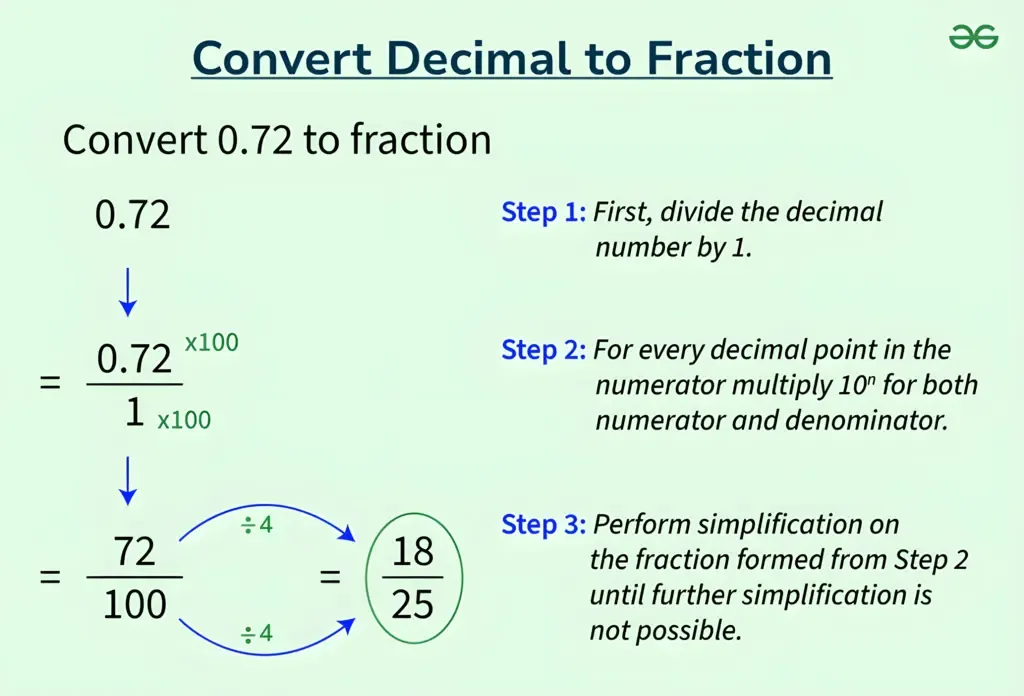
Let’s take a terminating decimal like 0.75 and walk through the manual conversion:
- Write the Decimal as a Fraction Over 1: Any number can be expressed as itself divided by 1. So, 0.75 becomes 0.75/1.
- Eliminate the Decimal Point (Multiply by Powers of 10): To remove the decimal point from the numerator, count the number of decimal places. In 0.75, there are two decimal places. Therefore, multiply both the numerator and the denominator by 10 raised to the power of the number of decimal places (10^2 = 100).
(0.75 * 100) / (1 * 100) = 75/100 - Simplify the Fraction: The final step is to reduce the fraction to its simplest form by dividing both the numerator and the denominator by their greatest common divisor (GCD). For 75 and 100, the GCD is 25.
75 ÷ 25 = 3
100 ÷ 25 = 4
So, 75/100 simplifies to 3/4.
For repeating decimals, the process is more involved, often requiring algebraic manipulation. For example, to convert 0.333… (or 0. $bar{3}$):
- Let x = 0.333… (Equation 1)
- Multiply by 10 (since one digit repeats): 10x = 3.333… (Equation 2)
- Subtract Equation 1 from Equation 2:
10x – x = 3.333… – 0.333…
9x = 3 - Solve for x: x = 3/9 = 1/3.
Challenges of Manual Conversion
While the steps are logical, manual conversion, especially for complex decimals, presents several challenges:
- Time-Consuming: The process can be lengthy, particularly for decimals with many places or for large numbers that require extensive simplification.
- Prone to Errors: Miscounting decimal places, errors in multiplication, or mistakes in identifying the GCD can lead to incorrect results.
- Difficulty with Repeating Decimals: As shown, converting repeating decimals requires specific algebraic steps that might not be intuitive or easily remembered by everyone.
- Simplification Complexity: Finding the greatest common divisor for larger numbers can be a significant hurdle, often requiring prime factorization or iterative division, which adds to the time and potential for error.
These challenges underscore the clear advantage of a dedicated tool that can automate this process, ensuring accuracy and saving valuable time.
The Power and Convenience of a Decimal to Fraction Calculator
Given the complexities and potential for error in manual conversion, especially with more intricate decimals, the advent of the decimal to fraction calculator has been a boon for students, professionals, and anyone needing precise numerical conversions.
What is a Decimal to Fraction Calculator?
At its core, a decimal to fraction calculator is a digital tool designed to automatically convert a given decimal number into its equivalent fractional form, often simplifying it to the lowest terms. These calculators can be found in various formats:
- Online Web Applications: Accessible through any browser, these are often free and user-friendly.
- Mobile Apps: Dedicated applications for smartphones and tablets, offering portability and offline functionality.
- Functions within Scientific/Graphing Calculators: Many advanced physical calculators include a built-in feature to perform this conversion.
- Software Tools: Integrated into more comprehensive mathematical or engineering software packages.
The primary purpose remains consistent: to provide a quick, accurate, and simplified fractional representation of any terminating or repeating decimal input.
How These Calculators Work (Behind the Scenes)
While the user experience is typically as simple as inputting a number and pressing a button, the underlying algorithms of these calculators are quite sophisticated.
- Terminating Decimals: For decimals like 0.75, the calculator essentially automates the manual steps:
- It determines the number of decimal places (e.g., 2 for 0.75).
- It multiplies the decimal by the corresponding power of 10 (0.75 * 100 = 75) to get the numerator and sets the denominator to that power of 10 (100).
- It then employs a highly efficient algorithm, such as the Euclidean algorithm, to find the Greatest Common Divisor (GCD) of the numerator and denominator.
- Finally, it divides both by the GCD to present the simplified fraction (75/100 becomes 3/4).

-
Repeating Decimals: This is where the calculators truly shine. For decimals like 0.333… or 0.142857142857…, the calculator implements the algebraic method described earlier.
- It identifies the repeating block of digits.
- It sets up and solves the system of equations to convert the repeating decimal into a fraction.
- It then simplifies the resulting fraction using the GCD method.
- Some advanced calculators can even detect non-pure repeating decimals (e.g., 0.1666…) and convert them correctly.
-
Approximation for Irrational Numbers: It’s important to note that a decimal to fraction calculator cannot convert irrational numbers (like Pi or the square root of 2) into exact fractions, as these numbers have infinite, non-repeating decimal expansions. In such cases, the calculator will either provide a warning, return a “not applicable” message, or, if designed for approximation, offer a close fractional approximation based on the input decimal’s precision (e.g., converting 3.14 to 157/50, or 3.14159 to 314159/100000).
Key Features to Look For
When choosing a decimal to fraction calculator, consider these features:
- Accuracy and Precision: The ability to handle long decimals without loss of precision.
- Support for Mixed Numbers: Can it convert improper fractions into mixed numbers and vice versa?
- Simplification: Automatic simplification to lowest terms is a must.
- Repeating Decimal Handling: The capability to accurately convert repeating decimals, ideally with a clear input mechanism for indicating the repeating part.
- User Interface: Intuitive and easy to use.
- Speed: Quick computation, especially for complex inputs.
- Portability/Accessibility: Whether it’s an online tool, a mobile app, or a function in a physical calculator that suits your needs.
Practical Applications and Benefits
The utility of a decimal to fraction calculator extends far beyond the classroom, touching numerous professional fields and everyday scenarios where precision and clarity are paramount.
Enhancing Accuracy in Professional Fields
In many technical and craft-based professions, fractional measurements are the standard, and errors can have significant consequences.
- Engineering and Manufacturing: Precise fractional dimensions are critical in blueprints, machining, and CAD designs. Converting sensor readings (often decimal) to exact fractions can ensure components fit perfectly. For instance, a drill bit might be specified as 3/8 inch, and converting a decimal measurement like 0.375 back to its fractional form ensures alignment with industry standards and physical tools.
- Carpentry and Construction: Woodworkers and builders regularly work with fractional increments (e.g., 1/4″, 1/8″, 1/16″). While measuring tapes might show decimals, a calculator can quickly convert calculated decimal lengths (from mathematical operations) back into usable fractional measurements for cutting and fitting.
- Culinary Arts: Recipes often specify ingredients in fractional cups or spoons. Scaling recipes (which might involve decimal multipliers) can result in decimal ingredient amounts that need to be converted back to practical fractions for kitchen use.
- Finance and Data Analysis: While financial data is typically decimal, understanding proportions and ratios in exact fractional terms can offer deeper insights, particularly when comparing parts of a whole or expressing probabilities. For example, a financial analyst might represent a market share as 1/7 rather than 0.142857 to emphasize its exact proportional relationship.
Streamlining Academic and Educational Processes
For students and educators, these calculators are invaluable learning aids and efficiency tools.
- Homework and Assignments: Students can quickly check their manual conversions, learn from the correct answers, and confidently tackle problems involving both decimal and fractional representations.
- Test Preparation: During exams where time is a factor, a calculator ensures that numerical conversion errors don’t derail an otherwise correct solution.
- Conceptual Understanding: By providing instant results, students can experiment with different numbers, observing how various decimals translate into fractions, thus strengthening their intuitive grasp of numerical equivalence. It helps bridge the gap between abstract mathematical concepts and practical numerical representation.
Boosting Efficiency and Reducing Errors
Perhaps the most universally appreciated benefit of a decimal to fraction calculator is its ability to save time and virtually eliminate common conversion errors.
- Time-Saving: Manual conversion, especially for non-terminating or complex decimals, can be laborious. A calculator performs these operations in milliseconds, freeing up cognitive resources for higher-level problem-solving.
- Consistent Accuracy: Human error is an inherent part of manual calculation. Digital calculators remove this variable, providing consistently accurate results, which is vital in applications where precision is paramount.
- Reduces Cognitive Load: By automating a repetitive task, the calculator reduces the mental effort required, allowing users to concentrate on the broader context of their work or studies. This is particularly beneficial in multi-step problems where conversion is just one component.
In essence, these calculators act as a reliable assistant, ensuring that the numerical backbone of any task is sound, allowing users to build upon a foundation of accurate data.
Choosing and Using the Right Calculator
With various options available, selecting the ideal decimal to fraction calculator depends on your specific needs, accessibility preferences, and the environment in which you’ll be using it.
Online Tools vs. Dedicated Apps vs. Physical Calculators
Each type of calculator offers distinct advantages and disadvantages:
- Online Tools:
- Pros: Free, easily accessible from any device with internet, no installation required, often simple and intuitive interfaces. Great for quick, occasional use. Many websites offer additional mathematical tools.
- Cons: Requires an internet connection, often includes ads, might lack advanced features found in dedicated software.
- Dedicated Apps (Mobile/Desktop):
- Pros: Offline functionality, tailored user experience, often more powerful features (e.g., history, advanced input for repeating decimals, integration with other math functions), generally ad-free.
- Cons: Requires installation, might incur a cost (for premium versions), takes up device storage.
- Physical Scientific/Graphing Calculators:
- Pros: Permitted in many academic settings (exams), robust and durable, no battery dependency on power grids, integrated with a wide range of other mathematical functions.
- Cons: Higher initial cost, can be less intuitive for specific conversions than a dedicated online tool, might require learning specific button sequences for the conversion function.
Your choice should align with whether you need portability, offline access, specific advanced features, or simply a quick online check.
A Step-by-Step Guide to Using a Typical Online Calculator
While interfaces may vary slightly, the general process for using most online decimal to fraction calculators is remarkably similar:
- Navigate to the Calculator: Open your web browser and go to a reputable decimal to fraction calculator website (e.g., WolframAlpha, Calculator.net, or a dedicated math education site).
- Locate the Input Field: You’ll typically find a clear text box labeled “Enter Decimal” or similar.
- Enter Your Decimal: Type the decimal number you wish to convert.
- For terminating decimals (e.g., 0.625), simply type it in.
- For repeating decimals (e.g., 0.333…), some calculators allow you to indicate the repeating part using parentheses (e.g., 0.(3)) or by typing enough repeating digits (e.g., 0.33333333). Check the calculator’s instructions if unsure.
- Initiate Conversion: Click the “Convert,” “Calculate,” or “Equals” button.
- Interpret the Result: The calculator will display the equivalent fraction, often in its simplest form. It might also show the improper fraction, mixed number, or even the steps taken for the conversion.
Tips for Optimal Use
To get the most out of your decimal to fraction calculator:
- Double-Check Inputs: Always verify that you’ve entered the decimal correctly. A single misplaced digit can lead to an entirely different fraction.
- Understand Limitations: Be aware that irrational numbers cannot be converted to exact fractions. If you input an approximation of an irrational number, the calculator will provide a fractional approximation.
- Review Simplification: Ensure the calculator automatically simplifies fractions to their lowest terms. This is a standard feature but worth confirming.
- Explore Advanced Features: If using a scientific calculator or a feature-rich app, explore options for handling mixed numbers or displaying the conversion steps.
- Bookmark Reliable Tools: For online users, save the URL of a trusted calculator for quick access.
By understanding the types of calculators available and how to effectively use them, you can leverage these powerful tech tools to ensure accuracy and efficiency in all your numerical tasks.
Conclusion
The journey from understanding the fundamental concepts of decimals and fractions to mastering their interconversion highlights a crucial aspect of numerical literacy. While manual methods offer invaluable insight into mathematical principles, they are often overshadowed by the demands of speed, accuracy, and precision in our fast-paced, tech-driven world. The decimal to fraction calculator emerges as an indispensable tool, bridging this gap by automating a complex and often tedious process.
From the meticulous requirements of engineering blueprints and culinary recipes to the foundational lessons in academic settings, these calculators ensure that the exactness of fractions can be readily accessed from the convenience of decimal notation. They demystify repeating decimals, streamline complex calculations, and significantly reduce the potential for human error, thereby boosting efficiency across a spectrum of professional and personal applications.
In an era where technology constantly empowers us to work smarter, the decimal to fraction calculator stands as a testament to how specialized software and digital tools can enhance our capabilities. By embracing these innovative solutions, we not only ensure the accuracy of our numerical work but also free up our cognitive resources to tackle more complex challenges, fostering greater understanding and productivity in every endeavor. Whether you’re a student grappling with homework, a craftsman perfecting a design, or a professional demanding exactitude, the decimal to fraction calculator is more than just a utility; it’s a gateway to precision and a vital component of the modern digital toolkit.
aViewFromTheCave is a participant in the Amazon Services LLC Associates Program, an affiliate advertising program designed to provide a means for sites to earn advertising fees by advertising and linking to Amazon.com. Amazon, the Amazon logo, AmazonSupply, and the AmazonSupply logo are trademarks of Amazon.com, Inc. or its affiliates. As an Amazon Associate we earn affiliate commissions from qualifying purchases.