
In the intricate world of finance, where numbers tell stories of growth, decline, and opportunity, the ability to accurately interpret and compute changes is paramount. Among the most fundamental yet powerful calculations is the percentage increase. Far from being a mere mathematical exercise, understanding how to compute percentage increase is an indispensable skill for anyone navigating personal finance, investing, business analysis, or economic trends. It allows us to quantify growth, compare performance, and make informed decisions that shape our financial futures. Whether you’re assessing the return on an investment, tracking your salary’s purchasing power, or analyzing a company’s revenue growth, mastering this calculation provides clarity and empowers better financial acumen.
This article delves into the core mechanics of computing percentage increase, exploring its practical applications within the “Money” sphere. We’ll break down the formula, walk through real-world examples, and discuss advanced considerations to ensure you’re not just crunching numbers, but truly understanding their financial implications.
The Fundamentals: Understanding Percentage Increase
Before we dive into the calculations, it’s essential to grasp what percentage increase truly represents and why it holds such significance in financial contexts. It’s more than just a number; it’s a metric that contextualizes growth.
What is Percentage Increase?
At its simplest, percentage increase measures the proportional change between two values, expressing the increase as a fraction of the original (or old) value, multiplied by 100 to present it as a percentage. It tells us by what proportion something has grown relative to its starting point. For instance, if your investment account grew from $100 to $110, the absolute increase is $10. But saying it increased by 10% gives a much clearer and more comparable picture of its performance than just the raw dollar amount, especially when comparing it to other investments or benchmarks.
This calculation is particularly valuable because it normalizes growth. A $100 increase might seem significant if you started with $500 (a 20% increase), but trivial if you started with $10,000 (a 1% increase). Percentages provide a standardized way to compare these different scales of growth.
Why it Matters in Finance
The applications of percentage increase in personal and business finance are vast and varied. It is a cornerstone for many critical analyses:
- Personal Finance: Tracking your net worth growth, assessing the real increase in your salary (after inflation), understanding interest rate changes on loans or savings, and evaluating the impact of budget adjustments. A 5% increase in your savings account interest rate, for example, has a direct and quantifiable impact on your earnings.
- Investing: This is where percentage increase truly shines. It’s used to calculate returns on stocks, bonds, mutual funds, and real estate. Investors constantly use percentage increase to compare the performance of different assets, analyze portfolio growth over various periods, and benchmark their returns against market averages. A stock that went from $50 to $60 experienced a 20% increase, which is a key metric for investment decision-making.
- Business Finance: Businesses rely heavily on percentage increases to monitor key performance indicators (KPIs). This includes year-over-year revenue growth, profit margin increases, customer acquisition rate improvements, and efficiency gains. Understanding these percentages helps management make strategic decisions, allocate resources, and report financial health to stakeholders.
- Economic Analysis: Economists and policymakers use percentage increases to track inflation, GDP growth, unemployment rate changes, and commodity price fluctuations. These macroeconomic indicators help assess the overall health and direction of an economy.
Without the ability to compute and interpret percentage increases, navigating financial decisions becomes significantly more challenging, often leading to misinformed choices.
Step-by-Step Guide to Calculating Percentage Increase
The formula for percentage increase is straightforward, but its correct application requires a clear understanding of its components. Let’s break it down.
The Core Formula Unpacked
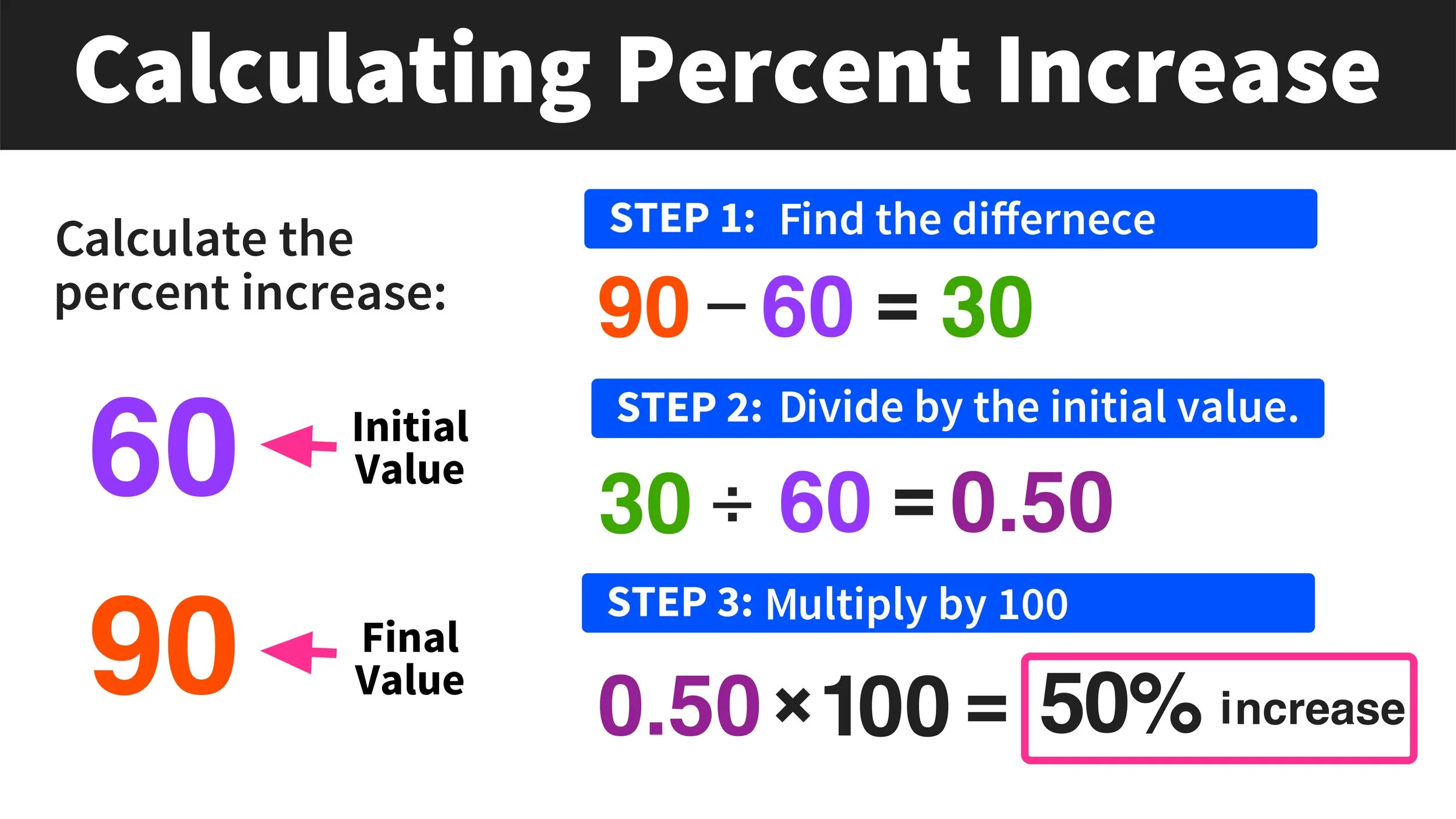
The universal formula for calculating percentage increase is:
$$ text{Percentage Increase} = left( frac{text{New Value} – text{Old Value}}{text{Old Value}} right) times 100% $$
Let’s dissect each part of this formula:
- New Value (or Final Value): This is the larger number, representing the amount after the increase.
- Old Value (or Original Value/Starting Value): This is the smaller number, representing the amount before the increase. This value is crucial as it forms the baseline against which the increase is measured.
- Difference (New Value – Old Value): This first step calculates the absolute amount of the increase.
- Divide by Old Value: This step expresses the absolute increase as a decimal fraction of the original value. This gives you the growth factor.
- Multiply by 100%: Finally, multiplying by 100 converts this decimal fraction into a percentage, making it easier to understand and compare.
It’s important to remember that if the New Value is less than the Old Value, the result will be a negative percentage, indicating a decrease rather than an increase.
Practical Example 1: Personal Finance Application (Salary Increase)
Imagine you received a raise at work. Let’s calculate your percentage salary increase.
- Old Salary (before raise): $50,000 per year
- New Salary (after raise): $53,000 per year
Step-by-Step Calculation:
- Find the difference: $53,000 – $50,000 = $3,000
- Divide the difference by the old salary: $3,000 / $50,000 = 0.06
- Multiply by 100 to get the percentage: 0.06 × 100 = 6%
Your salary increased by 6%. This percentage allows you to easily compare your raise to previous raises, inflation rates, or average industry increases.
Practical Example 2: Investment Growth
You invested in a stock, and its value has appreciated. Let’s determine the percentage return on your investment.
- Initial Investment Value (Old Value): $1,200
- Current Investment Value (New Value): $1,500
Step-by-Step Calculation:
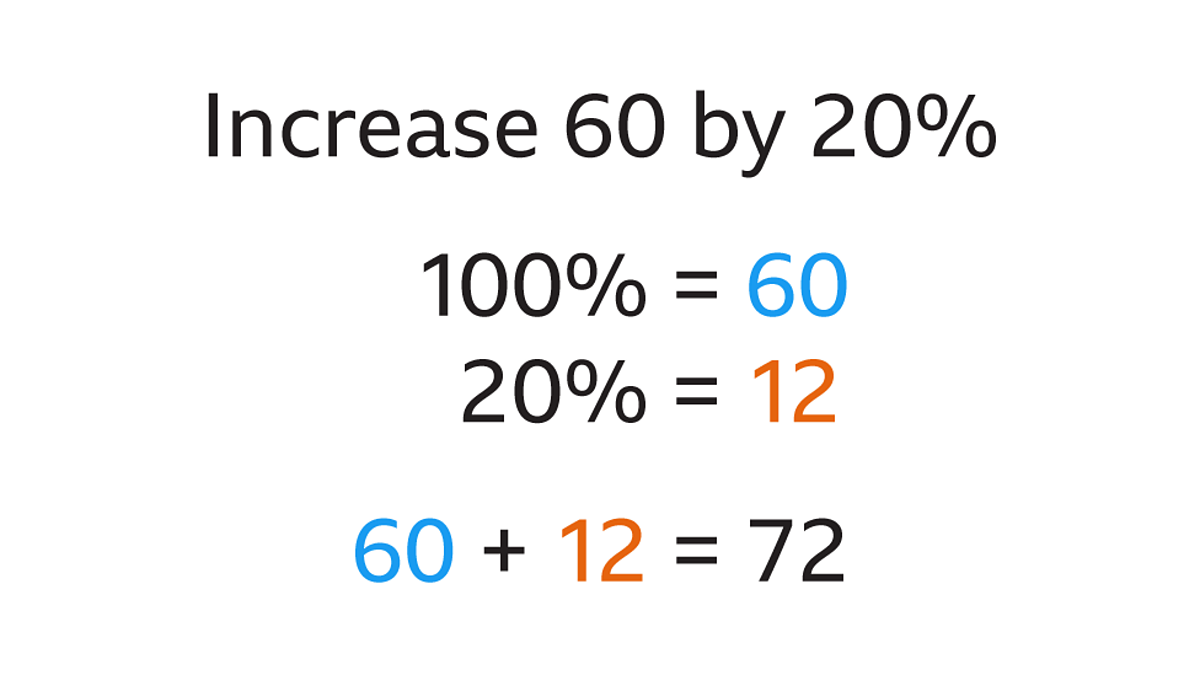
- Find the difference: $1,500 – $1,200 = $300
- Divide the difference by the initial investment value: $300 / $1,200 = 0.25
- Multiply by 100 to get the percentage: 0.25 × 100 = 25%
Your investment saw a 25% increase. This percentage is crucial for assessing the success of your investment strategy and comparing it against other investment opportunities or market benchmarks.
Beyond the Basics: Advanced Applications and Considerations
While the basic formula is powerful, financial analysis often requires a more nuanced approach, especially when dealing with multiple periods or external factors.
Annualized Percentage Increase (CAGR)
When discussing investments over several years, a simple percentage increase from the start to the end doesn’t fully capture the growth rate if the growth wasn’t linear. This is where the Compound Annual Growth Rate (CAGR) becomes invaluable. CAGR represents the mean annual growth rate of an investment over a specified period longer than one year, assuming the profits were reinvested at the end of each period. It smoothens out volatile returns to provide a representative constant growth rate.
The formula for CAGR is:
$$ text{CAGR} = left( left( frac{text{Ending Value}}{text{Beginning Value}} right)^{frac{1}{text{Number of Years}}} – 1 right) times 100% $$
For instance, if an investment grew from $10,000 to $18,000 over 5 years, the simple percentage increase is 80%. But the CAGR would be:
$((18000/10000)^{(1/5)} – 1) times 100% = ((1.8)^{0.2} – 1) times 100% approx (1.1247 – 1) times 100% = 12.47%$
This means the investment grew by an average of 12.47% each year, which is a much more useful metric for multi-year performance comparison.
Inflation and Real Growth
A critical consideration in personal and business finance is the impact of inflation. A nominal percentage increase in salary or investment might look good on paper, but if inflation rates are higher, your real purchasing power has actually decreased. The “real” percentage increase adjusts for inflation, providing a more accurate picture of financial growth.
To calculate real growth, you typically need to know the nominal growth rate and the inflation rate. A simplified approximation often used is:
$$ text{Real Growth} approx text{Nominal Growth Rate} – text{Inflation Rate} $$
For example, if your salary increased by 5% (nominal growth) but inflation was 3%, your real salary increase was approximately 2%. This means your purchasing power only increased by 2%, not 5%. More precise calculations involve deflating the new value, but the approximation provides a quick and useful insight. Understanding real growth is vital for long-term financial planning, ensuring that your wealth is genuinely increasing.
Using Percentage Increase in Business Finance
Beyond basic revenue and profit growth, percentage increases are vital for more granular business analysis:
- Profit Margins: Calculating the percentage increase or decrease in gross profit margin or net profit margin helps assess operational efficiency and pricing strategies.
- Customer Acquisition Cost (CAC) vs. Customer Lifetime Value (CLTV): Understanding the percentage increase in CLTV relative to CAC helps businesses evaluate the sustainability and profitability of their customer base.
- Market Share: Monitoring the percentage increase in market share indicates a company’s competitive standing and growth within its industry.
- Cost Control: Analyzing percentage increases in operating expenses, raw material costs, or labor costs allows businesses to identify areas for cost reduction and efficiency improvements.
These applications demonstrate how deeply percentage increase is embedded in the fabric of financial decision-making, guiding strategic planning and operational adjustments.
Common Pitfalls and Best Practices
While computing percentage increase is fundamental, there are common mistakes and best practices to ensure accuracy and avoid misinterpretation.
Misinterpreting the Base Value
The most common error is using the wrong “Old Value” or “base value” in the denominator. The base value must be the starting point or the value before the increase occurred. Using the new value by mistake would lead to an incorrect and often misleading percentage. For example, if a product price increased from $100 to $120, the increase is 20%. If you mistakenly used $120 as the base, the calculation would be ($20/$120) * 100 = 16.67%, which is wrong. Always double-check your starting point.
The Difference Between Percentage Point Change and Percentage Change
This is a subtle but significant distinction, especially in financial reporting.
- Percentage Change: This is what we’ve been discussing – the relative increase or decrease of a value. For example, if a stock went from $100 to $120, that’s a 20% percentage change.
- Percentage Point Change: This refers to the absolute difference between two percentages. For instance, if a company’s profit margin increased from 10% to 15%, the percentage point change is 5 percentage points (15% – 10%). However, the percentage increase in the profit margin itself is 50% (($15% – 10%)/10% times 100%$). Confusing these two can lead to severe misinterpretations of financial performance. Always clarify whether you are discussing a change in percentage points or a percentage change of a percentage.
Leveraging Financial Tools and Software
While manual calculation is good for understanding the concept, for practical applications, especially with large datasets, leveraging financial tools and software is a best practice.
- Spreadsheets (Excel, Google Sheets): These are indispensable. You can set up formulas that automatically calculate percentage increases for entire columns of data. For example, if your old value is in cell A2 and your new value is in B2, the formula
=(B2-A2)/A2will give you the decimal, which you can then format as a percentage. - Online Calculators: Numerous websites offer free percentage increase calculators, which are convenient for quick, one-off calculations.
- Financial Software: Investment platforms and accounting software often have built-in features to display percentage changes for portfolio performance, revenue growth, and other key metrics, reducing the need for manual calculations.
Embracing these tools not only saves time but also minimizes the risk of human error, allowing you to focus on interpreting the results rather than just computing them.

Conclusion
The ability to accurately compute percentage increase is more than just a mathematical skill; it is a fundamental pillar of financial literacy. From managing your personal budget and evaluating investment opportunities to dissecting complex business financials and understanding economic trends, percentage increase provides the clarity and context needed to make informed decisions.
By understanding the core formula, applying it to real-world scenarios, and being aware of advanced considerations like CAGR and inflation, you empower yourself with a powerful analytical tool. Avoiding common pitfalls and leveraging modern financial tools will further enhance your accuracy and efficiency. Mastering percentage increase means not just seeing numbers, but truly understanding the stories of growth, progress, and financial evolution they represent. It’s an indispensable asset in your journey towards greater financial acumen and success.
aViewFromTheCave is a participant in the Amazon Services LLC Associates Program, an affiliate advertising program designed to provide a means for sites to earn advertising fees by advertising and linking to Amazon.com. Amazon, the Amazon logo, AmazonSupply, and the AmazonSupply logo are trademarks of Amazon.com, Inc. or its affiliates. As an Amazon Associate we earn affiliate commissions from qualifying purchases.