
In the realm of personal finance and investing, few concepts hold as much transformative power as compound interest. Often lauded as the “eighth wonder of the world” by Albert Einstein, its ability to generate wealth is profound. While the general principle of earning interest on interest is well-understood, the specifics of its frequency can significantly amplify returns. Daily compounding, in particular, offers an accelerated path to growth that warrants a closer look.
This article delves into the intricacies of daily compound interest, explaining its mechanics, demonstrating how to compute it both manually and with readily available tools, and outlining strategies to harness its full potential. Whether you’re saving for retirement, building an emergency fund, or simply looking to grow your wealth more efficiently, mastering daily compound interest is a crucial step towards achieving your financial aspirations.

Understanding the Mechanics of Compound Interest
Before diving into daily calculations, it’s essential to grasp the fundamental concept of compound interest and why its frequency matters so profoundly.
What is Compound Interest?
At its core, compound interest is the interest you earn not only on your initial principal but also on the accumulated interest from previous periods. Unlike simple interest, which is calculated only on the original principal amount, compound interest continually builds upon itself. This creates a snowball effect, where your money grows at an increasingly faster rate over time.
Imagine you deposit $1,000 into an account with a 5% annual simple interest rate. After one year, you’d earn $50, bringing your total to $1,050. In the second year, you’d again earn $50, making your total $1,100. With compound interest, however, the interest earned in the first period is added to the principal, and then the next period’s interest is calculated on this new, larger amount. So, in the second year, you’d earn interest on $1,050, not just $1,000, leading to a higher return.
The Power of Compounding Frequency
The frequency with which interest is compounded plays a critical role in the overall returns. Interest can be compounded annually, semi-annually, quarterly, monthly, weekly, or even daily. The more frequently interest is compounded, the faster your money grows, assuming the same annual interest rate. This is because the interest earned is added back to the principal more often, allowing subsequent interest calculations to be based on an even larger sum.
For instance, an investment that compounds daily will typically yield slightly more than an identical investment that compounds monthly, and significantly more than one that compounds annually. While the difference might seem negligible over short periods, over years and decades, this seemingly small advantage can accumulate into substantial additional earnings. This is why financial products often highlight their Annual Percentage Yield (APY) rather than just the Annual Percentage Rate (APR), as APY accounts for the effect of compounding frequency.
Why Daily Compounding Matters
Daily compounding represents the pinnacle of compounding frequency for most practical purposes, short of continuous compounding which is a theoretical limit. For high-yield savings accounts, certain money market accounts, and even some investment vehicles, interest can be calculated and added to your balance every single day. This means that each day, your principal grows by a minuscule amount of interest, and the very next day, you earn interest on that slightly larger sum.
The impact of daily compounding is particularly significant for:
-
Long-term savings: The longer your money is compounded daily, the greater the exponential growth.
-
Large principal amounts: Even a small daily percentage translates into a larger absolute dollar amount on a substantial principal.
-
Accounts with no fees or minimums: Many high-yield savings accounts offer daily compounding without imposing stringent conditions, making them ideal for consistent growth.
Understanding that every single day your money has the potential to earn more interest on itself is a powerful motivator for both saving and investing consistently.
The Formula and Manual Calculation
While the concept of daily compounding is straightforward, calculating it accurately requires a specific formula. Understanding this formula not only allows for manual computation but also provides insight into how various financial tools arrive at their figures.
The Compound Interest Formula
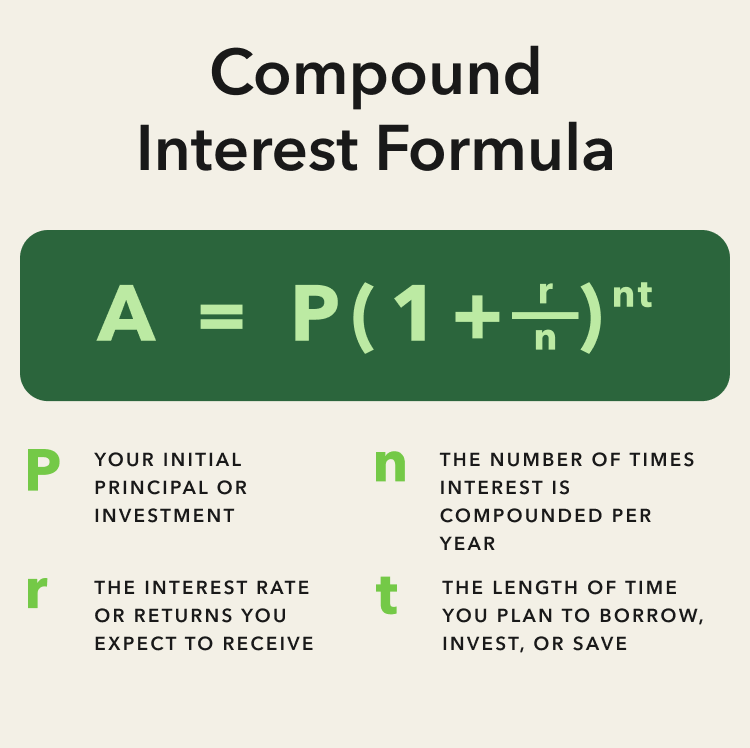
The universal formula for compound interest is:
$A = P(1 + r/n)^{nt}$
Where:
-
A = the future value of the investment/loan, including interest
-
P = the principal investment amount (the initial deposit or loan amount)
-
r = the annual interest rate (as a decimal)
-
n = the number of times that interest is compounded per year
-
t = the number of years the money is invested or borrowed for
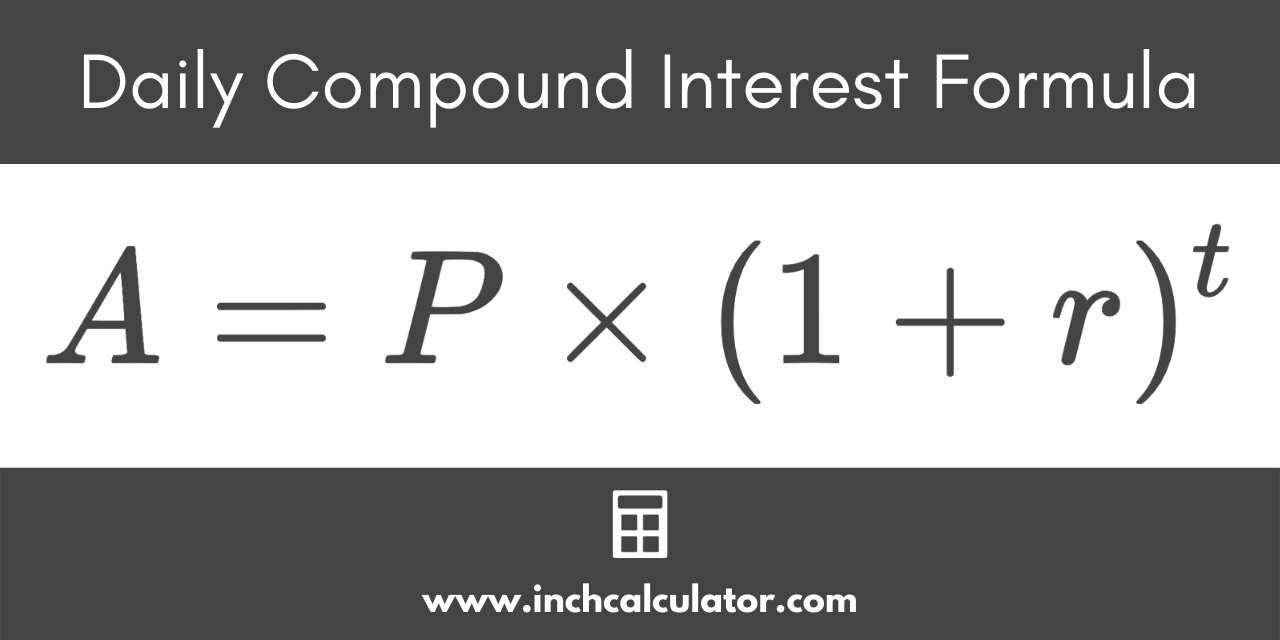
To adapt this formula for daily compound interest, we specifically set ‘n’ to 365 (for 365 days in a year).
So, for daily compounding, the formula becomes:
$A = P(1 + r/365)^{365t}$
It’s crucial to remember that the annual interest rate ‘r’ must always be expressed as a decimal. For example, if the annual interest rate is 5%, ‘r’ would be 0.05.
Step-by-Step Daily Compound Interest Calculation
Let’s illustrate with an example to demonstrate the manual calculation process.
Scenario: You deposit $10,000 into a savings account that offers a 3% annual interest rate, compounded daily. You want to know how much money you will have after one year.
Given values:
-
P (Principal) = $10,000
-
r (Annual interest rate) = 3% = 0.03
-
n (Compounding frequency) = 365 (daily)
-
t (Number of years) = 1
Calculation Steps:
-
Calculate the daily interest rate:
r/n = 0.03 / 365 $approx$ 0.00008219
-
Add 1 to the daily interest rate:
1 + (r/n) = 1 + 0.00008219 = 1.00008219
-
Calculate the total number of compounding periods:
n * t = 365 * 1 = 365
-
Raise the result from step 2 to the power of the result from step 3:
$(1 + r/n)^{nt} = (1.00008219)^{365} approx 1.030453$
-
Multiply by the principal:
$A = P * (1 + r/n)^{nt} = 10,000 * 1.030453 = 10,304.53$
So, after one year, your $10,000 investment would grow to approximately $10,304.53. The interest earned would be $304.53.
To put this into perspective, if the interest were compounded annually, the calculation would be $10,000 * (1 + 0.03)^1 = $10,300. The daily compounding yields an additional $4.53, illustrating the marginal but continuous benefit of higher frequency.
Limitations of Manual Calculation
While understanding the formula and performing a manual calculation is excellent for conceptual understanding, it quickly becomes cumbersome and impractical for several reasons:
-
Time-consuming: Calculating for multiple years or different scenarios requires repetitive and often complex exponentiation.
-
Prone to error: Small rounding errors in intermediate steps can lead to inaccuracies, especially over long periods.
-
Lack of flexibility: Manually adjusting variables (e.g., adding regular contributions) makes the process significantly more complex.
For these reasons, most individuals and financial professionals rely on digital tools to compute daily compound interest efficiently and accurately.
Leveraging Financial Tools for Daily Compounding
Given the complexity and potential for error in manual calculations, modern financial tools are indispensable for computing and understanding daily compound interest. These tools offer speed, accuracy, and the ability to model various scenarios effortlessly.
Online Compound Interest Calculators
The easiest and most accessible way to compute daily compound interest is through online calculators. A quick search for “daily compound interest calculator” will yield numerous reliable options from reputable financial institutions, investment websites, and educational platforms.
These calculators typically require you to input:
-
The initial principal amount.
-
The annual interest rate.
-
The compounding frequency (you would select “daily”).
-
The length of the investment period (in years).
-
Sometimes, they also allow for regular additional contributions.
The benefits of using online calculators include:
-
Instant results: Calculations are performed in seconds.
-
Accuracy: They eliminate human calculation errors.
-
Scenario planning: You can quickly adjust variables to see how changes in rate, principal, or time affect your final amount.
-
Visualizations: Many calculators provide graphs or tables that illustrate the growth of your money over time, making the power of compounding more tangible.
Always ensure you use a calculator from a trustworthy source to guarantee the accuracy of the results.
Spreadsheet Software (Excel/Google Sheets)
For those who desire more control, customization, and the ability to integrate compound interest calculations into broader financial models, spreadsheet software like Microsoft Excel or Google Sheets is an excellent choice. Spreadsheets allow you to build dynamic models that can track your investments over time and incorporate various financial nuances.
A basic formula for daily compound interest in a spreadsheet would look something like this:
=P*(1+r/365)^(365*t)
Where P, r, and t would refer to cells containing your principal, annual rate (as a decimal), and number of years, respectively.
Example in Excel:
-
Let Cell A1 = 10000 (Principal)
-
Let Cell A2 = 0.03 (Annual Rate)
-
Let Cell A3 = 1 (Years)
-
In Cell A4, you would enter:
=A1*(1+A2/365)^(365*A3)
This would give you the future value after one year. You can then extend this by creating columns for each year, or even each day, to track granular growth. Spreadsheets are particularly powerful for:
-
Modeling regular contributions: You can add a formula for monthly or annual contributions to see their impact on daily compounding.
-
Creating amortization schedules: For loans, you can see how daily interest accrues and how payments reduce the principal.
-
Comparison: Easily compare different interest rates or compounding frequencies side-by-side.
Financial Apps and Investment Platforms
Beyond standalone calculators and spreadsheets, many personal finance apps and investment platforms automatically handle daily compound interest calculations behind the scenes.
-
High-yield savings accounts: These often display your interest earnings daily or monthly, reflecting the daily compounding effect.
-
Robo-advisors and brokerage accounts: These platforms track and report your investment growth, which inherently includes the compounding of returns, dividends, and interest. While they may not explicitly show “daily compound interest” figures in the same way a calculator does, the reported total returns accurately reflect its impact.
-
Budgeting apps: Some advanced budgeting or net worth tracking apps can also integrate future value calculations for your savings based on daily compounding.
The primary benefit of these platforms is automation. They simplify the user’s experience by providing real-time balances that inherently account for daily compounding, allowing you to focus on saving and investing rather than constant calculation. It’s still beneficial to understand the underlying mechanics, but these tools remove the computational burden.
Strategies to Maximize Daily Compounding
Understanding how to compute daily compound interest is merely the first step. The true value lies in implementing strategies that maximize its powerful effects to accelerate your wealth accumulation.
Start Early and Be Consistent
Time is undeniably the most potent ally of compound interest. The longer your money has to grow, the more significant the impact of daily compounding. Even small amounts invested early can outperform much larger amounts invested later, thanks to the magic of time.
-
The Head Start Advantage: Beginning to save and invest in your 20s rather than your 30s can literally translate into hundreds of thousands of dollars more by retirement age, assuming identical contributions and rates.
-
Consistent Contributions: Beyond a lump sum, regularly contributing to your savings or investment accounts (e.g., monthly deposits) dramatically boosts the principal upon which daily interest is calculated. This strategy, known as dollar-cost averaging in investing, also helps mitigate market volatility.
Seek Higher Interest Rates (Within Reason)
While it’s important to be realistic about expected returns, actively seeking out financial products with competitive interest rates can significantly enhance daily compounding.
-
High-Yield Savings Accounts: These accounts typically offer significantly higher interest rates than traditional savings accounts, often with daily compounding. Compare options from online banks and credit unions.
-
Certificates of Deposit (CDs): While less liquid, CDs offer fixed, often higher, interest rates for specific terms. Ensure you understand the compounding frequency of any CD you consider.
-
Investment Vehicles: For long-term goals, consider diversified investment portfolios (e.g., index funds, ETFs) that historically offer higher returns than savings accounts. Reinvesting dividends and capital gains within these accounts allows for compounding on an even grander scale. Always balance the pursuit of higher returns with your risk tolerance.
Avoid Unnecessary Withdrawals
For compound interest to work its magic, the principal and accumulated interest must remain undisturbed. Every withdrawal, no matter how small, reduces the base upon which future interest is calculated, effectively setting back your compounding progress.
-
Emergency Fund: Ensure you have a separate, easily accessible emergency fund to cover unexpected expenses, preventing you from needing to tap into your compounding long-term savings or investments.
-
Financial Discipline: Cultivate financial discipline to avoid dipping into accounts specifically designated for long-term growth. The immediate gratification of a withdrawal often pales in comparison to the long-term financial benefit of uninterrupted compounding.
Reinvesting Dividends and Interest
In investment portfolios, many assets generate income in the form of dividends (from stocks) or interest (from bonds). To maximize daily compounding, it is almost always advisable to reinvest these earnings.
-
Dividend Reinvestment Plans (DRIPs): Many companies and brokerage firms offer DRIPs, which automatically use your cash dividends to purchase more shares of the same stock or fund. This increases your share count, leading to even more dividends in the future, creating a powerful compounding loop.
-
Automated Reinvestment: Most investment platforms offer the option to automatically reinvest any cash distributions. Ensure this feature is enabled for your long-term growth accounts.
By consistently putting your earnings back into your investments, you ensure that every cent is put to work, compounding daily and accelerating your journey toward financial prosperity.
Conclusion
The concept of daily compound interest, while sometimes overlooked in its nuances, is a cornerstone of effective financial planning and wealth accumulation. It demonstrates that consistent, incremental growth, applied over time, can lead to remarkably significant outcomes. By understanding the underlying formula, leveraging accessible financial tools, and adopting strategic habits, anyone can harness this “eighth wonder of the world” to their advantage.
From the meticulous manual calculation to the convenience of online calculators and sophisticated spreadsheet models, the means to compute daily compound interest are readily available. More importantly, by committing to starting early, making regular contributions, diligently seeking out optimal rates, and resisting the urge to withdraw, you empower your money to work harder for you, every single day. Embrace the power of daily compounding, and take control of your financial future with informed decisions and consistent action.
aViewFromTheCave is a participant in the Amazon Services LLC Associates Program, an affiliate advertising program designed to provide a means for sites to earn advertising fees by advertising and linking to Amazon.com. Amazon, the Amazon logo, AmazonSupply, and the AmazonSupply logo are trademarks of Amazon.com, Inc. or its affiliates. As an Amazon Associate we earn affiliate commissions from qualifying purchases.