
Navigating the landscape of higher education finance can often feel like deciphering a complex code. At the heart of most financial aid opportunities in the United States lies the Free Application for Federal Student Aid, commonly known as FAFSA. This critical form is the gateway to federal grants, scholarships, work-study programs, and federal student loans. While completing the FAFSA is a significant step, merely submitting it isn’t the end of the journey. A crucial, often overlooked, part of the process is diligently tracking the status of your application.
Understanding where your FAFSA stands can mean the difference between securing the necessary funds for your education and facing unexpected financial hurdles. From identifying potential errors to ensuring timely disbursement of aid, proactively monitoring your FAFSA status empowers you to remain in control of your financial future. This comprehensive guide will walk you through the essential steps, explain what different statuses mean, and provide insights into managing your application effectively, ensuring you’re well-equipped to secure the financial assistance you deserve.

Why Tracking Your FAFSA Status is Crucial for Financial Planning
The FAFSA process is not a one-and-done submission. It’s an interactive dialogue between you, the Department of Education, and the institutions you’re applying to. Monitoring its status regularly offers several significant advantages, directly impacting your financial well-being and educational journey.
Ensuring Timely Financial Aid Disbursement
Financial aid is often pivotal for covering tuition, housing, books, and living expenses. Delays in processing your FAFSA or unaddressed errors can directly lead to delays in receiving your financial aid package. This can create immense stress, potentially hindering your ability to register for classes, pay deposits, or even secure housing. By staying on top of your FAFSA status, you ensure that any aid you’re eligible for is processed and disbursed in a timely manner, allowing for a smoother start or continuation of your academic year.
Identifying and Correcting Errors Promptly
Even with the utmost care, mistakes can happen. Incorrectly entered income figures, missing signatures, or overlooked questions can all lead to your FAFSA being flagged for correction. If these errors are not identified and rectified promptly, your application could be delayed, or worse, rejected. Regularly checking your status allows you to quickly spot any notifications regarding incomplete or inaccurate information, enabling you to make the necessary corrections before they escalate into more significant problems. Early correction minimizes processing time and ensures your eligibility is accurately assessed.
Meeting Deadlines and Requirements
Both federal and institutional financial aid programs operate under strict deadlines. While the federal FAFSA deadline is generally quite generous, many states and individual colleges have their own priority deadlines for financial aid. Missing these can mean forfeiting access to certain grant programs or institutional scholarships, even if you are otherwise eligible. Your FAFSA status will often indicate if your application is fully processed and submitted by these critical dates. Proactive checks ensure you adhere to all requirements, maximizing your chances of receiving all available aid.
Proactive Financial Planning for College Costs
Understanding the status of your FAFSA application directly contributes to your overall financial planning for college. Once your FAFSA is processed and your Expected Family Contribution (EFC) or Student Aid Index (SAI) is determined, colleges can begin to formulate your financial aid offer. Knowing whether your application is complete and error-free gives you a clearer picture of your potential aid package much sooner. This allows you to plan for any remaining costs, explore other funding options, or make more informed decisions about which colleges are financially viable. It transforms an abstract application into concrete figures that aid in budgeting and decision-making.
Step-by-Step Guide to Checking Your FAFSA Status Online
The process of checking your FAFSA status is streamlined and designed for user convenience through the official Federal Student Aid website. Following these steps will ensure you can easily monitor your application’s progress.
Accessing the Federal Student Aid Website
Your primary portal for all FAFSA-related activities is the official StudentAid.gov website. It is crucial to always use this legitimate source to protect your personal and financial information. Avoid third-party websites that claim to help with FAFSA status checks, as they may be scams or charge unnecessary fees.
Logging In to Your Account
To access your FAFSA application status, you will need to log in using your FSA ID. An FSA ID is a username and password combination that serves as your legal signature and allows you to access federal student aid websites. If you don’t have one, you would have created it during your initial FAFSA submission. If you’ve forgotten your FSA ID, the website provides clear recovery options for your username and password. Once logged in, you’ll be directed to your personalized dashboard.
Navigating to Your Application Status
On your StudentAid.gov dashboard, look for a section or link that says something similar to “My FAFSA,” “View Your Processed FAFSA Form,” or “Check Application Status.” The exact wording may vary slightly depending on updates to the website’s interface, but it will always be intuitively placed for easy access. Clicking this link will typically bring you to a summary of your most recently submitted FAFSA application and its current status.
Understanding Your FAFSA Status Updates
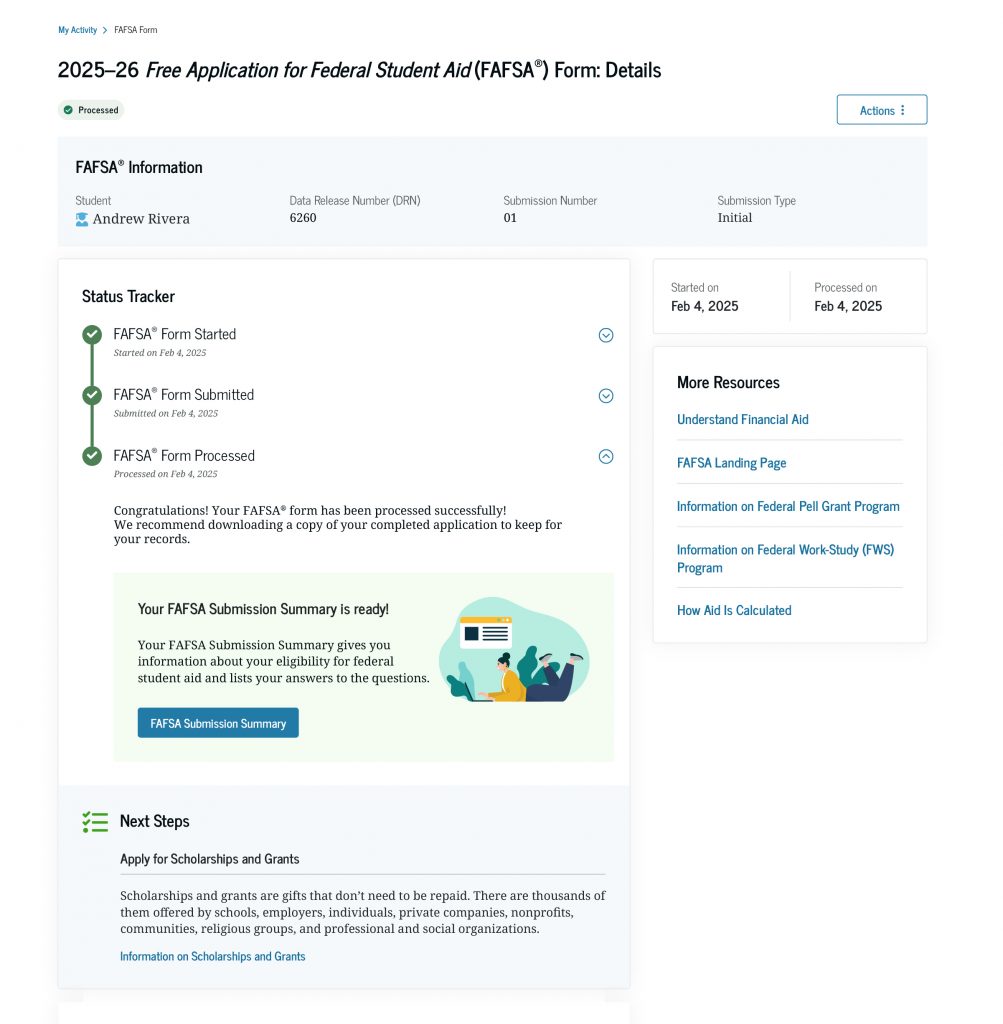
Once you access your application summary, you’ll see a status indicator. Here’s what some common statuses mean:
-
“Processing” or “Processed Successfully”: This is generally good news. “Processing” means the Department of Education has received your FAFSA and is reviewing it. “Processed Successfully” indicates that your application has been reviewed and a Student Aid Report (SAR) is available.
-
“Corrections Needed” or “Incomplete”: This status means there’s an issue with your application that requires your attention. It could be anything from a missing signature to an inconsistency in the data provided. You will need to review the specific comments in your SAR or application summary to understand what corrections are required.
-
“Application Rejected”: While less common, this status indicates a significant issue that prevents your FAFSA from being processed. This usually happens if critical information is missing or contradictory. You’ll need to review the reasons for rejection and resubmit a corrected application.
-
“SAR Available”: This is the most common and desired status after “Processed Successfully.” It means your Student Aid Report is ready for review.
Deciphering Your Student Aid Report (SAR)
The Student Aid Report (SAR) is a critical document generated after your FAFSA is successfully processed. It’s much more than just a summary; it’s a vital tool for understanding your financial aid eligibility and making necessary adjustments.
What is the SAR?
The SAR is an electronic or paper document that summarizes the information you reported on your FAFSA form. It also includes your Expected Family Contribution (EFC) – soon to be replaced by the Student Aid Index (SAI) for the 2024-2025 aid year and beyond – which is a number used by schools to determine your eligibility for federal student aid. Colleges and universities will use the EFC/SAI and the other information on your SAR to put together your financial aid package.
Key Information on the SAR
Your SAR will contain several crucial pieces of information:
-
Your EFC/SAI: This is the most important number on your SAR. It’s an index number (not the amount of money your family will have to pay) that colleges use to determine how much federal student aid you’re eligible for. A lower EFC/SAI generally means greater eligibility for need-based aid.
-
Data Submitted on the FAFSA: A detailed breakdown of all the financial and demographic information you provided on your FAFSA. This includes income, assets, household size, and student and parent demographics.
-
Comments from the Department of Education: This section will highlight any issues, discrepancies, or requests for additional information (like verification) that need your attention. Pay close attention to these comments, as they often indicate steps you need to take.
Reviewing Your SAR for Accuracy
Thoroughly reviewing your SAR for accuracy is paramount. Even small errors can significantly impact your EFC/SAI and, consequently, the amount of aid you receive. Check every single field against your original records (tax returns, bank statements, etc.). Look for:
-
Misspellings of names or addresses.
-
Incorrect social security numbers or dates of birth.
-
Typographical errors in income or asset figures.
-
Incorrect dependency status or household size.
If you identify any discrepancies, it’s essential to correct them immediately.
Making Corrections to Your FAFSA
If you find errors on your SAR, don’t panic. You can easily make corrections directly through StudentAid.gov. Log in with your FSA ID, navigate to your FAFSA application, and select the option to “Make FAFSA Corrections.” You’ll be able to edit specific fields. Once you’ve made the necessary changes, resubmit your FAFSA. It will then be re-processed, and a new SAR will be generated. Note that some changes (like those affecting dependency status) might require additional documentation or clarification.
What to Do After Your FAFSA is Processed
Once your FAFSA is processed and your SAR confirms accuracy, you’ve completed a significant phase. The next steps involve engaging with the colleges you’ve applied to and making informed financial decisions.
Receiving Financial Aid Offer Letters
After your FAFSA data is sent to the schools you listed, each college’s financial aid office will use your EFC/SAI to calculate your eligibility for various types of aid. They will then send you a financial aid offer letter (sometimes called an award letter or package) that details the specific grants, scholarships, federal work-study opportunities, and federal student loans they are offering you. These letters can arrive via postal mail or electronically through your college’s applicant portal.
Comparing Aid Offers
If you’ve applied to multiple schools, you’ll receive separate financial aid offer letters from each. It’s crucial to compare these offers carefully. Don’t just look at the total “aid” amount. Instead, focus on the net price – the actual cost you’ll have to pay after grants and scholarships are applied. Consider:
-
Gift Aid vs. Self-Help Aid: Prioritize offers with more grants and scholarships (gift aid) as they don’t need to be repaid, over loans and work-study (self-help aid).
-
Cost of Attendance (COA): Understand each school’s total COA, which includes tuition, fees, room, board, books, and personal expenses.
-
Loan Types and Amounts: Distinguish between subsidized and unsubsidized loans, and evaluate the total loan burden.
Understanding Different Types of Aid
Your aid offer will typically include a combination of financial aid types:
-
Grants: Need-based aid that does not need to be repaid (e.g., Pell Grant, FSEOG).
-
Scholarships: Merit-based or need-based aid that does not need to be repaid (from federal, state, institutional, or private sources).
-
Federal Work-Study: A program that allows students to earn money through part-time jobs, with funds subsidized by the federal government.
-
Federal Student Loans: Money that must be repaid with interest (e.g., Direct Subsidized Loans, Direct Unsubsidized Loans, PLUS Loans). Understand the terms, interest rates, and repayment options for each.
Next Steps for Accepting Aid
Once you’ve compared offers and made your college decision, you’ll need to formally accept the aid package from your chosen institution. Each college will have specific instructions for how to do this, usually through an online portal. You typically have the option to accept all, some, or none of the aid offered. For loans, you may need to complete additional steps like entrance counseling and signing a Master Promissory Note (MPN). Pay close attention to deadlines for accepting aid to avoid losing out on funds.
Common Challenges and Troubleshooting
Even with the best preparation, you might encounter issues when checking your FAFSA status or managing your application. Knowing how to troubleshoot these common challenges can save you time and stress.
Forgotten FSA ID
A forgotten FSA ID (username or password) is one of the most frequent hurdles. Fortunately, StudentAid.gov provides a straightforward recovery process. On the login page, click “Forgot My Username” or “Forgot My Password” and follow the prompts. You’ll typically need to provide your Social Security number, date of birth, and answer security questions, or receive a verification code via email or text.
Application Delays
While FAFSA processing is usually quick, sometimes delays can occur, especially during peak application periods. If your application status remains “Processing” for an extended time (beyond a week or two), first check for any notification emails from the Department of Education or StudentAid.gov. If there’s no clear reason, you can contact the Federal Student Aid Information Center (FSAIC) directly for assistance. Their contact information is available on StudentAid.gov.
Unresolved Errors
If your SAR indicates “Corrections Needed” and you’re unsure how to resolve the issues, review the comments section of your SAR carefully. It usually provides specific instructions. If the instructions aren’t clear, or if you’re dealing with a complex issue, reaching out to the financial aid office of a college you’re applying to can be helpful. They often have experience with common FAFSA errors and can guide you. The FSAIC is also a valuable resource for clarification.
Dealing with Verification Requests
Sometimes, after your FAFSA is processed, you might receive a notification that your application has been selected for “verification.” This is a process where the financial aid office at your chosen college (not the Department of Education directly) requests additional documentation (like tax transcripts, W-2s, or proof of household size) to confirm the information you reported on your FAFSA. It’s a routine process for a percentage of applicants and doesn’t necessarily mean you made an error. Respond promptly and provide all requested documents by the stated deadline to avoid aid delays. Failure to complete verification will result in the loss of federal student aid eligibility.

Conclusion
The journey through financial aid for higher education is a marathon, not a sprint. Submitting your FAFSA is merely the starting line. Proactively checking the status of your application, diligently reviewing your Student Aid Report, and understanding the subsequent steps are paramount to successfully navigating the complex world of student finance. By taking ownership of this process, you empower yourself to identify and correct potential issues, meet crucial deadlines, and ultimately secure the financial assistance that can make your educational aspirations a reality.
Remember, resources are available to help you every step of the way, from the official StudentAid.gov website to the financial aid offices at your prospective colleges and the Federal Student Aid Information Center. Don’t hesitate to leverage these tools and seek clarification when needed. Your vigilance in tracking your FAFSA status is an investment in your financial future and a critical component of achieving your academic goals.
aViewFromTheCave is a participant in the Amazon Services LLC Associates Program, an affiliate advertising program designed to provide a means for sites to earn advertising fees by advertising and linking to Amazon.com. Amazon, the Amazon logo, AmazonSupply, and the AmazonSupply logo are trademarks of Amazon.com, Inc. or its affiliates. As an Amazon Associate we earn affiliate commissions from qualifying purchases.