
Managing your personal finances effectively requires more than just monitoring your spending and investment portfolios; it involves maintaining the administrative integrity of your accounts. One of the most critical, yet often overlooked, tasks during a relocation is updating your physical and billing addresses with your financial institutions. As one of the largest banks in the United States, Chase Bank provides several streamlined methods for updating your information.
Ensuring your address is current with Chase is not merely a matter of convenience. It is a fundamental component of financial security, regulatory compliance, and seamless account management. This guide explores the various methods to update your address, the underlying financial reasons for doing so promptly, and the broader implications of residency changes on your financial profile.

Navigating the Chase Ecosystem: How to Update Your Address
Chase has invested heavily in its digital infrastructure, making it relatively simple for customers to manage their profiles through various touchpoints. Whether you prefer the convenience of a smartphone or the personal touch of a branch visit, there are four primary ways to update your information.
Updating via the Chase Mobile App
For the modern consumer, the Chase Mobile app is often the most efficient tool. Because the app utilizes biometric security or multi-factor authentication, it provides a secure environment for sensitive changes.
-
Log In: Open the app and authenticate your identity.
-
Access the Profile Icon: Tap the silhouette icon located at the top right of the home screen.
-
Select “Settings”: Navigate to the settings menu to manage your personal details.
-
Edit Profile and Shipping: Select “Profile” and then “Phone, email and address.”
-
Modify Address: Tap on the address you wish to change. You will likely see options for “Permanent Address” and “Mailing Address.”
-
Verify and Save: Enter the new details and confirm the change. Chase may send a one-time passcode to your mobile device or email to verify that you are indeed the one making the request.
Using the Chase Online Banking Portal
If you prefer a desktop interface, the Chase website offers a comprehensive dashboard for profile management.
-
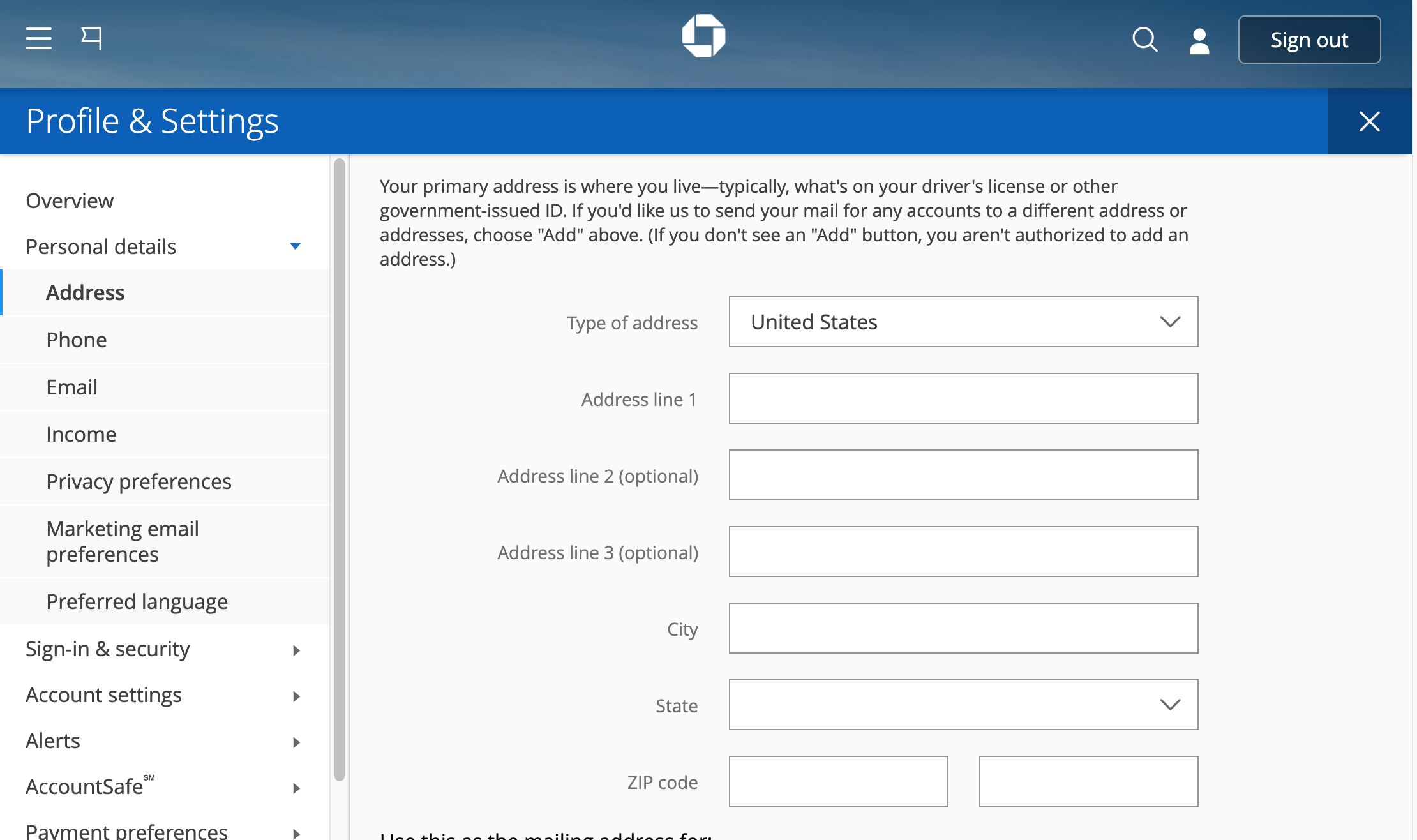
Sign In: Navigate to the Chase official website and log in to your account.
-
Profile & Settings: Click on the “Profile & Settings” icon (the person icon) in the top right corner.
-
Personal Settings: Select “Profile & settings” from the dropdown menu.
-
Update Contact Information: Click on “Phone, email and address” on the left-hand sidebar.
-
Edit Address: Choose the specific address field you need to update. Note that if you have multiple accounts (e.g., a Sapphire Credit Card and a Total Coaching Checking account), you should ensure the change applies to all relevant products.
-
Confirmation: Review the changes and submit. You should receive a confirmation email shortly thereafter.
Traditional Methods: Phone and In-Person Visits
For those who have complex account structures—such as business accounts, trusts, or private client status—speaking with a representative may be preferable.
-
By Phone: You can call the customer service number on the back of your Chase debit or credit card. Be prepared to answer several security questions to verify your identity. Automated systems may handle simple updates, but speaking to a representative ensures that any questions regarding specific account types are addressed.
-
In-Person: Visiting a local Chase branch is the most direct way to handle an address change. This is particularly useful if you need to provide physical documentation of your new residence, which is sometimes required for certain high-security or commercial accounts. Ensure you bring a valid government-issued ID.
Why Timely Address Updates Matter for Your Personal Finances
While the logistical process of changing an address is straightforward, the financial implications of failing to do so can be significant. From a personal finance perspective, your address is a core data point used by lenders, insurers, and government agencies.
Avoiding Missed Statements and Late Fees
Despite the shift toward paperless billing, many essential financial documents are still sent via mail. These can include new credit or debit cards, tax forms (1099s and 1098s), and legal notices regarding account terms. If a replacement credit card is sent to an old address, it creates a massive security vulnerability and leaves you without a primary payment method. Furthermore, if you rely on paper statements to prompt bill payments, a missed statement could lead to late fees and negative marks on your credit report.
Ensuring Regulatory Compliance and KYC Standards
Banks are required by federal law to follow “Know Your Customer” (KYC) regulations. These laws are designed to prevent money laundering, fraud, and identity theft. An outdated address can trigger red flags in a bank’s internal monitoring systems. If a bank cannot verify your current residence, they may temporarily freeze your accounts to protect against suspected unauthorized access. Maintaining an updated profile ensures that your relationship with the institution remains in good standing.

Protecting Your Credit Score and Loan Applications
Your address history is a significant part of your credit profile maintained by bureaus like Equifax, Experian, and TransUnion. When you apply for a mortgage, auto loan, or a new credit card, lenders cross-reference the address on your application with the address on file at your bank. Discrepancies can lead to delays in the approval process or even a denial of credit due to inability to verify identity. By updating Chase immediately, you ensure that the data they report to credit bureaus remains accurate and consistent.
The Post-Move Financial Checklist: Beyond the Bank
Changing your address with Chase is only one piece of the puzzle. To maintain a healthy financial life during a move, you must consider how your new location affects other financial pillars.
Syncing with Credit Reporting Agencies
While banks eventually report new addresses to credit bureaus, the process is not instantaneous. If you are planning to apply for significant credit shortly after a move, it is often wise to update your address directly with the three major credit bureaus. This ensures that your credit report is ready for scrutiny by potential lenders without the lag time associated with monthly bank reporting cycles.
Updating Investment Accounts and Insurance Policies
If you hold brokerage accounts (such as with J.P. Morgan Self-Directed Investing, which is integrated with Chase), you must ensure those addresses are updated simultaneously. Investment disclosures and proxy voting materials are legally required to be sent to your primary residence.
Furthermore, insurance is highly location-dependent. Your auto insurance premiums are calculated based on the risks associated with your specific zip code. Failing to update your address with your insurer can result in a denied claim if an accident occurs while you are living at an undisclosed location. Similarly, renters or homeowners insurance must be transitioned to the new property to ensure there is no gap in coverage.
Tax Implications of Relocation
Moving across state lines has profound implications for your tax liability. Different states have varying income tax rates, and some have no state income tax at all. Your bank records serve as a secondary form of proof regarding your residency. For high-net-worth individuals or those moving from high-tax states (like New York or California) to low-tax states (like Florida or Texas), maintaining consistent address records across all financial platforms is crucial for defending your residency status during an audit.
Enhancing Your Digital Security During a Geographic Transition
A move is a period of high vulnerability for identity theft. Mail theft is common during transitions when sensitive documents are being sent to both old and new locations.
Fraud Prevention and Identity Theft
When you update your address with Chase, it is an excellent time to review your security settings. Ensure that your “Paperless” settings are activated for all accounts. By receiving statements and notices digitally, you eliminate the risk of physical mail being intercepted at your old address. Additionally, check your “Authorized Users” list. If you have moved and your life circumstances have changed, ensure that only trusted individuals have access to your credit lines.
Reviewing Your Privacy Settings
Chase, like most large financial institutions, shares certain data with affiliates for marketing purposes. When you update your address, take a moment to navigate to the “Privacy Preferences” section of your profile. You can opt out of certain types of data sharing, which can reduce the amount of junk mail—and potential “pre-approved” credit offers—that arrive at your new doorstep. This reduces the footprint of your personal information in the physical world.
Troubleshooting Common Issues with Address Changes
Occasionally, updating an address isn’t as simple as clicking a button. Certain circumstances require additional steps.
Handling International Moves
If you are moving outside of the United States, Chase often requires a phone call or a branch visit. Standard online forms are typically designed for domestic addresses. International moves involve complex regulatory requirements, including the Foreign Account Tax Compliance Act (FATCA). You may need to provide a Form W-9 or W-8BEN to certify your tax status, and the bank must ensure that your account remains compliant with the laws of your new country of residence.
Verification Delays and Document Requirements
In some instances, Chase may “flag” an address change if the new address is a P.O. Box or a commercial mail receiving agency. Most banks require a physical residential address to comply with the USA PATRIOT Act. If you use a P.O. Box for mail, you will likely still need to provide a residential address for the bank’s internal records. If the system rejects your new address, be prepared to upload a utility bill, lease agreement, or driver’s license that shows your name and the new location.
In conclusion, updating your address with Chase Bank is a vital administrative task that supports your broader financial strategy. By utilizing the digital tools provided by Chase and understanding the ripple effects that an address change has on credit, taxes, and security, you can ensure that your move is a positive step forward for your financial well-being. Keeping your records accurate is not just about receiving mail—it is about maintaining a transparent, secure, and efficient relationship with the institutions that manage your wealth.
aViewFromTheCave is a participant in the Amazon Services LLC Associates Program, an affiliate advertising program designed to provide a means for sites to earn advertising fees by advertising and linking to Amazon.com. Amazon, the Amazon logo, AmazonSupply, and the AmazonSupply logo are trademarks of Amazon.com, Inc. or its affiliates. As an Amazon Associate we earn affiliate commissions from qualifying purchases.