
Cancelling a credit card, especially one from a major issuer like Citibank, is a decision that requires careful financial planning and execution. While it might seem like a straightforward task, there are several strategic considerations, procedural steps, and post-cancellation best practices that can impact your financial health, particularly your credit score. This guide will navigate you through the process, ensuring you make informed choices that align with your broader financial goals.
Strategic Considerations Before You Cancel
Before you pick up the phone to initiate the cancellation of your Citibank credit card, it’s crucial to evaluate the potential ramifications and ensure this action aligns with your personal finance strategy. A hasty decision could inadvertently affect your credit score or forfeit valuable benefits.

Assessing Your Financial Landscape
Begin by understanding why you want to cancel the card. Are you looking to reduce your overall debt, simplify your finances by having fewer cards, avoid an annual fee on a card you no longer use, or perhaps move to a card with better rewards or lower interest rates? Each of these motivations has different implications. If debt reduction is the primary goal, ensure the balance is fully paid off, or consider a balance transfer to a lower-interest card before closing the account. If it’s an annual fee, evaluate if the card’s benefits still outweigh the cost, or if there are alternative no-annual-fee options within Citibank you could downgrade to.
Maximizing Remaining Benefits
Many credit cards, including those from Citibank, offer a variety of benefits such as reward points, cash back, travel miles, or purchase protection. Before closing the account, make sure you redeem all outstanding rewards. Once an account is closed, any unredeemed points or miles are typically forfeited. Check your statement or log into your online account to verify your current rewards balance and understand the redemption options. Similarly, review any pending automatic payments linked to the card, such as subscriptions or utility bills, and switch them to another payment method well in advance to avoid service interruptions or late fees.
Understanding the Credit Score Ramifications
Cancelling a credit card can have both positive and negative impacts on your credit score, depending on your overall credit profile.
-
Credit Utilization Ratio: This is a key factor in your credit score, representing the amount of credit you’re using compared to your total available credit. Closing a card reduces your total available credit. If you carry balances on other cards, your utilization ratio could increase, potentially lowering your score. Ideally, keep your utilization below 30%.
-
Length of Credit History: Older accounts contribute positively to the “average age of accounts” component of your credit score. Closing an old, established Citibank card might shorten your average credit history, which could negatively impact your score. If the card is relatively new, this factor might be less significant.
-
Credit Mix: While less impactful than utilization or history, having a diverse mix of credit (e.g., credit cards, loans) is generally seen as favorable. Cancelling a card might slightly alter this mix.
Consider these factors carefully. If the Citibank card is one of your oldest accounts, or if closing it would significantly increase your credit utilization across your remaining cards, you might reconsider or explore alternatives like downgrading the card instead of outright cancellation.
The Step-by-Step Citibank Cancellation Process
Once you’ve made the informed decision to proceed, the actual process of cancelling your Citibank credit card is relatively straightforward but requires attention to detail to ensure a smooth closure.
Gathering Essential Information
Before contacting Citibank, ensure you have the following information readily available:
-
Your Citibank credit card number.
-
Your personal identification information: This typically includes your full name, address, date of birth, and possibly the last four digits of your Social Security Number for verification purposes.
-
The exact current balance on the card: Double-check this on your latest statement or through online banking. Ideally, the balance should be zero. If there’s a small residual balance, be prepared to pay it off immediately.
Initiating Contact with Citibank
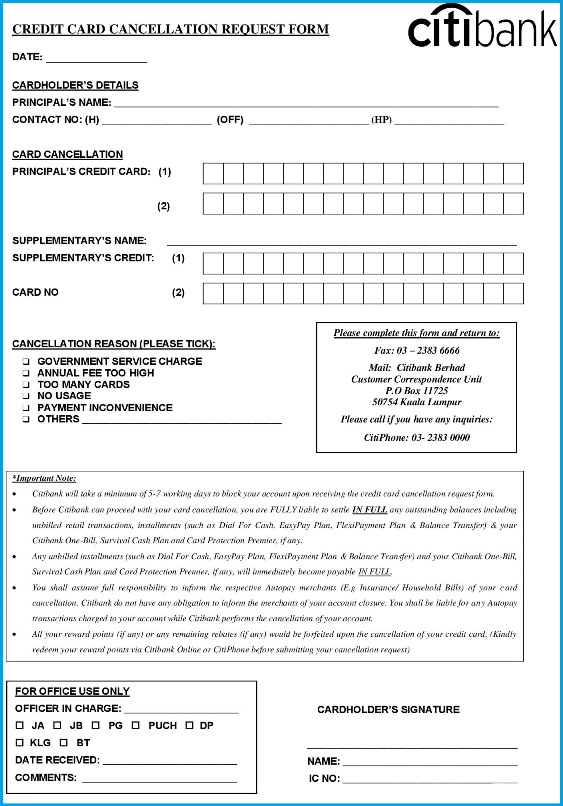
Citibank generally requires card cancellations to be handled over the phone. While you can manage many aspects of your account online, closing it typically necessitates a direct conversation with a customer service representative.
-
Locate the customer service number: This can usually be found on the back of your credit card, on your monthly statement, or on Citibank’s official website under the “Contact Us” section. For specific card types (e.g., Citi Double Cash, Citi Premier), there might be a dedicated number, but the general customer service line can direct you.
-
Optimal timing: Call during off-peak hours (e.g., mid-morning or late afternoon on weekdays) to minimize wait times.
-
State your intent clearly: Once connected, clearly state that you wish to cancel your Citibank credit card.
Navigating the Conversation
Expect the customer service representative to attempt to retain your business. This is standard practice for credit card issuers.
-
Be prepared for retention offers: They might inquire about your reasons for cancellation and offer incentives to keep the card open. These could include waiving the annual fee, offering bonus reward points, a lower interest rate, or a balance transfer promotion.
-
Evaluate the offer: If you’re open to keeping the card, assess whether the offer genuinely addresses your initial reasons for cancellation. If you’re firm in your decision to close the account, politely decline the offers and reiterate your request.
-
Confirm balance and pending charges: The representative will confirm your current balance. If it’s zero, great. If there’s a small residual balance (e.g., from an interest charge that posted after your last payment), they will inform you and guide you on how to pay it immediately. Ensure all pending transactions have cleared before closing to avoid complications.
-
Request immediate closure: Ask for the account to be closed immediately.

Securing Official Confirmation
This is a critical step. Do not hang up until you have explicit confirmation of the account closure.
-
Request a confirmation number: Ask the representative for a confirmation number or a reference ID for the cancellation. Note this down.
-
Request written confirmation: Specifically ask Citibank to send you a written confirmation (via email or postal mail) stating that the account has been closed and that you owe no further balance. This document is your official proof of cancellation.
Post-Cancellation Best Practices
The process isn’t truly complete until you’ve taken a few final steps to secure your financial position and verify the closure.
Verifying Account Closure
Once you’ve received your written confirmation from Citibank, hold onto it for your records. Additionally, keep an eye on your mail for any final statements that might reflect a residual balance or confirm the zero balance after closure. It’s also wise to check your online banking periodically for a month or two to ensure the account status shows as “closed” and there are no unexpected activities.
Safeguarding Your Identity
With the account formally closed, it’s time to physically secure your information.
-
Destroy the physical card: Use a cross-cut shredder to destroy the plastic card itself. Cut through the magnetic stripe and the chip to render it unusable. If you don’t have a shredder, cut it into many small pieces using scissors.
-
Update online accounts: If your Citibank card was linked to any online shopping sites, payment apps, or recurring subscription services, remove it as a payment method and update with a new card.
Monitoring Your Credit Report
Within 30 to 60 days after cancellation, obtain a copy of your credit report from one of the three major credit bureaus (Experian, Equifax, TransUnion). You are entitled to a free report from each bureau annually via AnnualCreditReport.com. Check the report to ensure:
-
The Citibank account is listed as “closed by consumer” or “closed.” This indicates you initiated the closure.
-
The balance is zero.
-
There are no unexpected negative marks.
-
Your credit score has not been unduly impacted. If you notice an unexpected drop, review the report for errors and dispute any inaccuracies.
Exploring Alternatives to Full Cancellation
Sometimes, completely cancelling a credit card isn’t the most financially optimal move. Citibank, like other issuers, offers options that might serve your interests better.
Downgrading to a No-Annual-Fee Card
If your primary reason for cancellation is to avoid an annual fee on a card you no longer frequently use, inquire about downgrading. Citibank offers various no-annual-fee cards (e.g., Citi Double Cash, Citi Custom Cash). Downgrading allows you to keep the account open, thus preserving your credit history and total available credit, which can benefit your credit score. You retain your account number and credit limit, but typically transition to a different rewards structure or set of benefits.
Balance Transfers and Debt Consolidation
If your goal is to manage high-interest debt, cancelling a card without a clear repayment strategy might not be the best solution. Instead, consider a balance transfer to a new card (possibly another Citibank card or one from a different issuer) that offers a 0% introductory APR for a promotional period. This can give you breathing room to pay down the principal without accruing additional interest. Another option is a personal loan for debt consolidation, which combines multiple debts into a single, lower-interest monthly payment.
Leveraging Retention Offers
As mentioned, Citibank representatives are often authorized to make retention offers. If your initial reason for cancelling was due to dissatisfaction with rewards, interest rates, or the annual fee, listen to their proposals. A waiver of the annual fee, a temporary boost in rewards, or a lower APR could be enough to make keeping the card worthwhile, especially if it’s an old account contributing positively to your credit history. Always weigh the value of the offer against your financial goals before accepting or declining.
By carefully considering these factors and following the outlined steps, you can effectively manage the cancellation of your Citibank credit card while safeguarding your financial well-being and credit score.
aViewFromTheCave is a participant in the Amazon Services LLC Associates Program, an affiliate advertising program designed to provide a means for sites to earn advertising fees by advertising and linking to Amazon.com. Amazon, the Amazon logo, AmazonSupply, and the AmazonSupply logo are trademarks of Amazon.com, Inc. or its affiliates. As an Amazon Associate we earn affiliate commissions from qualifying purchases.