
In an increasingly complex financial world, understanding the fundamental mechanics of numbers is not just a convenience—it’s a critical skill. Among the most ubiquitous and impactful of these numerical tools is the percentage. From personal budgeting to investment analysis, understanding “how to calculate the percent of a number” serves as the bedrock for informed financial decision-making. This article delves into the core concept of percentages, elucidates the universal formula, and explores its myriad applications across personal finance, investing, and business, equipping you with the knowledge to navigate your financial landscape with greater precision and confidence.

Understanding the Fundamentals: What Exactly is a Percentage?
Before we dive into calculations, it’s crucial to grasp what a percentage truly represents. At its heart, a percentage is simply a way to express a number as a fraction of 100. The word “percent” itself comes from the Latin “per centum,” meaning “by the hundred.” It’s a standardized way to compare parts of a whole, making different quantities relatable and easier to understand, regardless of their original scale.
The Core Concept: Representing Parts of a Whole
Imagine you have a pie cut into 100 slices. If you eat 15 slices, you’ve eaten 15 percent of the pie. If a company owns 25 out of 100 shares in another venture, it owns 25 percent. This “out of 100” framework is key. It allows for a universal language when discussing proportions, making it easy to compare, say, a 5% discount on a small purchase with a 5% interest rate on a large loan. Without percentages, we’d be comparing fractions like 1/20 to 1/20, or even more complex ones like 7/140 to 13/260, which, while mathematically equivalent, are less intuitive for quick comparison.
Why Percentages Matter in Finance
The relevance of percentages in finance cannot be overstated. They are the language of:
- Discounts and Sales: Every “20% off” sign or “buy one get one 50% off” deal hinges on percentage calculations.
- Interest Rates: Whether it’s the interest you earn on savings, the rate on your mortgage, or the APR on your credit card, percentages dictate the cost or reward of borrowing and lending.
- Taxes: Income tax rates, sales tax, property tax—all are expressed as percentages, directly impacting your disposable income.
- Investment Returns: The growth of your portfolio, the yield on a bond, or the performance of a stock is almost always quantified as a percentage return.
- Profit Margins: Businesses use percentages to understand how much profit they make relative to their sales or costs.
- Inflation: The rate at which prices rise, eroding purchasing power, is measured as a percentage.
Without a solid understanding of how to calculate and interpret percentages, one is essentially financially illiterate, leaving crucial decisions to guesswork rather than informed analysis.
Mastering the Calculation: The Universal Formula
The beauty of percentage calculation lies in its simplicity. Once you understand the core formula, you can apply it to a vast array of financial scenarios.
The Basic Formula: (Part / Whole) × 100
To calculate the percentage of a number, you need two pieces of information: the “part” and the “whole.”
The formula is:
$$ text{Percentage} = left( frac{text{Part}}{text{Whole}} right) times 100 $$
Let’s break down what “Part” and “Whole” mean in different financial contexts:
- Part: This is the specific amount or quantity you are interested in expressing as a percentage. It could be the discount amount, the interest paid, the profit earned, or the amount of tax.
- Whole: This is the total amount, the original value, or the base from which the part is derived. It could be the original price, the principal loan amount, the total investment, or the gross income.
The result of (Part / Whole) will be a decimal. Multiplying by 100 converts this decimal into its percentage equivalent.
Step-by-Step Examples: From Theory to Practice
Let’s apply this formula to common financial situations.
Example 1: Calculating Discounts and Savings
Imagine a coat is originally priced at $200, and it’s on sale for 25% off.
- Problem: How much is the discount in dollars, and what is the final price?
First, find the discount amount:
- Part (discount amount) = ?
- Whole (original price) = $200
- Percentage = 25%
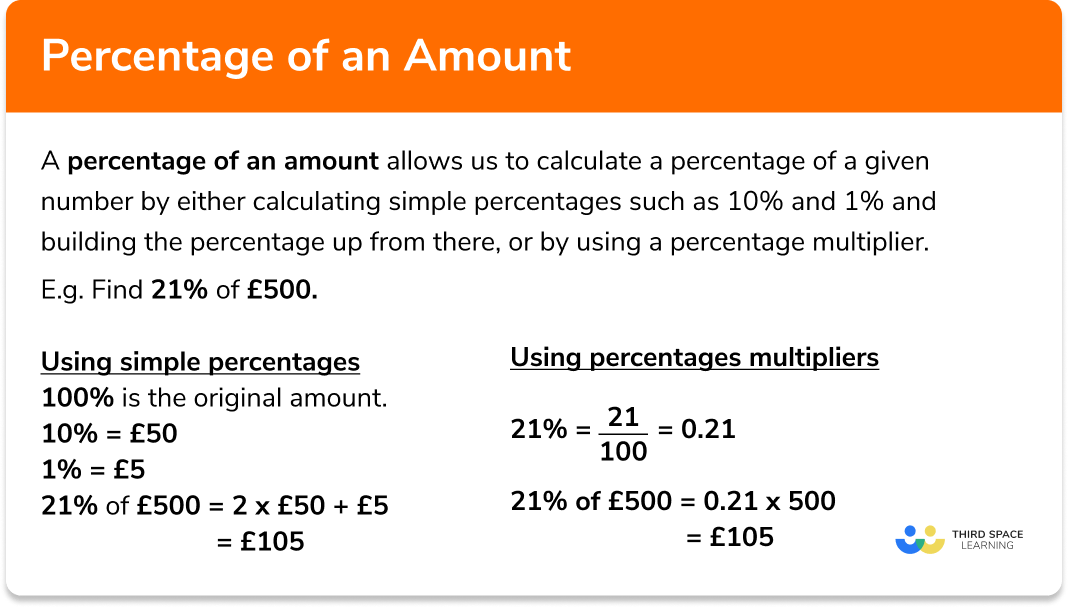
To find the part when you have the whole and the percentage, you rearrange the formula:
Part = (Percentage / 100) × WholeDiscount Amount = (25 / 100) × $200Discount Amount = 0.25 × $200Discount Amount = $50
Now, calculate the final price:
Final Price = Original Price - Discount AmountFinal Price = $200 - $50Final Price = $150
So, a 25% discount on a $200 coat saves you $50, making the final price $150.
Example 2: Determining Sales Tax or Tips
You’re buying a new gadget for $500, and the sales tax in your area is 8%.
-
Problem: How much sales tax will you pay, and what is the total cost?
-
Part (sales tax amount) = ?
-
Whole (item price) = $500
-
Percentage = 8%
Using the rearranged formula:
Sales Tax Amount = (8 / 100) × $500Sales Tax Amount = 0.08 × $500Sales Tax Amount = $40
Now, calculate the total cost:
Total Cost = Item Price + Sales Tax AmountTotal Cost = $500 + $40Total Cost = $540
Similarly, when tipping 15% on a $60 restaurant bill:
Tip Amount = (15 / 100) × $60 = $9Total Bill = $60 + $9 = $69
Example 3: Understanding Interest Rates (Simple vs. Compound Introduction)
You deposit $1,000 into a savings account that offers a 2% annual simple interest rate.
-
Problem: How much interest will you earn in one year?
-
Part (interest earned) = ?
-
Whole (principal amount) = $1,000
-
Percentage (annual interest rate) = 2%
-
Interest Earned = (2 / 100) × $1,000 -
Interest Earned = 0.02 × $1,000 -
Interest Earned = $20
After one year, your $1,000 will have grown to $1,020. This is a basic illustration of simple interest. Compound interest, which involves earning interest on previously earned interest, uses percentages iteratively and is a cornerstone of investment growth.
Real-World Financial Applications of Percentages
Percentages are not abstract mathematical concepts; they are the gears that drive almost every aspect of your financial life. Leveraging them effectively can significantly enhance your financial acumen and decision-making.
Personal Finance: Budgeting, Debt, and Savings Goals
Managing personal finances is fundamentally about managing proportions—how much of your income goes to expenses, how much to savings, and how much to debt repayment.
Budgeting: The 50/30/20 Rule and Beyond
A popular budgeting guideline, the 50/30/20 rule, is entirely percentage-based:
- 50% of your income for Needs (housing, utilities, groceries, transportation).
- 30% of your income for Wants (dining out, entertainment, hobbies).
- 20% of your income for Savings & Debt Repayment (emergency fund, retirement, extra debt payments).
To apply this, you first need to calculate:
Needs Budget = 0.50 × Net IncomeWants Budget = 0.30 × Net IncomeSavings/Debt Budget = 0.20 × Net Income
This framework allows you to easily categorize and allocate funds, ensuring you’re prioritizing your financial well-being.
Debt Management: Understanding Interest Accrual
Credit card interest rates, mortgage rates, and personal loan rates are all percentages. A 19.99% APR (Annual Percentage Rate) on a credit card means that, annually, you could pay nearly 20% of your outstanding balance in interest if you don’t pay it off. Understanding this allows you to calculate the true cost of debt and prioritize paying off high-interest balances. If you carry a $1,000 balance at 19.99% APR, your annual interest could be approximately 0.1999 * $1,000 = $199.90 (ignoring compounding for simplicity). This insight often motivates faster debt repayment.
Savings Growth: Tracking Progress Towards Financial Milestones
Setting a savings goal, like saving $10,000 for a down payment, becomes more manageable when viewed through percentages. If you’ve saved $2,500, you’ve reached ($2,500 / $10,000) × 100 = 25% of your goal. Tracking progress in percentages can be highly motivating and helps adjust your saving rate if you’re falling behind or ahead of schedule.
Investing: Evaluating Returns and Risk
In the world of investing, percentages are the primary metric for evaluating performance and assessing risk.
Return on Investment (ROI): Measuring Profitability
ROI is a crucial metric that measures the profitability of an investment relative to its cost.
$$ text{ROI} = left( frac{text{Net Profit}}{text{Cost of Investment}} right) times 100 $$
If you invest $1,000 in a stock and sell it for $1,200 (a $200 profit), your ROI is:
ROI = ($200 / $1,000) × 100 = 20%
This allows you to compare the efficiency of different investments, regardless of their initial cost.
Portfolio Allocation: Diversification Strategies
Modern portfolio theory emphasizes diversification, often expressed in percentages. An investor might decide on an asset allocation of “60% stocks, 30% bonds, 10% cash.” To maintain this balance, you constantly calculate the percentage of each asset class in your portfolio and rebalance as needed. If your stocks grow significantly, their percentage of the total portfolio might increase, prompting you to sell some stocks and buy more bonds to restore the desired allocation.
Compounding Returns: The Eighth Wonder of the World
While simple interest provides a basic understanding, true wealth accumulation in investing comes from compound returns. This is where interest (or returns) earned in one period is added to the principal, and then the next period’s interest is calculated on the new, larger principal. The percentage rate remains the same, but the base on which it is calculated grows, leading to exponential growth. Understanding this multiplicative power of percentages is vital for long-term financial planning and retirement savings.
Leveraging Percentages for Business and Entrepreneurship
For entrepreneurs and business professionals, percentage calculations are indispensable for analyzing performance, setting prices, and making strategic decisions.
Profit Margins and Pricing Strategies
Businesses use profit margins, expressed as percentages, to gauge their efficiency and profitability.
- Gross Profit Margin:
(Gross Profit / Revenue) × 100– Indicates how much profit a company makes from its sales after accounting for the cost of goods sold. - Net Profit Margin:
(Net Profit / Revenue) × 100– Shows the percentage of revenue left after all expenses, including taxes, have been deducted.
These percentages guide pricing strategies. If a company aims for a 30% gross profit margin, it can calculate the optimal selling price for its products given its production costs.
Sales Growth and Market Share Analysis
- Sales Growth: Businesses constantly track their sales growth, often year-over-year or quarter-over-quarter. If sales increased from $1,000,000 to $1,200,000, the percentage growth is
(($1,200,000 - $1,000,000) / $1,000,000) × 100 = 20%. This metric helps assess business health and effectiveness of strategies. - Market Share: This is the percentage of total sales in an industry generated by a particular company. If the total market is $10 million and your company has $2 million in sales, your market share is
($2,000,000 / $10,000,000) × 100 = 20%. Understanding market share is crucial for competitive analysis and strategic planning.
Expense Ratios and Cost Optimization
Businesses analyze expense ratios to identify areas for cost optimization. An “operating expense ratio” might compare operating expenses to revenue. If operating expenses are 40% of revenue, and a competitor manages 30%, it indicates a potential area for efficiency improvement. Regularly calculating and monitoring these percentage-based ratios helps businesses streamline operations and improve profitability.
Common Pitfalls and Advanced Considerations
While the core calculation is straightforward, understanding nuances and avoiding common misinterpretations is crucial for accurate financial analysis.
Avoiding Percentage Misinterpretations
One common pitfall is misunderstanding “percentage points” versus “percentage change.” If an interest rate increases from 5% to 7%, it’s an increase of 2 percentage points. However, the percentage change in the rate itself is ((7-5)/5) * 100 = 40%. Failing to distinguish between these can lead to significant misjudgments, especially in financial news or reports.
Another mistake is incorrectly applying percentages to different bases. A 10% increase followed by a 10% decrease does not bring you back to the original number. For example, $100 + 10% = $110. Then, $110 – 10% = $99. The base changed, leading to a different outcome.
Annual Percentage Rate (APR) vs. Annual Percentage Yield (APY)
In banking, you’ll encounter APR and APY, both percentage-based.
- APR (Annual Percentage Rate) usually represents the yearly cost of borrowing, including fees, but without accounting for the effect of compounding within the year.
- APY (Annual Percentage Yield), on the other hand, does account for the effect of compounding interest. APY typically reflects the actual annual rate of return an investment earns or a loan costs, taking into account how often the interest is compounded. For savings accounts, APY is usually higher than the stated interest rate because it reflects the power of compounding. For loans, the APR often provides a better comparison of the stated cost. Understanding the difference is vital when comparing loans or savings products.
Using Financial Tools and Calculators Effectively
While manual calculation is fundamental, financial calculators, spreadsheets (like Excel or Google Sheets), and online tools can automate complex percentage calculations, especially those involving compounding over multiple periods. Knowing the underlying formulas, however, empowers you to correctly input values and interpret the results from these tools, rather than blindly trusting the output. Functions like RATE, NPER, PMT, and FV in spreadsheets are powerful for financial planning, all built upon percentage logic.

Conclusion
The ability to calculate the percent of a number is more than a basic arithmetic skill; it is a foundational component of financial literacy. From navigating everyday purchases and managing personal budgets to making informed investment decisions and running a profitable business, percentages provide the indispensable framework for understanding the quantitative aspects of money. By mastering the core formula, applying it to real-world financial scenarios, and understanding its nuances, you gain a powerful tool for analyzing information, making strategic choices, and ultimately, building a more secure and prosperous financial future. Embrace percentages as your financial compass, and you’ll find yourself far better equipped to steer towards your economic goals.
aViewFromTheCave is a participant in the Amazon Services LLC Associates Program, an affiliate advertising program designed to provide a means for sites to earn advertising fees by advertising and linking to Amazon.com. Amazon, the Amazon logo, AmazonSupply, and the AmazonSupply logo are trademarks of Amazon.com, Inc. or its affiliates. As an Amazon Associate we earn affiliate commissions from qualifying purchases.