
Understanding how your Social Security benefits are calculated is not just an academic exercise; it’s a critical component of sound retirement planning. For millions of Americans, Social Security represents a significant, often foundational, source of income in their later years. Knowing how these benefits are derived empowers you to make informed decisions about your work life, claiming age, and overall financial future. Far from being a simple, one-size-fits-all number, your Social Security benefit is the product of a complex formula that considers decades of your earnings, inflation adjustments, and a host of other factors. This article aims to demystify that process, guiding you through the intricate steps the Social Security Administration (SSA) uses to determine your monthly payment. From understanding your earnings record to navigating the impact of claiming age, we’ll break down the essentials, providing you with a clearer picture of what you can expect and how your choices can influence that outcome.

Understanding the Foundation: Your Work Record
The bedrock of your Social Security benefit calculation is your detailed work history and, more specifically, your earnings record. The SSA meticulously tracks your income throughout your working life, using this data as the primary input for determining your future benefits. It’s a testament to decades of contributions and hard work, and every dollar earned (up to a certain limit) plays a role.
The Importance of Covered Earnings
Social Security benefits are funded through payroll taxes, also known as Federal Insurance Contributions Act (FICA) taxes, which are deducted from your wages. These wages, up to an annual maximum, are referred to as “covered earnings.” Only earnings on which you and your employer (or you, if self-employed) paid FICA taxes are considered when calculating your Social Security benefit. It’s crucial that your employers correctly report your earnings to the SSA each year. Discrepancies can impact your future benefits, highlighting the importance of regularly checking your Social Security statement. The more covered earnings you accrue over your career, the higher your potential benefit will be, assuming all other factors remain constant. This incentivizes a consistent and well-compensated work history.
The Annual Wage Base Limit
While maximizing your covered earnings is beneficial, it’s important to understand that there’s an annual limit to the amount of earnings that are subject to Social Security taxes and, consequently, are counted towards your benefit calculation. This limit, known as the “Social Security Wage Base” or “Maximum Taxable Earnings,” is adjusted annually to reflect changes in the national average wage index. For example, in 2023, the wage base was $160,200, and in 2024, it increased to $168,600. Earnings above this limit are not subject to Social Security taxes and do not contribute to your benefit calculation. This means that high-income earners will eventually hit a ceiling on the amount of earnings considered for their benefits, ensuring a progressive benefit formula that disproportionately favors lower-income individuals relative to their contributions.
The 35-Year Rule
A critical aspect of the calculation involves selecting a specific portion of your earnings history. The SSA doesn’t simply average all your years of work. Instead, it focuses on your highest-earning years. Specifically, the SSA uses your 35 highest years of indexed earnings to calculate your benefits. If you have worked for more than 35 years, your lowest-earning years (or years with no earnings) will be dropped from the calculation, effectively improving your average. Conversely, if you have fewer than 35 years of covered earnings, “zeroes” will be averaged in for the missing years. This significantly impacts individuals who take extended breaks from the workforce, work part-time for many years, or have shorter careers. Understanding this rule underscores the value of maintaining a consistent work history and potentially working longer to replace low-earning years with higher ones.
The Core Calculation: Average Indexed Monthly Earnings (AIME)
With your work record established, the next crucial step in determining your Social Security benefit involves a process called “indexing” your earnings and then calculating your Average Indexed Monthly Earnings (AIME). This step is designed to ensure that your past earnings accurately reflect their value in today’s economy.
Indexing Your Earnings
Inflation and general wage growth mean that a dollar earned in 1980 had significantly more purchasing power than a dollar earned today. To account for this, the SSA “indexes” your past earnings to bring them up to near current wage levels. This indexing process applies to earnings from two years prior to the year you turn 62, or two years before you become disabled or die. Earnings in the year you turn 62 and subsequent years are counted at their nominal (actual) value.
The indexing factor is determined by the national average wage index (AWI) for the year your earnings are being indexed and the AWI for the “indexing year” (two years before you turn 62). For example, if you turn 62 in 2024, your indexing year is 2022. Your earnings from 1990 would be multiplied by a factor derived from the AWI in 2022 divided by the AWI in 1990. This adjustment ensures that your benefits reflect a fair measure of your lifetime earnings in relation to the general wage level when you become eligible for benefits, rather than just their historical dollar value. This is a critical step because it standardizes the value of your contributions across different economic eras.
Calculating Your AIME
Once your earnings have been indexed, the SSA calculates your Average Indexed Monthly Earnings (AIME). This involves a few straightforward steps:
- Select the highest 35 years: From your indexed earnings record, the SSA identifies the 35 years in which you earned the most. If you have fewer than 35 years of earnings, zero earnings are used for the remaining years.
- Sum the indexed earnings: The indexed earnings from these 35 highest years are added together.
- Divide by 420: The total sum of these 35 years of indexed earnings is then divided by 420 (which is 35 years multiplied by 12 months per year).
The resulting figure is your AIME. This single number represents your average monthly earnings over your highest-earning 35 years, adjusted for historical wage growth. Your AIME is a pivotal value because it directly feeds into the final step of determining your basic benefit amount.
From AIME to Primary Insurance Amount (PIA)
With your Average Indexed Monthly Earnings (AIME) calculated, the SSA then uses this figure to determine your Primary Insurance Amount (PIA). The PIA is arguably the most important number in the entire Social Security calculation, as it represents the monthly benefit you would receive if you began collecting benefits exactly at your Full Retirement Age (FRA).
The Bend Points System
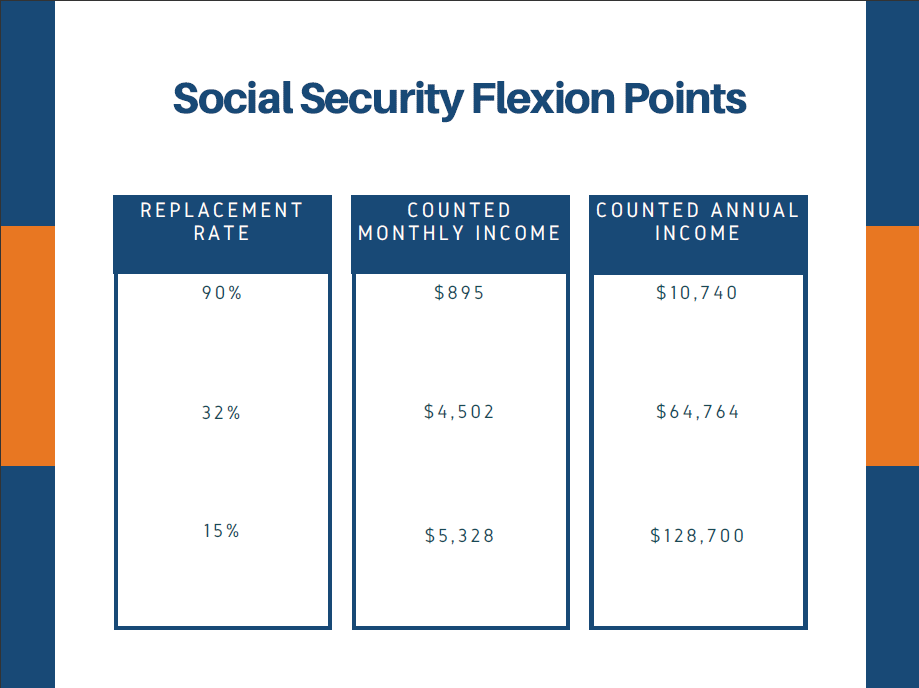
To convert your AIME into your PIA, the SSA uses a progressive formula involving “bend points.” This system is designed to provide a higher replacement rate (the percentage of your pre-retirement earnings replaced by benefits) for lower-income workers. The formula consists of three segments, each applying a different percentage to a portion of your AIME. These “bend points” are specific dollar amounts that define the thresholds between these segments and are adjusted annually based on changes in the national average wage index.
For example, for someone becoming eligible for retirement benefits in 2024:
- 90% of the first $1,174 of their AIME
- Plus 32% of their AIME over $1,174 up to $7,078
- Plus 15% of their AIME over $7,078
The sum of these three calculated amounts forms your PIA. This progressive structure is a hallmark of Social Security, ensuring that individuals with lower lifetime earnings receive a proportionally larger benefit relative to their contributions compared to high-income earners. It’s a key feature that underscores Social Security’s role as a social safety net.
What is Your Primary Insurance Amount (PIA)?
Your Primary Insurance Amount (PIA) is the monthly benefit amount you are entitled to if you file for retirement benefits precisely at your Full Retirement Age (FRA). It’s crucial to understand that the PIA itself is not necessarily the amount you will receive each month. Instead, it serves as the base figure from which all other benefit calculations are made. Whether you claim benefits earlier or later than your FRA, the final amount you receive will be an adjustment of your PIA.
For instance, spousal benefits are often calculated as a percentage of the worker’s PIA (up to 50%), and survivor benefits are also directly linked to the deceased worker’s PIA. Therefore, the PIA acts as the central pillar of the Social Security benefit system, and understanding how it’s derived from your AIME via the bend points is fundamental to grasping the entire calculation process.
Adjusting for When You Claim: The Impact of Timing
While your Primary Insurance Amount (PIA) is the fundamental building block of your Social Security benefit, the exact monthly payment you receive will heavily depend on one of the most significant decisions you’ll make: when you choose to start collecting your benefits. Claiming earlier or later than your Full Retirement Age (FRA) can result in a permanent reduction or increase in your monthly payout.
Full Retirement Age (FRA): The Benchmark
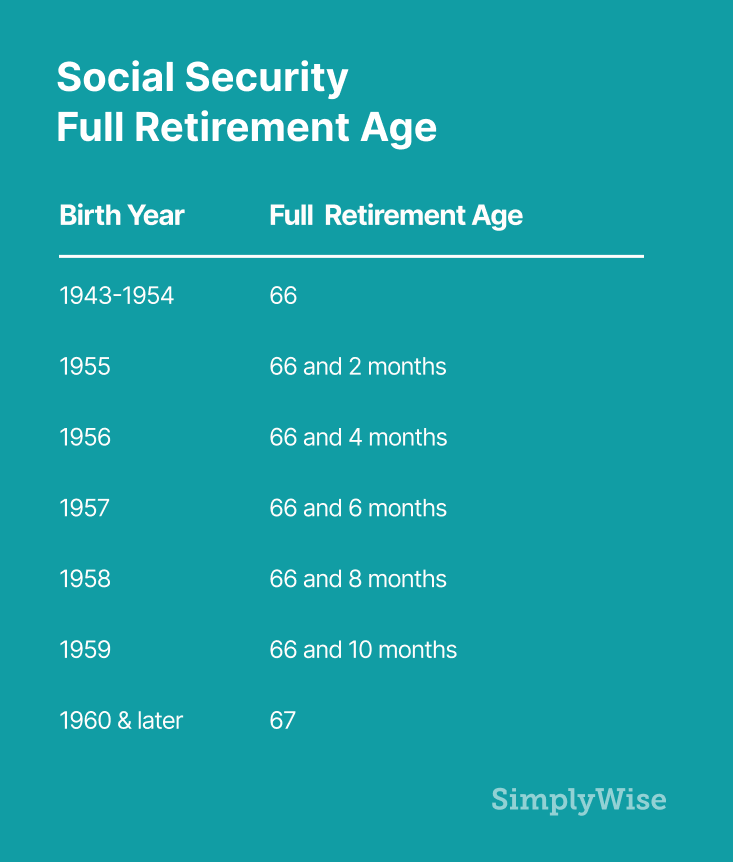
Your Full Retirement Age (FRA), sometimes called “normal retirement age,” is the age at which you are entitled to receive 100% of your calculated Primary Insurance Amount (PIA). This age is determined by your birth year and has been gradually increasing for several decades. For those born in 1937 or earlier, FRA was 65. For those born between 1943 and 1954, it is 66. For those born in 1960 or later, your FRA is 67. Understanding your specific FRA is paramount, as it serves as the benchmark against which all early or delayed claiming adjustments are measured. Claiming at FRA avoids any penalties or credits, allowing you to receive your unadjusted PIA.
Early Claiming Penalties
You can begin collecting Social Security retirement benefits as early as age 62. However, choosing to claim before your FRA results in a permanent reduction of your monthly benefit. This reduction is not temporary; it lasts for your entire lifetime. The amount of the reduction depends on how many months prior to your FRA you start receiving benefits.
The reduction is calculated in two tiers:
- For the first 36 months before FRA, your benefit is reduced by 5/9 of 1% for each month.
- For any months beyond 36 (if your FRA is later than 65), your benefit is reduced by an additional 5/12 of 1% per month.
For example, if your FRA is 67 and you claim at age 62, your benefit would be reduced by approximately 30%. This is a significant permanent reduction, which highlights the financial trade-off involved in accessing benefits earlier. While early claiming provides income sooner, it also means a lower monthly payment for the rest of your life.
Delayed Retirement Credits (DRCs): Boosting Your Benefits
Conversely, if you choose to delay claiming your Social Security benefits beyond your Full Retirement Age (FRA), you can earn Delayed Retirement Credits (DRCs). These credits permanently increase your monthly benefit amount. You can continue to earn DRCs up until age 70. There is no additional benefit to delaying beyond age 70.
The rate at which DRCs accrue depends on your birth year, but for most individuals born in 1943 or later, the annual increase is 8% per year. This means that for every year you delay claiming past your FRA, your monthly benefit increases by 8% of your PIA. For instance, if your FRA is 67 and you delay claiming until age 70, you would receive an additional 24% (3 years x 8% per year) on top of your PIA. This can lead to a substantially higher monthly payment, making delayed claiming an attractive option for those who are able to work longer or who have other sufficient income sources during their early retirement years.
The “Breakeven Point” Consideration
The decision of when to claim Social Security benefits is often complex and involves considering your personal financial situation, health, longevity expectations, and other retirement income sources. Financial advisors often discuss the concept of a “breakeven point,” which is the age at which the total cumulative benefits received by delaying claiming would surpass the total cumulative benefits received by claiming earlier. While a helpful concept, the breakeven point is an estimate and doesn’t account for all individual variables, making it a highly personal decision.
Other Factors and Tools for Calculation
Beyond your individual earnings record and claiming age, several other factors can influence your Social Security benefits. Understanding these nuances and utilizing the right tools can provide a more comprehensive picture of your financial future.
Spousal and Survivor Benefits
Social Security is not just for individual workers; it also provides crucial protections for families. Spousal benefits allow a non-working or lower-earning spouse to claim up to 50% of their higher-earning spouse’s Primary Insurance Amount (PIA), provided they claim at their own FRA. If the spouse claims early, their spousal benefit will also be reduced. Survivor benefits are paid to eligible family members (e.g., widow(er)s, minor children) upon the death of a worker. A widow or widower can typically receive 100% of their deceased spouse’s PIA if they claim at their own FRA or later, or a reduced amount if they claim earlier. These benefits are directly tied to the deceased worker’s PIA, underscoring the importance of that core calculation.
The Retirement Earnings Test
If you claim Social Security benefits before your Full Retirement Age (FRA) and continue to work, your benefits may be temporarily reduced or withheld if your earnings exceed certain annual limits. This is known as the Retirement Earnings Test. For example, in the year before you reach FRA, the SSA deducts $1 from your benefits for every $2 you earn above a specific annual limit. In the year you reach FRA, the deduction is $1 for every $3 earned above a higher annual limit, up until the month you reach FRA. Once you reach your FRA, the earnings test no longer applies, and you can earn any amount without it affecting your benefits. It’s important to note that any benefits withheld due to the earnings test are not lost; your PIA will be recalculated at your FRA to account for the withheld benefits, effectively giving you credit for them later.
Using the Social Security Administration’s Tools
While the calculation process might seem complex, the Social Security Administration (SSA) provides excellent resources to help you understand and estimate your benefits.
- “my Social Security” Account: Creating an online account at www.ssa.gov/myaccount is perhaps the most valuable tool. This portal allows you to view your personalized Social Security statement, which includes your detailed earnings record, estimates of your future benefits at different claiming ages (FRA, early, and delayed), and estimates for disability and survivor benefits. Regularly checking your earnings record for accuracy is a critical step in safeguarding your future benefits.
- Retirement Estimator: The SSA’s online Retirement Estimator tool allows you to plug in different scenarios (e.g., various claiming ages, future earnings projections) to see how these choices might impact your benefit amount. It’s an interactive way to explore the financial implications of your decisions.
- Benefit Calculators: The SSA website also hosts various other calculators and detailed publications that explain the benefit formulas and regulations in depth.
These tools are invaluable for financial planning, providing personalized and accurate estimates based on your actual earnings history.
Conclusion
Calculating Social Security benefits is a multi-step process that transforms decades of your work history into a monthly payment designed to support you in retirement. From the fundamental importance of your covered earnings and the 35-year rule to the intricate indexing of past wages leading to your Average Indexed Monthly Earnings (AIME), and finally, the conversion to your Primary Insurance Amount (PIA) via the bend points, each stage plays a vital role. Crucially, the final amount you receive is significantly influenced by your decision on when to claim your benefits relative to your Full Retirement Age (FRA), with penalties for early claiming and valuable Delayed Retirement Credits for delaying.
Understanding these mechanics is more than just knowing a number; it’s about gaining control over a significant aspect of your financial future. By regularly reviewing your “my Social Security” account, utilizing the SSA’s online estimators, and considering the broader context of your financial plan, you can make informed decisions that optimize your Social Security income. Social Security is a powerful retirement asset, and a clear understanding of its calculation is your first step towards leveraging it effectively for a secure retirement.
aViewFromTheCave is a participant in the Amazon Services LLC Associates Program, an affiliate advertising program designed to provide a means for sites to earn advertising fees by advertising and linking to Amazon.com. Amazon, the Amazon logo, AmazonSupply, and the AmazonSupply logo are trademarks of Amazon.com, Inc. or its affiliates. As an Amazon Associate we earn affiliate commissions from qualifying purchases.