
For most Americans, Social Security serves as the foundation of a sound retirement strategy. However, despite its ubiquity, the actual mechanics behind the calculation of these benefits remain a mystery to many. Understanding how the Social Security Administration (SSA) determines your monthly check is not merely an academic exercise; it is a critical component of financial planning that dictates when you can afford to stop working and how much you need to save in private accounts.
The calculation of Social Security retirement benefits is a multi-step process that accounts for your entire working history, the effects of inflation, and the specific age at which you choose to claim. By mastering these variables, you can move from guesswork to precision in your retirement projections.

The Foundation: Determining Your Primary Insurance Amount (PIA)
The journey to your monthly benefit begins with the Primary Insurance Amount, or PIA. This is the base figure the SSA uses to determine your monthly payment if you claim benefits exactly at your Full Retirement Age (FRA). To arrive at this number, the SSA uses a complex formula based on your lifetime earnings.
The 35-Year Rule and Indexing
The SSA does not simply look at your most recent salary. Instead, it looks at your highest 35 years of earnings. If you have worked for 40 years, only the 35 highest-earning years are used. If you have worked fewer than 35 years, the remaining years are calculated as zeros, which can significantly drag down your benefit average.
To ensure that earnings from decades ago are comparable to modern wages, the SSA “indexes” your earnings. This process adjusts your historical income to reflect changes in general wage levels that occurred during your working years. For example, $15,000 earned in 1985 is weighted much more heavily than $15,000 earned in 2023 because of the Social Security National Average Wage Index (NAWI).
Calculating AIME (Average Indexed Monthly Earnings)
Once your earnings are indexed, the SSA identifies the top 35 years and sums them. This total is then divided by 420 (the number of months in 35 years) to reach your Average Indexed Monthly Earnings (AIME). This figure represents the monthly average of your career earnings, adjusted for inflation, over your most productive decades.
Applying the “Bend Points”
Social Security is designed to be a progressive system, meaning it provides a higher “replacement rate” for lower-income earners than for higher-income earners. This is achieved through “bend points.”
For an individual reaching age 62 in 2024, the PIA formula is the sum of:
-
90% of the first $1,174 of AIME.
-
32% of AIME between $1,174 and $7,078.
-
15% of AIME over $7,078.
These dollar amounts (the bend points) change annually based on national wage trends. This tiered approach ensures that while higher earners receive a larger total check, lower earners receive a check that covers a larger percentage of their pre-retirement income.
The Impact of Timing: Full Retirement Age vs. Early or Delayed Filing
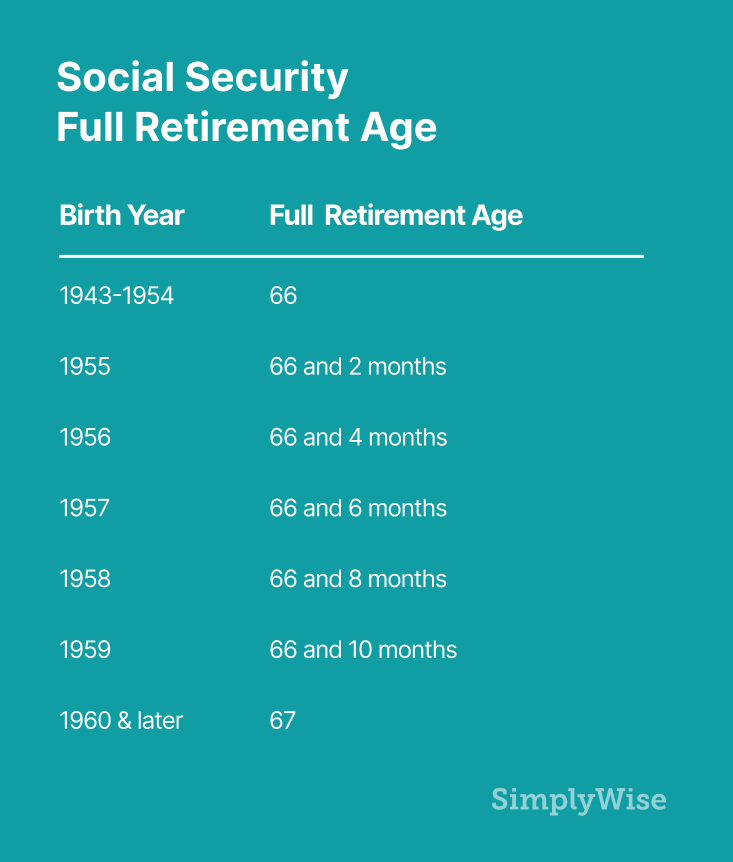
While the PIA provides the baseline, the actual amount you receive is heavily influenced by the age at which you elect to begin receiving benefits. The SSA assigns every individual a Full Retirement Age (FRA), which is 67 for anyone born in 1960 or later.
The Cost of Early Filing
You can begin claiming Social Security as early as age 62, but doing so comes with a permanent reduction in benefits. If your FRA is 67 and you claim at 62, your monthly benefit is reduced by 30%. This reduction is calculated based on a specific formula: benefits are reduced by 5/9 of 1% for each month before FRA, up to 36 months, and 5/12 of 1% for each additional month.
For many, the “early bird” approach is a necessity due to health or job loss. However, from a strictly financial perspective, claiming early requires a “break-even analysis.” You will receive more checks over your lifetime by starting at 62, but each check will be significantly smaller. Generally, if you live past your late 70s or early 80s, you would have been financially better off waiting.
The Reward for Delayed Retirement Credits
Conversely, for every month you delay claiming past your FRA up until age 70, your benefit increases by 2/3 of 1%. This equates to an 8% simple interest increase for every year you wait. There is no financial incentive to delay past age 70, as the credits stop accumulating.
For a retiree with an FRA of 67, waiting until age 70 results in a monthly check that is 124% of their PIA. In an era of market volatility, an 8% guaranteed annual increase is one of the most powerful “investments” available to a retiree. This strategy is particularly effective for the higher-earning spouse in a household, as it also increases the survivor benefit for the remaining spouse later in life.
Navigating the Retirement Earnings Test and Taxation
A common misconception is that Social Security is “all or nothing.” In reality, your lifestyle choices—specifically whether you continue to work while receiving benefits—can alter your immediate cash flow.
The Retirement Earnings Test (RET)
If you claim benefits before reaching your Full Retirement Age and continue to work, the SSA applies an earnings test. In 2024, if you are under FRA for the entire year, the SSA deducts $1 from your benefit payments for every $2 you earn above $22,320. In the year you reach FRA, the threshold increases significantly, and the deduction drops to $1 for every $3 earned.
It is important to note that these “withheld” benefits are not lost forever. Once you reach your FRA, the SSA recalculates your monthly benefit upward to account for the months where benefits were withheld. Essentially, the RET acts as a forced delay in benefits rather than a permanent tax.
The Taxation of Benefits
Social Security benefits themselves may be subject to federal income tax depending on your “provisional income.” Provisional income is the sum of your Adjusted Gross Income (AGI), non-taxable interest, and 50% of your Social Security benefits.
-
Individuals: If your provisional income is between $25,000 and $34,000, you may pay income tax on up to 50% of your benefits. If it exceeds $34,000, up to 85% of your benefits may be taxable.
-
Married Couples: If your joint provisional income is between $32,000 and $44,000, you may pay tax on up to 50% of benefits. Above $44,000, up to 85% may be taxable.
Understanding these thresholds is vital for tax-efficient withdrawal strategies involving 404(k)s and IRAs.
Strategic Planning: Using Tools and Real-World Scenarios
Calculating Social Security is complex because it is dynamic. Your benefit is not a static number but a variable that changes based on your career trajectory and the macro-economic environment.
Leveraging the “my Social Security” Account
The most accurate way to start your calculation is by creating an account on the SSA’s official website. This provides your “Social Security Statement,” which lists your verified earnings history. If there is an error in your reported income from ten years ago, your final calculation will be wrong. Reviewing this statement annually is a fundamental task for anyone over the age of 30.
The SSA also provides several calculators:
-
The Quick Calculator: Provides a rough estimate based on your current age and earnings.
-
The Retirement Estimator: Links to your actual earnings record for a more precise figure.
-
The Detailed Calculator: A downloadable program that allows for “what-if” scenarios, such as projected future raises or early retirement.
The Role of Spousal and Survivor Benefits
Your personal calculation might only be half the story. If you are married, you are eligible for the higher of your own retirement benefit or 50% of your spouse’s PIA (if you claim at your FRA). Furthermore, survivor benefits allow a widow or widower to inherit 100% of the deceased spouse’s benefit if that amount is higher than their own.
Strategic coordination between spouses can significantly increase the “household” lifetime benefit. Often, the optimal strategy involves the lower-earning spouse claiming early to provide immediate cash flow, while the higher-earning spouse delays until age 70 to maximize the long-term benefit and the potential survivor benefit.

Conclusion: The Long-View Approach to Calculation
Calculating your Social Security retirement benefit is not a “one and done” task. It requires periodic review as your income changes and as you approach your target retirement date. The interplay between the 35-year earnings average, the bend points of the PIA, and the mathematical impact of your claiming age creates a sophisticated financial puzzle.
By treating Social Security as a component of a larger portfolio—one that offers inflation-adjusted, government-backed longevity insurance—you can make more informed decisions about your other investments. Whether you choose to claim at 62 to enjoy an active early retirement or wait until 70 to lock in the highest possible guaranteed income, the power of the calculation lies in its ability to provide certainty in an uncertain financial future. Understanding the math today ensures that the “social safety net” becomes a robust pillar of your personal wealth tomorrow.
aViewFromTheCave is a participant in the Amazon Services LLC Associates Program, an affiliate advertising program designed to provide a means for sites to earn advertising fees by advertising and linking to Amazon.com. Amazon, the Amazon logo, AmazonSupply, and the AmazonSupply logo are trademarks of Amazon.com, Inc. or its affiliates. As an Amazon Associate we earn affiliate commissions from qualifying purchases.