
Understanding how your Social Security benefits are calculated is not just a matter of curiosity; it’s a fundamental aspect of comprehensive retirement planning. For millions of Americans, Social Security represents a significant, often indispensable, source of income in their golden years. Yet, the exact mechanism by which these benefits are determined can seem shrouded in complexity. Many people only dimly grasp that their lifetime earnings play a role, but the precise formula, the weights, and the various factors that influence the final payout often remain a mystery.
This article aims to demystify the process, breaking down the calculation of Social Security earnings into understandable components. By peeling back the layers of jargon and intricate formulas, we will reveal how the Social Security Administration (SSA) assesses your work history, converts those earnings into a monthly benefit, and ultimately determines the amount you’re entitled to receive. Far from being a mere academic exercise, this knowledge empowers you to make informed decisions about your career, retirement age, and overall financial strategy, ensuring you maximize this crucial retirement safety net. Whether you’re decades away from retirement or approaching it rapidly, grasping these mechanics is a powerful step towards securing your financial future.

Understanding the Fundamentals of Social Security Earnings
Before diving into the nuts and bolts of the calculation, it’s essential to establish a foundational understanding of what Social Security considers “earnings” and why your earnings record is so critical. This groundwork will illuminate the subsequent steps and provide context for the entire benefit determination process.
What are “Earnings” for Social Security Purposes?
When the Social Security Administration refers to your “earnings,” they are specifically talking about wages and net earnings from self-employment that are subject to Social Security taxes (FICA taxes). This means that not all income you receive throughout your working life necessarily counts towards your Social Security benefit. For instance, investment income, capital gains, most pensions, and inheritances are generally not subject to Social Security taxes and therefore do not directly contribute to your future benefits. The earnings that count are those reported by your employer on your W-2 form, or your net self-employment income reported on Schedule SE if you are self-employed, up to a certain annual limit. These reported earnings form the basis of your individual Social Security earnings record, a lifelong chronicle maintained by the SSA that is pivotal for calculating your benefits.
The Importance of Your Earnings Record
Your Social Security earnings record is arguably the single most important document for determining your future benefits. It’s a comprehensive history of all your taxed earnings throughout your working life. The SSA uses this record to:
- Determine Eligibility: You need a minimum number of “credits” (earned through your taxable earnings) to qualify for retirement, disability, or survivor benefits.
- Calculate Benefit Amount: The higher your lifetime average earnings (up to the annual limit), the higher your potential Social Security benefit. The calculation is directly tied to the specific dollar amounts recorded year by year.
- Correct Errors: Regularly reviewing your earnings record (which you can do online through your my Social Security account) is crucial to ensure accuracy. Mistakes, such as unreported earnings or incorrect figures, can significantly reduce your future benefits if not corrected promptly.
This record is the bedrock upon which all subsequent calculations are built. Its accuracy is paramount, underscoring the importance of periodically verifying its contents against your own records.
Maximum Taxable Earnings Limit
An often-misunderstood aspect of Social Security earnings is the annual maximum taxable earnings limit. Each year, there’s an upper cap on the amount of your earnings that are subject to Social Security taxes. For example, in 2024, the maximum taxable earnings limit is $168,600. This means that if you earn $200,000 in a given year, only the first $168,600 of your income will be subject to Social Security taxes and, crucially, only this amount will be credited to your earnings record for benefit calculation purposes. Any income earned above this threshold does not contribute to your Social Security benefits, nor are you taxed on it for Social Security purposes. This limit adjusts annually based on changes in the national average wage index. Understanding this cap is vital for high-income earners, as it defines the upper boundary of their contribution and potential benefit growth.
The Calculation Process: Key Components
With the fundamentals in place, we can now delve into the actual methodology the Social Security Administration employs to convert your lifetime earnings into a monthly benefit amount. This process involves several distinct steps, each contributing to the final figure.
Accumulating “Credits”
The first hurdle for anyone seeking Social Security benefits is to become “insured” by accumulating enough Social Security “credits.” In 2024, you earn one credit for every $1,730 in wages or self-employment income, up to a maximum of four credits per year. This means you need to earn $6,920 in a year to get the maximum four credits. While the dollar amount required for a credit changes annually with inflation, the maximum of four credits per year remains constant. Most people need 40 credits (10 years of work) to be eligible for retirement benefits. However, the number of credits needed for disability or survivor benefits can vary based on age at the time of disability or death. These credits establish your basic eligibility; they do not directly determine your benefit amount, but without them, no benefits can be paid.
Identifying Your Highest Earning Years (APEW)
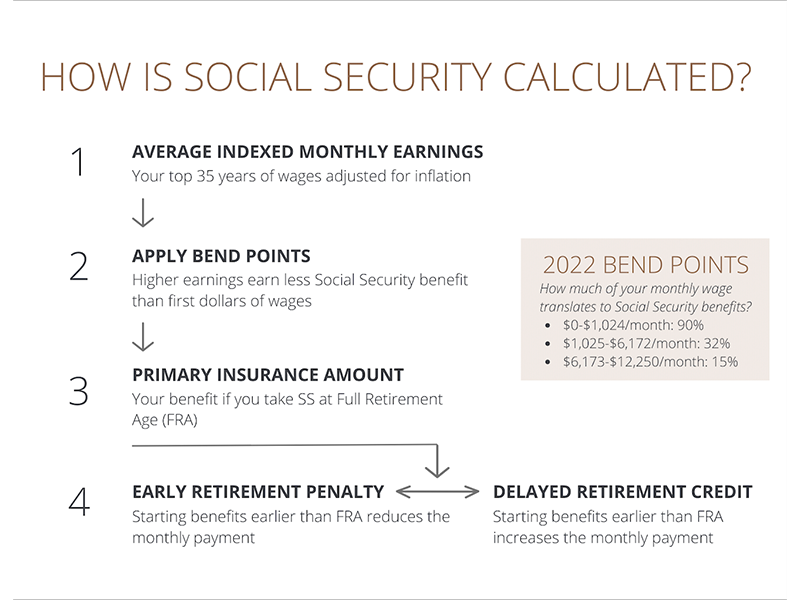
Once eligibility is established, the SSA moves to calculate your “average indexed monthly earnings” (AIME). This is a crucial step that directly impacts your benefit amount. The process begins by taking your earnings from all years you’ve worked and “indexing” them. Indexing is a method used to adjust your past earnings for changes in the national average wage level over time. This ensures that the purchasing power of your earnings from decades ago is reflected accurately in today’s dollars.
After indexing, the SSA looks at your entire indexed earnings record and selects your 35 highest-earning years. If you have fewer than 35 years of earnings, zero earnings years will be factored into the average, which will reduce your AIME. The total indexed earnings from these 35 highest-earning years are then summed up and divided by 420 (the number of months in 35 years) to arrive at your Average Indexed Monthly Earnings (AIME). This AIME figure is the foundation upon which your primary insurance amount (PIA) is built.
Applying the “Bend Points” for AIME
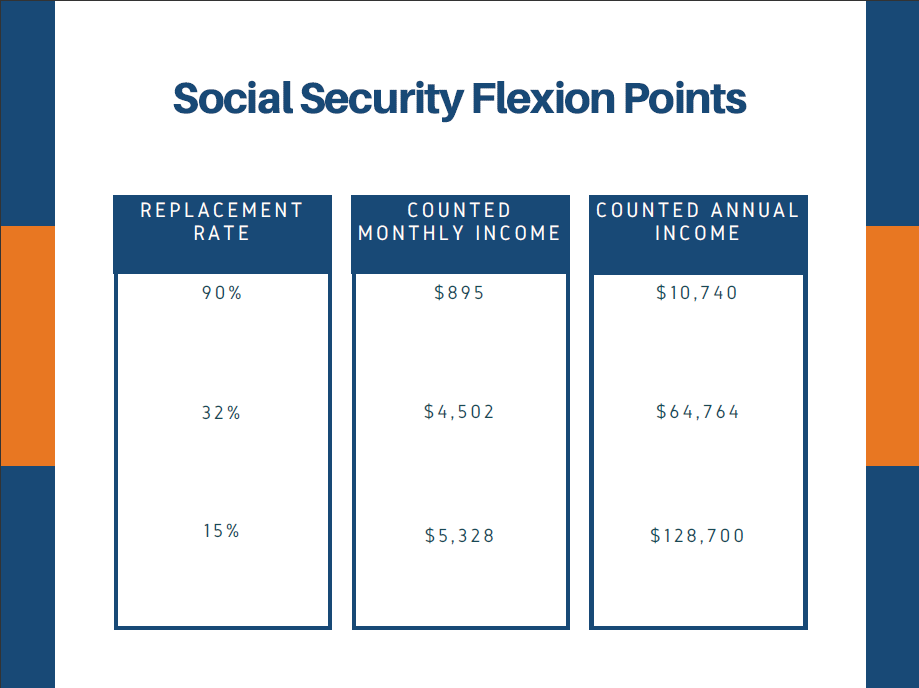
The AIME is not the final benefit amount; rather, it’s used to calculate your Primary Insurance Amount (PIA). The PIA is the benefit you would receive if you start collecting Social Security at your full retirement age. To calculate the PIA, the SSA applies a progressive formula using “bend points.” These bend points are dollar amounts that divide your AIME into three segments. Different percentages are applied to each segment, meaning that lower earners receive a higher percentage of their average indexed monthly earnings than higher earners. This progressive structure is a core tenet of Social Security, designed to provide a higher replacement rate for individuals with lower lifetime earnings.
For example, in 2024, the formula for someone reaching age 62 (the earliest age you can claim) is:
- 90% of the first $1,174 of AIME
- 32% of AIME between $1,174 and $7,078
- 15% of AIME above $7,078
The sum of these three calculations results in your PIA. These bend points also adjust annually, ensuring the system remains responsive to economic changes. This progressive formula ensures that Social Security serves as a vital safety net for all income levels, with a greater proportional impact for those with lower earnings.
Factors Influencing Your Benefit Amount
While your PIA is calculated based on your earnings history, it is not necessarily the exact amount you will receive. Several other factors come into play that can increase or decrease your monthly benefit. Understanding these variables is crucial for strategic retirement planning.
Your Full Retirement Age (FRA)
Your Full Retirement Age (FRA) is the age at which you are entitled to receive 100% of your Primary Insurance Amount (PIA). This age is determined by your birth year. For those born between 1943 and 1954, FRA is 66. For those born in 1960 or later, FRA is 67. If you were born between these years, your FRA falls somewhere in between (e.g., 66 and 2 months for those born in 1955, gradually increasing). Claiming benefits before or after your FRA will directly impact the size of your monthly payment.
Claiming Benefits Early vs. Delaying
The age at which you choose to claim your Social Security benefits is perhaps the most significant factor influencing your actual monthly payout.
- Claiming Early: You can start receiving retirement benefits as early as age 62. However, claiming before your FRA results in a permanent reduction of your monthly benefit. This reduction can be substantial, decreasing your benefit by as much as 25% to 30% if you claim at age 62, depending on your FRA. The reduction is applied monthly, meaning the earlier you claim, the greater the percentage reduction.
- Delaying Benefits: Conversely, if you delay claiming benefits past your FRA, you can earn “Delayed Retirement Credits” (DRCs). These credits permanently increase your monthly benefit by a certain percentage for each year you delay, up to age 70. The annual increase is 8% for those born in 1943 or later, meaning you could increase your PIA by up to 32% if your FRA is 66 and you wait until 70. This makes delaying benefits a powerful strategy for maximizing your monthly income, particularly for those who are healthy and can afford to wait.
The decision of when to claim is a complex one, involving considerations of health, life expectancy, other retirement income sources, and financial needs.
Cost-of-Living Adjustments (COLAs)
Once you begin receiving Social Security benefits, your payments are generally subject to annual Cost-of-Living Adjustments (COLAs). These adjustments are designed to help your benefits keep pace with inflation. COLAs are typically announced in the fall and take effect in December (for benefits paid in January of the following year). The COLA is based on the percentage increase in the Consumer Price Index for Urban Wage Earners and Clerical Workers (CPI-W) from the third quarter of the prior year to the third quarter of the current year. If there is no increase in the CPI-W, there is no COLA. While COLAs help preserve purchasing power, they don’t always fully reflect individual cost increases, especially for healthcare. Nevertheless, they are a vital mechanism for maintaining the real value of your benefits over time.
Practical Tools and Resources for Estimation
Navigating the intricacies of Social Security calculations doesn’t have to be a solo journey. A wealth of tools and resources are available to help you understand your specific situation and estimate your future benefits accurately. Leveraging these resources can provide clarity and confidence in your retirement planning.
The Social Security Administration’s Online Tools
The most authoritative source for Social Security information and estimation is the Social Security Administration (SSA) itself. The SSA offers a suite of online tools designed to help you understand your benefits:
- my Social Security Account: This is an indispensable resource. By creating a free online account, you can access your personal Social Security Statement, which provides estimates of your future retirement, disability, and survivor benefits based on your actual earnings record. You can also review your lifetime earnings history for accuracy and manage your benefits once you start receiving them. This is the single most important tool for personalized benefit estimation.
- Retirement Estimator: Available through your my Social Security account, this tool allows you to plug in different scenarios (e.g., various claiming ages, future earnings projections) to see how they impact your estimated benefit. It’s an interactive way to explore the financial implications of different retirement decisions.
- Benefit Calculators: The SSA website also provides various calculators for specific situations, such as early or delayed retirement, spousal benefits, and more. While less personalized than the Retirement Estimator, they offer general guidance.
These official tools are built directly on your verified earnings data, making them the most reliable sources for estimating your benefits.
Consulting a Financial Advisor
For a more comprehensive and personalized approach to retirement planning, including how Social Security fits into your broader financial picture, consulting a qualified financial advisor is highly recommended. A financial advisor can:
- Integrate Social Security: Help you understand how your estimated Social Security benefits interact with your other retirement savings (401(k)s, IRAs, pensions) and income sources.
- Optimize Claiming Strategy: Guide you through the complex decision of when to claim benefits, considering factors like your health, spouse’s benefits, tax implications, and overall financial goals.
- Address Complex Scenarios: Provide expertise on unique situations, such as spousal benefits, survivor benefits, divorced spouse benefits, government pension offset, or windfalls elimination provision.
- Tax Planning: Advise on the potential taxation of Social Security benefits and strategies to minimize your tax burden in retirement.
While SSA tools provide the numbers, a financial advisor helps you craft a strategy around those numbers.
Understanding Your Social Security Statement
Your annual Social Security Statement is a vital document that typically arrives in the mail (for those over 60 who haven’t set up an online account) or is always accessible through your my Social Security account. It contains:
- Estimated Benefits: Projections for your retirement, disability, and survivor benefits based on your current earnings record.
- Earnings History: A year-by-year breakdown of your reported earnings. It’s critical to review this section carefully for any discrepancies. Unreported or underreported earnings can significantly impact your future benefits.
- Credits Earned: The number of credits you’ve accumulated towards eligibility for various benefits.
- General Information: Explanations of how Social Security works and important program details.
Regularly reviewing your statement and ensuring its accuracy is a proactive step in protecting your future financial security. If you find errors, you should contact the SSA to correct them, as these changes can take time.
Strategic Planning for Maximizing Your Benefits
Understanding the calculation is only half the battle; the other half is using that knowledge to strategically plan for retirement. There are actionable steps you can take throughout your working life and as you approach retirement to maximize your Social Security income.
Working Longer and Earning More
Given that your Social Security benefit is based on your 35 highest-earning years, working longer, especially in your prime earning years, can significantly boost your Average Indexed Monthly Earnings (AIME). If you have fewer than 35 years of earnings, working additional years will replace zero-earning years in your calculation with positive earnings, directly increasing your AIME. Even if you already have 35 years of earnings, working an additional year at a higher salary can replace an earlier, lower-earning year in your top 35, thus raising your overall average. This strategy is particularly effective for individuals whose salaries have increased substantially later in their careers. The impact of even a few extra years of high earnings can be substantial.
Coordinating with Other Retirement Income
Social Security should be viewed as one component of a holistic retirement income strategy, not the sole source. Integrating your Social Security claiming decision with your other retirement assets is key:
- 401(k)s and IRAs: If you have substantial savings in tax-advantaged accounts, you might be able to draw from these funds in your early retirement years, allowing you to delay claiming Social Security and accumulate Delayed Retirement Credits. This strategy can lead to a higher guaranteed income stream for life.
- Pensions: If you have a defined-benefit pension, its income stream can also provide the financial flexibility needed to delay Social Security.
- Part-time Work: Some retirees choose to work part-time in their early retirement years. This income can both help fund daily expenses and allow for delaying Social Security benefits. Be mindful of the Social Security earnings test if you claim before your Full Retirement Age and continue to work.
A coordinated approach ensures that you leverage all your resources optimally, creating a robust and diversified income stream throughout retirement.
Navigating Spousal and Survivor Benefits
Social Security offers valuable benefits not just for individual workers but also for their spouses, ex-spouses, and survivors. Understanding these provisions can significantly enhance family financial security:
- Spousal Benefits: If you are married, your spouse may be eligible for benefits based on your earnings record, even if they have little to no earnings history of their own. A spouse can receive up to 50% of your Primary Insurance Amount (PIA) at their own full retirement age. This can be particularly beneficial for stay-at-home parents or lower-earning spouses.
- Survivor Benefits: If you pass away, your surviving spouse, children, or even dependent parents may be eligible for survivor benefits based on your earnings record. A surviving spouse can receive up to 100% of your PIA, depending on their age and circumstances.
- Divorced Spouse Benefits: Even after divorce, you may be eligible for benefits based on your ex-spouse’s record (up to 50% of their PIA) if the marriage lasted at least 10 years, you are currently unmarried, and are age 62 or older, among other criteria.
These auxiliary benefits are complex and often require careful planning to optimize. They underscore the importance of understanding the Social Security system as a family safety net, not just an individual one.
In conclusion, the calculation of Social Security earnings is a multi-faceted process rooted in your lifetime contributions and influenced by strategic decisions you make around retirement age. By understanding the fundamentals of what constitutes earnings, how your AIME is calculated, the role of “bend points,” and the significant impact of your claiming age, you gain invaluable insight into your financial future. Armed with this knowledge and utilizing the available tools and resources, you are empowered to make informed choices that can significantly enhance your retirement security, allowing you to approach your golden years with greater confidence and peace of mind.
aViewFromTheCave is a participant in the Amazon Services LLC Associates Program, an affiliate advertising program designed to provide a means for sites to earn advertising fees by advertising and linking to Amazon.com. Amazon, the Amazon logo, AmazonSupply, and the AmazonSupply logo are trademarks of Amazon.com, Inc. or its affiliates. As an Amazon Associate we earn affiliate commissions from qualifying purchases.