
Understanding how your savings grow is a cornerstone of effective personal finance. For many, a savings account is the first step on their financial journey, a secure place to store funds for emergencies, short-term goals, or future investments. Yet, the mechanism by which these savings accrue interest often remains a mystery, leading to missed opportunities or unrealistic expectations. Demystifying the calculation of savings interest empowers you to make informed decisions, compare financial products more effectively, and ultimately accelerate your wealth accumulation. This comprehensive guide will break down the intricacies of interest calculation, from fundamental concepts to practical applications, ensuring you have the knowledge to optimize your savings strategy.

Understanding the Basics of Savings Interest
At its core, savings interest is the cost of borrowing money, or in your case, the reward you receive for lending your money to a bank or financial institution. When you deposit funds into a savings account, the bank uses that capital to make loans, invest, and operate. In return for the use of your money, they pay you a percentage of your deposit over time. This seemingly simple exchange has several key components that dictate how much you ultimately earn.
What is Savings Interest?
Savings interest is essentially the income generated from your principal deposit. It’s the mechanism through which your money, over time, can make more money, a concept central to financial growth. Banks offer interest to attract and retain depositors, as the aggregate of these deposits forms the capital they need to conduct their business. For you, the saver, it’s a passive way to grow your wealth, ensuring your money isn’t just sitting idly, losing purchasing power to inflation.
Key Components of Interest Calculation
To fully grasp how your interest is computed, it’s vital to understand the variables involved:
- Principal (P): This is the initial amount of money you deposit into your savings account, or the balance on which interest is calculated at any given time. As interest is added to your account, the principal amount for subsequent calculations can increase.
- Interest Rate (R): Expressed as a percentage, this is the rate at which your principal earns interest over a specified period, typically annually. For example, a 1% annual interest rate means you’d earn 1% of your principal each year. It’s crucial to note that this is often referred to as the Annual Percentage Rate (APR) and may not always reflect the true annual earnings if compounding is involved.
- Time Period (T): This refers to the duration over which the interest is calculated and applied. While interest rates are often quoted annually, the calculation might happen more frequently (e.g., monthly, daily), with the interest added to your account over shorter timeframes. The longer your money stays in the account, the more interest it potentially accrues.
- Compounding Frequency (n): This is arguably the most powerful, yet often overlooked, component. Compounding frequency dictates how often the earned interest is added back to your principal, thereby increasing the base on which future interest is calculated. The more frequently interest compounds (e.g., daily vs. annually), the faster your money grows.
Understanding these components is the first step toward accurately predicting and maximizing your savings growth. The interplay between them, particularly the compounding frequency, is what truly differentiates basic interest earnings from substantial wealth accumulation.
Simple Interest vs. Compound Interest: A Crucial Distinction
The world of savings interest is fundamentally divided into two primary types: simple interest and compound interest. While both involve earning money on your deposits, their mechanisms and long-term impacts are vastly different. Recognizing this distinction is not just academic; it’s essential for anyone serious about growing their savings.
Simple Interest Explained
Simple interest is the most straightforward form of interest calculation. It is calculated solely on the original principal amount of your deposit, regardless of any interest accumulated in previous periods. It does not “reinvest” the interest back into the principal for subsequent calculations.
The formula for simple interest is:
I = P × R × T
Where:
- I = Interest earned
- P = Principal amount
- R = Annual interest rate (as a decimal)
- T = Time period (in years)
Example: If you deposit $1,000 into an account with a 3% simple annual interest rate, for 5 years:
I = $1,000 × 0.03 × 5
I = $150
After 5 years, you would have earned $150 in interest, bringing your total to $1,150.
Simple interest is easy to calculate and understand, but its growth potential is limited because your earnings don’t contribute to future earnings. It’s less common for traditional savings accounts, but you might encounter it with certain short-term loans, bonds, or specific types of fixed deposits where interest is paid out rather than reinvested.
The Power of Compound Interest
Compound interest, often hailed as the “eighth wonder of the world” by Albert Einstein, is where your money truly begins to work for you. Unlike simple interest, compound interest is calculated on the initial principal plus all the accumulated interest from previous periods. This means your interest earnings start earning interest themselves, creating a snowball effect over time.
The general formula for compound interest that accounts for multiple compounding periods within a year is:
A = P (1 + r/n)^(nt)
Where:
- A = The future value of the investment/loan, including interest
- P = The principal investment amount (the initial deposit or loan amount)
- r = The annual interest rate (as a decimal)
- n = The number of times that interest is compounded per year
- t = The number of years the money is invested or borrowed for
Example: Let’s revisit the $1,000 deposit at a 3% annual interest rate for 5 years, but this time, with annual compounding (n=1):
Year 1: $1,000 * (1 + 0.03/1)^(1*1) = $1,030.00
Year 2: $1,030 * (1 + 0.03/1)^(1*1) = $1,060.90
Year 3: $1,060.90 * (1 + 0.03/1)^(1*1) = $1,092.73
Year 4: $1,092.73 * (1 + 0.03/1)^(1*1) = $1,125.51
Year 5: $1,125.51 * (1 + 0.03/1)^(1*1) = $1,159.27
Total interest earned: $159.27
While the difference ($159.27 vs. $150) might seem small over 5 years, imagine this over decades, with larger principals and more frequent compounding (e.g., monthly or daily). The impact becomes monumental. Most high-yield savings accounts and Certificates of Deposit (CDs) utilize compound interest, making it a critical factor in your long-term financial planning. The more frequently interest compounds (daily, monthly, quarterly), the faster your money grows, assuming the same annual interest rate.
The Role of Annual Percentage Yield (APY): Beyond the Stated Rate
When comparing savings accounts, you’ll invariably encounter two key rates: the Annual Percentage Rate (APR) and the Annual Percentage Yield (APY). While they sound similar, understanding their fundamental difference is crucial for accurately assessing your potential earnings and choosing the best savings product. The APY provides a more complete and realistic picture of what you will actually earn on your savings.
Why APY Matters More Than APR (Annual Percentage Rate)
The Annual Percentage Rate (APR) represents the stated annual interest rate on your account before accounting for the effects of compounding. It’s a simple, annualized rate. While useful for basic understanding, it can be misleading when comparing accounts, especially if they have different compounding frequencies. For instance, a bank might advertise a 2% APR, but if that interest only compounds annually, the effective return might be lower than an account advertising a 1.95% APR but with daily compounding.
The Annual Percentage Yield (APY), on the other hand, is the standardized metric that truly matters for savings. It reflects the effective annual rate of return on an investment, taking into account the effect of compounding interest. In essence, APY tells you how much interest you will actually earn over a year, factoring in how frequently that interest is added to your principal and subsequently earns interest itself. Because APY incorporates compounding, it allows for an “apples-to-apples” comparison between different savings products, regardless of their stated APR or compounding frequency. When choosing a savings account or CD, always prioritize comparing APY values.
How APY is Calculated

The formula to calculate APY is derived from the compound interest formula, specifically designed to show the equivalent annual simple interest rate:
APY = (1 + r/n)^n – 1
Where:
- r = The nominal annual interest rate (APR, as a decimal)
- n = The number of times interest is compounded per year
Let’s illustrate with an example:
Scenario 1: Annual Compounding
Suppose a savings account offers a 2.00% APR, compounded annually (n=1).
APY = (1 + 0.02/1)^1 – 1
APY = (1 + 0.02)^1 – 1
APY = 1.02 – 1
APY = 0.02 or 2.00%
In this case, with annual compounding, the APR and APY are the same.
Scenario 2: Monthly Compounding
Now, consider an account with the same 2.00% APR, but compounded monthly (n=12).
APY = (1 + 0.02/12)^12 – 1
APY = (1 + 0.00166667)^12 – 1
APY = (1.00166667)^12 – 1
APY ≈ 1.020184 – 1
APY ≈ 0.020184 or 2.0184%
Notice that with monthly compounding, the APY (2.0184%) is slightly higher than the APR (2.00%). This seemingly small difference can amount to significant additional earnings over many years, especially with larger balances.
Scenario 3: Daily Compounding
If the same 2.00% APR were compounded daily (n=365):
APY = (1 + 0.02/365)^365 – 1
APY ≈ (1.00005479)^365 – 1
APY ≈ 1.0202008 – 1
APY ≈ 0.0202008 or 2.0201%
As you can see, the more frequently interest is compounded, the higher the APY, even if the nominal APR remains the same. This is why always looking at the APY is paramount when comparing different savings opportunities. It provides the definitive measure of how much your money will actually grow over a year.
Practical Calculation Methods and Tools
While understanding the formulas for simple and compound interest, as well as APY, is crucial, manually calculating these figures can be tedious and prone to error, especially for complex scenarios. Fortunately, a variety of practical methods and tools are available to help you accurately determine your savings interest. Leveraging these resources can save you time, increase accuracy, and allow you to explore various “what-if” scenarios for your financial planning.
Manual Calculation Walkthroughs
For educational purposes and to solidify your understanding, a brief manual walkthrough can be very insightful.
Simple Interest Example:
You deposit $2,500 into an account with a 1.5% simple annual interest rate. How much interest do you earn after 3 years?
- P = $2,500
- R = 0.015 (1.5% as a decimal)
- T = 3 years
- I = P × R × T = $2,500 × 0.015 × 3 = $112.50
Your total balance would be $2,500 + $112.50 = $2,612.50.
Compound Interest (Annual) Example:
You deposit $5,000 into an account with a 2.0% annual interest rate, compounded annually, for 2 years.
- Year 1:
- Interest = $5,000 × 0.02 = $100
- New Principal = $5,000 + $100 = $5,100
- Year 2:
- Interest = $5,100 × 0.02 = $102
- Total Balance = $5,100 + $102 = $5,202
Total interest earned: $202.
While helpful for understanding, these manual calculations quickly become cumbersome for longer terms or more frequent compounding.
Leveraging Online Calculators and Spreadsheets
For most practical applications, online calculators and spreadsheet software are your best friends.
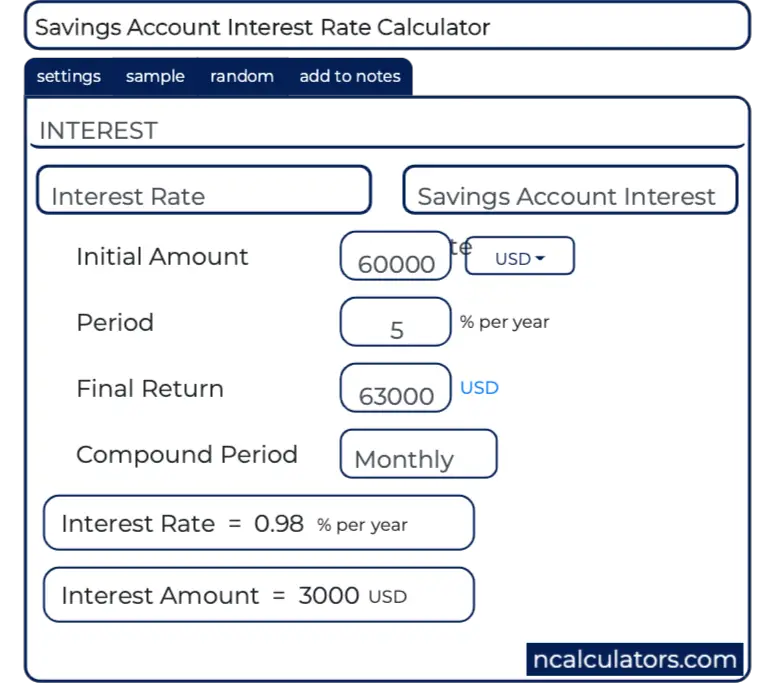
- Online Calculators: A quick search for “savings interest calculator” or “APY calculator” will yield numerous free tools from financial websites and banks.
- Benefits: User-friendly interfaces, instant results, and the ability to easily change variables (principal, rate, term, compounding frequency) to see different outcomes. Many even show graphs of your money’s growth over time.
- How to Use: Simply input the required fields. They typically ask for your initial deposit, regular contributions, interest rate, and how often interest compounds.
- Spreadsheets (Excel, Google Sheets): For those who prefer more control and customization, spreadsheets are powerful tools.
- Benefits: You can build your own models, integrate interest calculations into broader financial plans, and perform complex “what-if” analyses.
- Key Functions:
- FV (Future Value): This function is specifically designed to calculate the future value of an investment based on a constant interest rate and periodic payments.
=FV(rate, nper, pmt, [pv], [type])rate: Interest rate per period (e.g., annual rate/12 for monthly compounding).nper: Total number of payment periods (e.g., years * 12 for monthly).pmt: The payment made each period (e.g., monthly deposit; use 0 if no periodic payments).pv: The present value, or the lump-sum amount that a series of future payments is worth right now.
- You can also build custom formulas using the compound interest equation
A = P (1 + r/n)^(nt).
- FV (Future Value): This function is specifically designed to calculate the future value of an investment based on a constant interest rate and periodic payments.
Reading Bank Statements and Disclosures
Finally, don’t overlook your bank statements and the account disclosures provided when you open an account.
- Bank Statements: Most bank statements will clearly show the interest earned in a given period (e.g., monthly). This allows you to track your actual earnings and verify that they align with your expectations.
- Account Disclosures: These legal documents contain all the crucial details about your account, including the current interest rate, compounding frequency, APY, and any fees that might apply. Always read these thoroughly before opening an account to fully understand the terms.
Regularly reviewing these documents helps ensure transparency and confirms that your savings are growing as anticipated.
Maximizing Your Savings Interest
Simply understanding how interest is calculated is only half the battle; the other half is actively using that knowledge to maximize your earnings. In today’s dynamic financial landscape, making your money work harder for you requires strategic choices and continuous vigilance. By adopting a proactive approach, you can significantly enhance the interest you earn and accelerate your progress toward your financial goals.
Choosing the Right Account
The type of account you choose plays a critical role in how much interest you accrue. Not all savings vehicles are created equal, and selecting one that aligns with your financial objectives and risk tolerance is paramount.
- High-Yield Savings Accounts (HYSAs): These accounts typically offer significantly higher interest rates than traditional savings accounts, often with competitive APYs. They are ideal for emergency funds or short-term savings goals due to their liquidity. Many are offered by online-only banks, which have lower overheads and can pass those savings on to customers in the form of better rates.
- Certificates of Deposit (CDs): CDs offer fixed interest rates for a specified term (e.g., 6 months, 1 year, 5 years). In exchange for locking up your money for the agreed period, CDs often provide higher interest rates than standard savings accounts. They are excellent for savings goals with a defined timeline, where you won’t need immediate access to the funds. Longer terms generally offer higher rates.
- Money Market Accounts (MMAs): MMAs blend features of both savings and checking accounts. They typically offer higher interest rates than traditional savings accounts and often come with check-writing privileges and debit cards, though usually with limits on transactions. They can be a good option for those seeking a balance between higher interest and some liquidity.
Strategies to Boost Earnings
Beyond selecting the right account, several actionable strategies can help you maximize your interest earnings:
- Consistent Deposits: The more money you consistently add to your principal, the larger the base upon which interest is calculated, leading to greater compound growth. Even small, regular contributions can make a substantial difference over time.
- Long-Term Saving: The magic of compound interest truly unfolds over extended periods. The longer your money remains invested and continues to earn interest on interest, the exponential its growth becomes. Patience is a powerful ally in wealth building.
- Comparing Rates Regularly: Interest rates are not static. Banks frequently adjust their APYs based on market conditions and the federal funds rate. Periodically review your current account’s APY and compare it with competitors to ensure you’re getting the best possible return. Don’t hesitate to switch banks if a significantly better offer emerges, though be mindful of any transfer fees or minimum balance requirements.
- Understanding Tax Implications: Interest earned on savings is generally considered taxable income. Be aware of how this might affect your overall tax liability. For very large savings, exploring tax-advantaged accounts or investments might be a consideration, though these fall outside the scope of basic savings accounts.
The Impact of Inflation
While focusing on maximizing nominal interest earnings is important, it’s crucial to consider the eroding power of inflation. Inflation is the rate at which the general level of prices for goods and services is rising, and subsequently, the purchasing power of currency is falling.
- Understanding Real vs. Nominal Returns: The interest rate your bank quotes is a nominal rate. Your real rate of return is your nominal interest rate minus the rate of inflation. If you earn 2% interest but inflation is 3%, your money is actually losing purchasing power by 1% annually, despite earning interest.
- Importance of an Interest Rate That Beats Inflation: Ideally, your savings interest rate should at least keep pace with, if not exceed, the current rate of inflation. This ensures that your money retains, or even increases, its purchasing power over time. While basic savings accounts may sometimes struggle to consistently beat inflation, high-yield options offer a better fighting chance. For long-term goals, investing in assets with higher growth potential (e.g., stocks, real estate) might be necessary to outpace inflation significantly, though these carry different risk profiles than savings accounts.
By understanding the mechanics of interest calculation and actively applying strategies to maximize your earnings while considering the broader economic context of inflation, you can transform your savings from merely stored money into a powerful engine for financial growth. Your diligence in choosing the right accounts and monitoring market rates will pay dividends, literally, in your journey toward financial well-being.
aViewFromTheCave is a participant in the Amazon Services LLC Associates Program, an affiliate advertising program designed to provide a means for sites to earn advertising fees by advertising and linking to Amazon.com. Amazon, the Amazon logo, AmazonSupply, and the AmazonSupply logo are trademarks of Amazon.com, Inc. or its affiliates. As an Amazon Associate we earn affiliate commissions from qualifying purchases.