
In the complex world of personal finance, investing, and business operations, few mathematical concepts are as fundamental and universally applied as percentages. From understanding discounts on a new purchase to analyzing the performance of an investment portfolio, or even interpreting crucial business financial statements, the ability to accurately calculate and interpret percentages is not just a mathematical convenience—it’s a critical life skill and a cornerstone of sound financial literacy. This article will demystify percentage calculations, anchoring them firmly within the “Money” domain, and demonstrate their pervasive and indispensable role in navigating financial landscapes effectively.

At its core, a percentage is simply a way of expressing a number as a fraction of 100. It provides a standardized method for comparison, allowing us to gauge proportions, changes, and relationships in a clear and intuitive manner. Without a firm grasp of percentages, making informed decisions about budgets, loans, investments, taxes, and business profitability becomes significantly more challenging, often leading to costly misunderstandings or missed opportunities. Embracing this fundamental skill empowers individuals and businesses alike to take control of their financial destiny, making smarter choices rooted in data rather than guesswork.
The Fundamentals of Percentage Calculation
Before diving into the intricate financial applications, it’s crucial to establish a solid understanding of the basic mechanics behind percentage calculations. These foundational principles serve as the building blocks for more complex financial analysis.
What is a Percentage?
The term “percentage” originates from the Latin “per centum,” meaning “by the hundred.” It’s a dimensionless number or ratio, expressed as a fraction of 100. For instance, 50% means 50 out of 100, or 1/2. The symbol “%” is universally used to denote a percentage. Its utility lies in providing a common reference point, making it easier to compare different quantities, especially when the total amounts vary significantly. Instead of saying “you saved $10 out of $500 and I saved $20 out of $1,000,” we can simply say “we both saved 2%,” which immediately conveys the proportional saving more clearly.
Basic Formula: Part / Whole x 100
The most fundamental way to calculate a percentage is to determine what part a given number represents of a whole, and then multiply that ratio by 100.
Formula: Percentage = (Part / Whole) × 100
Let’s illustrate with a simple, non-financial example: If there are 20 apples in a basket (the Whole) and 5 of them are red (the Part), what percentage of the apples are red?
Percentage = (5 / 20) × 100 = 0.25 × 100 = 25%
This basic formula is incredibly versatile and forms the basis for numerous financial calculations, from calculating your budget allocation to understanding investment returns.
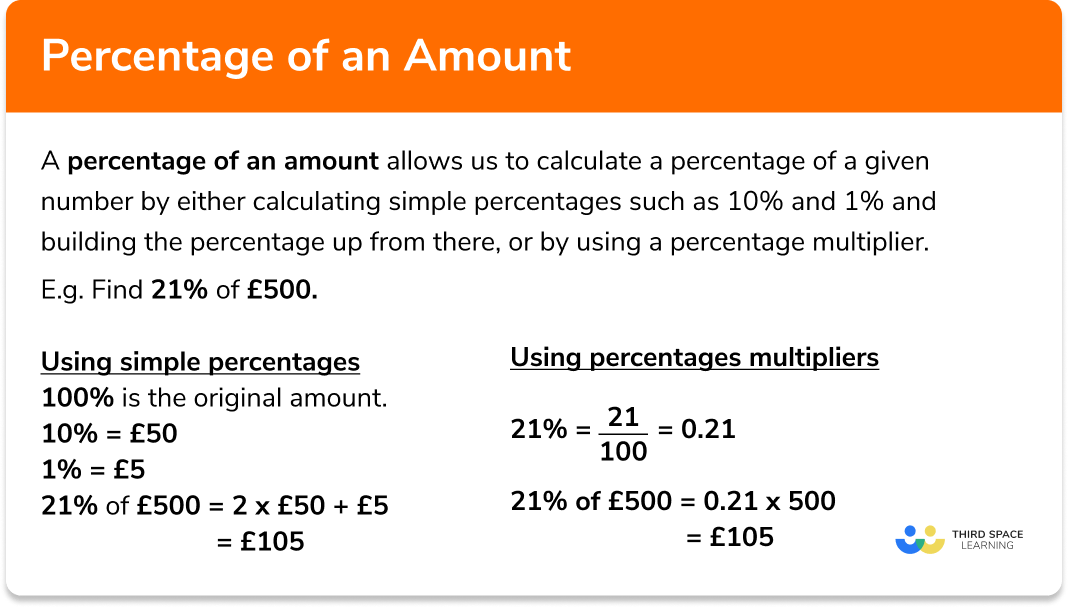
Calculating a Percentage of a Number
Often, you’ll need to find a specific percentage of a given number. This is common when calculating discounts, taxes, or interest.
Formula: Amount = (Percentage / 100) × Total Number
Suppose you want to calculate 15% of $200.
First, convert the percentage to a decimal by dividing by 100: 15 / 100 = 0.15.
Then, multiply the decimal by the total number: 0.15 × $200 = $30.
So, 15% of $200 is $30. This is crucial for tasks like figuring out the sales tax on a purchase or the amount of a discount.
Calculating Percentage Change
One of the most frequent financial applications of percentages is calculating percentage change, which can be either an increase or a decrease. This is vital for tracking growth, inflation, investment performance, or cost fluctuations.
Formula for Percentage Change: Percentage Change = ((New Value - Old Value) / Old Value) × 100
If your investment grew from $1,000 to $1,200:
Percentage Change = (($1,200 - $1,000) / $1,000) × 100 = ($200 / $1,000) × 100 = 0.20 × 100 = 20% increase.
If a stock price dropped from $50 to $45:
Percentage Change = (($45 - $50) / $50) × 100 = (-$5 / $50) × 100 = -0.10 × 100 = -10% decrease.
Understanding percentage change allows you to gauge the magnitude of shifts in financial figures, providing context beyond mere absolute dollar amounts. A $100 increase means different things if your starting point was $1,000 versus $10,000.
Percentages in Personal Finance
The relevance of percentages in personal finance cannot be overstated. They are the language through which we understand and manage our daily financial lives, empowering us to make deliberate and informed decisions.
Budgeting and Expense Tracking
A fundamental aspect of personal finance is budgeting. Percentages help in allocating your income to various categories. For instance, the popular 50/30/20 rule suggests allocating 50% of your income to needs, 30% to wants, and 20% to savings and debt repayment. To apply this, you’d calculate:
Needs = 0.50 × Net IncomeWants = 0.30 × Net IncomeSavings/Debt = 0.20 × Net Income
Similarly, when tracking expenses, percentages reveal where your money is actually going. If your housing costs represent 40% of your take-home pay, understanding this percentage helps you determine if you’re overspending in one area and guides adjustments to achieve financial balance.
Discounts and Sales
Shopping smart often involves understanding discounts. A “25% off” sale means you’ll pay 75% of the original price. If an item costs $80, a 25% discount means you save 0.25 × $80 = $20, and the new price is $80 - $20 = $60. Or, more directly, you pay 0.75 × $80 = $60. Being able to quickly perform these calculations ensures you’re truly getting a good deal and can compare offers effectively.
Interest Rates (Loans and Savings)
Interest rates are almost universally expressed as percentages and are central to loans, mortgages, credit cards, and savings accounts. A loan with a 5% annual interest rate means you’ll pay an additional 5% of the principal amount in interest each year. For a $10,000 loan, that’s $0.05 × $10,000 = $500 in interest annually (simplified, excluding compounding). Conversely, a savings account offering 1% interest means your money grows by 1% each year. Understanding how these percentages translate into actual dollar amounts is vital for choosing the right financial products and comprehending the true cost of borrowing or the real return on saving.
Taxes and Deductions
Taxes—income tax, sales tax, property tax—are all percentage-based. Sales tax of 7% on a $100 purchase means you pay an extra $0.07 × $100 = $7. Income tax brackets mean different portions of your income are taxed at different percentage rates. Understanding these percentages helps you calculate your take-home pay, anticipate your tax burden, and plan for various financial obligations. Similarly, deductions from your paycheck for retirement contributions or health insurance are often expressed as percentages of your gross income.
Percentages in Investing and Wealth Building
For anyone looking to grow their wealth, percentages are the universal language of investment performance, risk, and strategy.
Investment Returns and Growth
The most common application in investing is calculating return on investment (ROI). If you invest $5,000 and it grows to $5,500, your absolute gain is $500. But the percentage return provides context:
ROI = (($5,500 - $5,000) / $5,000) × 100 = 10%.
This allows you to compare the performance of different investments, regardless of their initial principal amounts. Compound annual growth rate (CAGR) is another percentage-based metric that smooths out year-over-year volatility to show a steady annual growth rate. Understanding these percentage returns is paramount for evaluating investment opportunities and tracking progress toward financial goals.
Diversification and Risk Management
Asset allocation—the division of an investment portfolio among different asset categories—is expressed in percentages. For example, an investor might aim for a portfolio of “70% stocks, 25% bonds, and 5% cash.” These percentages reflect the investor’s risk tolerance and financial goals. Rebalancing a portfolio means adjusting these percentages back to the target allocations periodically. By understanding how to calculate and maintain these percentage allocations, investors can manage risk and optimize their portfolios.
Inflation and Purchasing Power
Inflation, the rate at which the general level of prices for goods and services is rising, and subsequently, purchasing power is falling, is always quoted as a percentage. If inflation is 3% annually, it means that, on average, goods and services that cost $100 today will cost $103 next year. This is a critical concept for long-term financial planning, as it demonstrates how investment returns must exceed the rate of inflation to truly increase purchasing power over time. Understanding the corrosive effect of inflation, expressed as a percentage, helps investors set realistic return expectations and choose appropriate investment vehicles.
Percentages in Business Finance
For entrepreneurs, business owners, and financial professionals, percentages are the analytical tools used to gauge performance, assess health, and make strategic decisions.
Profit Margins and Revenue Analysis
Businesses extensively use percentages to evaluate profitability. Key metrics include:
- Gross Profit Margin:
(Gross Profit / Revenue) × 100. This shows the percentage of revenue left after deducting the cost of goods sold. A higher percentage indicates better operational efficiency. - Net Profit Margin:
(Net Profit / Revenue) × 100. This reveals the percentage of revenue left after all expenses, including taxes, have been deducted. It’s a key indicator of a company’s overall financial health.
Understanding these margins, comparing them against industry averages, and tracking their changes over time, all rely on a solid grasp of percentage calculations.
Growth Rates and Market Share
Businesses measure their growth in percentage terms:
- Revenue Growth Rate:
((Current Year Revenue - Prior Year Revenue) / Prior Year Revenue) × 100. This shows how quickly a company’s sales are increasing. - Market Share:
(Company Sales / Total Market Sales) × 100. This percentage indicates a company’s portion of the total sales within its industry, a crucial measure of competitive standing.
These percentage metrics are vital for investors to assess a company’s potential and for management to set strategic goals.
Financial Ratios
Many critical financial ratios are expressed as percentages or are derived using percentages to provide comparative insights into a company’s liquidity, solvency, efficiency, and profitability. Examples include:
- Debt-to-Equity Ratio: Often expressed as a percentage, it indicates the proportion of equity and debt used to finance a company’s assets.
- Current Ratio: While often a simple ratio (current assets / current liabilities), its interpretation is inherently percentage-based, indicating how many times current assets can cover current liabilities.
These ratios allow for benchmarking against competitors and historical performance, offering a percentage-based health check on a company’s financial position.
Tools and Tips for Accurate Percentage Calculations
While the underlying math is straightforward, accuracy and efficiency are key in financial applications.
Mental Math Shortcuts
For common percentages, developing mental math shortcuts can save time.
- 10%: Move the decimal one place to the left (e.g., 10% of $500 is $50).
- 5%: Half of 10% (e.g., 5% of $500 is $25).
- 1%: Move the decimal two places to the left (e.g., 1% of $500 is $5).
- 20%: Double 10%.
- 25%: Divide by 4.
- 50%: Divide by 2.
These quick estimates are incredibly useful for on-the-spot financial assessments, such as quickly calculating a tip, a sales discount, or a rough budget allocation.
Using Calculators and Spreadsheets
For more complex or large-scale calculations, a calculator is indispensable. For ongoing financial management, spreadsheets (like Microsoft Excel or Google Sheets) are powerful tools. They allow you to set up formulas once and apply them to multiple data points, automate calculations, and perform “what-if” analyses. For example, you can easily track your budget, calculate compound interest over years, or project investment returns by simply inputting values and letting the spreadsheet handle the percentage calculations. Most spreadsheet programs have a dedicated percentage format that simplifies display and calculation.
Avoiding Common Pitfalls
Be mindful of common errors:
- Percentage Points vs. Percentage Change: An increase from 5% to 7% is a 2 percentage point increase, but a
((7-5)/5)*100 = 40%percentage change. The distinction is crucial, especially in financial news and analysis. - Incorrect Base Value: Always ensure you’re calculating the percentage based on the correct “whole” or “old value.” For instance, a discount percentage should always be applied to the original price, not the discounted price.
- Compounding Errors: When dealing with multiple percentage changes over time (like investment returns or inflation), remember that they compound, meaning each subsequent percentage is applied to the new, increased (or decreased) value, not the original.

Conclusion
The ability to calculate percentages of a number is far more than a mere arithmetic skill; it is a vital instrument for financial empowerment. In the realm of “Money,” percentages provide the clarity and precision needed to navigate the complexities of personal finance, investment strategies, and business operations. From carefully crafting a budget to shrewdly assessing investment opportunities, understanding the true cost of debt, or evaluating a company’s profitability, percentages are the indispensable lens through which informed financial decisions are made.
By mastering the fundamental formulas and their diverse applications, individuals and businesses can move beyond guesswork, gain confidence in their financial acumen, and actively work towards achieving their financial goals. Embrace the power of percentages—they are the key to unlocking a more transparent, predictable, and prosperous financial future.
aViewFromTheCave is a participant in the Amazon Services LLC Associates Program, an affiliate advertising program designed to provide a means for sites to earn advertising fees by advertising and linking to Amazon.com. Amazon, the Amazon logo, AmazonSupply, and the AmazonSupply logo are trademarks of Amazon.com, Inc. or its affiliates. As an Amazon Associate we earn affiliate commissions from qualifying purchases.