
Understanding percentages is a fundamental skill that underpins nearly every aspect of personal finance, investing, and business operations. From deciphering sale discounts and calculating interest on loans to evaluating investment returns and setting profitable prices, the ability to accurately calculate percentages of a price is not just a convenience—it’s a critical component of financial literacy and sound decision-making. In a world saturated with financial data and purchasing opportunities, mastering this mathematical concept empowers individuals and businesses to navigate complex financial landscapes with confidence and precision.
This guide will demystify percentage calculations, breaking down the core concepts and providing practical, real-world examples rooted deeply in the realm of money. Whether you’re a consumer trying to find the best deal, an investor tracking portfolio performance, or a business owner optimizing pricing strategies, the insights shared here will equip you with the knowledge to leverage percentages effectively for your financial benefit.

Understanding the Foundation: What Percentages Mean for Your Money
Before diving into the mechanics, it’s crucial to grasp what a percentage fundamentally represents and why it holds such significant sway in financial contexts. A percentage is simply a way of expressing a number as a fraction of 100. The word “percent” literally means “per hundred.” When we talk about a percentage of a price, we’re referring to a specific portion of that price, relative to its total value.
The Concept of a Percentage in Financial Contexts
In finance, percentages provide a standardized way to compare parts to a whole, or to compare changes over time, regardless of the absolute values involved. For instance, a 10% discount on a $100 item is $10, and a 10% discount on a $1,000 item is $100. While the dollar amounts differ greatly, the relative benefit (10%) remains constant, making percentages invaluable for comparative analysis.
Consider a 5% sales tax. It means for every $100 of the item’s price, you pay an additional $5. If your investment grew by 8%, it means for every $100 you invested, you gained $8. This consistent ratio makes percentages a universal language for financial communication and analysis, allowing for easy comparison across different currencies, scales, and timeframes. Without this standardized measure, evaluating financial performance or comparing pricing would be significantly more complex and prone to misinterpretation.
Why Percentage Calculations are Indispensable in Finance
The pervasive nature of percentages in financial calculations stems from their ability to simplify complex relationships and facilitate informed decisions.
-
For Consumers: Percentages are key to smart shopping. Understanding discounts (20% off), sales tax (7% added), and interest rates (APY on savings, APR on loans) directly impacts your purchasing power and debt management. Being able to quickly calculate these helps you stick to budgets and avoid overpaying.
-
For Investors: Portfolio performance, dividend yields, expense ratios, and capital gains are almost universally expressed as percentages. Calculating percentage changes allows investors to track growth, assess risk, and compare the performance of different assets or funds over various periods. An investment that grows 15% in a year is performing well, irrespective of its initial value, and knowing this allows for sound rebalancing and strategy adjustments.
-
For Businesses: From setting prices and calculating profit margins to offering sales and understanding market share, percentages are at the core of business finance. Businesses use percentages to analyze cost structures, forecast sales, evaluate marketing campaign effectiveness, and report financial health. For example, knowing that a product has a 40% profit margin means that 40 cents of every dollar in revenue from that product contributes to profit after accounting for direct costs.
In essence, a firm grasp of percentages isn’t just about math; it’s about empowerment—giving you the tools to understand, analyze, and control your financial world.
The Core Mechanics: Basic Percentage Calculations
At its heart, calculating a percentage of a price involves simple arithmetic operations, but the context dictates which formula to apply. There are three primary scenarios you’ll encounter.
Finding a Percentage Of a Number (e.g., Sales Tax, Discount Amount)
This is perhaps the most common percentage calculation. You have a total price (the “whole”) and you want to find out what a certain percentage of that price amounts to in absolute terms. This is used for calculating discounts, sales tax, tips, or commissions.
Formula: Percentage Value = (Percentage / 100) * Whole Number
Let’s break it down:
-
Step 1: Convert the percentage to a decimal. Divide the percentage by 100. (e.g., 20% becomes 0.20, 5% becomes 0.05).
-
Step 2: Multiply the decimal by the whole number (the price).
Example 1: Calculating a Discount
You see a jacket priced at $80, and it’s advertised as “25% off.”
-
Convert 25% to a decimal: 25 / 100 = 0.25
-
Multiply by the original price: 0.25 * $80 = $20
-
The discount amount is $20. The final price you pay would be $80 – $20 = $60.
Example 2: Calculating Sales Tax
You buy an item for $150, and the sales tax rate is 7%.
-
Convert 7% to a decimal: 7 / 100 = 0.07
-
Multiply by the item price: 0.07 * $150 = $10.50
-
The sales tax is $10.50. Your total cost would be $150 + $10.50 = $160.50.
Expressing One Number As a Percentage Of Another (e.g., Discount Rate, Profit Margin)
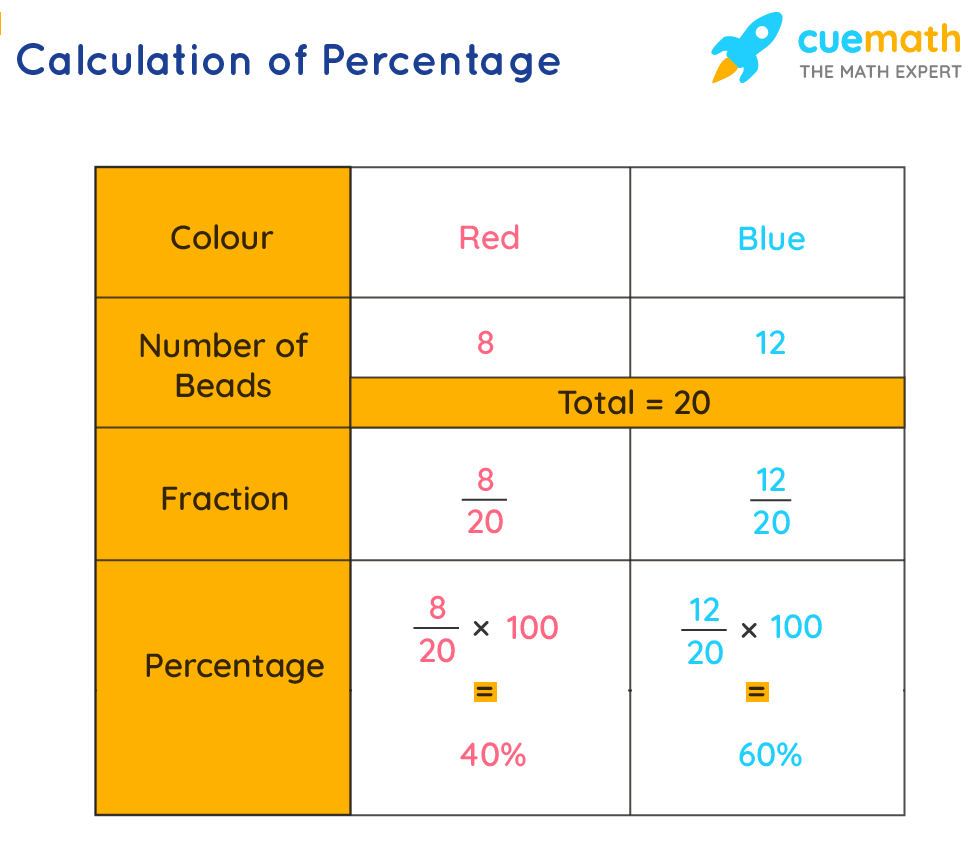
This scenario is about determining what percentage one number (the “part”) represents of a larger number (the “whole”). This is useful for figuring out what percentage discount you received, calculating profit margins, or understanding how much of your budget a certain expense consumes.
Formula: Percentage = (Part / Whole) * 100
Example 1: Determining a Discount Percentage
A shirt originally priced at $50 is on sale for $35. What is the discount percentage?
-
First, find the discount amount: $50 – $35 = $15. This is your “part.”
-
The original price, $50, is your “whole.”
-
Divide the part by the whole: $15 / $50 = 0.30
-
Multiply by 100 to get the percentage: 0.30 * 100 = 30%
-
The discount percentage is 30%.
Example 2: Calculating Profit Margin
A product sells for $200, and its cost to produce was $120. What is the profit margin percentage?
-
First, find the profit amount: $200 (revenue) – $120 (cost) = $80. This is your “part” (profit).
-
The selling price, $200, is your “whole” (revenue).
-
Divide profit by revenue: $80 / $200 = 0.40
-
Multiply by 100: 0.40 * 100 = 40%
-
The profit margin is 40%.
Calculating Percentage Increase or Decrease (e.g., Investment Growth, Price Changes)

This calculation measures the relative change between two values over time or across different points. It’s vital for analyzing investment growth, inflation, salary increases, or price fluctuations.
Formula: Percentage Change = ((New Value – Old Value) / Old Value) * 100
-
If the result is positive, it’s a percentage increase.
-
If the result is negative, it’s a percentage decrease.
Example 1: Investment Growth
You invested $5,000, and a year later, its value is $5,750. What is the percentage increase?
-
New Value = $5,750
-
Old Value = $5,000
-
Change = $5,750 – $5,000 = $750
-
Divide change by old value: $750 / $5,000 = 0.15
-
Multiply by 100: 0.15 * 100 = 15%
-
Your investment increased by 15%.
Example 2: Price Decrease
A car was priced at $25,000 last year, and this year it’s selling for $22,500. What is the percentage decrease?
-
New Value = $22,500
-
Old Value = $25,000
-
Change = $22,500 – $25,000 = -$2,500
-
Divide change by old value: -$2,500 / $25,000 = -0.10
-
Multiply by 100: -0.10 * 100 = -10%
-
The car’s price decreased by 10%.
Practical Applications in Personal Finance and Business
Mastering these core calculations opens the door to a deeper understanding and more effective management of various financial scenarios.
Navigating Sales, Discounts, and Markups
For both consumers and businesses, discounts and markups are daily occurrences that rely heavily on percentage calculations.
-
Calculating Sale Prices: If an item is $120 and has a 30% discount: $120 * 0.30 = $36 discount. New price = $120 – $36 = $84. Alternatively, if it’s 30% off, you pay 70% of the price: $120 * 0.70 = $84.
-
Determining Discount Percentages: If a $40 item is selling for $30, the discount is $10. ($10 / $40) * 100 = 25% discount.
-
Understanding Markups and Profit Margins: A business buys a product for $50 and sells it for $75. The markup is $25. ($25 / $50) * 100 = 50% markup on cost. The profit margin is ($25 / $75) * 100 = 33.33% profit margin on selling price. These distinctions are critical for pricing strategies.
Understanding Taxes and Tips
These are everyday percentage applications that directly impact your spending.
-
Sales Tax Calculation: If your bill is $75 and the sales tax is 8%: $75 * 0.08 = $6 in tax. Total bill = $75 + $6 = $81.
-
Tipping Etiquette and Calculation: For a $45 meal, a 15% tip is $45 * 0.15 = $6.75. A 20% tip is $45 * 0.20 = $9. Being able to quickly estimate these helps you budget and avoid awkward situations.
Analyzing Financial Growth and Change
For investors and anyone managing savings or loans, these calculations are indispensable.
-
Investment Returns and Losses: If your investment account grew from $10,000 to $10,800 in a year, that’s an 8% return ($800 / $10,000 * 100). If it dropped to $9,500, that’s a 5% loss ((-$500) / $10,000 * 100). Comparing these percentages allows for informed portfolio adjustments.
-
Loan Interest and Savings Growth: Understanding annual percentage yield (APY) on savings accounts or annual percentage rate (APR) on loans helps you evaluate the true cost of borrowing or the real growth of your savings. A 3% APY on $1,000 means $30 earned in interest over a year. A 10% APR on a $5,000 loan means you could pay $500 in interest over a year, depending on the compounding and repayment schedule.
Tools and Tips for Accurate Percentage Calculations
While the underlying math is straightforward, practical application often benefits from the right tools and an awareness of common pitfalls.
Leveraging Calculators and Spreadsheets
For complex calculations or to avoid errors, don’t shy away from technology:
-
Basic Calculators: Most smartphones and physical calculators have a ‘%’ button that can simplify “percentage of a number” calculations. For example, to find 25% of $80, you can often just type
80 * 25 % =. -
Spreadsheets (e.g., Excel, Google Sheets): These are powerful tools for financial planning. You can set up columns for original price, discount percentage, discount amount, and final price, with formulas automatically updating values. For instance, if original price is in A2 and discount percentage (as a decimal) is in B2, the discount amount would be
=A2*B2and the final price=A2-(A2*B2). This is especially useful for budgeting, tracking expenses, or managing inventory.
Common Pitfalls to Avoid
-
Confusing “of” with “from”: “20% of the price” is different from “20% off the price.” The former is just the percentage amount, the latter is the percentage subtracted.
-
Percentage Points vs. Percentage Change: An interest rate changing from 5% to 7% is a 2 percentage point increase, but a 40% percentage change ( (7-5)/5 * 100 ). This distinction is critical in financial reporting.
-
Using the Wrong Base: When calculating percentage increase/decrease, always divide by the original (old) value, not the new value.
-
Rounding Errors: Be mindful of rounding, especially in financial contexts where small differences can accumulate. It’s often best to carry more decimal places during intermediate steps and round only the final result to two decimal places (cents).
Cultivating Financial Literacy Through Percentage Mastery
Ultimately, the ability to calculate percentages of a price is more than just a mathematical trick; it’s a cornerstone of financial literacy. It allows you to:
-
Make informed consumer choices: Evaluate deals, understand true costs, and budget effectively.
-
Manage your investments wisely: Track performance, assess risks, and understand returns.
-
Operate a business profitably: Price goods correctly, calculate margins, and analyze financial performance.
-
Understand economic news: Grasp concepts like inflation, GDP growth, and interest rate changes.
By dedicating time to understand and practice these calculations, you’re not just improving your math skills; you’re building a robust foundation for a more secure and prosperous financial future. The seemingly simple concept of a percentage becomes a powerful lens through which to view and interact with the financial world, transforming you from a passive participant into an active, informed decision-maker.
aViewFromTheCave is a participant in the Amazon Services LLC Associates Program, an affiliate advertising program designed to provide a means for sites to earn advertising fees by advertising and linking to Amazon.com. Amazon, the Amazon logo, AmazonSupply, and the AmazonSupply logo are trademarks of Amazon.com, Inc. or its affiliates. As an Amazon Associate we earn affiliate commissions from qualifying purchases.