
Understanding how to calculate percent loss is a cornerstone of financial literacy, a critical skill for anyone managing money—be it personal investments, a household budget, or a multi-million-dollar business. In a world brimming with financial data, the ability to interpret a decrease in value not just in absolute terms, but proportionally, offers profound insights into performance, risk, and future strategy. This guide will demystify percent loss, providing you with a clear, actionable framework to apply this essential calculation across various financial scenarios.
While an absolute dollar amount of loss tells one part of the story, the percentage loss contextualizes it. A $100 loss on a $1,000 investment is dramatically different from a $100 loss on a $100,000 investment. The former represents a significant 10% setback, while the latter is a negligible 0.1% blip. This distinction is vital for making informed decisions, assessing risk, and setting realistic financial goals. From the individual investor tracking their portfolio’s performance to the business owner analyzing inventory shrinkage or sales downturns, mastering percent loss calculation empowers better financial health and strategic foresight.
The Core Formula: Deconstructing Percent Loss
At its heart, calculating percent loss is a straightforward mathematical process that standardizes the measurement of a decrease in value. It allows for direct comparisons between different assets, investments, or time periods, regardless of their initial scale.
Understanding the Concept of Percent Loss
Percent loss represents the proportional decrease of a final value relative to an original value, expressed as a percentage. It answers the question: “How much of the initial value was lost?” This metric is far more insightful than simply stating the absolute dollar amount lost because it normalizes the loss against the starting point. For instance, knowing a stock dropped $5 per share isn’t as informative as knowing it dropped 50% from its original $10 per share value, which immediately signals a significant impairment.
The power of percentages lies in their ability to provide a common language for comparison. Whether you’re comparing the performance of two different stocks purchased at different prices or analyzing the depreciation of a car versus a piece of equipment, percent loss provides a standardized benchmark. It helps in assessing the magnitude of a financial event relative to its context, which is crucial for effective decision-making in personal and business finance.
The Universal Formula Explained Step-by-Step
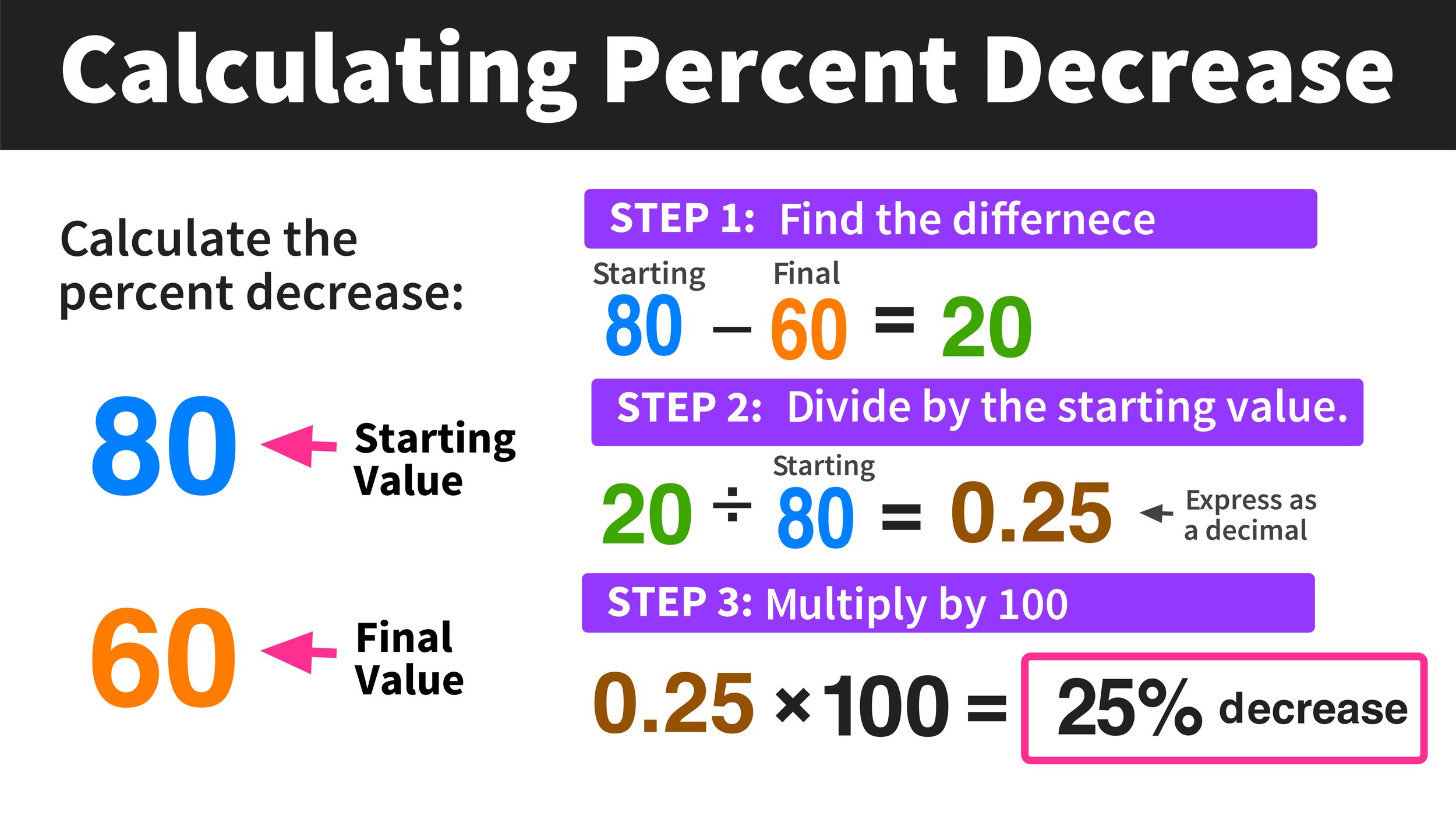
The formula for calculating percent loss is universally applicable across all financial contexts:
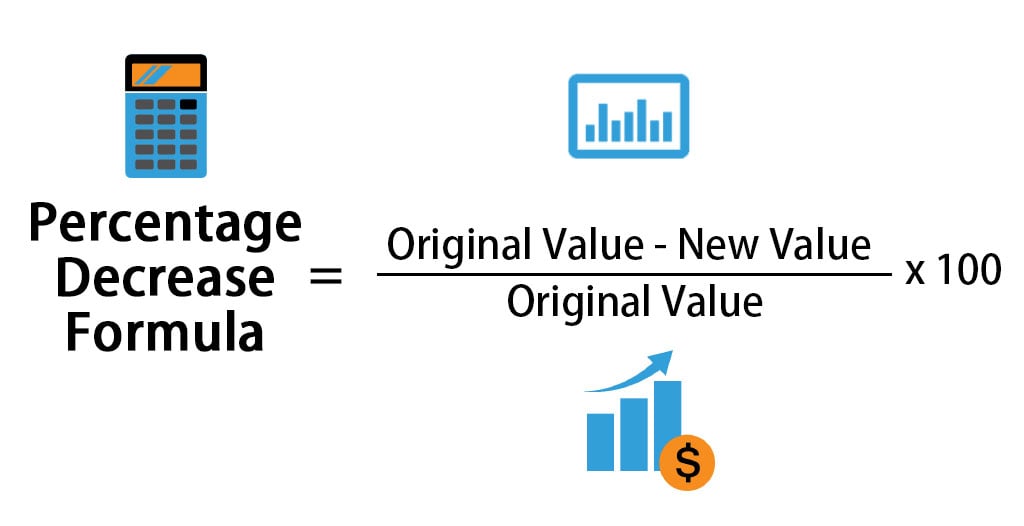
Percent Loss = ((Original Value - Final Value) / Original Value) * 100%
Let’s break down each component:
-
Original Value (OV): This is the starting point, the initial price, cost, or value of the asset or investment before any decrease occurred. It’s crucial to identify this accurately, as it forms the baseline for your calculation.
-
Final Value (FV): This is the ending point, the price, cost, or value of the asset or investment after the decrease. It’s the current or selling value that is lower than the original value.
-
Original Value – Final Value: This part of the formula calculates the absolute loss or the dollar amount of the decrease.
-
(Absolute Loss / Original Value): This ratio determines the proportion of the original value that was lost. It yields a decimal number, which represents the fractional loss.
-
*100%: Multiplying the fractional loss by 100 converts it into a percentage, making it easily understandable and comparable.
Practical Example:
Imagine you bought shares of Company X for $500. A year later, due to market volatility, you decide to sell them for $400.
-
Original Value (OV): $500
-
Final Value (FV): $400
-
Absolute Loss: $500 – $400 = $100
-
Fractional Loss: $100 / $500 = 0.20
-
Percent Loss: 0.20 * 100% = 20%
In this scenario, you experienced a 20% loss on your investment. This calculation is the bedrock upon which more complex financial analysis is built, providing clarity and context to financial outcomes.
Essential Applications Across Personal and Business Finance
The ability to calculate percent loss is not merely an academic exercise; it’s a practical skill with profound implications across various facets of personal and business finance.
Measuring Investment Declines
For investors, understanding percent loss is indispensable. It’s the primary way to gauge the performance of individual assets and entire portfolios during downturns.
-
Stocks, Bonds, Cryptocurrencies, Real Estate: Whether you’re tracking the value of your stock portfolio, monitoring a bond’s price fluctuations, assessing a cryptocurrency’s dip, or valuing a real estate property whose market price has fallen, percent loss provides a standardized metric. It helps you understand the magnitude of your losses relative to your initial capital, which is crucial for managing expectations and emotional responses to market movements.
-
Tracking Portfolio Drawdowns and Assessing Risk: Investors frequently analyze “drawdowns,” which refer to the peak-to-trough decline in an investment, fund, or trading account during a specific period. Expressed as a percentage, drawdowns help in assessing the risk profile of an investment. A portfolio that consistently experiences significant percentage losses during market corrections might indicate a higher risk tolerance than desired, prompting a re-evaluation of its asset allocation. This understanding allows for more informed decisions about diversification and risk mitigation strategies.
Example: You purchased 100 shares of TechCo at $120 per share, totaling $12,000. Six months later, the shares are trading at $90 per share.
-
Original Value: $12,000 (100 shares * $120)
-
Final Value: $9,000 (100 shares * $90)
-
Percent Loss = (($12,000 – $9,000) / $12,000) * 100% = ($3,000 / $12,000) * 100% = 0.25 * 100% = 25%
This indicates a substantial quarter of your initial investment has been lost.
Analyzing Business Inventory and Asset Depreciation
Businesses rely on percent loss calculations to identify inefficiencies, manage costs, and evaluate the health of their assets.
-
Calculating Losses Due to Inventory Shrinkage, Damage, or Obsolescence: Retailers and manufacturers often face inventory losses due to theft (shrinkage), damage, spoilage, or becoming outdated (obsolescence). Calculating the percentage of lost inventory helps businesses quantify the problem, identify root causes, and implement corrective measures.
Example: A clothing boutique started the quarter with $50,000 worth of inventory. At the end of the quarter, after accounting for sales, a physical count reveals $48,000 worth of remaining inventory, indicating $2,000 in shrinkage.
-
Original Inventory Value (expected after sales): $50,000
-
Final Inventory Value (actual after physical count): $48,000
-
Percent Loss (Shrinkage) = (($50,000 – $48,000) / $50,000) * 100% = ($2,000 / $50,000) * 100% = 0.04 * 100% = 4%
A 4% shrinkage rate is a clear signal for management to investigate security, handling, or accounting procedures.
-
-
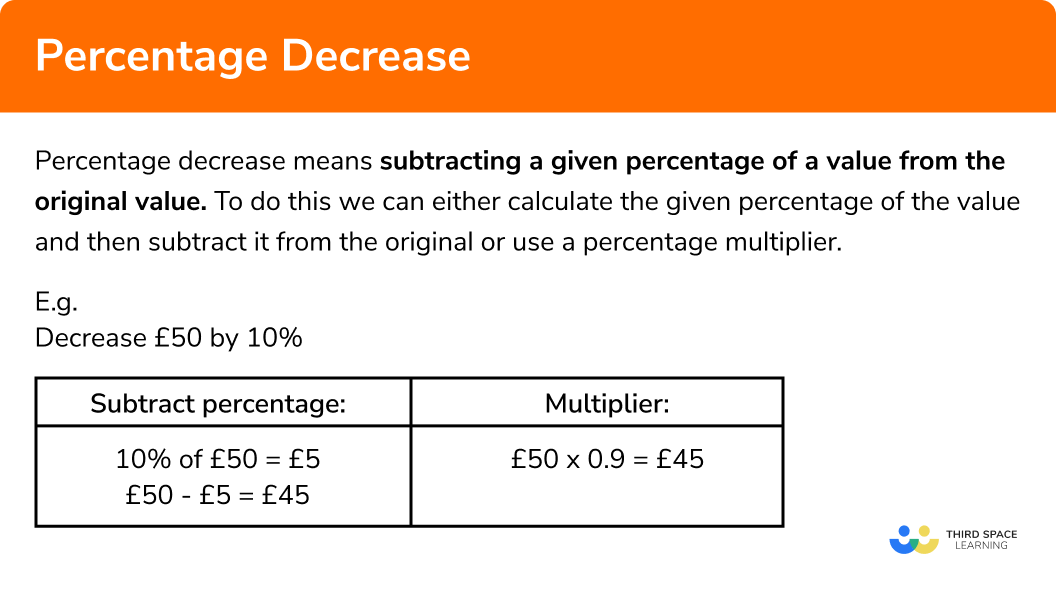
Understanding Asset Depreciation Over Time: While depreciation is often calculated using specific accounting methods (straight-line, declining balance), the concept of percent loss helps contextualize the decrease in an asset’s market value or utility over time. For example, a vehicle purchased for business use loses a percentage of its value each year, which impacts the company’s balance sheet and potential resale value.
Quantifying Personal Financial Setbacks
Beyond investments, percent loss helps individuals quantify financial setbacks in their personal lives.
-
Loss of Value in Personal Assets: Consider a collectible item, like a limited-edition watch, that you purchased as an investment. If its market value drops, calculating the percent loss shows the actual impact on your personal wealth. Similarly, knowing the depreciation rate (a form of percent loss) for a car helps in understanding its true cost of ownership.
-
Understanding the Real Impact of Unexpected Expenses on Savings: While an unexpected expense isn’t a “loss” of an asset’s value, it represents a loss of potential capital or a depletion of savings. For example, if you had $10,000 saved for a down payment and had to spend $2,000 on an emergency car repair, you’ve experienced a 20% “loss” of your down payment fund, directly impacting your financial goals.
Beyond the Basics: Advanced Insights and Strategic Implications
Calculating percent loss is just the beginning. The true value lies in understanding its deeper implications, especially when making strategic financial decisions.
The Asymmetry of Gains and Losses
One of the most critical insights derived from percent loss is the inherent asymmetry between gains and losses. Recovering from a percentage loss always requires a larger percentage gain. This phenomenon has profound implications for risk management and investment recovery strategies.
-
Mathematical Demonstration:
-
If you lose 10%, you need an 11.11% gain to break even. ($100 down to $90 is a $10 loss. To get back to $100 from $90, you need to gain $10. $10/$90 = 0.1111 or 11.11%).
-
If you lose 25%, you need a 33.33% gain.
-
If you lose 50%, you need a 100% gain to recover. ($100 down to $50 is a $50 loss. To get back to $100 from $50, you need to gain $50. $50/$50 = 1.00 or 100%).
-
If you lose 75%, you need a 300% gain.
-
-
Implications for Risk Management: This asymmetry underscores the importance of limiting losses. A small percentage loss is much easier to recover from than a large one. This insight drives strategies like stop-loss orders in investing, which automatically sell an asset if it drops below a certain percentage to prevent more significant drawdowns. It also highlights the importance of capital preservation: avoiding significant losses is often more beneficial than chasing exceptionally high returns, especially in volatile markets.
Psychological Impact and Decision Making
Behavioral finance teaches us that humans often react to losses more intensely than to equivalent gains—a concept known as “loss aversion.”
-
Prospect Theory and Loss Aversion: The pain of a 10% loss typically feels more significant than the pleasure of a 10% gain. This psychological bias can lead to irrational financial decisions, such as holding onto losing investments too long (hoping they’ll recover) or selling winning investments too early (to lock in gains).
-
Informed Decisions: Understanding the mathematical reality of percent loss, combined with an awareness of your own psychological biases, can help you make more rational, less emotionally driven financial decisions. It allows you to detach from the immediate pain of a loss and focus on the strategic implications for your long-term financial health.
Common Pitfalls and Nuances
Even with a clear formula, several nuances can lead to miscalculations or misinterpretations of percent loss.
-
Mistaking Nominal Loss for Real Loss: Nominal loss is the dollar amount lost, while real loss considers the impact of inflation. For example, if your investment loses 5% nominally but inflation was 3%, your real purchasing power loss is closer to 8% (simplistically). For a true real loss, the final value needs to be adjusted for inflation before calculating the percent loss. This is crucial for long-term financial planning.
-
Inaccurate Original Value: Ensure your “Original Value” accurately reflects all costs incurred. For investments, this should include transaction costs like commissions, brokerage fees, or transfer taxes. Ignoring these can lead to an underestimation of your true original cost and, consequently, an underestimation of your percent loss.
-
The Importance of Context and Timeframes: A 20% loss over one month is far more alarming than a 20% loss over five years. Always consider the timeframe and surrounding market conditions when evaluating a percent loss. Contextualizing losses helps in understanding their significance and whether they represent a temporary fluctuation or a systemic problem.
Leveraging Tools and Strategies for Mitigation
While calculating percent loss helps you understand past performance, the ultimate goal is to use this knowledge to inform future actions and mitigate potential losses.
Digital Tools for Calculation and Tracking
Modern financial management is significantly enhanced by digital tools.
-
Spreadsheets (Excel, Google Sheets) for Custom Calculations: For those who prefer a hands-on approach, spreadsheets are invaluable. You can set up custom formulas to track individual investments, calculate overall portfolio performance, and even model different loss scenarios. This allows for flexibility and a deeper understanding of the underlying mechanics.
-
Financial Calculators and Investment Tracking Apps: Numerous online financial calculators and dedicated investment tracking apps (e.g., Mint, Personal Capital, brokerage platforms) automate percent loss calculations. They provide real-time updates on your holdings, automatically factor in transaction costs, and often present data in intuitive graphs, simplifying the monitoring process.
-
Automating Loss Analysis: Integrating your financial accounts with these tools can automate the analysis of gains and losses, providing quick insights into which assets are underperforming and allowing you to set alerts for significant percentage drops.
Proactive Risk Management Techniques
Understanding percent loss is a prerequisite for effective risk management.
-
Diversification in Investment Portfolios: Spreading investments across various asset classes (stocks, bonds, real estate), industries, and geographies reduces the impact of a significant percentage loss in any single holding. If one asset experiences a large percent loss, others might perform well, cushioning the overall portfolio’s impact.
-
Setting Stop-Loss Orders: For actively traded assets, a stop-loss order is an instruction to sell an investment if its price falls to a specific level. This limits potential percentage losses by automatically exiting a position before further declines occur, safeguarding capital.
-
Building Emergency Funds and Adequate Insurance Coverage: In personal finance, an emergency fund acts as a buffer against unexpected expenses that could otherwise deplete long-term savings or force the sale of assets at a loss. Similarly, adequate insurance (health, auto, home) prevents large, unforeseen costs from turning into significant personal financial losses.
-
Regular Financial Reviews: Periodically reviewing your financial statements, investment performance, and budget allows you to identify potential areas of loss early. This proactive approach enables timely adjustments, whether it’s rebalancing an investment portfolio, cutting unnecessary expenses, or renegotiating contracts in business.
Conclusion
The ability to calculate percent loss is a foundational skill in the realm of money. It transforms raw financial data into meaningful insights, providing a standardized and contextualized view of value decreases. From quantifying investment drawdowns and assessing business inventory shrinkage to understanding the true impact of personal financial setbacks, this calculation is indispensable.
Beyond the numbers, mastering percent loss fosters a deeper understanding of financial risk, encourages strategic decision-making, and helps mitigate the psychological biases often associated with market fluctuations. By leveraging digital tools and implementing proactive risk management strategies, individuals and businesses alike can use this knowledge to navigate the complexities of the financial world with greater confidence and competence, ultimately building more resilient and prosperous financial futures.
aViewFromTheCave is a participant in the Amazon Services LLC Associates Program, an affiliate advertising program designed to provide a means for sites to earn advertising fees by advertising and linking to Amazon.com. Amazon, the Amazon logo, AmazonSupply, and the AmazonSupply logo are trademarks of Amazon.com, Inc. or its affiliates. As an Amazon Associate we earn affiliate commissions from qualifying purchases.