
In the intricate world of personal finance, investing, and business strategy, numbers tell a story. They reveal growth, highlight stagnation, and signal areas for improvement. Among the most fundamental yet powerful calculations used to interpret these stories is the “percent increase.” Far more than just a mathematical exercise, understanding how to calculate percent increase is an indispensable skill that empowers individuals and businesses to track progress, make informed decisions, and set realistic goals.
Whether you’re monitoring the appreciation of your investment portfolio, analyzing a raise in your salary, evaluating the growth of your online business revenue, or simply tracking the rising cost of living, grasping this concept provides invaluable clarity. It transforms raw data into meaningful insights, allowing you to gauge performance relative to a previous state and contextualize changes over time. This article will demystify the process, providing a comprehensive guide to calculating percent increase and illustrating its critical applications within the realm of money and finance.
The Fundamental Formula for Percent Increase
At its core, calculating percent increase is about quantifying the relative change between an original value and a new, larger value. It answers the question: “By what percentage has this number grown?” The beauty of this calculation lies in its simplicity and universal applicability across various financial scenarios.
Deconstructing the Formula
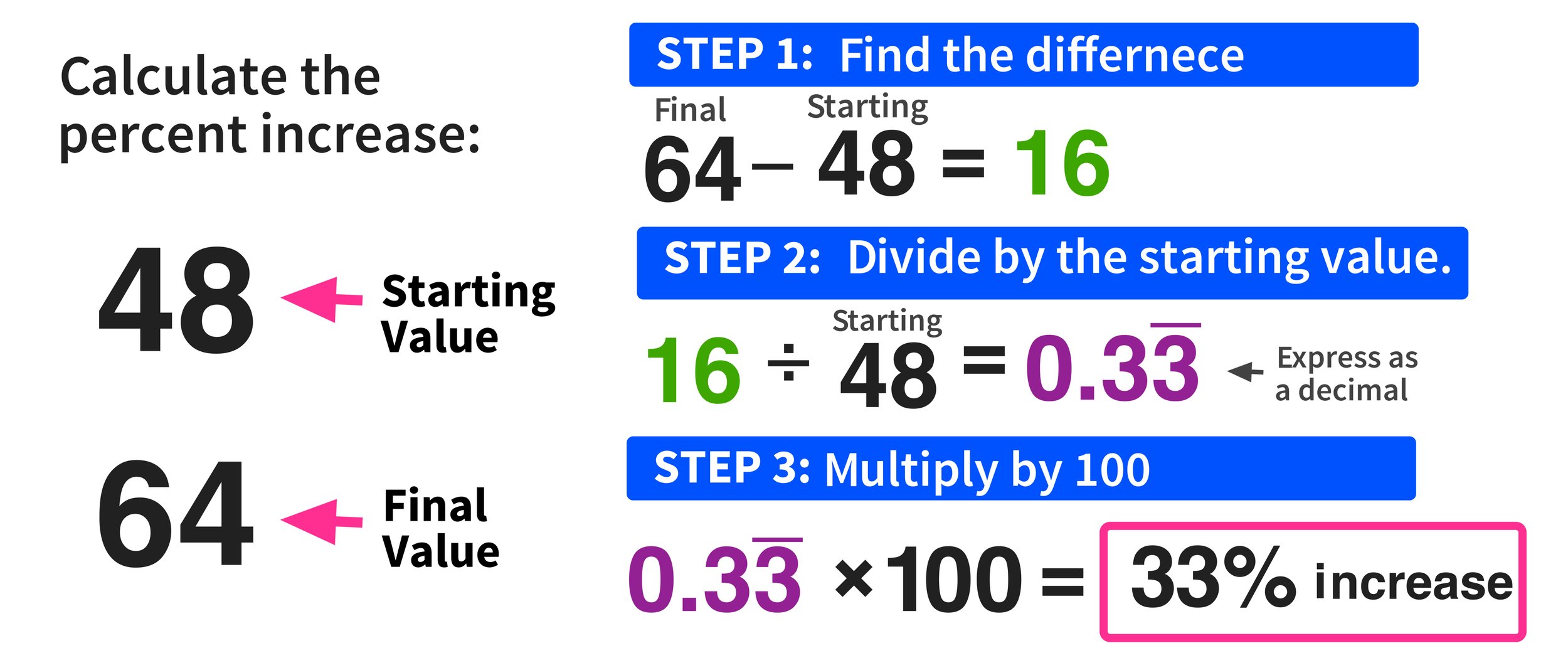
The formula for percent increase is straightforward:
Percent Increase = ((New Value – Original Value) / Original Value) * 100
Let’s break down each component:
- New Value: This is the larger, subsequent number, representing the current or ending state after the increase.
- Original Value: This is the smaller, initial number, representing the starting point before the increase occurred.
- Difference (New Value – Original Value): This first step calculates the absolute amount of change or the raw increase between the two numbers.
- Division by Original Value: By dividing the absolute change by the original value, we normalize the increase, converting it into a decimal representation of the growth relative to the starting point. This is crucial because it allows for a standardized comparison, regardless of the magnitude of the original numbers. A $100 increase on a $1,000 investment is vastly different in significance than a $100 increase on a $10 investment.
- Multiplication by 100: Finally, multiplying the result by 100 converts the decimal into a percentage, making it easier to understand and communicate.
Step-by-Step Calculation Guide
To ensure clarity, let’s walk through the process with a simple example:
- Identify the Original Value: This is your starting point.
- Identify the New Value: This is your ending point after the increase.
- Calculate the Difference: Subtract the Original Value from the New Value.
- Example: New Value ($120) – Original Value ($100) = $20
- Divide by the Original Value: Take the difference you just calculated and divide it by the Original Value.
- Example: $20 / $100 = 0.20
- Multiply by 100: Convert the decimal to a percentage by multiplying by 100.
- *Example: 0.20 * 100 = 20%*
A Simple Example (Personal Finance Context)
Imagine you received a salary raise. Your original annual salary was $50,000, and your new annual salary is $53,000. How much did your salary increase in percentage terms?
- Original Value = $50,000
- New Value = $53,000
- Difference: $53,000 – $50,000 = $3,000
- Divide by Original: $3,000 / $50,000 = 0.06
- Multiply by 100: 0.06 * 100 = 6%
Your salary increased by 6%. This percentage gives you a much clearer picture than just the $3,000 absolute increase, allowing you to compare it against inflation rates, industry averages, or previous raises.
Practical Applications in Personal Finance and Investing
The utility of percent increase extends across virtually every facet of personal money management and investment strategy. It’s a metric that provides vital context and allows for meaningful performance evaluation.
Tracking Investment Growth
One of the most common and compelling uses of percent increase is in assessing investment performance.
- Stock Performance: If you bought a stock at $50 per share and it’s now trading at $65, that’s a ((65-50)/50)*100 = 30% increase. This helps you understand the return on your capital.
- Mutual Funds and ETFs: Fund managers and financial advisors frequently report returns as percentage increases over various periods (e.g., year-to-date, 1-year, 5-year, 10-year). This allows investors to compare different funds objectively.
- Real Estate Appreciation: The value of a property bought for $300,000 that is now appraised at $390,000 has seen a ((390,000-300,000)/300,000)*100 = 30% increase in value. This is critical for assessing equity and potential selling profits.
- Compounding Interest: While percent increase measures discrete changes, understanding it is foundational to grasping compounding interest, where your initial investment grows, and then that growth itself earns returns, leading to exponential percentage increases over longer durations.
Analyzing Personal Income and Expenses
Beyond investments, percent increase offers clarity on your day-to-day financial health.
- Salary Raises vs. Inflation: You might get a 3% raise, but if inflation is 5%, your purchasing power has actually decreased in real terms. Calculating the percentage change in both helps paint a more accurate picture.
- Budgeting and Expense Tracking: Identifying which expense categories are increasing fastest in percentage terms (e.g., groceries, utilities, housing) can highlight areas where you need to adjust your spending habits. If your energy bill went from $150 to $180, that’s a ((180-150)/150)*100 = 20% increase, which might prompt you to investigate causes or conservation methods.
- Saving Goals Progress: If your savings account grew from $10,000 to $11,000, you’ve achieved a 10% increase. This helps motivate and track progress towards financial milestones.
Understanding Cost Increases and Debt Servicing
While “percent increase” often implies positive growth, it’s equally crucial for understanding increases in financial obligations or costs.
- Loan Interest Accrual: While not a direct ‘increase between two numbers’ in the simple sense, understanding how interest rates (which are percentages) cause your outstanding debt to grow allows you to calculate the percentage increase in your total repayment over time.
- Healthcare Costs: Tracking the percentage increase in insurance premiums or out-of-pocket expenses can be vital for financial planning.
Leveraging Percent Increase for Business Finance & Online Income
For entrepreneurs, small business owners, and those generating online income, percent increase is a cornerstone metric for evaluating operational performance and strategic effectiveness. It helps quantify success, identify trends, and inform future decisions.
Sales and Revenue Growth
This is perhaps the most fundamental application in business.
- Quarter-over-Quarter (QoQ) and Year-over-Year (YoY) Growth: Businesses routinely compare sales, revenue, and customer acquisition metrics against previous periods using percent increase. A business that grew its Q2 revenue from $100,000 to $125,000 has achieved a 25% QoQ increase, a clear indicator of positive momentum.
- Identifying Successful Strategies: A significant percentage increase in sales following a new marketing campaign suggests the campaign was effective, justifying further investment.
- Benchmarking Performance: Comparing your business’s percentage growth against industry averages or competitors provides critical context for your performance.
Profit Margin Evolution
Revenue growth is important, but profit is king.
- Tracking Operational Efficiency: If your gross profit increased from $50,000 to $60,000 on the same revenue, your profit margin has improved in percentage terms, indicating better cost management or pricing strategies.
- Impact of Cost Increases vs. Revenue Increases: Calculating the percent increase in cost of goods sold (COGS) versus the percent increase in revenue helps determine if rising costs are eating into your profitability or if revenue growth is outpacing cost inflation.
Marketing ROI (Return on Investment) – Simplified
While a full ROI calculation is more complex, percent increase helps gauge marketing effectiveness.
- Lead Generation: If a new ad campaign increased your monthly leads from 200 to 300, that’s a 50% increase, suggesting the campaign is driving more interest.
- Conversion Rates: An increase in the percentage of website visitors who make a purchase (conversion rate) directly impacts revenue growth and can be measured as a percent increase from a previous period.
Pricing Strategies
When considering price adjustments, understanding the potential percent increase is crucial.
- Impact of Price Hikes: If you increase a product’s price from $10 to $12, that’s a 20% increase. Understanding this percentage helps you anticipate customer reaction and model potential changes in sales volume.
Common Pitfalls and Nuances to Consider
While calculating percent increase is straightforward, its interpretation requires a nuanced understanding to avoid misleading conclusions.
Misinterpreting the Base Value
The “Original Value” is always the denominator in the formula, and it serves as the benchmark for growth. A common mistake is to confuse the original with the new, or to use an inappropriate base. Always ensure you are comparing against the true starting point of the change you wish to measure. For instance, if you want to know the growth from last year, last year’s figure is your original value.
The Impact of Negative Numbers (Percent Decrease)
Our focus here is “percent increase,” implying growth. However, if the new value is smaller than the original value, the formula will yield a negative percentage. This indicates a “percent decrease.” While the calculation method is the same, the interpretation changes. For example, if an investment drops from $100 to $80, the calculation would be ((80-100)/100)*100 = -20%, representing a 20% decrease. It’s vital to differentiate between increase and decrease for accurate financial reporting.
The Importance of Context and Timeframes
A percentage increase rarely tells the whole story in isolation.
- Short-term Volatility vs. Long-term Trends: A 50% increase in a stock over one week might be exciting, but if it follows a 70% decrease, the long-term picture is still negative. Always consider the duration over which the change occurred.
- Annualized vs. Cumulative Growth: An investment that grew 10% in Year 1 and 15% in Year 2 has a cumulative growth of (1.10 * 1.15) – 1 = 26.5%, not simply 25%. Understanding if a reported percentage is annualized (average per year) or cumulative (total over a period) is crucial for comparing investments fairly.
- Scale of Numbers: A 100% increase on $10 is $10; a 10% increase on $1,000,000 is $100,000. While the percentage might be smaller, the absolute monetary impact is vastly different.
Beyond a Single Metric
While powerful, percent increase should ideally be combined with other financial indicators for a holistic view. For a business, percent increase in revenue should be considered alongside profit margins, customer retention rates, and operating expenses. For personal finance, salary increase percentages should be weighed against inflation, savings rates, and debt levels.
Tools and Resources for Easier Calculation
While the formula is simple enough for manual calculation, various tools can expedite the process, especially when dealing with large datasets or frequent analyses.
Spreadsheet Software (Excel/Google Sheets)
Spreadsheets are invaluable for financial analysis, and calculating percent increase is one of their most basic functions.
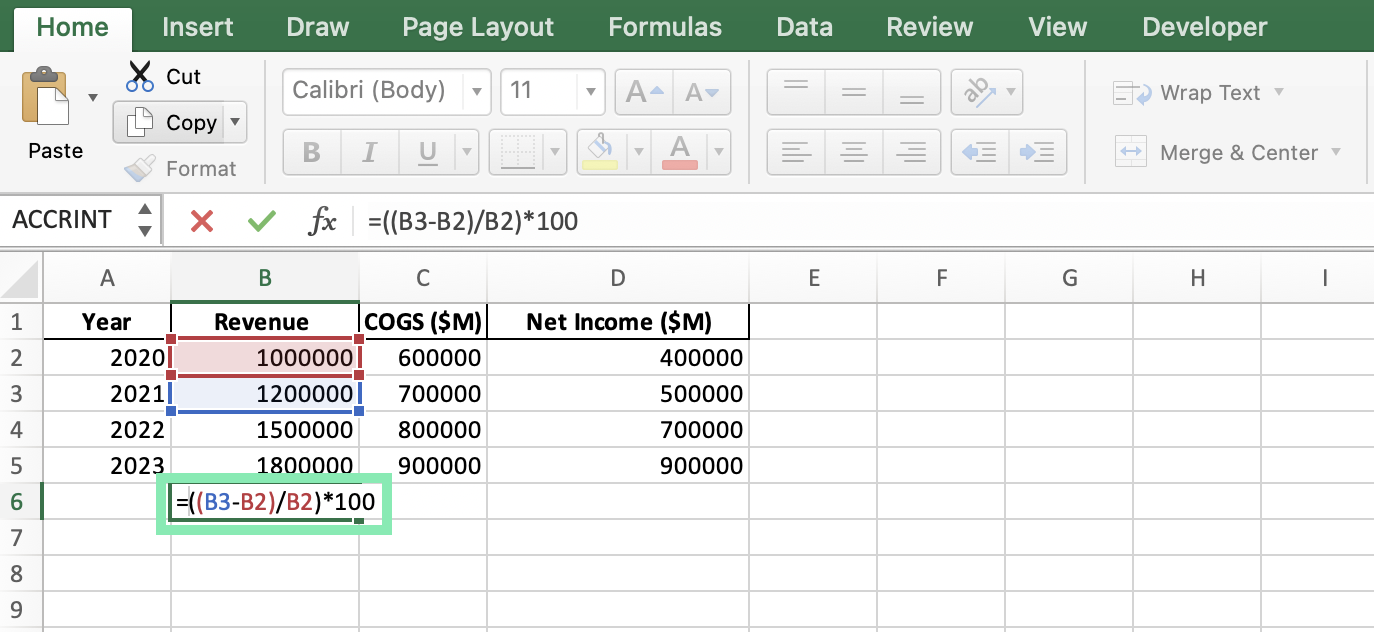
- Simple Formulas: If your original value is in cell A1 and your new value is in cell B1, the formula for percent increase would be
=(B1-A1)/A1. Remember to format the cell as a percentage to display the result correctly. If you want it multiplied by 100 explicitly, you can add*100. - Tracking Over Time: You can easily set up columns for monthly or yearly data and drag the formula down to calculate percent increases across multiple periods, providing dynamic tracking capabilities.
Online Calculators and Financial Apps
Numerous websites and mobile applications offer quick and easy percent increase calculators. These are ideal for on-the-go calculations or when you don’t need a full spreadsheet. A quick search for “percentage change calculator” will yield many options. Many personal finance apps also incorporate these calculations into their budgeting or investment tracking features.
Financial Planning Software
More advanced financial planning software and investment platforms often have built-in dashboards that automatically display percentage changes for your assets, liabilities, income, and expenses over various timeframes, eliminating the need for manual calculations altogether. These tools aggregate data and present it in an easily digestible format, complete with graphical representations of growth.
Conclusion
The ability to calculate percent increase between two numbers is not merely an academic exercise; it is a fundamental skill that underpins sound financial decision-making in personal finance, investing, and business. From tracking the growth of your retirement savings and analyzing a salary increase against inflation to evaluating the profitability of your online ventures, this simple formula provides critical context and clarity.
By mastering this calculation, you gain a powerful lens through which to view your financial world. It enables you to move beyond raw numbers and understand the relative magnitude of change, empowering you to identify trends, measure performance, and ultimately, make more informed choices that align with your financial goals. Embrace this essential tool, and you’ll find yourself far better equipped to navigate the ever-evolving landscape of money and investments.
aViewFromTheCave is a participant in the Amazon Services LLC Associates Program, an affiliate advertising program designed to provide a means for sites to earn advertising fees by advertising and linking to Amazon.com. Amazon, the Amazon logo, AmazonSupply, and the AmazonSupply logo are trademarks of Amazon.com, Inc. or its affiliates. As an Amazon Associate we earn affiliate commissions from qualifying purchases.