
Purchasing a car is one of the most significant financial decisions many individuals make, second only to buying a home. While the excitement of a new vehicle can be intoxicating, approaching this decision with financial acumen is paramount. Understanding how your monthly car payment is calculated isn’t just about satisfying curiosity; it’s a critical skill that empowers you to budget effectively, negotiate confidently, and ultimately make a choice that aligns with your long-term financial health. Without a clear grasp of the underlying figures, buyers risk committing to payments they can ill afford or paying substantially more in interest than necessary. This guide aims to demystify the process, breaking down the components of a car loan and equipping you with the knowledge to calculate your payments accurately.
Understanding the Core Components of a Car Loan
Before diving into formulas, it’s essential to understand the variables that collectively determine your monthly car payment. Each element plays a significant role, and a slight adjustment to any of them can dramatically alter the final figure and the total cost of your loan.
Vehicle Price (Principal Amount)
The principal amount is the actual sum of money you are borrowing. This isn’t always the sticker price of the car. It’s the negotiated sale price of the vehicle, minus any down payment you make and any trade-in value from your old car. For instance, if a car is priced at $30,000, and you make a $5,000 down payment and trade in a vehicle worth $3,000, your principal amount would be $30,000 – $5,000 – $3,000 = $22,000. A larger down payment directly reduces the principal, leading to lower monthly payments and less interest paid over the life of the loan. Conversely, a smaller down payment or no down payment means you’re financing a larger sum, increasing both your monthly payments and total interest.
Interest Rate (Annual Percentage Rate – APR)
The interest rate is essentially the cost of borrowing money, expressed as a percentage of the principal. Lenders charge interest to profit from providing the loan. When discussing car loans, you’ll often hear the term “APR” (Annual Percentage Rate). APR is a broader measure of the cost of borrowing money, representing the annual rate charged for borrowing, including any fees or additional costs associated with the transaction. While the nominal interest rate reflects just the cost of borrowing the principal, the APR provides a more comprehensive picture, often slightly higher due to these embedded fees. Factors influencing your APR include your credit score, the loan term, current market interest rates, and the lender’s specific policies. A higher credit score typically qualifies you for a lower APR, significantly reducing the overall cost of the loan.
Loan Term (Repayment Period)
The loan term is the duration over which you agree to repay the loan, typically expressed in months (e.g., 36, 48, 60, 72, or even 84 months). The loan term has a direct and significant impact on your monthly payment. A longer loan term will result in lower monthly payments because the principal is spread out over more installments. However, this convenience comes at a cost: a longer term almost always means you’ll pay more in total interest over the life of the loan. Conversely, a shorter loan term will lead to higher monthly payments but a lower total interest paid, saving you money in the long run. Choosing the right loan term involves balancing affordability with the total cost of the loan.
Additional Costs and Fees
Beyond the vehicle price and interest, several other costs can influence the total amount you finance or must pay out-of-pocket. These often include:
- Sales Tax: A percentage of the vehicle’s purchase price, varying by state and locality.
- Registration and Licensing Fees: Charges to register the vehicle with your state’s Department of Motor Vehicles and obtain license plates.
- Documentation Fees (Doc Fees): Administrative fees charged by dealerships for preparing paperwork. These can sometimes be negotiable.
- Extended Warranties: Optional service contracts that cover repairs beyond the manufacturer’s warranty. While sometimes valuable, they significantly increase the financed amount if rolled into the loan.
- Guaranteed Asset Protection (GAP) Insurance: Covers the difference between what you owe on your car loan and the car’s actual cash value if it’s totaled or stolen. Often recommended, but can add to your monthly payment.
Understanding these additional costs is crucial for accurate budgeting and to avoid surprises during the purchase process.
The Formula for Calculating Your Monthly Car Payment
While online calculators offer instant results, understanding the underlying mathematical formula provides a deeper insight into how your payments are structured. It empowers you to verify calculations and manipulate variables to understand their impact.
The Basic Loan Payment Formula
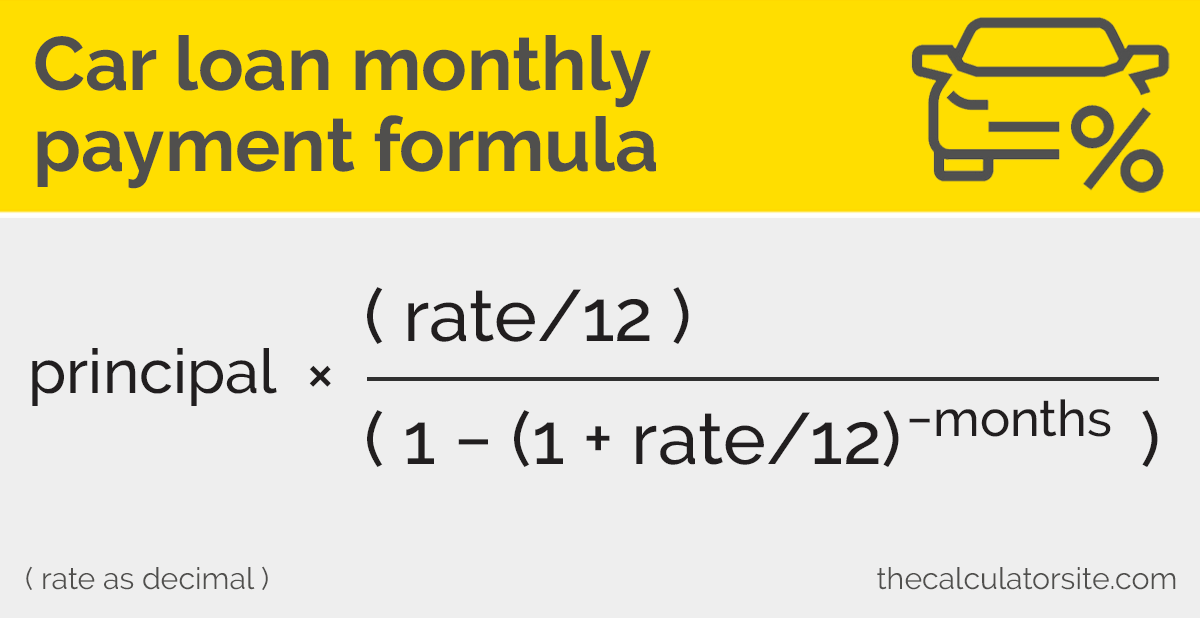
The standard formula used to calculate a fixed monthly loan payment, including for a car, is:
$M = P [ i(1 + i)^n ] / [ (1 + i)^n – 1]$
Where:
- $M$ = Your monthly payment
- $P$ = The principal loan amount (the amount you are financing after down payment and trade-in)
- $i$ = Your monthly interest rate (your annual interest rate divided by 12)
- $n$ = The total number of payments (your loan term in years multiplied by 12)
This formula effectively amortizes the loan, ensuring that each payment covers both a portion of the principal and the accrued interest. In the initial months of the loan, a larger portion of your payment goes towards interest, gradually shifting towards principal as the loan matures.
Breaking Down the Variables
To use the formula, you need to correctly convert your known values into the required format:
- P (Principal Loan Amount): As discussed, this is the net amount you are borrowing. For a $25,000 car with a $3,000 down payment, $P = $22,000.
- i (Monthly Interest Rate): This is your annual interest rate (APR) expressed as a decimal and then divided by 12. For example, if your APR is 6%, it becomes 0.06. Your monthly interest rate $i$ would then be $0.06 / 12 = 0.005$. It’s crucial not to forget this step, as using the annual rate directly will yield an incorrect payment.
- n (Total Number of Payments): This is the loan term in months. If you have a 5-year loan, $n = 5 text{ years} times 12 text{ months/year} = 60 text{ payments}$.
A Step-by-Step Example Calculation
Let’s walk through an example to illustrate the formula in action:
Scenario:
- Principal Loan Amount (P): $20,000
- Annual Interest Rate (APR): 5%
- Loan Term: 4 years
Step 1: Convert Annual Rate to Monthly Interest Rate (i)
- APR as decimal: $5% = 0.05$
- Monthly rate ($i$): $0.05 / 12 = 0.00416667$
Step 2: Convert Loan Term to Total Number of Payments (n)
- Loan term in months ($n$): $4 text{ years} times 12 text{ months/year} = 48 text{ payments}$
Step 3: Plug Values into the Formula
$M = 20000 [ 0.00416667(1 + 0.00416667)^{48} ] / [ (1 + 0.00416667)^{48} – 1]$
Step 4: Calculate $(1 + i)^n$
- $(1 + 0.00416667)^{48} = (1.00416667)^{48} approx 1.220999$
Step 5: Substitute and Solve
$M = 20000 [ 0.00416667 times 1.220999 ] / [ 1.220999 – 1]$
$M = 20000 [ 0.0050875 ] / [ 0.220999 ]$
$M = 101.75 / 0.220999$
$M approx 460.45$
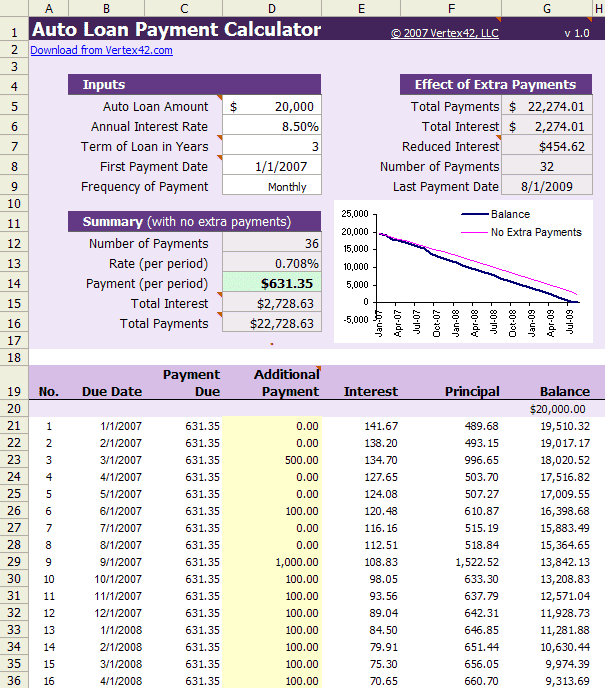
So, for a $20,000 loan at 5% APR over 4 years, the estimated monthly payment would be approximately $460.45. While this manual calculation can be tedious, it vividly demonstrates the mechanics behind your monthly obligation.
Practical Tools and Resources for Calculation
While the formula provides the fundamental understanding, in practice, most people rely on more convenient and less error-prone tools for calculating car payments.
Online Car Loan Calculators
The most accessible and widely used tools are online car loan calculators. You can find these on almost every lender’s website (banks, credit unions, auto finance companies), as well as on independent financial portals (e.g., NerdWallet, Bankrate, Edmunds, Kelley Blue Book).
Benefits:
- Speed and Accuracy: They instantly provide precise calculations.
- Ease of Use: Simply input the principal amount, interest rate (APR), and loan term.
- Scenario Planning: Most allow you to easily adjust variables (e.g., increasing down payment, extending the term) to see how it impacts your monthly payment, empowering you to explore different financing options.
How to Use Them Effectively: Be sure to input the correct APR (not just the simple interest rate) and include any additional fees you plan to roll into the loan to get the most accurate estimate.
Spreadsheet Software (Excel/Google Sheets)
For those comfortable with spreadsheets, tools like Microsoft Excel or Google Sheets offer powerful built-in functions for financial calculations. The PMT function is specifically designed for this purpose:
=PMT(rate, nper, pv, [fv], [type])
Where:
rate: The interest rate per period (i.e., monthly interest rate, like0.05/12for 5% APR).nper: The total number of payments for the loan (i.e., loan term in months, like4*12for 4 years).pv: The present value or the principal amount of the loan (e.g.,$20000).[fv]: Optional. The future value, or a cash balance you want to attain after the last payment is made. Default is 0.[type]: Optional. When payments are due. 0 for end of period (default), 1 for beginning of period.
Using =-PMT(0.05/12, 4*12, 20000) in Excel would yield the same result as our manual calculation, 460.45. Spreadsheets are invaluable for creating detailed budget plans, comparing multiple loan offers side-by-side, and projecting total interest paid over various scenarios.
Dealership Finance Departments
When you purchase a car from a dealership, their finance department will present you with payment options. While they are a source of information, it’s crucial to have done your own calculations beforehand. Dealerships often focus on the monthly payment figure, sometimes extending loan terms to make payments seem more affordable, which can drastically increase your total interest cost. Use their figures to compare against your own pre-calculations and pre-approvals, rather than accepting them at face value.
Beyond the Calculation: Strategic Considerations for Car Financing
Calculating the monthly payment is just the first step. Strategic planning around your loan can significantly improve your financial outcome.
The Importance of a Down Payment
A substantial down payment is one of the most effective ways to reduce your monthly payment and total interest paid. It immediately lowers the principal amount you finance, which in turn reduces the amount of interest that accrues. A larger down payment also helps you avoid being “upside down” on your loan (owing more than the car is worth), which can happen rapidly due to depreciation. Financial experts often recommend aiming for at least a 10-20% down payment, if possible.
Impact of Your Credit Score
Your credit score is arguably the most critical factor determining the interest rate you’re offered. Lenders use credit scores to assess your creditworthiness and the risk of lending to you. A higher credit score (generally above 700-720) signals lower risk, allowing you to qualify for the most competitive APRs. Conversely, a lower credit score will result in a higher APR, making your loan more expensive. It’s wise to check your credit score well in advance of car shopping and take steps to improve it if necessary, such as paying down existing debts or correcting errors on your credit report.
Shopping Around for Loan Rates
Never accept the first loan offer you receive, especially from a dealership. Just as you comparison shop for the car itself, you should comparison shop for your loan. Obtain pre-approvals from multiple lenders—banks, credit unions, and online lenders—before you even set foot in a dealership. This strategy gives you leverage during negotiations, as you’ll know what a competitive interest rate looks like for your financial profile. Often, credit unions offer some of the best rates. Most credit inquiries for auto loans within a short period (typically 14-45 days, depending on the credit bureau) are treated as a single inquiry, minimizing the impact on your credit score.
Budgeting for Total Car Ownership Costs
Your monthly car payment is only one piece of the puzzle. A truly responsible car purchase considers the total cost of ownership. This includes:
- Car Insurance: Mandatory and often a significant monthly expense, varying widely based on vehicle, driver, and location.
- Fuel: An ongoing cost that can fluctuate with gas prices and your driving habits.
- Maintenance and Repairs: Regular oil changes, tire rotations, and unexpected repairs are inevitable. Budgeting for these helps prevent financial distress.
- Registration and Licensing Renewals: Annual or biennial fees.
- Parking Fees/Tolls: If applicable to your daily routine.
Ensure that the combined total of these expenses, along with your car payment, comfortably fits within your overall monthly budget without straining other essential expenditures.
Common Pitfalls and How to Avoid Them
Even with all the right information, car buyers can fall prey to common mistakes that cost them more in the long run.
Focusing Only on the Monthly Payment
Dealerships often highlight the monthly payment to make a car seem more affordable. While the monthly payment is important for budgeting, fixating solely on it can lead to problems. A low monthly payment achieved by extending the loan term (e.g., 72 or 84 months) significantly increases the total interest you pay over the life of the loan. Always ask for the total cost of the loan and compare that figure across different financing options.
Not Factoring in All Costs
As discussed, overlooking sales tax, registration fees, documentation fees, and optional add-ons like extended warranties or GAP insurance, can lead to an underestimation of the true amount you need to finance or pay upfront. Always get a clear breakdown of all charges before signing any agreement.
Accepting the First Offer
Whether it’s the car price or the loan terms, accepting the first offer presented to you is almost always a missed opportunity to save money. Be prepared to negotiate, and have pre-approvals from other lenders to use as leverage. Every percentage point off your APR or a few hundred dollars off the vehicle price can translate to substantial savings over the loan term.

Neglecting Your Credit Score
Underestimating the power of your credit score can cost you thousands of dollars in interest. Before you start car shopping, pull your credit report, review it for accuracy, and take steps to improve your score if needed. Even a seemingly small improvement in your credit score can move you into a better interest rate tier.
In conclusion, knowing how to calculate your monthly car payment is more than a mathematical exercise; it’s a fundamental aspect of financial literacy that empowers you to make wise purchasing decisions. By understanding the core components of a loan, utilizing available tools, strategically planning your financing, and avoiding common pitfalls, you can navigate the car-buying process with confidence and secure a vehicle that enhances your life without compromising your financial well-being. Arm yourself with knowledge, calculate diligently, and drive away with peace of mind.
aViewFromTheCave is a participant in the Amazon Services LLC Associates Program, an affiliate advertising program designed to provide a means for sites to earn advertising fees by advertising and linking to Amazon.com. Amazon, the Amazon logo, AmazonSupply, and the AmazonSupply logo are trademarks of Amazon.com, Inc. or its affiliates. As an Amazon Associate we earn affiliate commissions from qualifying purchases.