
Purchasing a vehicle is a significant financial decision for most individuals and families. Beyond the excitement of choosing a make and model, understanding the financial intricacies, particularly your monthly auto payment, is paramount. Far too many car buyers focus solely on whether a payment “fits” their budget without truly grasping how that figure is derived or what factors influence it. This often leads to overspending, unexpected costs, or a loan structure that doesn’t align with their long-term financial goals.
Calculating your monthly auto payment isn’t just about crunching numbers; it’s about empowering yourself with knowledge. It allows you to set realistic expectations, negotiate effectively, and ensure your new vehicle is an asset, not a burden. This comprehensive guide will demystify the process, breaking down the key components, explaining the underlying formula, and highlighting crucial factors that impact your final payment, all while equipping you with the tools to make informed financial decisions.
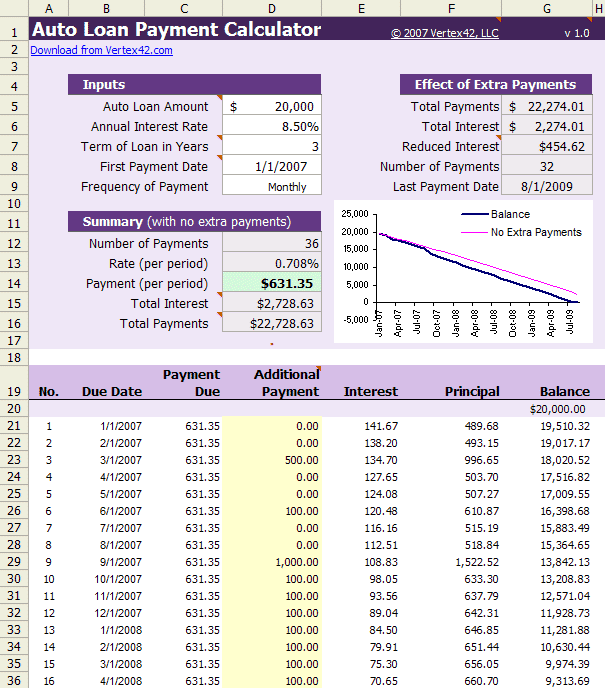
Understanding the Core Components of Your Auto Loan
Before diving into complex formulas, it’s essential to grasp the fundamental elements that constitute any auto loan. These three primary variables work in concert to determine your monthly financial obligation.
The Principal Amount: Your Starting Point
The principal is the actual amount of money you are borrowing to finance the vehicle. It’s not simply the sticker price. To determine your loan principal, you must factor in several elements:
- Vehicle Purchase Price: This is the negotiated price of the car itself.
- Down Payment: Any cash you pay upfront reduces the amount you need to borrow. A larger down payment directly translates to a smaller principal and, consequently, lower monthly payments and less interest paid over the life of the loan.
- Trade-in Value: If you’re trading in an old vehicle, its agreed-upon value will also reduce the principal amount. Ensure you understand how your trade-in is valued and applied to the new purchase.
- Taxes and Fees: Depending on your location and the dealership, sales tax, registration fees, documentation fees, and other charges might be rolled into your loan amount, thereby increasing the principal. While sometimes unavoidable, be vigilant about what’s being added.
A smaller principal amount is always desirable, as it immediately lowers your borrowing cost.
The All-Important Interest Rate (APR)
The interest rate is the cost of borrowing money, expressed as a percentage of the principal. When discussing auto loans, this is typically referred to as the Annual Percentage Rate (APR). The APR not only includes the interest rate but also any additional fees charged by the lender, giving you a more complete picture of the annual cost of the loan.
Your creditworthiness plays a colossal role in determining the interest rate you’ll be offered. Borrowers with excellent credit scores (generally 720 and above) qualify for the lowest rates, sometimes even 0% APR promotions. Conversely, those with lower credit scores will face higher interest rates, significantly increasing their monthly payments and the total amount paid over the loan term. It’s crucial to shop around for the best APR, as even a seemingly small difference of one or two percentage points can save you hundreds, if not thousands, of dollars over the life of the loan.
The Loan Term: How Long Will You Be Paying?
The loan term refers to the duration over which you agree to repay the loan, typically expressed in months (e.g., 36, 48, 60, 72, or even 84 months). This variable has a direct and significant impact on your monthly payment and the total interest you’ll pay.
- Shorter Loan Terms: Result in higher monthly payments but lower total interest paid because you’re paying off the principal faster. This is generally the financially savvier option if your budget can accommodate the higher payments.
- Longer Loan Terms: Lead to lower monthly payments, making the car seem more affordable upfront. However, you’ll pay significantly more interest over the life of the loan, and the vehicle will depreciate faster than you’re building equity in it, potentially leading to an “upside-down” loan where you owe more than the car is worth.
Choosing the right loan term involves balancing your monthly budget with the total cost of ownership.
Demystifying the Auto Loan Payment Formula
While online calculators are convenient, understanding the underlying formula empowers you to analyze offers critically and even perform calculations manually if needed. The standard formula used to calculate monthly loan payments (for fixed-rate loans) is as follows:
$$ M = P [i(1 + i)^n] / [(1 + i)^n – 1] $$
Where:
- M = Monthly Payment
- P = Principal Loan Amount (the amount you’re financing)
- i = Monthly Interest Rate (APR divided by 12)
- n = Total Number of Payments (Loan Term in months)
Breaking Down the Standard Formula
Let’s dissect each part of this formula:
- P (Principal Loan Amount): As discussed, this is the total amount you’re borrowing after any down payment, trade-in, and including any rolled-in taxes or fees.
- i (Monthly Interest Rate): This is crucial. Lenders quote an Annual Percentage Rate (APR), but payments are monthly. So, you must convert the APR to a monthly rate. If your APR is 6%, then
i = 0.06 / 12 = 0.005. - n (Total Number of Payments): This is your loan term in months. A 5-year loan would be
5 * 12 = 60months.
The numerator i(1 + i)^n accounts for the interest accrued over the life of the loan. The denominator (1 + i)^n – 1 essentially represents the accumulation factor of your payments relative to the interest. Together, they distribute the principal and total interest evenly across your monthly payments.
A Step-by-Step Calculation Example
Let’s put the formula into practice with an example:
- Vehicle Price: $30,000
- Down Payment: $5,000
- Principal (P): $25,000 ($30,000 – $5,000)
- APR: 5%
- Loan Term: 60 months (5 years)
- Calculate monthly interest rate (i):
i = 0.05 / 12 = 0.00416667 - Calculate (1 + i):
1 + 0.00416667 = 1.00416667 - Calculate (1 + i)^n:
(1.00416667)^60 = 1.283358(using a calculator) - Calculate numerator:
P * [i * (1 + i)^n] = 25,000 * [0.00416667 * 1.283358] = 25,000 * 0.005347325 = 133.683 - Calculate denominator:
[(1 + i)^n – 1] = 1.283358 - 1 = 0.283358 - Calculate Monthly Payment (M):
M = 133.683 / 0.283358 = $471.86
So, your estimated monthly payment would be approximately $471.86.
The Power of Online Calculators
While understanding the formula is insightful, for day-to-day use, online auto loan calculators are indispensable. Websites of banks, credit unions, and financial publications often feature user-friendly tools that allow you to plug in your principal, APR, and loan term to instantly generate an estimated monthly payment. Many also allow you to factor in down payments, trade-ins, and even additional fees. These tools are excellent for:
- Quick estimates: Rapidly compare different scenarios (e.g., how a larger down payment impacts your payment).
- Pre-qualification planning: Determine what vehicle price point aligns with your desired monthly payment.
- “What If” analysis: Explore how changes in APR or loan term affect affordability.
Always use reputable calculators and ensure you input accurate figures for the most reliable results.
Key Factors That Influence Your Monthly Payment
Beyond the core components of the formula, several other practical considerations significantly influence the final amount you’ll pay each month. Being aware of these empowers you to optimize your financial strategy.
The Impact of Your Down Payment and Trade-In
As briefly touched upon, a substantial down payment is one of the most effective ways to lower your monthly auto payment. By reducing the principal amount you borrow, you directly decrease the loan burden. Similarly, if you have a vehicle to trade in, its value acts like an additional down payment.
- Lower Principal: Less money borrowed means less to repay.
- Reduced Interest: A smaller principal accrues less interest over the life of the loan.
- Better Loan-to-Value (LTV): Lenders prefer lower LTV ratios, which might make you eligible for better interest rates.
- Immediate Equity: You start with more equity in your vehicle, reducing the risk of being “upside-down.”

Aim for at least a 10-20% down payment if possible, especially for new cars, to reap these benefits.
Your Credit Score: A Crucial Determinant
Your credit score is arguably the single most influential factor in determining the interest rate you’ll be offered, which, in turn, heavily impacts your monthly payment. Lenders use your credit score to assess your risk as a borrower.
- Excellent Credit (720+): Qualify for the lowest APRs, resulting in significantly lower monthly payments and total interest paid.
- Good Credit (660-719): Still eligible for competitive rates, but perhaps not the absolute best.
- Fair Credit (600-659): Will likely face higher interest rates, increasing monthly payments.
- Poor Credit (Below 600): Will be offered the highest interest rates, making a vehicle much more expensive to finance.
Before applying for an auto loan, it’s wise to check your credit score and report. If your score needs improvement, consider delaying your purchase to build credit, which can save you thousands in interest over the loan term.
Navigating Additional Costs and Fees
While not directly part of the loan payment formula, several other costs can be rolled into your loan, inflating the principal and thus your monthly payment. Be aware of:
- Sales Tax: Varies by state and can add hundreds or thousands to the vehicle price.
- Registration and Licensing Fees: Mandatory costs to legally operate your vehicle.
- Documentation Fees (Doc Fees): Charged by dealerships for processing paperwork. These can sometimes be negotiated.
- Extended Warranties/Service Contracts: Often aggressively pushed by finance managers. While they offer peace of mind, they can significantly increase your loan amount. Carefully evaluate if these are necessary and shop around for third-party options.
- GAP Insurance: Covers the difference between what you owe on your loan and the vehicle’s actual cash value if it’s totaled or stolen. Important for new cars or small down payments, but can also be purchased from your auto insurer for less.
Always ask for a detailed breakdown of all fees and charges before signing any agreement.
Short-Term vs. Long-Term Loans: Pros and Cons
The choice of loan term presents a classic financial trade-off: lower monthly payments now versus lower total cost over time.
- Short-Term Loans (e.g., 36 or 48 months):
- Pros: Lower total interest paid, faster equity build-up, quicker path to debt-free ownership.
- Cons: Higher monthly payments, requiring a larger budget.
- Long-Term Loans (e.g., 72 or 84 months):
- Pros: Lower monthly payments, making a more expensive vehicle seem affordable.
- Cons: Significantly higher total interest paid, greater risk of being “upside-down,” longer debt obligation.
Opt for the shortest loan term you can comfortably afford to minimize interest expenses and build equity more rapidly.
Strategic Planning Beyond the Monthly Figure
Focusing solely on the monthly payment can be a short-sighted approach to vehicle ownership. A holistic view considers the entire financial picture.
Assessing the Total Cost of Ownership
The monthly auto payment is just one piece of the puzzle. The total cost of ownership extends far beyond the loan itself. Consider:
- Total Interest Paid: Use an amortization schedule or an online calculator to see the full interest burden over the life of the loan. You might be surprised at how much extra you pay, especially with longer terms.
- Depreciation: Vehicles lose value over time, often significantly in the first few years. Understanding a car’s depreciation rate is vital for future resale value.
- Insurance Costs: Research insurance premiums for the specific vehicle you’re considering. More expensive or high-performance cars typically have higher rates.
- Maintenance and Repairs: Factor in routine maintenance (oil changes, tire rotations) and potential repair costs, especially for used vehicles or certain brands.
- Fuel Costs: Estimate your annual fuel expenses based on the car’s fuel efficiency and your typical driving habits.
Looking at the bigger picture ensures you’re prepared for all financial aspects of owning a vehicle.
Budgeting for Ongoing Vehicle Expenses
Once you’ve calculated your estimated monthly car payment, integrate it into your overall budget. Don’t forget to allocate funds for the ongoing operational costs:
- Insurance Premiums: Whether paid monthly, quarterly, or annually.
- Fuel: A variable but essential expense.
- Maintenance Fund: Set aside a small amount each month for unexpected repairs or routine servicing.
- Registration Renewals: Annual or biennial fees.
- Parking Fees/Tolls: If applicable to your daily commute or lifestyle.
A comprehensive budget prevents the car payment from becoming a strain on your finances and ensures you can comfortably afford all aspects of vehicle ownership.
Exploring Early Repayment Strategies
If your financial situation improves, consider strategies to pay off your auto loan early. This can save you a significant amount in interest and free up cash flow for other financial goals.
- Make Extra Payments: Even small additional payments (e.g., rounding up your payment or making an extra payment annually) can shorten the loan term and reduce total interest.
- Bi-weekly Payments: Paying half your monthly payment every two weeks results in 13 full payments per year instead of 12, effectively making an extra payment annually.
- Apply Windfalls: Use bonuses, tax refunds, or other unexpected income to make lump-sum payments directly to the principal.
Always confirm with your lender that extra payments are applied directly to the principal and that there are no prepayment penalties (which are rare for auto loans but good to verify).
Empowering Your Car-Buying Decision
Knowing how to calculate your monthly auto payment and understanding all the influencing factors transforms you from a passive consumer into an informed negotiator.
Leveraging Financial Tools and Resources
Utilize every resource at your disposal:
- Online Calculators: For quick “what if” scenarios.
- Amortization Schedules: To see how principal and interest are paid down over time.
- Credit Score Monitoring: Keep an eye on your credit health.
- Comparison Shopping: Get pre-approved by multiple lenders (banks, credit unions) before visiting a dealership to secure the best interest rate.
Having a pre-approval in hand gives you leverage and a clear benchmark for any financing offered by the dealership.

Negotiating for Better Terms
With your calculations and knowledge, you’re better equipped to negotiate:
- Vehicle Price: Negotiate the car price independently of the financing.
- Interest Rate (APR): Use your pre-approved rate as a negotiating tool.
- Fees: Question and potentially negotiate documentation fees or unnecessary add-ons.
- Trade-in Value: Research your car’s value beforehand so you know if you’re getting a fair offer.
By focusing on one variable at a time and understanding its impact on your overall cost, you can secure more favorable terms.
In conclusion, calculating your monthly auto payment is more than a simple arithmetic exercise; it’s a fundamental step in responsible financial planning. By understanding the principal, interest rate, and loan term, leveraging the payment formula, and being mindful of additional costs and your credit score, you can approach the car-buying process with confidence. This knowledge empowers you to choose a vehicle that fits your lifestyle and, more importantly, your financial health, ensuring your automotive journey starts on a solid monetary foundation.
aViewFromTheCave is a participant in the Amazon Services LLC Associates Program, an affiliate advertising program designed to provide a means for sites to earn advertising fees by advertising and linking to Amazon.com. Amazon, the Amazon logo, AmazonSupply, and the AmazonSupply logo are trademarks of Amazon.com, Inc. or its affiliates. As an Amazon Associate we earn affiliate commissions from qualifying purchases.