
Understanding how interest is calculated is a cornerstone of financial literacy. Whether you’re saving for retirement, investing in a certificate of deposit, or simply trying to make your money work harder for you, grasping the mechanics of interest is paramount. Interest isn’t just a number; it’s the engine that can drive your savings growth, mitigate the impact of inflation, and ultimately contribute to your financial well-being. This comprehensive guide will demystify the process, breaking down the essential concepts, formulas, and real-world applications so you can confidently calculate and optimize your interest earnings.
Understanding the Fundamentals of Interest
Before diving into calculations, it’s crucial to establish a solid understanding of what interest is and the key terms associated with it. This foundational knowledge will serve as your compass in the complex world of personal finance and investing.
What is Interest?
At its core, interest is the cost of borrowing money or the reward for lending it. When you deposit money into a savings account, you are essentially lending your money to the bank, and in return, the bank pays you interest. Conversely, when you take out a loan, you pay interest to the lender for the privilege of using their money. For those looking to grow their wealth, earned interest represents the return on their capital, a passive income stream that can significantly boost long-term financial goals.
Key Terminology
To navigate interest calculations effectively, familiarize yourself with these critical terms:
- Principal (P): This is the initial amount of money deposited, invested, or borrowed. It’s the starting point from which interest is calculated.
- Interest Rate (R): Expressed as a percentage, the interest rate is the charge or payment for the use of an asset. It dictates how quickly your principal will grow or how much you’ll pay on a loan. Rates are typically quoted on an annual basis (Annual Percentage Rate or APR).
- Time (T): This refers to the duration over which the money is borrowed or invested, typically expressed in years. If the period is in months or days, it must be converted to a fraction of a year for calculations.
- Compounding Frequency (n): This term applies specifically to compound interest and denotes how many times per year the interest is calculated and added back to the principal. Common frequencies include annually, semi-annually, quarterly, monthly, or even daily. The more frequent the compounding, the faster your money grows.
The Time Value of Money
A fundamental principle in finance, the time value of money (TVM) states that a sum of money today is worth more than the same sum will be at a future date due to its potential earning capacity. In essence, money now can be invested and earn interest, leading to a larger sum in the future. Understanding TVM highlights why early investment and consistent savings are so powerful, allowing your money more time to compound and grow.
Calculating Simple Interest
Simple interest is the most straightforward form of interest calculation. It is calculated only on the principal amount, making it easier to understand and apply for basic financial scenarios.
Simple Interest Formula Explained
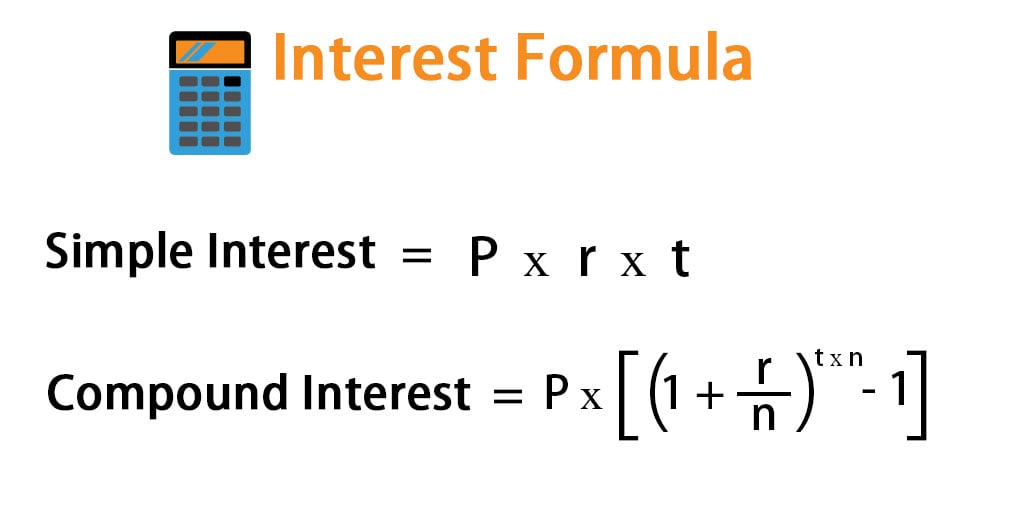
The formula for simple interest is:
I = P × R × T
Where:
- I = Interest Earned
- P = Principal amount
- R = Annual interest rate (as a decimal)
- T = Time period (in years)
Let’s break down how to convert the annual interest rate from a percentage to a decimal: simply divide the percentage by 100. For example, 5% becomes 0.05. If your time period is in months, divide the number of months by 12 to get its equivalent in years.
Practical Example of Simple Interest
Imagine you deposit $1,000 into a savings account that pays 3% simple annual interest. You leave the money in the account for 2 years.
- P = $1,000
- R = 3% = 0.03
- T = 2 years
Using the formula:
I = $1,000 × 0.03 × 2
I = $60
After two years, you would have earned $60 in simple interest. Your total balance would be $1,000 (principal) + $60 (interest) = $1,060. Simple interest is consistent; it only ever calculates interest on the initial $1,000, never on the interest previously earned.
When Simple Interest is Typically Used
Simple interest is often applied to short-term loans, such as car loans (though many car loans use an amortizing schedule that effectively incorporates interest over time), some personal loans, or certain types of bonds where the interest payment is fixed and only paid on the face value. It’s also a common starting point for basic financial education due to its ease of calculation. However, for most long-term savings and investment accounts, compound interest is the norm, as it offers a more significant growth potential.
Unlocking the Power of Compound Interest
Compound interest is often hailed as the “eighth wonder of the world” for good reason. It’s a powerful force that allows your wealth to grow exponentially over time, as interest is earned not only on the initial principal but also on the accumulated interest from previous periods.
What is Compound Interest?
Unlike simple interest, compound interest is interest calculated on the initial principal and also on all the accumulated interest of previous periods of a deposit or loan. This concept, often referred to as “interest on interest,” creates a snowball effect where your earnings begin to earn their own interest, accelerating your wealth accumulation. The longer your money compounds and the more frequently it compounds, the greater the impact.
Compound Interest Formula Explained
The formula for calculating the future value of an investment with compound interest is more complex than simple interest, but immensely powerful:
A = P (1 + r/n)^(nt)
Where:
- A = The future value of the investment/loan, including interest
- P = The principal investment amount (the initial deposit or loan amount)
- r = The annual interest rate (as a decimal)
- n = The number of times that interest is compounded per year
- t = The number of years the money is invested or borrowed for
This formula provides the total amount (A) you’ll have at the end of the period, which includes both your initial principal and the total compound interest earned. To find only the interest earned, you would subtract the principal from A (i.e., Interest Earned = A – P).

Practical Example of Compound Interest
Let’s revisit our example: you deposit $1,000 into an account. This time, it pays 3% annual interest, compounded monthly, for 2 years.
- P = $1,000
- r = 3% = 0.03
- n = 12 (compounded monthly)
- t = 2 years
Plugging these values into the formula:
A = $1,000 (1 + 0.03/12)^(12*2)
A = $1,000 (1 + 0.0025)^(24)
A = $1,000 (1.0025)^(24)
A ≈ $1,000 × 1.061757
A ≈ $1,061.76
The total amount after two years would be approximately $1,061.76.
The interest earned is $1,061.76 – $1,000 = $61.76.
Compare this to the $60 earned with simple interest. Even over just two years, monthly compounding earned an additional $1.76. This difference becomes vastly more significant over longer periods and with larger principal amounts, illustrating the sheer power of compound interest.
The Impact of Compounding Frequency
The frequency with which interest is compounded plays a crucial role in how much you earn. The more frequently interest is compounded, the faster your money grows. While the difference between annual and monthly compounding might seem small in the short term, over decades, daily compounding can yield substantially more than annual compounding, even with the same annual interest rate. This is why when comparing savings accounts or investments, it’s essential to look not just at the interest rate, but also at the compounding frequency.
Advanced Considerations and Real-World Applications
Beyond the core formulas, understanding the nuances of interest calculation involves recognizing different rates, utilizing quick estimation tools, and being aware of how interest applies across various financial products and its tax implications.
Annual Percentage Yield (APY) vs. Annual Percentage Rate (APR)
When evaluating interest earnings, you’ll often encounter both APR and APY:
- Annual Percentage Rate (APR): This represents the simple annual rate of interest. For loans, it’s the cost of borrowing over a year, without factoring in compounding. For savings, it’s the basic interest rate before compounding.
- Annual Percentage Yield (APY): This is the effective annual rate of return, taking into account the effect of compounding interest. APY always considers the effect of compounding over a year. For savings accounts, the APY will always be equal to or higher than the APR (unless compounding is only annual). When comparing savings accounts or CDs, always use APY for an accurate comparison of potential earnings.
The Rule of 72
The Rule of 72 is a handy mental math shortcut used to estimate the number of years required to double an investment at a given fixed annual rate of interest. It’s a quick, rough estimate, particularly useful for understanding the power of compounding.
Years to Double = 72 / Annual Interest Rate (as a whole number)
For example, if you have an investment earning 6% annually:
Years to Double = 72 / 6 = 12 years.
This means your investment would roughly double in 12 years. At 10% interest, it would double in approximately 7.2 years. While not perfectly precise, it provides a valuable perspective on the impact of different interest rates over time.
Interest in Different Financial Products
Interest calculation principles apply across a wide spectrum of financial products, though their specific presentation may vary:
- Savings Accounts & Money Market Accounts: These typically earn compound interest, often compounded monthly or daily, and expressed as an APY.
- Certificates of Deposit (CDs): CDs offer a fixed interest rate for a specified term. Interest can be compounded monthly, quarterly, or annually, and paid out or reinvested.
- Bonds: Traditional bonds pay simple interest (coupon payments) to bondholders at regular intervals (e.g., semi-annually) based on their face value, though their overall yield considers market value and compounding if coupons are reinvested.
- Loans (Mortgages, Auto Loans, Personal Loans): Here, you are paying interest. Most loans use amortization schedules where a portion of each payment goes towards interest and a portion towards the principal, with interest calculated on the remaining balance.
Tax Implications of Interest Earned
It’s crucial to remember that interest earned on savings accounts, CDs, and many other investments is generally considered taxable income. This means a portion of your interest earnings will be subject to federal, state, and sometimes local income taxes. Certain tax-advantaged accounts, like Roth IRAs or 401(k)s, allow investments to grow tax-free or tax-deferred, which can significantly enhance your net interest earnings over the long term. Always consult a tax professional for personalized advice regarding your specific financial situation.
Tools and Strategies for Maximizing Interest Earnings
Calculating interest is merely the first step. The true value lies in using this knowledge to make informed decisions that maximize your earnings and accelerate your financial goals.
Leveraging High-Yield Savings Accounts and CDs
In an environment where traditional savings accounts often offer minimal interest, seeking out high-yield savings accounts (HYSAs) and Certificates of Deposit (CDs) is a smart strategy. HYSAs typically offer significantly higher interest rates than standard savings accounts, though they are usually offered by online banks. CDs lock in your money for a set period in exchange for a higher fixed interest rate, providing predictable returns, especially in a rising interest rate environment. Comparing APYs across different institutions is key.
Understanding Investment Vehicles
While savings accounts and CDs are straightforward interest-bearing vehicles, other investments offer returns that are analogous to or incorporate interest. Bonds, for instance, pay interest. Dividend-paying stocks offer income streams. While the mechanisms differ, understanding the concept of a return on capital (whether interest, dividends, or capital gains) is fundamental to choosing investment vehicles that align with your risk tolerance and financial objectives. Diversification across various assets can help optimize your overall portfolio’s earning potential.
Utilizing Online Calculators and Financial Software
In today’s digital age, manual calculations are often unnecessary. Numerous online interest calculators, financial planning apps, and spreadsheet software can instantly compute simple and compound interest for various scenarios. These tools allow you to quickly model different interest rates, compounding frequencies, and investment durations, helping you visualize the impact of your choices without complex manual effort. Many banking and investment platforms also provide projections of your potential earnings directly within your account interfaces.

The Importance of Early Investment and Consistent Contributions
The most powerful strategy for maximizing interest earnings, especially compound interest, is time. The longer your money has to grow and compound, the more substantial your returns will be. Starting to save and invest early in life, even with small amounts, allows the “snowball effect” of compounding to work its magic over decades. Furthermore, making consistent, regular contributions to your savings and investment accounts amplifies this effect. Each new contribution adds to the principal, and that larger principal then earns interest, which in turn earns more interest. This disciplined approach is a cornerstone of long-term wealth building.
In conclusion, mastering the calculation of interest earned is more than just a mathematical exercise; it’s an essential skill for anyone looking to achieve financial independence and prosperity. By understanding simple and compound interest, recognizing key terminology, and leveraging smart strategies, you can take control of your financial future, making your money work harder for you, year after year.
aViewFromTheCave is a participant in the Amazon Services LLC Associates Program, an affiliate advertising program designed to provide a means for sites to earn advertising fees by advertising and linking to Amazon.com. Amazon, the Amazon logo, AmazonSupply, and the AmazonSupply logo are trademarks of Amazon.com, Inc. or its affiliates. As an Amazon Associate we earn affiliate commissions from qualifying purchases.