
The Foundational Link Between Decimal and Fractional Representations
Decimals and fractions are two fundamental ways to represent parts of a whole. While they may seem distinct, they are intrinsically linked, serving as different notations for the same underlying numerical value. Understanding how to convert between them is not just a mathematical exercise; it’s a crucial skill that underpins a wide range of applications, particularly within the realm of personal finance, business operations, and investment analysis. This article delves into the practical methods of converting decimals to fractions, explaining the underlying principles and providing actionable steps for accurate and efficient calculation.
Why Converting Decimals to Fractions Matters
The ability to translate a decimal representation into its fractional equivalent, and vice-versa, offers several significant advantages. In financial contexts, fractions often provide a more precise and intuitive understanding of proportions, especially when dealing with rates, percentages, or ratios that may not terminate cleanly in decimal form.
For instance, a recurring decimal like 0.333… represents one-third. While we can approximate this as 0.33 or 0.333 in decimal form, the fraction 1/3 is exact. In financial calculations, particularly for interest rates, profit margins, or ownership stakes, this precision can be paramount. Misinterpreting or inaccurately rounding a recurring decimal could lead to significant discrepancies in financial outcomes.
Furthermore, many financial tools and formulas are historically rooted in fractional calculations. Understanding these conversions allows for a deeper comprehension of these tools and can sometimes simplify complex calculations. For businesses, accurate fractional representation is vital for profit sharing, equity distribution, and cost allocation. For individuals, it can be key to understanding loan terms, investment returns, and budgeting.
The Anatomy of Decimals and Fractions
Before diving into the conversion process, it’s helpful to briefly revisit the structure of each number type.
A decimal is a number expressed in base-10, where a decimal point separates the whole number part from the fractional part. The digits to the right of the decimal point represent powers of one-tenth. For example, in 0.75, the ‘7’ represents seven-tenths (7/10), and the ‘5’ represents five-hundredths (5/100). Together, 0.75 is equal to 7/10 + 5/100, which simplifies to 75/100.
A fraction consists of two parts: a numerator (the top number) and a denominator (the bottom number), separated by a fraction bar. The numerator indicates how many parts of the whole are being considered, while the denominator indicates the total number of equal parts the whole is divided into. For example, in the fraction 3/4, 3 is the numerator and 4 is the denominator, meaning 3 out of 4 equal parts.
The conversion process essentially bridges the gap between these two representational systems, leveraging the place value of decimal digits to construct the equivalent fraction.
Converting Terminating Decimals to Fractions: A Step-by-Step Guide
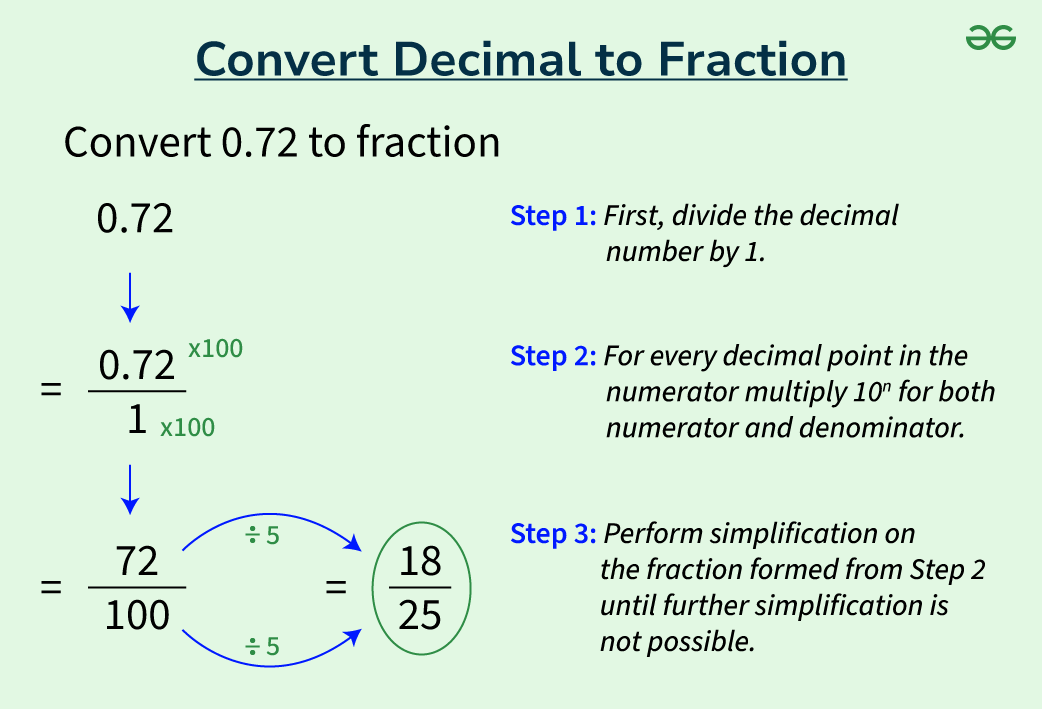
Terminating decimals are those that have a finite number of digits after the decimal point. Examples include 0.5, 0.25, 0.125, and 0.789. These are the simplest to convert into fractions, as their fractional equivalents are typically straightforward to derive.
Step 1: Identify the Decimal Places
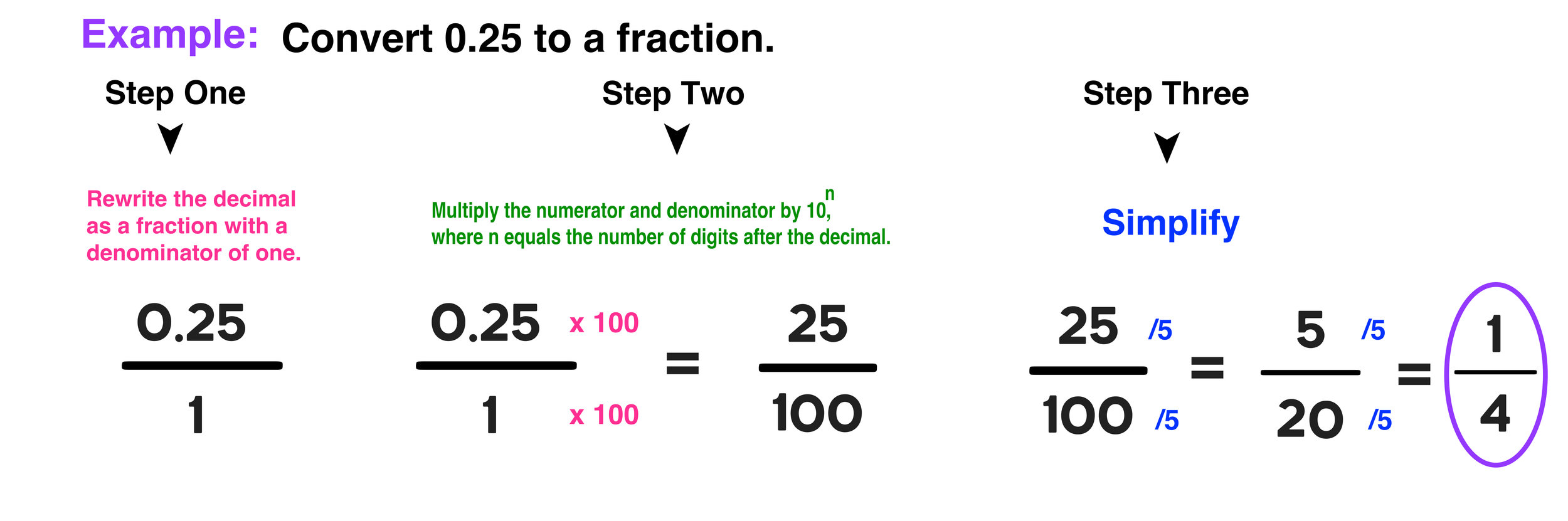
The first step in converting a terminating decimal to a fraction is to determine the number of digits present after the decimal point. This number of digits will directly dictate the denominator of your fraction.
For instance, in the decimal 0.45, there are two digits after the decimal point (4 and 5). In the decimal 0.125, there are three digits after the decimal point (1, 2, and 5).
Step 2: Form the Numerator
The numerator of your fraction will be the entire decimal number, without the decimal point.
So, for 0.45, the numerator becomes 45.
For 0.125, the numerator becomes 125.
Step 3: Determine the Denominator
The denominator of your fraction will be a power of 10. The exponent of 10 corresponds to the number of decimal places you identified in Step 1.
- If there is 1 decimal place, the denominator is 10 (10¹).
- If there are 2 decimal places, the denominator is 100 (10²).
- If there are 3 decimal places, the denominator is 1000 (10³).
- And so on.
Continuing with our examples:
For 0.45 (2 decimal places), the denominator is 100.
For 0.125 (3 decimal places), the denominator is 1000.
Step 4: Write the Initial Fraction
Now, combine the numerator and denominator to form the initial fraction.
For 0.45, the initial fraction is 45/100.
For 0.125, the initial fraction is 125/1000.
Step 5: Simplify the Fraction (Reduce to Lowest Terms)
This is a crucial step in financial calculations and mathematical accuracy. Most often, the initial fraction can be simplified by dividing both the numerator and the denominator by their greatest common divisor (GCD). This process is known as reducing the fraction to its lowest terms.
To find the GCD, you can list the factors of both numbers and identify the largest factor they share, or use more systematic methods like the Euclidean algorithm.
Let’s simplify our examples:
- 0.45: The initial fraction is 45/100.
- Factors of 45: 1, 3, 5, 9, 15, 45
- Factors of 100: 1, 2, 4, 5, 10, 20, 25, 50, 100
- The greatest common divisor is 5.
- Divide both numerator and denominator by 5:
- 45 ÷ 5 = 9
- 100 ÷ 5 = 20
- The simplified fraction is 9/20.
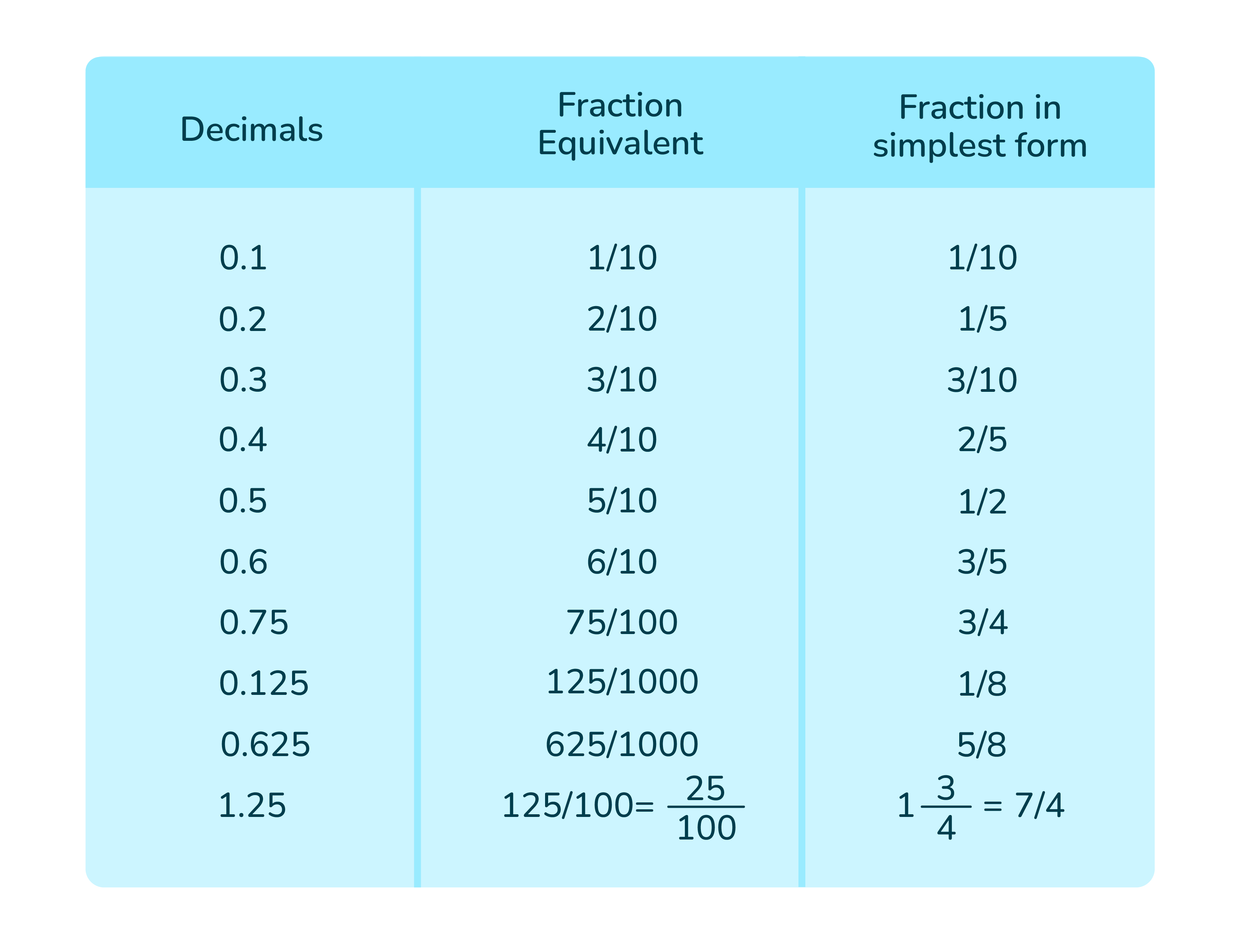
- 0.125: The initial fraction is 125/1000.
- Factors of 125: 1, 5, 25, 125
- Factors of 1000: 1, 2, 4, 5, 8, 10, 20, 25, 40, 50, 100, 125, 200, 250, 500, 1000
- The greatest common divisor is 125.
- Divide both numerator and denominator by 125:
- 125 ÷ 125 = 1
- 1000 ÷ 125 = 8
- The simplified fraction is 1/8.
Example with a whole number:
If you have a decimal like 2.75:
- Identify decimal places: 2 decimal places (7 and 5).
- Form numerator: 275.
- Determine denominator: 100 (for 2 decimal places).
- Initial fraction: 275/100.
- Simplify:
- GCD of 275 and 100 is 25.
- 275 ÷ 25 = 11
- 100 ÷ 25 = 4
- Simplified fraction: 11/4. This can also be expressed as a mixed number: 2 and 3/4.
This systematic approach ensures that any terminating decimal can be accurately converted into its simplest fractional form, a critical skill for any financial professional or savvy individual.
Tackling Recurring Decimals: Unlocking Precision in Financial Math
Recurring decimals are where the ability to convert to fractions truly shines, as they represent values that cannot be expressed finitely in decimal form without losing precision. These occur when a sequence of digits repeats infinitely after the decimal point. Examples include 0.333…, 0.1666…, and 0.142857142857…
While approximating recurring decimals in decimal form is often done in everyday contexts, in finance, exact fractional representation is vital for accurate calculations involving interest, annuities, or long-term investment projections.
Method 1: Algebraic Approach for Simple Recurring Decimals
A common and effective method for converting recurring decimals to fractions involves basic algebra. This method is particularly useful for decimals where the repeating block starts immediately after the decimal point or after a few non-repeating digits.
Case 1: Purely Recurring Decimals (Repeating block starts immediately after the decimal point)
Let’s convert 0.666… to a fraction.
- Assign a variable: Let $x = 0.666…$
- Multiply by a power of 10: Multiply $x$ by 10 raised to the power of the number of repeating digits. In this case, there is one repeating digit (6), so we multiply by $10^1 = 10$.
$10x = 6.666…$ - Subtract the original equation: Subtract the original equation ($x = 0.666…$) from the multiplied equation ($10x = 6.666…$).
$10x – x = 6.666… – 0.666…$
$9x = 6$ - Solve for x: Divide by the coefficient of $x$.
$x = 6/9$ - Simplify: Reduce the fraction to its lowest terms.
$x = 2/3$
So, 0.666… is equal to 2/3.
Let’s try another example: 0.121212…
- Let $x = 0.121212…$
- There are two repeating digits (12), so multiply by $10^2 = 100$.
$100x = 12.121212…$ - Subtract the original equation:
$100x – x = 12.121212… – 0.121212…$
$99x = 12$ - Solve for $x$:
$x = 12/99$ - Simplify: The GCD of 12 and 99 is 3.
$x = 12 div 3 / 99 div 3 = 4/33$
So, 0.121212… is equal to 4/33.
Case 2: Mixed Recurring Decimals (Non-repeating digits followed by repeating digits)
Let’s convert 0.1666… to a fraction.
- Assign a variable: Let $x = 0.1666…$
- Multiply to move the decimal point to the start of the repeating block: There is one non-repeating digit (1). Multiply $x$ by 10.
$10x = 1.666…$ - Multiply again to include one full repeating block: Now, consider the number of digits in the repeating block, which is one (6). Multiply $10x$ by 10.
$10 times (10x) = 10 times (1.666…)$
$100x = 16.666…$ - Subtract the equation from Step 2: Subtract $10x = 1.666…$ from $100x = 16.666…$.
$100x – 10x = 16.666… – 1.666…$
$90x = 15$ - Solve for x:
$x = 15/90$ - Simplify: The GCD of 15 and 90 is 15.
$x = 15 div 15 / 90 div 15 = 1/6$
So, 0.1666… is equal to 1/6.
Let’s try another example: 0.23454545…
- Let $x = 0.23454545…$
- Move the decimal to the start of the repeating block (after 3): Multiply by 1000.
$1000x = 234.545454…$ - Include one repeating block (45): Multiply by 100.
$100 times (1000x) = 100 times (234.545454…)$
$100000x = 23454.545454…$ - Subtract:
$100000x – 1000x = 23454.545454… – 234.545454…$
$99000x = 23220$ - Solve for $x$:
$x = 23220 / 99000$ - Simplify: This might take a few steps. Both are divisible by 10: 2322 / 9900. Both are divisible by 2: 1161 / 4950. The sum of digits in 1161 (1+1+6+1=9) is divisible by 9, as is 4950 (4+9+5+0=18).
$1161 div 9 = 129$
$4950 div 9 = 550$
So, the simplified fraction is 129/550.
Method 2: Using Common Fractions for Known Recurring Decimals
In finance, certain recurring decimals are so common that their fractional equivalents are almost standardized. Recognizing these can save significant calculation time and reduce the chance of errors.
-
0.333… is universally recognized as 1/3.
-
0.666… is universally recognized as 2/3.
-
0.111… is 1/9.
-
0.222… is 2/9.
-
…and so on, up to 0.888… which is 8/9.
-
0.090909… is 1/11.
-
0.181818… is 2/11.
-
…up to 0.999… which is 9/11.
-
0.142857… (the repeating block is 142857) is 1/7. This is a particularly important one in finance as it relates to fractions of a dollar and other currencies.
-
0.285714… is 2/7.
-
…and so on, up to 0.857142… which is 6/7.
-
0.010101… is 1/99.
-
0.020202… is 2/99.
-
…up to 0.989898… which is 98/99.
Recognizing these common recurring decimals and their fractional equivalents can be a significant shortcut in financial analysis, budgeting, and investment calculations. For example, an interest rate quoted as 3.333…% is precisely 1/3 of a percent, which is 1/300 as a decimal or 1/300 as a fraction. This exactitude is crucial for avoiding compounding errors over time.
Applications in Personal Finance and Business Operations
The ability to accurately convert decimals to fractions is not merely an academic exercise; it has direct and impactful applications in managing personal finances, running businesses, and navigating investment landscapes. Understanding these conversions allows for clearer financial planning, more precise budgeting, and a deeper comprehension of financial instruments.
Personal Finance: Budgeting, Loans, and Investments
In personal finance, clarity and precision are key to sound decision-making. Fractions often provide this clarity, especially when dealing with recurring costs, interest rates, or profit-sharing.
- Budgeting: When allocating funds, you might decide to put aside 1/4 of your income for savings. This is easily understood as 25% or 0.25. However, if a recurring expense is described as being “about a third” of your variable income, understanding this as 0.333… or precisely 1/3 is vital for accurate budgeting. If you consistently budget based on 0.33, you’ll be underestimating your actual allocation by a small but cumulative amount over time.
- Loans and Mortgages: Interest rates are often expressed as percentages, which are easily converted to decimals. However, some loan terms or calculations might be simplified or better understood using fractions. For instance, if a loan has a variable interest rate that fluctuates in a predictable recurring decimal pattern, converting it to a fraction can simplify long-term projection calculations. Understanding the difference between 0.0333… annual interest and 0.035 annual interest can amount to hundreds or thousands of dollars over the life of a loan.
- Investments: When investing, understanding ownership stakes, dividend yields, and profit margins is critical. If a company announces that it will distribute 1/8 of its profits as dividends, this is easily calculated as 12.5% or 0.125. However, if a venture capital firm negotiates for a 30% stake in a startup, and this stake is represented by a complex series of options and convertible notes that might involve recurring decimal valuations, being able to convert these back to precise fractions ensures fair valuation and ownership.
Business Operations: Profit Sharing, Equity, and Cost Allocation
For businesses, accurate financial representation is the bedrock of operational efficiency and strategic planning.
- Profit Sharing and Bonuses: When distributing profits among partners or employees through bonuses, using fractions ensures that the entire profit is accounted for accurately. If a profit of $100,000 is to be shared, and partners agree on shares of 1/2, 1/4, and 1/4, it’s straightforward. However, if those shares are described in less exact terms, like “around 50%,” “about 25%,” and “roughly 25%,” and these were to be calculated from decimal figures, potential rounding errors could lead to disputes or an imbalance in distribution. Converting a decimal bonus percentage like 0.075 to 3/40 provides an exact share.
- Equity and Ownership: In mergers, acquisitions, or initial public offerings (IPOs), precisely defining equity stakes is paramount. If a shareholder owns a percentage that translates to a recurring decimal (e.g., 16.666…%), converting this to its fractional equivalent (1/6) is essential for accurate valuation of their holdings and for calculating voting rights.
- Cost Allocation and Pricing: Businesses often need to allocate costs across different departments or products. If a marketing campaign’s cost needs to be divided among product lines based on their contribution to sales, and this contribution is represented by a decimal percentage, converting it to a fraction can help in establishing clear and auditable cost allocation rules. Similarly, pricing strategies might involve fractional markups or discounts that are better understood and managed as fractions. For example, a discount of 0.1666… or 1/6 off an item’s price is much clearer when expressed as the fraction.
By mastering the conversion of decimals to fractions, individuals and businesses can enhance their financial literacy, reduce the risk of costly errors, and make more informed and confident financial decisions. It’s a foundational skill that empowers better management of money in all its forms.
aViewFromTheCave is a participant in the Amazon Services LLC Associates Program, an affiliate advertising program designed to provide a means for sites to earn advertising fees by advertising and linking to Amazon.com. Amazon, the Amazon logo, AmazonSupply, and the AmazonSupply logo are trademarks of Amazon.com, Inc. or its affiliates. As an Amazon Associate we earn affiliate commissions from qualifying purchases.