
Understanding child support obligations is a critical aspect of personal finance for co-parents in California. The state employs a complex yet standardized guideline formula to determine support amounts, ensuring consistency and prioritizing the child’s best interests. Navigating this calculation requires a clear grasp of income, time-share, and other financial factors that directly influence the final order. This guide delves into the specifics of California’s child support framework, providing insight into its core components and practical implications.
The Foundational Principles of California Child Support
California law mandates that both parents share equally in the responsibility for supporting their children. The primary objective of child support is to ensure that children maintain a standard of living commensurate with that which they would have enjoyed if their parents had remained together. To achieve this, California utilizes a statewide uniform guideline formula, which is considered presumptively correct in most cases. This guideline is designed to be a transparent and objective method for determining support, minimizing litigation and promoting equitable outcomes.
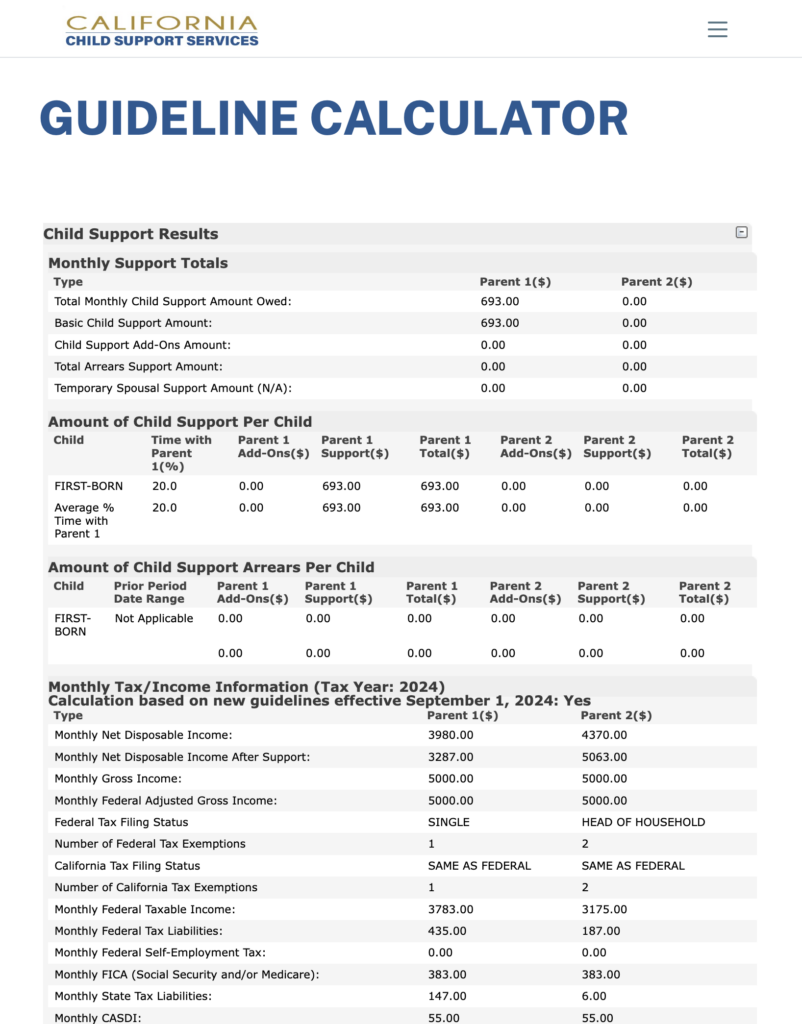
The formula takes into account various financial details of both parents, moving beyond a simple percentage of income. It aims to balance the needs of the children with the financial realities of each parent, ensuring that children benefit from both parents’ incomes. This approach acknowledges that child-rearing costs are shared and proportional to each parent’s ability to contribute.
Understanding the Guideline Formula Inputs
The California child support guideline calculation is highly dependent on specific financial data and the allocation of parental responsibility. Accurate reporting of these inputs is paramount to deriving a correct support order.
Net Disposable Income (NDI): The Core Calculation
The cornerstone of the child support calculation is each parent’s Net Disposable Income (NDI). This is not merely gross income but rather the income remaining after certain mandatory deductions.
Gross Income Components
Gross income encompasses a broad range of financial resources available to each parent. This includes, but is not limited to:
- Wages and Salaries: Regular pay from employment.
- Self-Employment Income: Gross receipts minus legitimate business expenses.
- Commissions and Bonuses: Variable income streams are often averaged over time.
- Rental Income: Income from properties owned, minus related expenses.
- Unemployment Benefits, Disability Payments, Social Security Benefits: Government assistance programs.
- Investment Income: Dividends, interest, and capital gains.
- Spousal Support Received: If one parent receives spousal support from the other parent in the current case, that amount is typically added to the recipient’s gross income for child support calculation purposes.
It’s crucial to report all sources of income accurately, as omissions can lead to incorrect calculations and potential legal repercussions.
Permissible Deductions
Once gross income is established, the guideline formula allows for specific deductions to arrive at the Net Disposable Income. These deductions reflect necessary expenses that reduce a parent’s actual available income for support. Common deductions include:
- State and Federal Income Taxes: Based on filing status and dependents claimed.
- FICA Contributions: Social Security and Medicare taxes.
- Health Insurance Premiums: For the parent and any children they support.
- Mandatory Retirement Contributions: If a parent is legally required to contribute to a retirement plan as a condition of employment.
- Union Dues: Mandatory contributions to a labor organization.
- Child Support or Spousal Support Paid: If a parent is legally obligated to pay support for children from another relationship or spousal support to a previous spouse.
- Hardship Deductions: In rare cases, a court may allow deductions for “extraordinary hardship,” such as expenses for supporting other minor children living with the parent or catastrophic medical expenses.
The careful calculation of NDI for both parents is foundational, as it directly determines the pool of resources available for child support.
Time-Share (Custodial Time Percentage)
The percentage of time each parent has physical custody of the children is another critical input, often referred to as “time-share.” California’s guideline formula significantly adjusts the support amount based on how much time each parent spends with the children. The underlying logic is that the parent with whom the children spend more time incurs a greater share of the direct costs associated with daily care (food, housing, utilities, supervision).
- Higher time-share for the paying parent: Generally results in a lower child support obligation for that parent. This is because they are already contributing more directly to the children’s daily needs through their increased custodial time.
- Lower time-share for the paying parent: Generally results in a higher child support obligation, as the other parent is bearing more of the direct daily costs.
Time-share can be calculated based on the number of overnight stays with each parent or, in some cases, a specific schedule agreed upon by the parents or ordered by the court. Accurate tracking of overnight stays is essential for this component.
Other Key Financial Considerations
Beyond NDI and time-share, several other expenses related to the children’s well-being are factored into the child support calculation, often as “add-ons” to the base support amount. These typically include:
- Childcare Costs: Reasonable and necessary expenses related to a parent’s employment or education directly benefit the children and are usually shared.
- Health Insurance Premiums: The cost of health insurance for the children is typically included in the calculation.
- Uninsured Healthcare Costs: Medical, dental, and vision expenses not covered by insurance are generally shared equally, or in proportion to each parent’s NDI.
- Special Needs or Educational Expenses: Extraordinary expenses for a child with special medical, psychological, or educational needs may be added to the support order.
- Travel Expenses for Visitation: In some cases, if one parent has a significantly higher burden for travel costs to facilitate visitation, the court may consider an adjustment or add-on.
These add-ons are crucial for covering the holistic financial needs of the children and are typically allocated between parents based on their respective net disposable incomes.
The California Guideline Formula in Action
While the California guideline formula is mathematically precise, its actual computation is complex and is almost universally performed using specialized computer software. Attorneys and courts primarily rely on programs like DissoMaster to input all the necessary data and generate the guideline support amount.
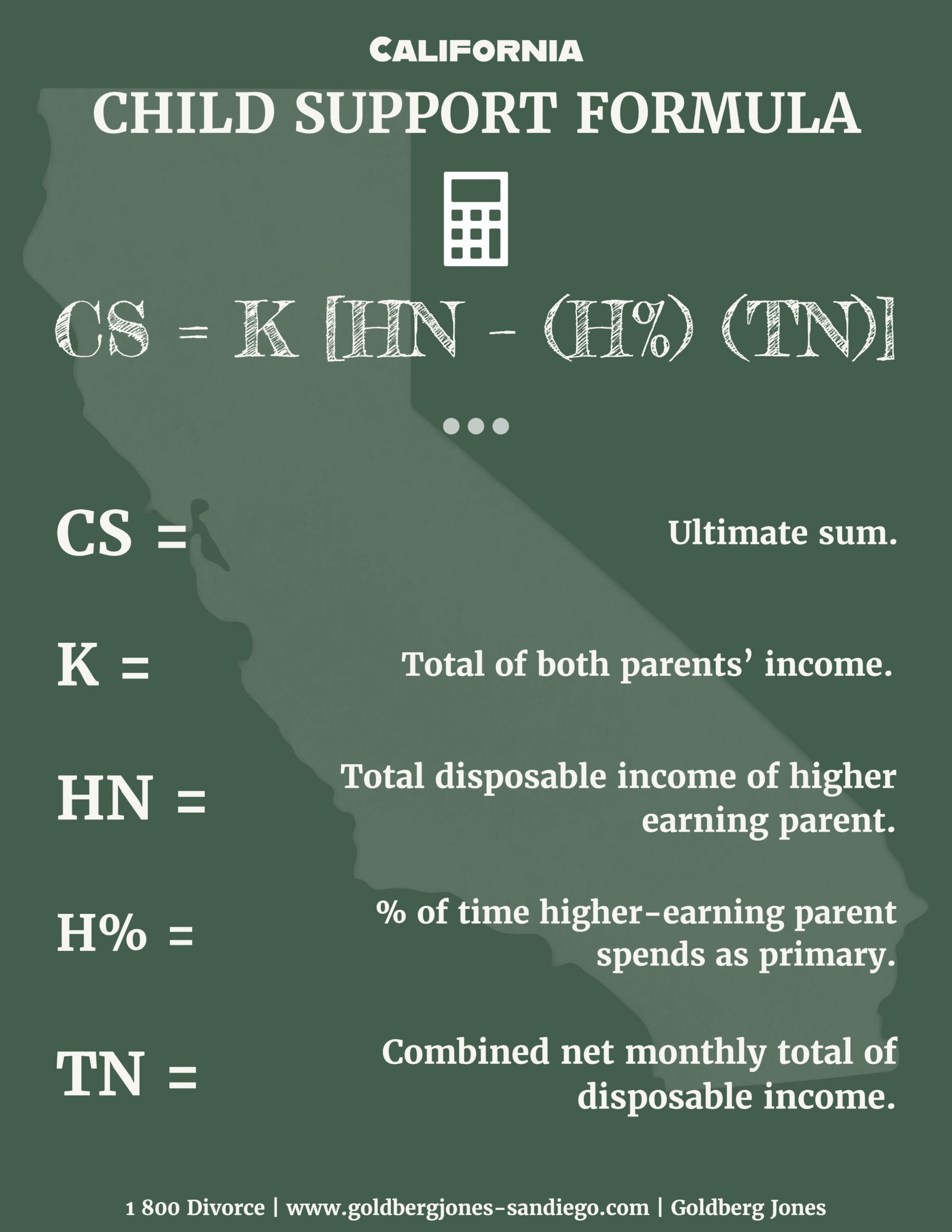
The formula itself can be represented generally as:
CS = K [HN - (H%)(TN)]
Where:
CSis the child support amount.Kis an income allocation factor that adjusts based on the total net disposable income and the number of children.HNis the high earner’s net monthly disposable income.H%is the high earner’s approximate percentage of time having the children.TNis the total net monthly disposable income of both parents.
This formula, however, is a simplification of a more intricate calculation that accounts for marginal tax rates, deductions, and other variables. The software automates these complexities, providing a consistent result.
For individuals seeking a preliminary estimate, various online child support calculators are available. These tools can provide a rough idea of potential support obligations by asking for key inputs like income, deductions, and time-share. However, it’s critical to understand that these online calculators are often simplified and may not account for every nuance of a specific financial situation or the precise way the court-mandated software processes data. They should be used only as a starting point, not as a definitive calculation. Consulting with a legal professional who uses the official software is essential for an accurate determination.
Navigating Deviations and Special Circumstances
While the guideline formula is presumed correct, California law allows for deviations in specific, limited circumstances. However, the burden to prove that a deviation is warranted is high.
Presumptive Correctness of the Guideline
The law is clear: the child support guideline amount calculated by the formula is considered “presumptively correct.” This means a court must order the guideline amount unless specific statutory grounds for deviation are met. This presumption ensures consistency, predictability, and reduces the potential for arbitrary decisions in child support cases. It reinforces the state’s policy that children are entitled to support based on a standardized framework.
Grounds for Deviation (Rare Exceptions)
A court may only deviate from the guideline if it finds, by a preponderance of the evidence, that applying the formula would be unjust or inappropriate due to special circumstances. These special circumstances are narrowly defined and include:
- Parents’ Agreement: Both parents can agree to a non-guideline amount, but the court must approve it. The agreement must be in the children’s best interest, ensure their needs are met, and both parents must be fully informed.
- Extraordinarily High Income: If a parent has an extraordinarily high income, and the guideline amount would exceed the children’s reasonable needs.
- Unequal Contribution to Needs: If the parent being ordered to pay support does not have the children for a significant percentage of time, but has expenses for the children that significantly reduce the other parent’s expenses.
- Financial Hardship: As mentioned earlier, approved hardship deductions can alter the NDI, indirectly leading to a deviation from what the formula would yield without the deduction.
- Deferred Sale of Family Residence: If a court order for the deferred sale of a family residence significantly reduces the housing expenses of the custodial parent.
- Parent’s Refusal to Exercise Visitation: If a parent intentionally reduces their time-share to avoid paying child support or to increase the support amount, the court may impute a higher time-share to them.
It’s important to reiterate that these deviations are exceptions, not the norm. Most child support orders adhere strictly to the guideline.
Imputation of Income (“Earning Capacity”)
One significant “special circumstance” that often arises is the concept of “imputation of income” or “earning capacity.” If a parent is intentionally unemployed or underemployed to avoid paying child support, the court has the authority to attribute income to that parent based on their earning capacity. This means the court will calculate child support as if the parent were earning their potential income, rather than their actual, lower income.
To impute income, the court considers several factors:
- Skills and Education: The parent’s professional qualifications and training.
- Job Market Conditions: The availability of jobs suitable for the parent’s skills and experience in their geographical area.
- Past Employment History: Previous wages and positions held.
- Health and Disability: Any physical or mental limitations affecting the parent’s ability to work.
- Child’s Best Interests: Whether imputing income serves the children’s welfare.
Imputation of income is a powerful tool to prevent parents from manipulating their financial situation to evade their child support obligations, ensuring that children continue to receive the financial support they are entitled to.
Modifying and Enforcing Child Support Orders
Child support orders are not set in stone and can be adjusted if financial circumstances change. Furthermore, mechanisms exist to enforce these orders if a parent fails to comply.
When Can an Order Be Modified?
A child support order can be modified if there has been a “significant change in circumstances” since the last order was made. This is a crucial aspect of family finance, allowing support to remain appropriate as life evolves. Common examples of a significant change include:
- Substantial Change in Income: A job loss, promotion, demotion, or significant increase/decrease in earnings for either parent.
- Change in Time-Share: A shift in the percentage of time each parent has physical custody of the children.
- Change in Child’s Needs: New medical expenses, educational requirements, or special needs.
- New Child: The birth or adoption of a new child for either parent can affect their ability to pay or their need for support.
- Change in Childcare or Health Insurance Costs: Significant alterations to these expenses.
To request a modification, a parent must file a motion with the court, demonstrating the change in circumstances. The court will then recalculate support using the current financial information and guideline formula.

Enforcement Mechanisms
When a parent fails to pay child support as ordered, several enforcement mechanisms are available to collect arrears and ensure ongoing payments. In California, the Department of Child Support Services (DCSS) plays a vital role in enforcing orders. Common enforcement tools include:
- Wage Garnishment: An employer is legally required to withhold a portion of the paying parent’s wages and send it directly to the receiving parent or DCSS.
- Bank Levies: Funds can be seized from the delinquent parent’s bank accounts.
- Property Liens: A lien can be placed on real estate or other property, preventing its sale or transfer until the arrears are paid.
- Driver’s License, Professional License, and Passport Suspension/Denial: State and federal agencies can suspend licenses or deny passport applications for parents with significant overdue child support.
- Tax Refund Intercepts: State and federal income tax refunds can be intercepted to cover overdue support.
- Contempt of Court: In extreme cases, a parent who willfully refuses to pay child support can be found in contempt of court, potentially leading to fines or even jail time.
These enforcement measures underscore the legal and financial gravity of child support obligations. Understanding how child support is calculated, its foundational principles, and the mechanisms for modification and enforcement is essential for any Californian parent navigating separation or divorce, ensuring the financial well-being of their children.
aViewFromTheCave is a participant in the Amazon Services LLC Associates Program, an affiliate advertising program designed to provide a means for sites to earn advertising fees by advertising and linking to Amazon.com. Amazon, the Amazon logo, AmazonSupply, and the AmazonSupply logo are trademarks of Amazon.com, Inc. or its affiliates. As an Amazon Associate we earn affiliate commissions from qualifying purchases.