
Understanding how to calculate annual interest is a foundational skill for anyone navigating the world of personal finance, investing, and even borrowing. Whether you’re diligently saving for retirement, taking out a loan for a new home, or simply trying to make sense of your bank statements, interest plays a pivotal role in your financial journey. This guide will demystify the concept of annual interest, breaking down its various forms and providing clear, actionable steps for calculation, empowering you to make more informed decisions and optimize your financial outcomes.

At its core, interest is the cost of borrowing money or the reward for lending it. It represents the percentage of the principal (the initial amount of money) charged or earned over a specific period, typically a year. Mastering its calculation isn’t just about crunching numbers; it’s about gaining control, maximizing your savings, minimizing your debts, and truly understanding the trajectory of your wealth.
The Fundamentals of Annual Interest: Decoding the Core Concepts
Before diving into the mechanics of calculation, it’s essential to grasp the fundamental concepts that underpin annual interest. These building blocks are crucial for understanding how interest is applied across different financial products, from basic savings accounts to complex investment portfolios.
Defining Annual Interest
Annual interest refers to the percentage of the principal balance that is either paid to a lender (when borrowing) or earned by an investor (when saving or investing) over the course of one full year. It’s the standard metric used by financial institutions to express the cost or return associated with a financial product. For borrowers, it’s a cost; for savers and investors, it’s a form of income or growth. Understanding this basic definition is the first step towards demystifying your financial statements and planning your future effectively.
Key Components of Interest Calculation
Every interest calculation, regardless of its complexity, relies on a few core variables. Familiarizing yourself with these components is vital for accurately determining interest amounts:
-
Principal (P): This is the initial amount of money deposited, invested, or borrowed. It’s the base upon which interest is calculated.
-
Interest Rate (R): Expressed as a percentage, this is the rate at which interest is charged or earned. For calculations, it must always be converted to a decimal (e.g., 5% becomes 0.05).
-
Time (T): This represents the duration over which the money is borrowed or invested. For annual interest, time is typically measured in years. If the period is less than a year (e.g., 6 months), it would be expressed as a fraction of a year (e.g., 0.5 years).
-
Number of Compounding Periods (n): This component becomes relevant specifically for compound interest. It refers to how many times within a year the interest is calculated and added back to the principal. This could be annually (n=1), semi-annually (n=2), quarterly (n=4), monthly (n=12), or even daily (n=365).
Simple vs. Compound Interest: A Crucial Distinction
The single most important distinction in interest calculation lies between simple and compound interest. While simple interest is straightforward, compound interest is where the real power (and complexity) lies.
-
Simple Interest: This is calculated only on the original principal amount. The interest earned or paid does not get added back to the principal to earn further interest. It’s often used for short-term loans or very basic financial instruments.
-
Compound Interest: Often referred to as “interest on interest,” compound interest is calculated on the initial principal and on the accumulated interest from previous periods. This means your money grows (or your debt increases) at an accelerating rate, making it a powerful force in long-term financial planning.
Calculating Simple Annual Interest
Simple interest is the most basic form of interest calculation. While less common for long-term investments or significant loans, it’s frequently used for certain types of bonds, short-term personal loans, or when calculating interest over periods shorter than a year. Understanding simple interest is a good stepping stone before tackling the more complex world of compounding.
The Simple Interest Formula Explained
The formula for calculating simple interest is straightforward and easy to apply:
I = P × R × T
Where:
-
I = Total Interest Earned or Paid
-
P = Principal Amount
-
R = Annual Interest Rate (as a decimal)
-
T = Time (in years)
Let’s break down how each variable contributes to the calculation with practical examples.
Step-by-Step Calculation Examples
To solidify your understanding, let’s walk through a couple of common scenarios using the simple interest formula.
Example 1: Basic Savings Account
Imagine you deposit $1,000 into a savings account that offers a simple annual interest rate of 2%. You leave the money in the account for 3 years.
-
P = $1,000
-
R = 2% = 0.02
-
T = 3 years
I = $1,000 × 0.02 × 3
I = $60
After three years, you would have earned $60 in simple interest, bringing your total balance to $1,060.
Example 2: Short-Term Personal Loan
Suppose you take out a short-term personal loan of $5,000 with a simple annual interest rate of 8%. The loan term is for 6 months (0.5 years).
-
P = $5,000
-
R = 8% = 0.08
-
T = 0.5 years
I = $5,000 × 0.08 × 0.5
I = $200
In this scenario, you would pay $200 in simple interest over the six-month period, making the total repayment amount $5,200 (excluding any fees).
Limitations and Scenarios for Simple Interest
While easy to calculate, simple interest has its limitations. It doesn’t account for the “growth on growth” phenomenon that makes compound interest so powerful. Simple interest is typically used in specific financial products such as:
-
Certain types of bonds: Some government or corporate bonds might pay simple interest periodically.
-
Short-term loans: Very short-duration loans might opt for simple interest calculations.
-
Interim interest calculations: Sometimes, interest for a period less than a year might be calculated simply before it’s compounded annually.
For long-term investments or most standard loans (like mortgages or credit cards), simple interest rarely applies because the financial world largely operates on the principle of compounding.
Mastering Compound Annual Interest Calculations
Compound interest is the engine of wealth creation and accumulation. As Benjamin Franklin famously said, “Money makes money. And the money that money makes, makes money.” This aptly describes the magic of compounding, where interest earned on your principal also begins to earn interest itself, leading to exponential growth over time.
The Power of Compounding: Interest on Interest
The core idea behind compounding is that interest isn’t just calculated on the initial principal; it’s calculated on the principal plus any accumulated interest from previous periods. Each time interest is calculated and added to the principal, the base for the next interest calculation increases. This “snowball effect” can dramatically accelerate your savings and investment growth, making it an indispensable concept for long-term financial planning. Conversely, for borrowers, it means the cost of debt can also escalate rapidly if not managed correctly.
The Compound Interest Formula Demystified

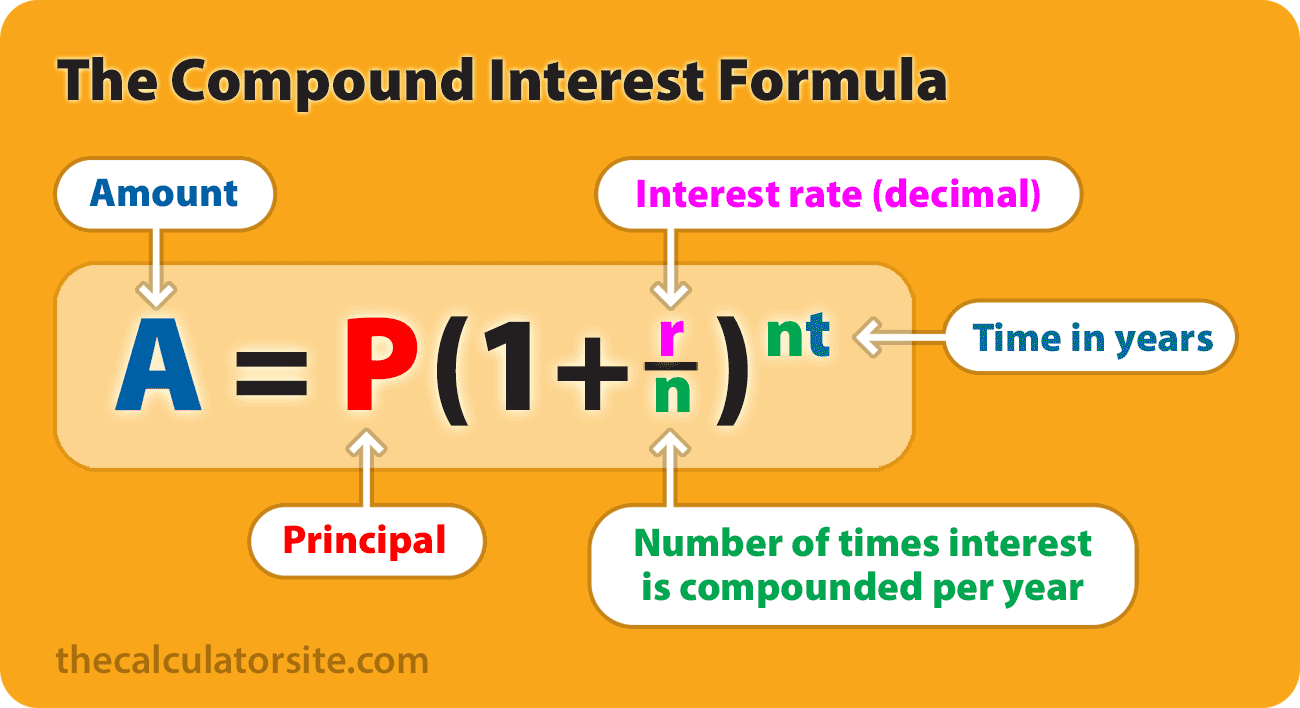
The formula for compound interest is more complex than simple interest, but it accurately reflects the powerful growth it enables:
A = P (1 + R/n)^(nt)
Where:
-
A = The future value of the investment/loan, including interest (Accumulated Amount)
-
P = The principal investment amount (the initial deposit or loan amount)
-
R = The annual interest rate (as a decimal)
-
n = The number of times that interest is compounded per year
-
t = The number of years the money is invested or borrowed for
Let’s break down the n variable which is crucial here. The frequency of compounding significantly impacts the total interest:
-
Annually: n = 1
-
Semi-annually: n = 2
-
Quarterly: n = 4
-
Monthly: n = 12
-
Daily: n = 365
The more frequently interest is compounded, the faster your money grows (or your debt accrues).
Practical Compound Interest Examples
Let’s illustrate the power of compounding with examples:
Example 1: Savings with Quarterly Compounding
You deposit $5,000 into a savings account that offers an annual interest rate of 3% compounded quarterly. You want to know your balance after 5 years.
-
P = $5,000
-
R = 3% = 0.03
-
n = 4 (quarterly)
-
t = 5 years
A = $5,000 (1 + 0.03/4)^(4*5)
A = $5,000 (1 + 0.0075)^20
A = $5,000 (1.0075)^20
A = $5,000 × 1.16118
A ≈ $5,805.90
After 5 years, your initial $5,000 would have grown to approximately $5,805.90 due to quarterly compounding. The interest earned is $805.90.
For comparison, if this were simple interest: I = $5,000 * 0.03 * 5 = $750. The difference of $55.90 is the power of compounding.
Example 2: Investment with Annual Compounding
You invest $10,000 in a fund that promises an average annual return of 7% compounded annually over 10 years.
-
P = $10,000
-
R = 7% = 0.07
-
n = 1 (annually)
-
t = 10 years
A = $10,000 (1 + 0.07/1)^(1*10)
A = $10,000 (1.07)^10
A = $10,000 × 1.96715
A ≈ $19,671.51
Your initial $10,000 would nearly double to $19,671.51 over a decade, with $9,671.51 being the interest earned. This clearly demonstrates the exponential growth compounding provides over longer periods.
Annual Percentage Yield (APY) vs. Annual Percentage Rate (APR)
When dealing with interest, especially compound interest, two terms frequently appear: APY and APR. Understanding their distinction is critical for savvy financial decision-making.
-
Annual Percentage Rate (APR): This represents the simple annual rate of interest charged on a loan or earned on an investment. It often does not account for compounding within the year. For loans, APR typically reflects the nominal annual interest rate and might not include all associated fees. It’s usually quoted for credit cards, mortgages, and other loans.
-
Annual Percentage Yield (APY): This is the effective annual rate of return, taking into account the effect of compounding interest. APY reflects the actual amount of interest earned on an investment or paid on a deposit over a year, considering how frequently interest is compounded. It’s a more accurate measure for comparing savings accounts or certificates of deposit (CDs) because it provides a true picture of how much your money will grow in a year. When comparing interest rates for savings or investments, always look at the APY.
Rule of thumb: When you’re saving or investing, look for the highest APY. When you’re borrowing, look for the lowest APR (and be mindful of all fees).
Advanced Considerations and Practical Applications
Beyond the formulas, understanding the nuances of interest calculation involves recognizing how various factors can influence your financial outcomes and how to leverage financial tools to your advantage.
Impact of Compounding Frequency
As demonstrated by the compound interest formula, the frequency of compounding (n) has a direct impact on the final amount. The more frequently interest is compounded, the greater the final balance. For example, an account compounded daily will yield slightly more interest than one compounded monthly, which in turn yields more than one compounded annually, even if the nominal annual interest rate (R) is the same. While the difference might seem small over short periods, it becomes substantial over many years, especially with larger principal amounts. This emphasizes the value of seeking financial products that offer higher compounding frequencies when you are saving or investing.
Inflation and Real Interest Rates
It’s crucial to consider the impact of inflation when evaluating interest earnings. Inflation erodes the purchasing power of money over time. A 5% annual interest gain on your savings might sound good, but if inflation is running at 3%, your “real” return is only 2%.
-
Nominal Interest Rate: The stated interest rate without taking inflation into account.
-
Real Interest Rate: The nominal interest rate minus the rate of inflation. This gives you a more accurate picture of the actual increase in your purchasing power.
Understanding real interest rates helps you assess whether your investments are genuinely growing your wealth or merely keeping pace with rising costs.
Utilizing Financial Tools for Interest Calculation
While understanding the formulas is empowering, you don’t always need to manually crunch the numbers. Various financial tools can simplify interest calculations:
-
Online Calculators: Most bank websites, financial planning sites, and investment platforms offer free compound interest calculators. These allow you to input different principals, rates, compounding frequencies, and timeframes to quickly see potential outcomes.
-
Spreadsheets (Excel, Google Sheets): For more customized analysis or tracking multiple scenarios, spreadsheets are invaluable. Functions like
FV(Future Value) or building your own compound interest formulas offer flexibility and power. -
Financial Apps: Many personal finance apps include built-in calculators or integrate with financial tools that can help you visualize the impact of interest on your savings or debt.
These tools are excellent for planning, comparing offers, and projecting future financial positions.
Strategic Implications for Personal Finance
Applying your knowledge of annual interest calculations has profound strategic implications for your personal finance:
-
For Savers/Investors:
-
Start Early: The longer your money has to compound, the more significant the growth.
-
Seek Higher APY: Always compare APYs when choosing savings accounts, CDs, or other interest-bearing investments.
-
Regular Contributions: Consistently adding to your principal enhances the compounding effect.
-
-
For Borrowers:
-
Understand APR: Be fully aware of the annual interest rate on loans and credit cards.
-
Minimize Compounding: Pay down high-interest debts as quickly as possible to reduce the impact of compounding interest working against you.
-
Negotiate Rates: Where possible, negotiate for lower interest rates on loans.
-
Debt Consolidation: Consider strategies like debt consolidation to reduce overall interest costs.
-
By strategically leveraging the principles of annual interest, you can either amplify your wealth or significantly reduce the cost of your debts.
Conclusion
The ability to calculate annual interest, whether simple or compound, is a fundamental financial literacy skill that empowers you to take control of your monetary future. It moves you from passively accepting financial terms to actively understanding and optimizing them. From maximizing your investment returns through the power of compounding to minimizing the drag of interest on your debts, this knowledge is a cornerstone of effective financial planning.
By understanding the key components, differentiating between simple and compound interest, and recognizing the importance of compounding frequency and real interest rates, you gain a significant advantage. Utilize available financial tools, apply strategic thinking to your savings and borrowing, and watch as your financial acumen translates into tangible growth and greater financial security. The journey to financial mastery begins with understanding the numbers, and mastering annual interest calculation is an essential first step.
aViewFromTheCave is a participant in the Amazon Services LLC Associates Program, an affiliate advertising program designed to provide a means for sites to earn advertising fees by advertising and linking to Amazon.com. Amazon, the Amazon logo, AmazonSupply, and the AmazonSupply logo are trademarks of Amazon.com, Inc. or its affiliates. As an Amazon Associate we earn affiliate commissions from qualifying purchases.