
In the world of finance, whether personal or professional, one metric consistently stands out as a critical indicator of success: Return on Investment, or ROI. It’s a simple yet incredibly powerful tool that helps individuals, investors, and businesses evaluate the efficiency and profitability of an investment. At its core, ROI tells you what you gained in proportion to what you put in. Understanding how to calculate and interpret ROI is not just a desirable skill; it’s an absolute necessity for anyone looking to make informed decisions about their money, time, and resources.
From deciding whether to pursue a new career path, invest in a stock, launch a marketing campaign, or purchase a piece of equipment for a side hustle, the underlying question often boils down to: “What will be my return on this investment?” This comprehensive guide will demystify ROI, walking you through its calculation, advanced applications, and practical interpretations across various financial scenarios, empowering you to measure your financial success with clarity and confidence.
Understanding the Core Concept of ROI
Before diving into the formulas and figures, it’s essential to grasp the foundational idea behind ROI. It’s more than just a number; it’s a principle of evaluating efficiency and gain.
What Exactly is ROI? Definition and Significance
Return on Investment (ROI) is a performance measure used to evaluate the efficiency or profitability of an investment or compare the efficiency of a number of different investments. It directly measures the amount of return on a particular investment, relative to the investment’s cost. A high ROI means the investment’s gains compare favorably to its cost. As a performance metric, ROI is commonly expressed as a percentage, though it can also be expressed as a ratio.
The significance of ROI cannot be overstated. It provides a standardized and tangible way to assess whether an investment was a good decision. Without ROI, decisions would be based on intuition or incomplete data, leading to potentially costly errors. It acts as a compass, guiding financial strategies and resource allocation, ensuring that capital is deployed in areas that promise the greatest potential for positive returns. For a small business owner, it helps prioritize which marketing channels to invest in; for an individual, it might guide decisions about higher education versus immediate job entry; for an investor, it’s the bedrock of portfolio management.
Why ROI Matters: From Personal Investments to Business Ventures
The universal applicability of ROI is one of its most compelling features. Its relevance spans across every financial domain:
-
Personal Finance: When considering buying a home, investing in a retirement fund, or even spending money on a skill-building course, ROI helps you gauge the long-term financial benefits against the initial outlay. Will that home appreciate significantly? Will that course lead to a higher-paying job?
-
Investing: For stock market investors, real estate developers, or venture capitalists, ROI is the primary tool for comparing different investment opportunities. Which stock offers a better return? Which property development promises higher profitability? It helps in making objective decisions, rather than emotional ones.
-
Business Finance: Businesses leverage ROI extensively to evaluate everything from product development and marketing campaigns to equipment purchases and software upgrades. Does upgrading our machinery justify the cost in terms of increased production and reduced waste? Will this new advertising campaign generate enough sales to cover its expense and then some? ROI provides the data to answer these questions decisively, driving strategic planning and operational efficiency.
-
Online Income & Side Hustles: Even in the burgeoning gig economy, ROI plays a role. If you’re investing time and money into learning a new skill for a side hustle, ROI helps you evaluate if the potential income justifies the investment of effort and capital.
In essence, ROI empowers better decision-making by providing a clear, quantifiable measure of financial performance.
The Basic ROI Formula and Its Application
The beauty of ROI lies in its straightforward calculation. While its implications can be complex, the fundamental formula is elegantly simple.
Deconstructing the Formula: (Net Profit / Cost of Investment) x 100%
The most common and basic formula for calculating ROI is:
$$ text{ROI} = left( frac{text{Net Profit}}{text{Cost of Investment}} right) times 100% $$
Let’s break down each component:
-
Net Profit: This is the gain from an investment, minus any associated costs. It’s calculated as (Final Value of Investment – Initial Value of Investment – Cost of Investment). For example, if you bought a stock for $100, sold it for $120, and paid $5 in trading fees, your net profit would be $120 – $100 – $5 = $15.
-
Cost of Investment: This is the total amount of money initially invested. In the stock example, it would be the initial $100 purchase price. Sometimes, this can also include various direct and indirect costs associated with the investment, which we’ll explore in the advanced section.
-
x 100%: Multiplying by 100 converts the ratio into a percentage, making it easier to understand and compare.
A positive ROI indicates a net gain, meaning the investment was profitable. A negative ROI signifies a net loss, indicating the investment was unprofitable.
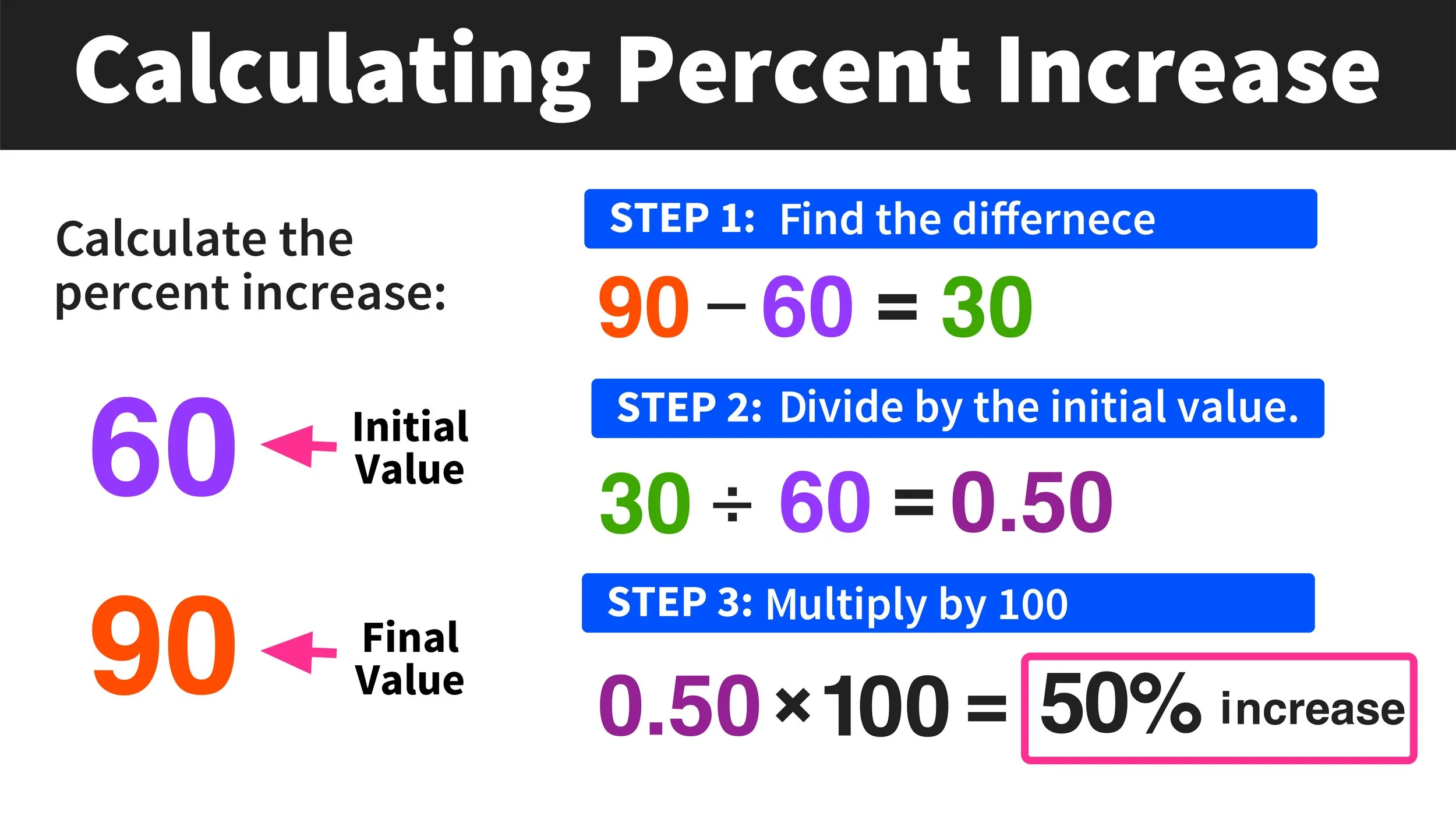
Step-by-Step Calculation: A Simple Example
Let’s walk through a practical example to solidify your understanding.
Scenario: You decided to invest $5,000 in a friend’s small online business selling handmade jewelry. After one year, your share of the business’s profits and the increase in its valuation means your initial $5,000 investment is now valued at $6,500.
Step 1: Determine the Final Value of Investment.
Final Value = $6,500
Step 2: Determine the Initial Value of Investment (Cost of Investment).
Initial Value = $5,000
Step 3: Calculate the Net Profit.
Net Profit = Final Value – Initial Value
Net Profit = $6,500 – $5,000 = $1,500
Step 4: Apply the ROI Formula.
ROI = (Net Profit / Cost of Investment) × 100%
ROI = ($1,500 / $5,000) × 100%
ROI = 0.3 × 100%
ROI = 30%
In this example, your investment yielded a 30% return, indicating a successful and profitable venture. This simple calculation provides a clear, actionable insight into the performance of your investment.
Advanced Applications and Nuances of ROI
While the basic ROI formula is powerful, real-world investments often involve complexities that require a more nuanced approach. Accounting for time, various costs, and different types of returns can provide a more accurate and insightful picture.
Accounting for Time: Annualized ROI and Compound Returns
The basic ROI formula doesn’t inherently consider the duration of the investment. A 30% ROI over one year is excellent, but a 30% ROI over ten years is considerably less impressive. This is where annualized ROI becomes crucial.
Annualized ROI normalizes the return over a one-year period, allowing for an apples-to-apples comparison of investments with different durations. While there are complex formulas, a simplified way to approximate is:
$$ text{Annualized ROI} approx left[ (1 + text{Overall ROI})^{(1/text{Number of Years})} – 1 right] times 100% $$
For instance, if you had a 50% overall ROI on an investment held for 5 years:
Annualized ROI = $[(1 + 0.50)^{(1/5)} – 1] times 100%$
Annualized ROI = $[(1.50)^{0.2} – 1] times 100%$
Annualized ROI = $[1.08447 – 1] times 100%$
Annualized ROI = $8.45%$

This shows that while the total gain was 50%, the average annual gain was about 8.45%.
Furthermore, understanding compound returns is vital. Compound interest or returns mean that earnings from an investment are reinvested, generating additional earnings. This “interest on interest” effect can significantly amplify returns over time, making long-term investments particularly attractive, even if their annual ROI seems modest. Tools like compound interest calculators are invaluable for projecting these long-term gains.
Incorporating All Costs: Direct vs. Indirect Expenses
When calculating the “Cost of Investment,” it’s easy to overlook certain expenses. A truly accurate ROI includes all relevant costs, not just the initial purchase price.
-
Direct Costs: These are easily attributable expenses like the purchase price of an asset, brokerage fees, shipping costs, installation charges, and direct marketing spend.
-
Indirect Costs: These are often harder to quantify but can significantly impact the overall profitability. Examples include opportunity costs (what you could have earned by investing elsewhere), time spent managing an investment, administrative overhead, maintenance costs, and even the cost of capital (interest on borrowed funds).
For instance, if you’re calculating the ROI of a new piece of machinery for your business, the cost isn’t just the sticker price. It includes transportation, installation, training for employees, increased electricity consumption, and ongoing maintenance. Neglecting these indirect costs can inflate your perceived ROI and lead to poor financial decisions.
Different Types of “Returns”: Financial Gains, Time Savings, and More
While ROI is typically expressed in monetary terms, the “return” can sometimes be broader than just financial profit.
-
Monetary Gains: The most common form, including capital appreciation, dividends, interest, rental income, or business profits.
-
Time Savings: For internal business projects or personal efficiency tools, the return might be measured in saved labor hours, leading to increased productivity and indirect cost savings.
-
Efficiency Improvements: A new software system might not directly generate revenue but can streamline operations, reduce errors, and improve customer satisfaction, leading to long-term financial benefits.
-
Strategic Advantage: Investing in R&D or employee training might not show immediate financial ROI but can provide a significant competitive edge or enhance human capital, translating to future growth.
It’s crucial to define what “return” you’re measuring when applying the ROI framework to non-monetary benefits. Quantifying these non-financial returns (e.g., valuing an hour of saved labor) is key to making the calculation meaningful.
Beyond the Numbers: Interpreting and Utilizing ROI
Calculating ROI is only half the battle. The real value comes from interpreting the results, understanding their limitations, and using them to make strategic decisions.
What Constitutes a “Good” ROI? Benchmarking and Context
There’s no universal “good” ROI. What’s considered acceptable varies wildly depending on the industry, the type of investment, the risk involved, and the prevailing economic conditions.
-
Risk vs. Return: Generally, higher-risk investments are expected to yield higher returns. A low-risk government bond might offer a 2-3% annual ROI, which is considered acceptable given its safety. A startup investment, however, would be expected to deliver a much higher ROI (e.g., 20-50% or more) to compensate for the significant risk of failure.
-
Industry Benchmarks: Different sectors have different average ROIs. A retail business might target a higher ROI on inventory than a utility company does on infrastructure. Researching industry averages provides a crucial benchmark.
-
Opportunity Cost: A good ROI is also relative to other available investment opportunities. If you can achieve a 10% annual return with a similar risk profile elsewhere, then an investment yielding 7% might not be “good” enough.
-
Company/Personal Goals: What is a good ROI for a specific project might depend on whether the goal is rapid growth, steady income, or capital preservation.
Understanding the context is paramount. A 15% ROI might be phenomenal for a mature, stable business, but concerning for a high-growth tech startup.
Limitations of ROI: A Single Metric’s Shortcomings
While powerful, ROI is not a perfect metric and has several limitations:
-
Ignores Time Value of Money (in basic form): As discussed, the basic ROI doesn’t inherently account for the length of time an investment is held.
-
Doesn’t Account for Risk: A high ROI might come with extremely high risk, which ROI alone doesn’t quantify. Two investments with the same ROI could have vastly different risk profiles.
-
Potential for Manipulation: The “cost of investment” and “net profit” can sometimes be defined or calculated in ways that present a more favorable ROI, especially if indirect costs are ignored.
-
Focus on Short-Term Gains: Businesses might prioritize projects with quick, high ROIs, potentially neglecting long-term strategic investments that have lower immediate returns but build sustainable value (e.g., R&D, brand building).
-
Doesn’t Consider Scale: A 100% ROI on a $100 investment ($100 profit) is less impactful than a 10% ROI on a $1,000,000 investment ($100,000 profit). ROI doesn’t provide insight into the absolute size of the profit.
Therefore, ROI should always be used in conjunction with other financial metrics such as Net Present Value (NPV), Internal Rate of Return (IRR), payback period, and risk assessments to get a holistic view.
Strategic Decision-Making with ROI: Prioritizing Investments
Despite its limitations, ROI remains a cornerstone of strategic decision-making.
-
Project Prioritization: When faced with multiple investment opportunities (e.g., several marketing campaigns, different product lines, or various personal finance goals), calculating the potential ROI for each helps to rank them and allocate resources to those promising the greatest financial return.
-
Performance Evaluation: After an investment has matured, comparing the actual ROI to the projected ROI provides valuable insights into the accuracy of initial assumptions and the effectiveness of execution. This feedback loop is crucial for continuous improvement.
-
Budget Allocation: Businesses use ROI to justify expenditures. If a new IT system can demonstrate a strong ROI through increased efficiency or cost savings, it’s more likely to secure budget approval.
-
Identifying Inefficiencies: Low or negative ROIs can signal problem areas in operations, marketing strategies, or investment portfolios, prompting corrective action.
By systematically applying ROI, individuals and organizations can move beyond guesswork, making data-driven choices that optimize financial outcomes.
Practical Scenarios: Applying ROI in Real Life
Let’s explore how ROI is applied in diverse real-world contexts, demonstrating its versatility and critical role in financial analysis.
Personal Investing: Stocks, Real Estate, and Education
-
Stocks: If you buy 100 shares of a company at $50 each ($5,000 total) and sell them a year later at $60 each ($6,000 total), paying $20 in trading fees:
Net Profit = ($6,000 – $5,000 – $20) = $980
Cost of Investment = $5,000
ROI = ($980 / $5,000) * 100% = 19.6%
-
Real Estate: You buy a rental property for $200,000. Over five years, you collect $50,000 in rent, spend $10,000 on maintenance, and sell the property for $260,000.
Net Profit = ($50,000 – $10,000) + ($260,000 – $200,000) = $40,000 + $60,000 = $100,000
Cost of Investment = $200,000
ROI = ($100,000 / $200,000) * 100% = 50% (Overall, not annualized)
-
Education: Investing in a master’s degree might cost $50,000 in tuition and lost income. If, over your career, this degree leads to an additional $200,000 in earnings (after taxes), then:
Net Profit = $200,000
Cost of Investment = $50,000
ROI = ($200,000 / $50,000) * 100% = 400% (A rough estimate over a career, often requiring more complex lifetime earnings calculations).
Business Finance: Marketing Campaigns, Equipment Upgrades, and Project Evaluation
-
Marketing Campaign: A company spends $10,000 on a digital advertising campaign that directly generates $35,000 in new sales, with a 30% profit margin on those sales.
Net Profit = $35,000 * 0.30 = $10,500
Cost of Investment = $10,000
ROI = ($10,500 / $10,000) * 100% = 105% (A very successful campaign!)
-
Equipment Upgrades: A manufacturing plant invests $50,000 in new machinery that reduces labor costs by $15,000 annually and decreases waste by $5,000 annually.
Annual Net Profit (Savings) = $15,000 + $5,000 = $20,000
Cost of Investment = $50,000
Annual ROI = ($20,000 / $50,000) * 100% = 40% (This suggests the investment would pay for itself in 2.5 years).
-
Project Evaluation: A software development project costs $100,000 to develop and is projected to generate $180,000 in revenue over its lifespan, with associated operational costs of $30,000.
Net Profit = $180,000 – $30,000 – $100,000 = $50,000
Cost of Investment = $100,000
ROI = ($50,000 / $100,000) * 100% = 50%
Online Income & Side Hustles: Time vs. Financial Returns
-
Learning a New Skill: You spend 100 hours (valued at $25/hour lost income = $2,500) and $500 on courses to learn web development. This leads to a side hustle that generates an extra $6,000 in income over the next year.
Net Profit = $6,000
Cost of Investment = $2,500 (time) + $500 (courses) = $3,000
ROI = ($6,000 / $3,000) * 100% = 200%
-
Setting up an E-commerce Store: Investing $2,000 in website setup, initial inventory, and advertising for an e-commerce store. In the first year, after all costs of goods sold and operating expenses, the store generates a net profit of $1,500.
Net Profit = $1,500
Cost of Investment = $2,000
ROI = ($1,500 / $2,000) * 100% = 75%
These examples illustrate how ROI can be tailored and applied to almost any situation where resources are allocated with the expectation of a return.

Conclusion
The ability to calculate Return on Investment is a foundational skill for anyone navigating the financial landscape. It provides a clear, objective lens through which to view the effectiveness and profitability of any venture, from personal savings strategies to complex corporate initiatives. By mastering the basic formula, understanding its advanced applications, and critically interpreting its results, you empower yourself to make more informed, strategic decisions that optimize your financial gains.
While ROI offers invaluable insights, remember it is a single metric. Always consider it alongside other financial tools, risk assessments, and strategic objectives for a truly holistic understanding of your investments. Embrace ROI as a powerful ally in your journey towards greater financial literacy and success, using it not just to measure, but to proactively shape your financial future.
aViewFromTheCave is a participant in the Amazon Services LLC Associates Program, an affiliate advertising program designed to provide a means for sites to earn advertising fees by advertising and linking to Amazon.com. Amazon, the Amazon logo, AmazonSupply, and the AmazonSupply logo are trademarks of Amazon.com, Inc. or its affiliates. As an Amazon Associate we earn affiliate commissions from qualifying purchases.