
Understanding how to calculate the return on your investments is a foundational skill for anyone looking to build wealth and make informed financial decisions. Whether you’re a seasoned investor evaluating a complex portfolio or a beginner considering your first stock purchase, quantifying your gains and losses is essential. Return on Investment (ROI) isn’t just a number; it’s a powerful metric that reveals the efficiency and profitability of your capital allocation. It allows you to assess past performance, compare different opportunities, and strategize for future growth. Without this crucial calculation, you’re essentially navigating the financial markets blindfolded, unable to truly gauge the success of your ventures. This article will demystify the process, exploring various methods for calculating investment returns, highlighting their practical applications, and discussing how to interpret these figures to drive smarter financial choices within the realm of personal and business finance.

Understanding the Fundamentals of Return on Investment (ROI)
At its core, calculating a return on an investment is about understanding how much profit you’ve made relative to the cost of that investment. It’s a universal metric used across various financial domains, from evaluating marketing campaigns to assessing the performance of real estate holdings or stock portfolios.
Defining ROI and Its Significance
Return on Investment (ROI) is a performance measure used to evaluate the efficiency or profitability of an investment or compare the efficiency of a number of different investments. ROI attempts to directly measure the amount of return on a particular investment, relative to the investment’s cost. To be an investment, the asset must involve capital being put to use with the expectation of a future benefit. This benefit could be in the form of interest, dividends, increased asset value, or any other financial gain.
The significance of ROI cannot be overstated. For individuals, it helps answer questions like, “Was buying that rental property a good idea?” or “Is my stock portfolio generating sufficient returns?” For businesses, it informs decisions about capital expenditures, project viability, and strategic allocations. A positive ROI indicates a net gain, while a negative ROI signifies a loss. Its simplicity and versatility make it an indispensable tool for financial analysis.
The Basic ROI Formula
The most fundamental way to calculate ROI is straightforward:
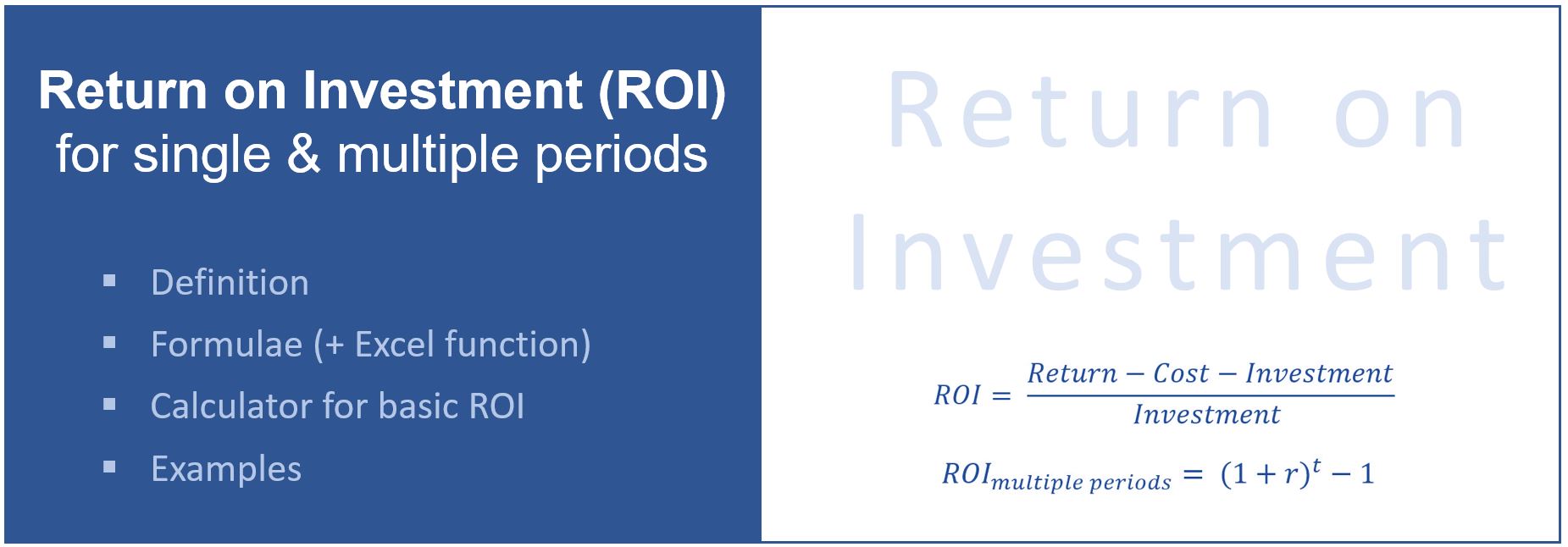
ROI = (Net Return on Investment / Cost of Investment) x 100%
Let’s break down the components:
- Net Return on Investment: This is the total profit or loss generated by the investment. It’s calculated as the current value of the investment (or the proceeds from its sale) minus the initial cost of the investment.
- Cost of Investment: This is the original amount of capital you put into the investment. It should include all direct costs associated with acquiring the investment, such as purchase price, commissions, and fees.
For example, if you bought a stock for $100 and sold it for $120, your net return is $20.
ROI = ($20 / $100) x 100% = 20%.
This means for every dollar you invested, you earned 20 cents back in profit. This basic formula provides a quick, clear snapshot of an investment’s profitability.
Why ROI Matters for Every Investor
ROI is more than just a calculation; it’s a critical lens through which investors evaluate past decisions and project future outcomes. For every investor, whether managing personal finance or overseeing a business portfolio, ROI provides:
- Performance Measurement: It’s the primary indicator of how well an investment has performed over a given period.
- Comparative Analysis: ROI allows investors to compare the profitability of different investment opportunities, regardless of their size or type. This is crucial when deciding where to allocate limited capital – should you invest in real estate, stocks, or a small business?
- Decision-Making Tool: By understanding the potential ROI of various options, investors can make more informed choices about where to put their money. A higher ROI generally indicates a more attractive investment, assuming risks are comparable.
- Goal Setting and Tracking: Investors can set ROI targets for their portfolios or individual investments, and then use the calculation to track progress towards those goals.
- Risk Assessment: While ROI doesn’t directly measure risk, a low or negative ROI can signal an overly risky or poorly performing asset, prompting further investigation.
Mastering the calculation of ROI is therefore not just about crunching numbers; it’s about gaining a deeper understanding of your financial landscape and empowering yourself to make strategic, data-driven decisions that align with your wealth-building objectives.
Delving Deeper into ROI Calculation Methods
While the basic ROI formula provides a useful starting point, various scenarios and investment types necessitate more nuanced approaches to calculating returns. Understanding these different methods is crucial for an accurate and comprehensive assessment of your investment performance.
Simple ROI: A Quick Snapshot
As discussed, simple ROI is the most straightforward calculation. It looks at the net profit against the initial cost, expressed as a percentage.
Formula: [(Current Value - Initial Cost) / Initial Cost] x 100%
Example: You bought 10 shares of a company at $50 per share (Total Initial Cost = $500). You sell them later for $65 per share (Total Sale Value = $650).
Net Profit = $650 – $500 = $150.
Simple ROI = ($150 / $500) x 100% = 30%.
When to use it: Ideal for quick, back-of-the-envelope calculations for a single investment or project where the time horizon isn’t a primary factor, or when comparing investments of similar duration. It’s excellent for a first-pass evaluation.
Annualized ROI: Accounting for Time
Simple ROI doesn’t consider the time period over which the investment was held. An investment that yields a 20% return in one year is significantly better than one that yields 20% over five years. Annualized ROI normalizes returns to a per-year basis, making it easier to compare investments with different holding periods.
Formula: Annualized ROI = [(1 + Simple ROI)^(1/n) - 1] x 100%
Where ‘n’ is the number of years the investment was held.
Example: You made a 30% simple ROI on an investment held for 3 years.
Annualized ROI = [(1 + 0.30)^(1/3) – 1] x 100%
Annualized ROI = [(1.30)^(0.3333) – 1] x 100%
Annualized ROI = [1.09139 – 1] x 100% = 9.14% (approximately).
This means, on average, your investment grew by about 9.14% each year.
When to use it: Essential for comparing investments held for different durations, providing a standardized measure of yearly performance. It’s particularly useful for long-term investments like real estate, retirement accounts, or bonds.
Total Return: Incorporating All Gains and Losses
Many investments generate returns in multiple ways. For example, stocks can appreciate in value and pay dividends. Rental properties can appreciate and generate rental income. Total return captures all forms of income and capital appreciation or depreciation.
Formula: Total Return = [(Ending Value - Beginning Value + Income Received) / Beginning Value] x 100%
Example: You bought a stock for $100 (Beginning Value). Over a year, it paid $5 in dividends (Income Received) and is now worth $110 (Ending Value).
Total Return = [($110 – $100 + $5) / $100] x 100%
Total Return = ($15 / $100) x 100% = 15%.
When to use it: Crucial for investments that generate regular income streams in addition to potential capital gains, such as dividend stocks, bonds, mutual funds, ETFs, and rental properties. It gives a complete picture of profitability.

Compound Annual Growth Rate (CAGR): For Consistent Growth Over Multiple Periods
CAGR is a useful metric for smoothing out volatile returns over multiple years, providing a hypothetical constant rate of return that would yield the same final investment value. It accounts for the effect of compounding, where earnings from previous periods are reinvested.
Formula: CAGR = [(Ending Value / Beginning Value)^(1 / Number of Years) - 1] x 100%
Example: Your investment portfolio started at $10,000, and after 5 years, it’s worth $16,105.
CAGR = [($16,105 / $10,000)^(1/5) – 1] x 100%
CAGR = [(1.6105)^(0.2) – 1] x 100%
CAGR = [1.10 – 1] x 100% = 10%.
This means your investment grew at an average compounded rate of 10% per year over the five-year period.
When to use it: Ideal for understanding the average annual growth rate of an investment over a multi-year period, especially for portfolios, businesses, or assets expected to grow steadily. It helps to visualize a smooth growth path, even if actual year-to-year returns were volatile.
Choosing the right ROI calculation depends on the specific investment, the time horizon, and what you aim to analyze. A sophisticated investor often uses a combination of these methods to gain a comprehensive understanding of their financial performance.
Practical Applications and Considerations When Calculating ROI
Calculating ROI is more than just plugging numbers into a formula; it involves careful consideration of all relevant factors and an understanding of the metric’s inherent limitations. Accuracy in input is paramount to derive meaningful insights.
Identifying All Costs and Benefits
One of the most common pitfalls in ROI calculation is failing to account for all costs and benefits associated with an investment.
- Costs: This includes the initial purchase price, but also transaction fees, brokerage commissions, advisory fees, maintenance costs (for real estate), taxes paid on gains or income, and any ongoing expenses. For a business investment, it might include operating costs, marketing expenses, or training costs. Overlooking these can significantly inflate your perceived ROI.
- Benefits: This covers the obvious (capital appreciation, dividends, interest, rental income) but also potential indirect benefits, especially in a business context, such as increased brand value, customer loyalty, or operational efficiencies, though these are harder to quantify in a financial ROI. Focus primarily on direct financial benefits for standard investment ROI.
A thorough inventory of both direct and indirect financial inflows and outflows related to the investment is crucial for an accurate ROI figure.
The Impact of Taxes and Fees
Taxes and fees are often underestimated but can significantly erode real returns.
- Transaction Fees: Brokerage commissions, legal fees for property transfers, or platform fees for trading can eat into initial capital or final proceeds.
- Ongoing Fees: Management fees for mutual funds or advisory fees for wealth management services are recurring costs that reduce net returns.
- Taxes: Capital gains taxes (short-term vs. long-term), dividend taxes, and income taxes on interest or rental earnings directly impact your net profit. It’s vital to calculate ROI after these deductions to understand your true, take-home return. A pre-tax ROI might look attractive, but a post-tax ROI often tells a different, more realistic story.
Always aim to calculate a “net” ROI by factoring in all these deductions to get a clearer picture of your actual financial gain.
Comparing Different Investment Opportunities
One of the most powerful applications of ROI is its ability to facilitate comparison between disparate investment options. A 15% ROI on a stock portfolio can be directly compared to a 10% ROI on a real estate venture, allowing you to identify which allocation of capital yielded a better return relative to its cost.
- Standardization: ROI provides a standardized percentage, making it possible to compare investments of different sizes, durations (using annualized ROI), and types.
- Risk-Adjusted Returns: While ROI doesn’t explicitly measure risk, it’s often used in conjunction with risk metrics. For instance, an investment with a 20% ROI but extremely high volatility might be less attractive than one with a 15% ROI but stable, predictable returns. Financial professionals often look at “risk-adjusted ROI” to make more sophisticated comparisons.
- Opportunity Cost: Calculating ROI helps assess the opportunity cost of choosing one investment over another. If Investment A yielded 8% and Investment B could have yielded 12% for similar risk, the 4% difference represents the lost opportunity.
Limitations and Nuances of ROI
While invaluable, ROI is not a perfect metric and has several limitations:
- Time Value of Money: Simple ROI does not inherently account for the time value of money, meaning a dollar today is worth more than a dollar tomorrow. Annualized ROI and CAGR help address this, but it’s an important consideration.
- Risk Ignorance: ROI provides no information about the risk associated with an investment. A high ROI might come with unacceptably high risk.
- Cash Flow: A high ROI doesn’t necessarily mean good liquidity. An investment might show a great return on paper but tie up capital for extended periods without providing regular cash flow.
- Comparability Issues: Comparing ROIs between different industries or projects can be misleading due to varying capital structures, operating cycles, or risk profiles.
- Forecasting vs. Historical: ROI is primarily a historical metric. While it informs future decisions, it doesn’t guarantee future performance. Projected ROIs are estimates and inherently carry uncertainty.
Understanding these limitations ensures that ROI is used as one tool in a larger analytical toolkit, rather than the sole determinant of investment strategy.
Beyond the Numbers: Interpreting and Utilizing Your ROI
Calculating ROI is merely the first step. The true value lies in understanding what those numbers mean for your financial future and how to leverage them for better decision-making. Interpretation involves context, comparison, and forward-thinking strategy.
Setting Realistic Expectations
An ROI of 100% might sound fantastic, but is it realistic or sustainable? Setting realistic expectations for your investments is paramount to avoid disappointment and making rash decisions.
- Market Averages: Understand what typical returns are for different asset classes (e.g., historical stock market returns, average real estate appreciation in your area, bond yields). Comparing your ROI to these benchmarks provides a sense of whether your performance is exceptional, average, or subpar.
- Risk Profile: Higher potential returns often come with higher risk. If you are a conservative investor, aiming for market-beating returns might expose you to undue risk. Your expected ROI should align with your personal risk tolerance.
- Time Horizon: Short-term investments can be volatile. Long-term investments tend to smooth out market fluctuations and often yield more consistent, albeit possibly lower, annualized returns. Be realistic about what ROI is achievable over your specific investment horizon.
- Inflation: Always consider real return (ROI minus inflation). A 5% ROI in a 3% inflation environment is only a 2% real return. Inflation erodes purchasing power, so your ROI needs to outpace it to truly grow your wealth.
ROI as a Decision-Making Tool
ROI is an active tool, not just a historical report. It should guide your future investment choices.
- Portfolio Rebalancing: If certain investments consistently show low ROI compared to others with similar risk profiles, it might be time to rebalance your portfolio, divesting from underperformers and reallocating capital to assets with stronger potential.
- Investment Screening: Use target ROI thresholds to filter potential investments. If a new venture doesn’t project an ROI above your minimum acceptable rate (considering risk), it might not be worth pursuing.
- Resource Allocation (Business Finance): For businesses, ROI helps decide which projects to fund, which marketing campaigns are effective, or whether a new piece of equipment justifies its cost. It directs capital to the most profitable uses.
- Exit Strategy: A declining or stagnating ROI on an asset might signal that it’s time to sell or liquidate the investment before further capital erosion.
Reinvesting Returns for Future Growth
The power of compounding is a cornerstone of wealth creation, and reinvesting your returns amplifies this effect.
- Snowball Effect: When you reinvest dividends, interest, or capital gains, those additional funds start earning returns themselves. This creates a “snowball effect” where your capital grows exponentially over time.
- Accelerated Growth: Imagine an investment yielding 10% annually. If you consistently reinvest that 10%, your principal grows, and the next year’s 10% return is calculated on a larger base, accelerating your wealth accumulation.
- Discipline: Reinvesting requires financial discipline. While tempting to spend investment profits, deferring gratification to funnel returns back into your portfolio is a powerful strategy for long-term growth.
The Importance of Regular Review
Financial markets are dynamic, and so should be your approach to evaluating investments.
- Periodic Assessment: Regularly review the ROI of your individual investments and overall portfolio – quarterly, semi-annually, or annually. This helps you stay abreast of performance and identify trends.
- Adaptation: Market conditions, economic environments, and even your personal financial goals can change. Regular review allows you to adapt your strategy, adjusting allocations or divesting from assets that no longer align with your objectives or show diminished returns.
- Learning Opportunity: Analyzing past ROIs, both successes and failures, provides invaluable learning opportunities. What factors contributed to high returns? What led to losses? This reflective process refines your investment acumen.
By moving beyond the mere calculation and delving into the interpretation and strategic application of ROI, investors can transform a simple percentage into a powerful tool for achieving their financial aspirations, building a robust portfolio, and securing a prosperous future.
Conclusion
Calculating a return on an investment is far more than a mathematical exercise; it is an indispensable discipline that underpins sound financial decision-making for both individuals and businesses. From the straightforward simplicity of basic ROI to the time-sensitive precision of annualized returns and the holistic view offered by total return and CAGR, each method provides a unique lens through which to evaluate your capital’s performance.
Understanding how to accurately identify all costs and benefits, factoring in the often-overlooked impacts of taxes and fees, and recognizing the limitations of ROI are critical for generating meaningful insights. More importantly, the true power of this metric lies in its application: using ROI to compare diverse opportunities, set realistic expectations, inform strategic portfolio adjustments, and leverage the magic of compounding through reinvestment.
By regularly reviewing and interpreting your investment returns, you gain clarity, foster discipline, and refine your financial acumen. In an ever-evolving financial landscape, the ability to effectively calculate and utilize ROI empowers you to navigate market fluctuations with confidence, make data-driven choices, and ultimately steer your financial journey towards sustainable wealth creation. Embrace this fundamental skill, and you unlock a clearer path to achieving your financial goals and securing your future.
aViewFromTheCave is a participant in the Amazon Services LLC Associates Program, an affiliate advertising program designed to provide a means for sites to earn advertising fees by advertising and linking to Amazon.com. Amazon, the Amazon logo, AmazonSupply, and the AmazonSupply logo are trademarks of Amazon.com, Inc. or its affiliates. As an Amazon Associate we earn affiliate commissions from qualifying purchases.