
Understanding how to calculate a loan payment is a fundamental skill for sound financial management. Whether you’re considering a mortgage, an auto loan, a personal loan, or even managing business debt, grasping the mechanics behind your monthly payments empowers you to make informed decisions, budget effectively, and potentially save thousands over the life of a loan. Far from being a complex mathematical enigma, the calculation process is logical and accessible, relying on a few key variables and a standard formula. This guide will demystify the process, breaking down the components of a loan payment and equipping you with the knowledge to analyze any lending scenario with confidence.

Understanding the Fundamentals of Loan Calculation
Before diving into formulas and numbers, it’s essential to grasp the core concepts that dictate how a loan payment is structured. Every loan payment serves two primary functions: repaying a portion of the principal balance and covering the interest accrued on the outstanding balance. The interplay of these factors, along with the loan term, creates the consistent monthly payment amount that lenders present.
Key Variables in a Loan Payment Formula
Three main variables are universally present in any loan payment calculation:
- Principal (P): This is the initial amount of money borrowed. It’s the face value of the loan before any interest or fees are added. For example, if you borrow $200,000 for a home, your principal is $200,000.
- Interest Rate (i): This is the cost of borrowing money, expressed as a percentage of the principal. It’s typically given as an annual percentage rate (APR). For calculation purposes, this annual rate needs to be converted into a monthly rate. A 6% annual interest rate becomes 0.06 / 12 = 0.005 as a monthly decimal rate.
- Loan Term (n): This is the total number of payments required to repay the loan. It’s usually expressed in years but must be converted to months for the calculation. A 30-year mortgage, for instance, has a term of 30 * 12 = 360 months.
The Amortization Process Explained
Most consumer and business loans operate on an amortization schedule. Amortization is the process of paying off debt over time through regular, equal installments. In the early stages of an amortized loan, a larger portion of each payment goes towards interest, while a smaller portion reduces the principal. As the loan matures, the proportion shifts: more of each payment goes towards principal reduction, and less towards interest, because the outstanding principal balance (on which interest is calculated) is decreasing. Understanding amortization is crucial because it highlights why early additional principal payments can have a disproportionately large impact on the total interest paid over the loan’s life.
Deconstructing the Loan Payment Formula
The standard formula used by lenders, financial institutions, and online calculators to determine a fixed loan payment is a cornerstone of personal and business finance. While it might look intimidating at first glance, breaking it down into its individual components reveals its logical structure.
The Standard Loan Payment Formula
The most common formula for calculating a fixed monthly loan payment (M) is:
M = P [ i(1 + i)^n ] / [ (1 + i)^n – 1]
Where:
M= Monthly PaymentP= Principal Loan Amounti= Monthly Interest Rate (annual rate divided by 12)n= Total Number of Payments (loan term in months)
Breaking Down Each Component
Let’s dissect each part of the formula to understand its role:
- P (Principal Loan Amount): As discussed, this is the total sum borrowed.
- i (Monthly Interest Rate): This is perhaps the trickiest part to correctly input. If your annual interest rate is 5%, you must divide it by 100 to get a decimal (0.05), and then divide that by 12 to get the monthly decimal rate (0.05 / 12 = 0.00416667). Precision here is key.
- n (Total Number of Payments): This is simply the loan term in years multiplied by 12. For a 15-year loan, n = 15 * 12 = 180.
- ** (1 + i)^n :** This exponential term represents the future value of a dollar, compounded over the life of the loan. It accounts for the cumulative effect of interest over the entire term. This part is calculated twice in the formula, underscoring its importance in both the numerator and denominator.
- Numerator: P * [ i(1 + i)^n ] : This top part of the fraction effectively calculates the total amount of money that would be owed if the principal and all accrued interest were paid at the end of the term, then factors in the monthly interest rate to determine the portion of that total attributed to each payment.
- Denominator: [ (1 + i)^n – 1 ] : This bottom part helps normalize the payment over the term, essentially adjusting for the amortization schedule and ensuring that the payment remains constant.
Practical Application: Converting Annual Rate to Monthly
Always remember this crucial step: convert your annual interest rate into a monthly decimal rate before plugging it into the formula. For example, if you have a 4.5% annual interest rate:
- Convert percentage to decimal: 4.5 / 100 = 0.045
- Convert annual to monthly: 0.045 / 12 = 0.00375
This0.00375is the value you’ll use foriin your calculation.
Step-by-Step Calculation Examples
Theory is best understood through practice. Let’s walk through a couple of examples to illustrate how the formula works in real-world scenarios.
Example 1: A Simple Personal Loan
Suppose you want to borrow $10,000 for a personal loan at an annual interest rate of 7% over 5 years.
- Identify P: P = $10,000
- Calculate i: Annual rate = 7% = 0.07. Monthly rate (i) = 0.07 / 12 = 0.00583333
- Calculate n: Loan term = 5 years. Total months (n) = 5 * 12 = 60
- Plug into the formula:
- (1 + i)^n = (1 + 0.00583333)^60 = (1.00583333)^60 ≈ 1.3956
- Numerator = P * [ i(1 + i)^n ] = 10,000 * [ 0.00583333 * 1.3956 ] = 10,000 * 0.0081393 = 81.393
- Denominator = [ (1 + i)^n – 1 ] = 1.3956 – 1 = 0.3956
- M = Numerator / Denominator = 81.393 / 0.3956 ≈ $205.74
Your estimated monthly payment for this personal loan would be approximately $205.74.
Example 2: A Mortgage Loan Scenario
Let’s consider a more significant loan: a $300,000 mortgage at an annual interest rate of 4% over 30 years.
- Identify P: P = $300,000
- Calculate i: Annual rate = 4% = 0.04. Monthly rate (i) = 0.04 / 12 = 0.00333333
- Calculate n: Loan term = 30 years. Total months (n) = 30 * 12 = 360
- Plug into the formula:
- (1 + i)^n = (1 + 0.00333333)^360 = (1.00333333)^360 ≈ 3.3102
- Numerator = P * [ i(1 + i)^n ] = 300,000 * [ 0.00333333 * 3.3102 ] = 300,000 * 0.011034 = 3310.2
- Denominator = [ (1 + i)^n – 1 ] = 3.3102 – 1 = 2.3102
- M = Numerator / Denominator = 3310.2 / 2.3102 ≈ $1,432.88
Your estimated monthly mortgage payment would be approximately $1,432.88.
Understanding the Impact of Different Variables
These examples highlight how changes in interest rate and loan term significantly affect the monthly payment. A higher interest rate or a shorter loan term will result in higher monthly payments but potentially lower total interest paid over the life of the loan. Conversely, a lower interest rate or a longer term typically leads to lower monthly payments but often means paying more interest over the long run. Experimenting with these variables using the formula can offer valuable insights into your borrowing options.
Leveraging Tools for Accuracy and Efficiency
While understanding the manual calculation is empowering, in practice, most people rely on various tools for quick and accurate loan payment calculations. These tools can save time, minimize calculation errors, and allow for easy scenario planning.
Online Loan Calculators: Benefits and Features
Online loan calculators are ubiquitous and incredibly user-friendly. Most financial institution websites, mortgage lenders, and personal finance portals offer them.
- Benefits: Instant results, simple interface (just input P, i, n), often include amortization schedules, and allow for quick comparison of different loan scenarios. Many also show the total interest paid over the life of the loan.
- Features: Beyond basic payment calculation, some advanced calculators allow you to factor in additional payments, property taxes, home insurance (for mortgages), and private mortgage insurance (PMI), providing a more comprehensive “total housing cost” or similar breakdown.
Spreadsheet Software (Excel/Google Sheets) for Custom Calculations
For those who need more control, flexibility, or want to build a custom financial model, spreadsheet software like Microsoft Excel or Google Sheets is invaluable.
- Excel/Sheets
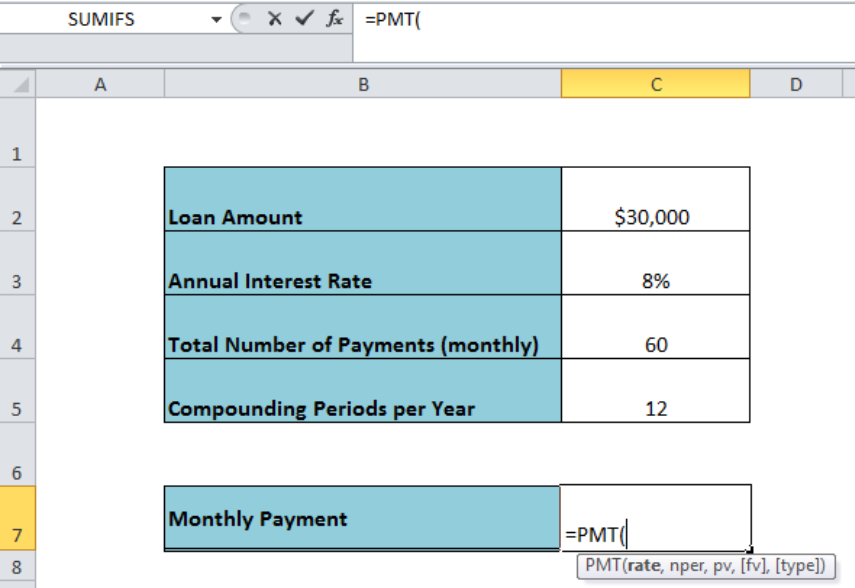
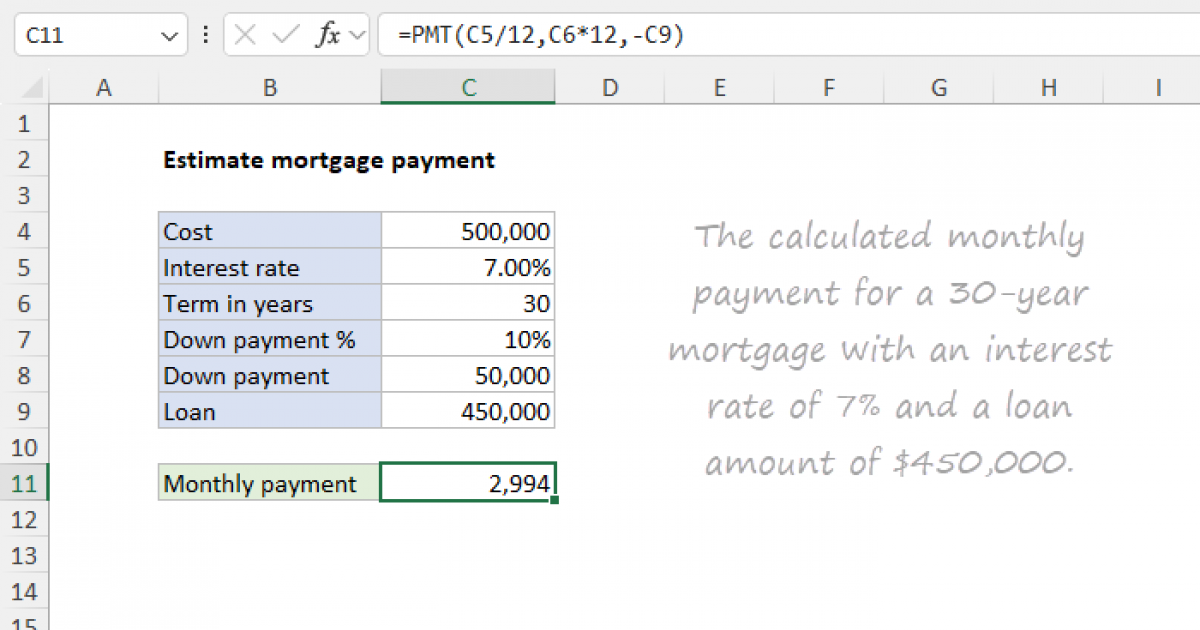
PMTfunction: These programs have a built-inPMTfunction that simplifies loan payment calculation:=PMT(rate, nper, pv, [fv], [type]).rate: The interest rate per period (i.e., monthly rate).nper: The total number of payments for the loan (i.e., total months).pv: The present value, or the total value of all loan payments now (i.e., the principal loan amount).fv(optional): The future value, or a cash balance you want to attain after the last payment is made (usually 0 for a loan).type(optional): When payments are due (0 for end of period, 1 for beginning of period).
- Custom Amortization Tables: With a spreadsheet, you can easily create a detailed amortization table, showing how much principal and interest are paid each month, and the remaining balance. This level of detail is excellent for understanding the loan’s progression.
Financial Calculators and Mobile Apps
Dedicated financial calculators (like the HP 12c or Texas Instruments BA II Plus) offer robust financial functions, including time value of money calculations, which are perfect for loan payments. Similarly, numerous mobile apps are available for smartphones and tablets that provide quick and easy loan calculations on the go. These are often handy for quick estimates when you’re away from a computer.
Why Mastering Loan Payment Calculation Matters
Beyond the academic exercise, truly understanding how loan payments are calculated holds significant practical value, impacting various aspects of your financial life.
Informed Financial Decision-Making
Knowing the mechanics behind your loan payments allows you to compare different loan offers accurately. You can discern whether a seemingly lower interest rate with a shorter term is truly better than a slightly higher rate with a longer term, based on your cash flow and total cost goals. This knowledge enables you to question lender proposals and seek out terms that best suit your financial capacity.
Budgeting and Financial Planning
Your monthly loan payments represent a fixed outgoing expense that directly impacts your budget. By calculating these payments yourself, you gain a clear picture of your financial obligations, helping you allocate funds, manage cash flow, and avoid overextending yourself. This clarity is vital for creating a realistic and sustainable personal or business budget.
Negotiating Better Loan Terms
When you understand the components of a loan payment, you are in a stronger position to negotiate. For instance, if you understand how a slight reduction in the interest rate or a modest increase in the down payment can dramatically reduce your total interest paid, you can use this knowledge to advocate for better terms with lenders. This insight transforms you from a passive borrower into an active participant in your financial future.
Avoiding Financial Pitfalls
Lack of understanding about loan payments can lead to unpleasant surprises, such as underestimating the total cost of a loan or misjudging your ability to make repayments. By actively calculating and analyzing loan scenarios, you can identify potential financial pitfalls before committing, thus safeguarding your financial stability and avoiding unnecessary stress or default risks.
In conclusion, the ability to calculate a loan payment is more than just a mathematical exercise; it’s a critical life skill for anyone navigating the world of personal or business finance. By understanding the formula, its variables, and the power of available tools, you empower yourself to make smarter borrowing decisions, plan more effectively, and ultimately achieve greater financial well-being. This knowledge transforms you from a mere borrower into an educated financial steward.
aViewFromTheCave is a participant in the Amazon Services LLC Associates Program, an affiliate advertising program designed to provide a means for sites to earn advertising fees by advertising and linking to Amazon.com. Amazon, the Amazon logo, AmazonSupply, and the AmazonSupply logo are trademarks of Amazon.com, Inc. or its affiliates. As an Amazon Associate we earn affiliate commissions from qualifying purchases.