
For many consumers, the car leasing process remains a mathematical enigma. While a traditional auto loan is relatively straightforward—principal plus interest divided by time—a lease is a more complex financial instrument. It is essentially a contract for the predicted depreciation of a vehicle over a specific period, plus the cost of financing and various fees.
Understanding how to calculate a car lease payment is not merely an academic exercise; it is a vital skill for personal financial management. When you walk into a dealership without knowing the underlying formula, you are at a significant disadvantage, forced to negotiate based on a monthly payment rather than the actual cost of the asset. To master your personal balance sheet, you must deconstruct the lease into its core components: the capitalized cost, the residual value, and the money factor.
Understanding the Core Components of a Lease Agreement
Before diving into the math, you must define the variables that dictate the final monthly output. A lease payment is composed of three main parts: the depreciation fee, the finance fee (rent charge), and sales tax. These are derived from several key figures found in a lease worksheet.
Gross Capitalized Cost
The “Cap Cost” is the equivalent of the vehicle’s sales price. It includes the agreed-upon price of the car, plus any extra items you choose to finance, such as extended warranties, service contracts, or prior loan balances (negative equity) rolled into the new deal. In the world of personal finance, the Cap Cost is the most important lever you can pull; a lower Cap Cost directly reduces the amount of depreciation you must pay for.
Capitalized Cost Reductions
This category includes anything that reduces the amount being financed. This could be a down payment (often called a “cap cost reduction” in leasing parlance), a trade-in allowance, or manufacturer rebates. While a large down payment lowers your monthly commitment, financial experts often advise against it in leasing. If the vehicle is totaled or stolen early in the lease term, that “cap reduction” money is typically lost, as insurance payouts go to the owner of the vehicle (the leasing company), not the lessee.
Residual Value
The residual value is the estimated value of the car at the end of the lease term. This figure is set by the lessor (the bank or the manufacturer’s captive finance arm) and is usually expressed as a percentage of the Manufacturer’s Suggested Retail Price (MSRP). Unlike the Cap Cost, the residual value is generally non-negotiable. From a financial perspective, a higher residual value is beneficial for the lessee because it means the car is expected to retain more of its value, resulting in a lower depreciation charge over the term.
The Money Factor
The money factor represents the interest rate on a lease. Instead of being expressed as an Annual Percentage Rate (APR), it is written as a small decimal, such as .00125. To convert the money factor into a recognizable APR, multiply it by 2400. For example, a money factor of .00125 multiplied by 2400 equals a 3% APR. Understanding this conversion is critical for comparing lease financing against traditional bank loans.
The Step-by-Step Formula for Lease Calculations
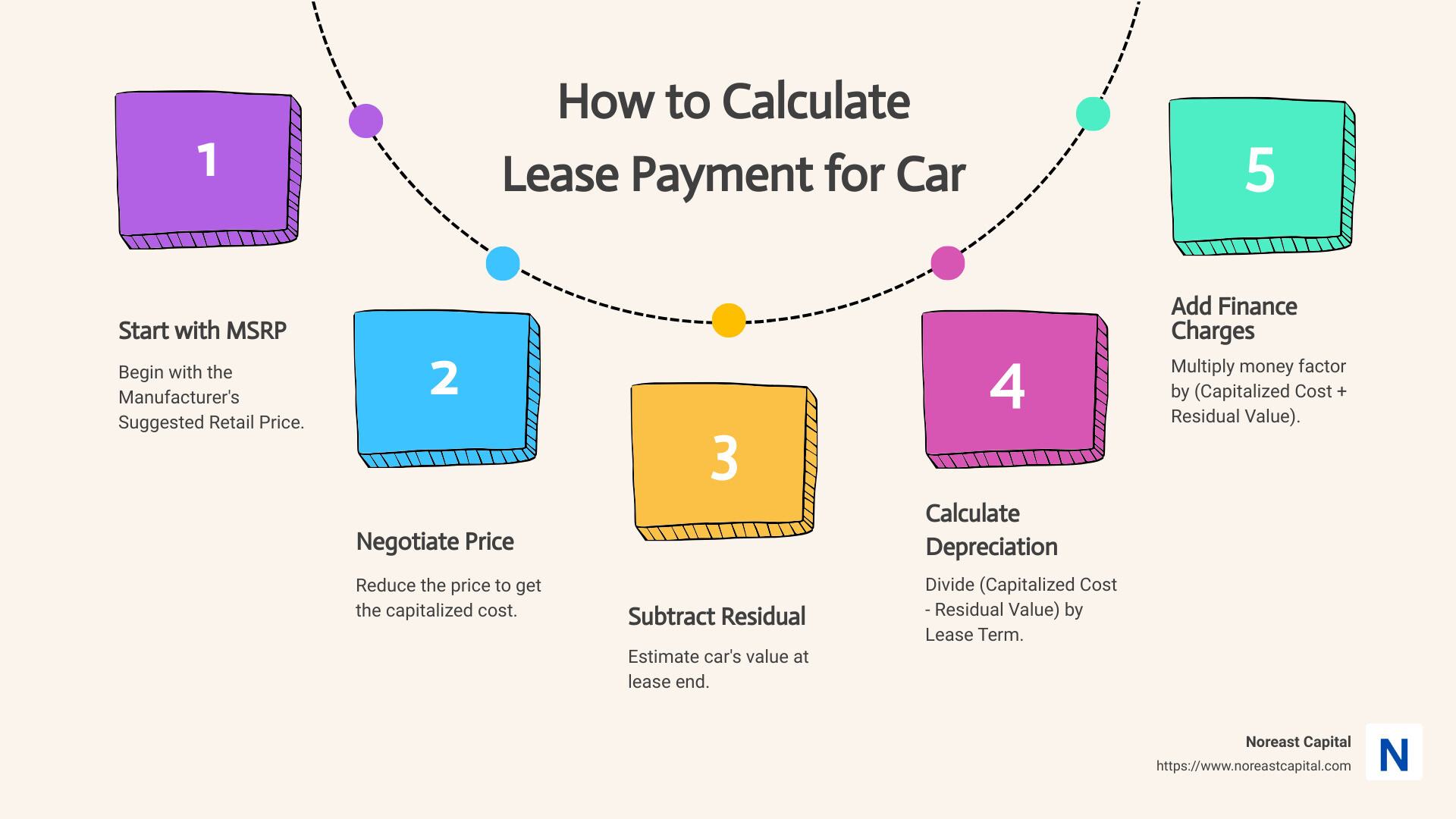
Calculating a lease payment requires a three-stage mathematical process. By separating the depreciation from the finance charges, you can see exactly where your money is going.
Step 1: Calculating Monthly Depreciation
The depreciation fee is the core of the lease. It covers the loss in value the vehicle experiences while you drive it. To calculate this, you first need the “Adjusted Capitalized Cost,” which is the Gross Cap Cost minus any Cap Cost Reductions.
The formula is:
(Adjusted Cap Cost – Residual Value) / Term in Months = Monthly Depreciation
For example, if you negotiate a car down to an adjusted cap cost of $35,000 and the residual value is $20,000 over a 36-month term:
($35,000 – $20,000) / 36 = $416.67 per month.
Step 2: Calculating the Monthly Rent Charge
The rent charge is the cost of borrowing the money used to purchase the vehicle from the manufacturer. Unlike a standard loan where interest is calculated on a declining balance, lease interest is calculated using a simplified formula that applies the money factor to the sum of the adjusted cap cost and the residual value.
The formula is:
(Adjusted Cap Cost + Residual Value) * Money Factor = Monthly Rent Charge
Using our previous example with a money factor of .0015 (3.6% APR):
($35,000 + $20,000) * .0015 = $82.50 per month.
It may seem counterintuitive to add the Cap Cost and Residual Value together, but this is a standard financial shortcut used in the leasing industry to approximate an average balance over the life of the lease.

Step 3: Factoring in Sales Tax
The final component is sales tax. In most states, you do not pay tax on the full value of the car; you only pay tax on the monthly lease payment. This makes leasing tax-efficient for many users.
The formula is:
(Monthly Depreciation + Monthly Rent Charge) * Local Sales Tax Rate = Monthly Tax
If your local tax rate is 8%:
($416.67 + $82.50) * 0.08 = $39.93 per month.
Total Monthly Payment: $416.67 + $82.50 + $39.93 = $539.10
Hidden Costs and Financial Variables to Consider
Beyond the base monthly payment, several ancillary costs can significantly impact the total financial commitment of a car lease. These fees are often buried in the fine print but should be integrated into your overall budget.
Acquisition and Disposition Fees
Almost every lease includes an acquisition fee (sometimes called an administrative fee or origination fee) charged by the leasing company to set up the account. This usually ranges from $500 to $900. On the back end, you will likely face a disposition fee—a charge to clean up and re-market the vehicle after you return it. These fees are part of the cost of “renting” the asset and should be factored into your effective monthly cost.
Gap Insurance
Because cars depreciate rapidly the moment they leave the lot, there is often a “gap” between what you owe on the lease and what the insurance company would pay if the car were totaled. Most modern leases include Gap Insurance automatically, but it is essential to verify this. Without it, a total loss could result in a significant out-of-pocket expense to settle the remaining balance with the lessor.
Mileage Overages and Excessive Wear-and-Tear
Lease contracts are built on the assumption of a specific mileage limit—typically 10,000, 12,000, or 15,000 miles per year. If you exceed this limit, you will be charged a per-mile fee (often $0.15 to $0.25) at the end of the term. From a financial strategy perspective, it is almost always cheaper to pay for a higher mileage limit upfront than to pay the overage penalties at the end. Similarly, “excessive” wear-and-tear is subjective. If the vehicle has significant scratches, dents, or worn tires, the lessor will bill you for the repairs upon return.
Strategies for Negotiating a Better Lease Payment
Once you understand the math, you can begin to manipulate the variables to your advantage. Negotiation is not about the monthly payment; it is about the components that create that payment.
Focusing on the Sale Price
The most common mistake consumers make is telling a dealer, “I want to pay $400 a month.” This allows the dealer to hide high interest rates or long terms to reach that number. Instead, negotiate the “Selling Price” or “Gross Cap Cost” just as you would if you were buying the car outright. Every thousand dollars off the sale price will lower your monthly payment significantly.
Researching High Residual Values
Since you only pay for the portion of the car you use, vehicles that hold their value well are often cheaper to lease than cheaper cars that depreciate quickly. For example, a $50,000 luxury SUV with a 65% residual may have a lower monthly payment than a $40,000 sedan with a 45% residual. Before shopping, look for vehicles with high “residual support” from the manufacturer’s finance arm.
Lowering the Money Factor (MSDs)
Some manufacturers allow “Multiple Security Deposits” (MSDs). This involves putting down several refundable security deposits at the start of the lease in exchange for a reduction in the money factor. Unlike a down payment (Cap Cost Reduction), which is lost if the car is totaled, MSDs are generally returned to you at the end of the lease. This is often an excellent use of cash, as the “return on investment” via interest savings can far exceed what you might earn in a standard savings account.
Lease vs. Buy: The Long-term Wealth Perspective
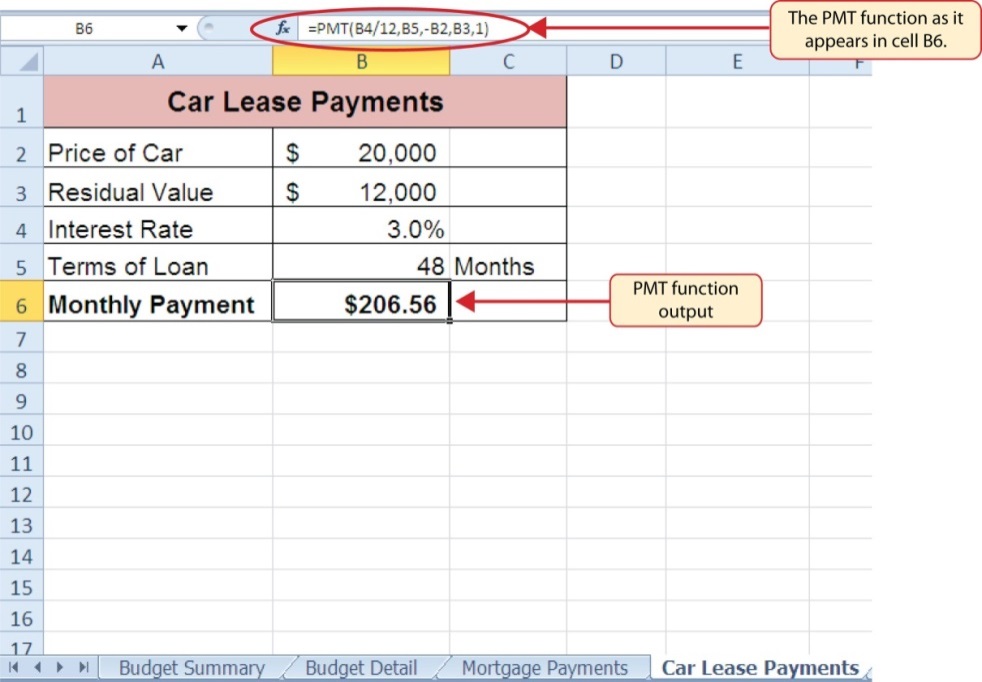
From a wealth-building standpoint, the decision to lease should be made with a clear understanding of opportunity cost. Leasing is essentially paying for the most expensive years of a vehicle’s life—the first three years, where depreciation is steepest.
However, for business owners or those who can deduct lease payments as a business expense, leasing can offer tax advantages that purchasing does not. Furthermore, leasing preserves liquidity. Instead of tying up $50,000 in a depreciating asset, a lease allows you to keep that capital in the market or in a business where it can generate a return that exceeds the money factor of the lease.
Ultimately, calculating a car lease payment is about transparency. When you can run the numbers yourself, you move from being a “payment buyer” to a “sophisticated borrower.” You gain the ability to spot marked-up interest rates, inflated fees, and unrealistic residual projections. In the landscape of personal finance, knowledge of the formula is your greatest tool for ensuring that your transportation costs remain an optimized line item rather than a financial burden.
aViewFromTheCave is a participant in the Amazon Services LLC Associates Program, an affiliate advertising program designed to provide a means for sites to earn advertising fees by advertising and linking to Amazon.com. Amazon, the Amazon logo, AmazonSupply, and the AmazonSupply logo are trademarks of Amazon.com, Inc. or its affiliates. As an Amazon Associate we earn affiliate commissions from qualifying purchases.