
Understanding how to calculate percentage increases is a fundamental skill in personal and business finance. Whether you’re tracking investment growth, adjusting budgets for inflation, or evaluating a salary raise, accurately determining a 3 percent increase can provide crucial insights into your financial landscape. This seemingly simple calculation underpins a wide array of financial decisions, helping individuals and businesses plan for the future, assess performance, and manage resources effectively.
Understanding the Fundamentals of Percentage Increases
Before diving into the mechanics of calculation, it’s essential to grasp what a percentage represents and why this specific type of calculation holds such significance in financial contexts. A solid foundation ensures not only accurate computation but also a deeper understanding of its implications.

What is a Percentage?
A percentage, denoted by the symbol “%”, is a way of expressing a number as a fraction of 100. For example, 3 percent means 3 out of every 100 parts, or 3/100. This standardized way of comparing quantities makes it easy to understand proportions and changes, regardless of the original scale of the numbers involved. When we talk about a “3 percent increase,” we’re referring to an addition that amounts to three hundredths of the original value.
Why Calculate Increases? Common Scenarios
The need to calculate increases arises in countless financial situations. For individuals, understanding a 3 percent increase might be vital when:
- Evaluating a Salary Raise: A common scenario where an employee receives a 3% raise on their current salary.
- Budgeting for Inflation: Prices of goods and services typically increase over time due to inflation. Knowing how to factor in a 3% increase helps in anticipating future costs.
- Assessing Investment Growth: If an investment portfolio grows by 3%, calculating the new value helps track wealth accumulation.
- Loan Interest Accrual: While often viewed negatively, understanding how a 3% interest rate (or an increase in it) affects a loan balance is crucial for debt management.
For businesses, this calculation is equally critical for:
- Pricing Strategies: Adjusting product prices by a small percentage, such as 3%, to account for increased production costs or market changes.
- Sales Forecasting: Projecting future revenue based on anticipated sales growth.
- Expense Management: Anticipating increases in operational costs like rent, utilities, or raw materials.
- Employee Compensation: Planning for annual pay raises or bonus structures.
In every instance, the ability to quickly and accurately calculate a 3 percent increase empowers better financial decision-making and planning.
The Core Method: Step-by-Step Calculation
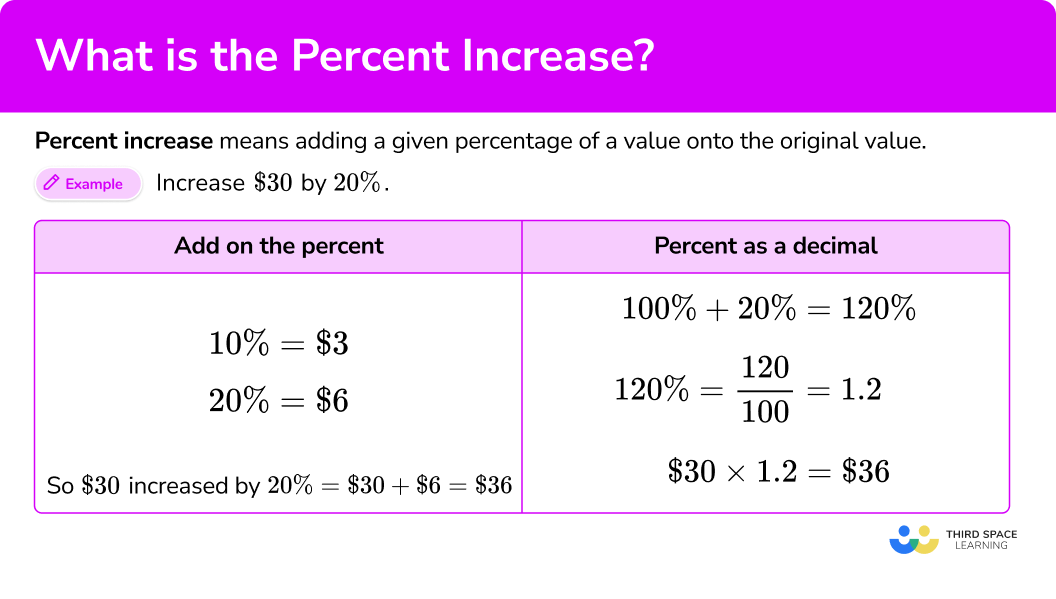
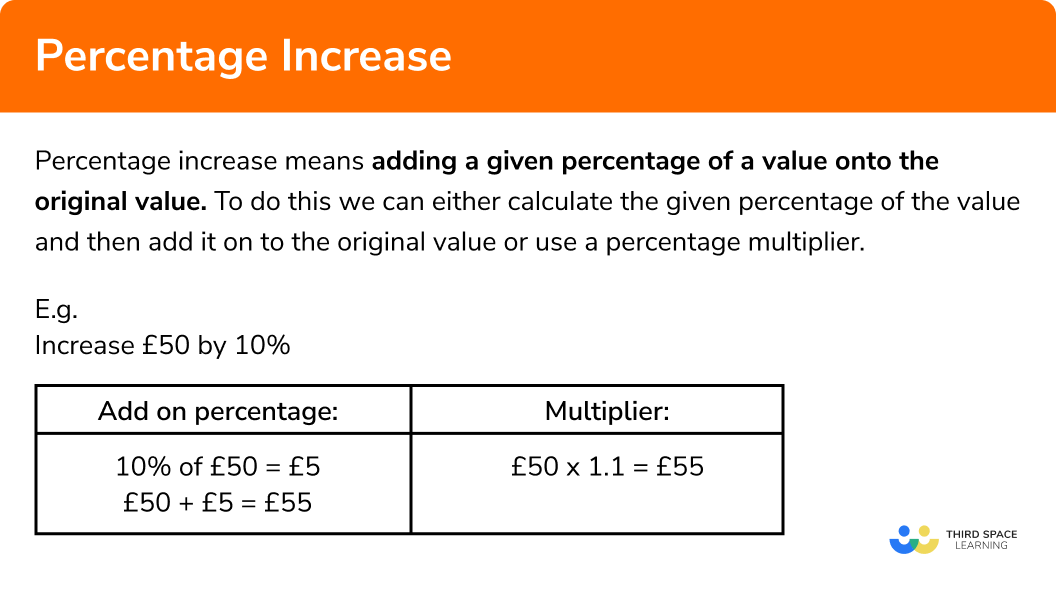
Calculating a 3 percent increase is a straightforward process that can be broken down into a few simple steps. There are primarily two methods: a three-step approach that builds understanding, and a quicker, more direct method.
Let’s use an example: Suppose you have an original value of $500, and you want to calculate a 3 percent increase.
Step 1: Convert the Percentage to a Decimal
The first step in any percentage calculation is to convert the percentage into a decimal. To do this, you divide the percentage by 100.
- 3% ÷ 100 = 0.03
This decimal represents the fractional part of the original value that will be added.
Step 2: Multiply the Original Value by the Decimal
Next, multiply your original value by the decimal you just calculated. This will give you the exact amount of the increase.
- $500 (original value) × 0.03 (decimal equivalent of 3%) = $15 (the increase amount)
So, a 3 percent increase on $500 amounts to $15.
Step 3: Add the Increase to the Original Value
Finally, to find the new value after the increase, add the increase amount back to the original value.
- $500 (original value) + $15 (increase amount) = $515 (new value)
Therefore, $500 increased by 3 percent is $515.
A Quicker Method: The Direct Multiplier
For those who prefer a more streamlined approach, you can combine the steps into a single multiplication. When you want to find an amount after an increase, you’re essentially calculating 100% of the original value plus the percentage increase (e.g., 100% + 3% = 103%).
- Convert 103% to a decimal: 103 ÷ 100 = 1.03
- Multiply the original value by this direct multiplier: $500 × 1.03 = $515
This method directly yields the new value, saving a step and often proving more efficient for quick calculations or when using spreadsheets. Both methods produce the same correct result; choose the one that feels most intuitive to you.
Practical Applications in Personal Finance
Understanding how to calculate a 3 percent increase is more than just a mathematical exercise; it’s a vital tool for managing and growing your personal finances. This skill helps in budgeting, wealth building, and making informed decisions about income and expenses.
Salary Raises and Wage Adjustments
One of the most common applications is in understanding salary increases. If your current annual salary is $60,000 and you receive a 3% raise:
- Increase amount: $60,000 × 0.03 = $1,800
- New annual salary: $60,000 + $1,800 = $61,800
This calculation helps you anticipate your new take-home pay, adjust your budget, and understand the real impact of the raise on your financial health. Similarly, if you work hourly, a 3% increase on your $20/hour wage would result in a new wage of $20 × 1.03 = $20.60 per hour.
Budgeting for Inflation and Cost Increases
Inflation erodes purchasing power over time, meaning that the same amount of money buys less in the future. If the average inflation rate is projected to be 3%, you need to consider this when budgeting for future expenses. For example, if your current monthly grocery bill is $700, and you anticipate a 3% increase due to inflation:
- Increase: $700 × 0.03 = $21
- Anticipated new grocery bill: $700 + $21 = $721
Factoring in such increases helps maintain realistic budgets and avoid being caught off guard by rising costs. This applies to everything from rent to utility bills and transportation costs.
Investment Growth and Returns
For investors, understanding percentage increases is crucial for tracking portfolio performance. If you have an investment valued at $10,000 that yields a 3% return over a period:
- Profit: $10,000 × 0.03 = $300
- New investment value: $10,000 + $300 = $10,300
This calculation allows you to monitor your wealth accumulation and assess the effectiveness of your investment strategies. It also applies to calculating interest earned on savings accounts or certificates of deposit (CDs).
Debt Accrual and Interest Rates
While usually unwelcome, understanding how a 3% interest rate impacts debt is critical for financial planning. If you have a credit card balance of $2,000 and a monthly interest rate of 3% (uncommon but illustrative):
- Monthly interest: $2,000 × 0.03 = $60
- New balance (before payments): $2,000 + $60 = $2,060
This highlights how quickly debt can grow and underscores the importance of managing high-interest liabilities. For larger loans with annual interest rates, the calculation would be similar, though often compounded over time.
Business Finance Perspectives
In the realm of business, the ability to calculate a 3 percent increase is indispensable for strategic planning, operational efficiency, and profitability. It influences decisions across pricing, sales, and expense management.
Pricing Adjustments and Profit Margins
Businesses frequently adjust prices to cover rising costs, respond to market dynamics, or optimize profit margins. If a product currently sells for $150 and the company decides on a 3% price increase:
- Price increase: $150 × 0.03 = $4.50
- New selling price: $150 + $4.50 = $154.50
This ensures that the business maintains desired profit levels even as input costs or operational expenses fluctuate. Understanding the impact of small percentage changes on pricing is key to competitive positioning and revenue generation.
Sales Growth and Revenue Projections
Projecting future sales and revenue is a critical aspect of business planning. If a company’s sales last quarter were $500,000 and they anticipate a 3% growth for the next quarter:
- Projected growth: $500,000 × 0.03 = $15,000
- Projected sales for next quarter: $500,000 + $15,000 = $515,000
Accurate sales projections help businesses allocate resources, set production targets, and make informed decisions about marketing and expansion strategies.
Expense Management and Budgeting
Managing expenses is vital for a business’s financial health. If a company’s monthly utility bill is typically $1,200 and they are notified of a 3% rate increase:
- Increase amount: $1,200 × 0.03 = $36
- New anticipated bill: $1,200 + $36 = $1,236
Factoring in such increases helps businesses maintain accurate budgets, identify areas for cost control, and forecast cash flow more precisely. This proactive approach prevents unexpected budget shortfalls and supports fiscal responsibility.
Tools and Tips for Accuracy
While the calculation of a 3 percent increase is straightforward, ensuring accuracy and understanding the context are paramount for effective financial management.
Using Calculators and Spreadsheets
For everyday calculations, a basic calculator is perfectly adequate. Most smartphones also come equipped with a calculator app. For more complex scenarios, or when dealing with multiple calculations, spreadsheet software like Microsoft Excel or Google Sheets becomes an invaluable tool.
- Calculator: Simply input the original number, then multiply by 1.03 (for the direct method) or multiply by 0.03 and add the result to the original number.
- Spreadsheets: Spreadsheets allow you to set up formulas (e.g.,
=A1*1.03where A1 contains the original value) that automatically update if the original value changes. This is especially useful for budgeting, financial modeling, and tracking multiple line items with percentage increases. Spreadsheets also reduce the risk of manual errors and provide a clear audit trail for your calculations.
Double-Checking Your Work
Even with simple calculations, it’s always wise to double-check your work, especially when significant financial decisions hinge on the outcome. One way to quickly verify is to estimate. If you’re increasing $100 by 3%, you know it should be a small amount. $3 is reasonable. If your calculation yielded $30, you’d know something was wrong. Another method is to reverse the calculation: if you increased $500 to $515, what percentage increase was that? Divide the increase ($15) by the original amount ($500) to get 0.03, confirming your 3% increase.
Understanding Contextual Nuances
While the mathematical process is standard, the practical interpretation of a 3 percent increase can vary based on the context.
- Compounding: Be aware if the increase is a one-time event or if it compounds over multiple periods (e.g., interest on investments or loans). A 3% increase compounded annually for several years will result in a significantly larger total increase than a simple 3% increase each year on the original principal.
- “Of” vs. “To”: Understand if the language is “an increase of 3 percent” (which means adding 3% of the original amount) or “increased to 3 percent” (which implies the new value is 3% of the original, a massive decrease if the original was 100%). The former is almost always the intended meaning in these financial contexts.
- Rounding: When dealing with currency, remember to round to two decimal places (cents). Spreadsheets typically handle this, but manual calculations require attention to rounding rules.
Mastering the calculation of a 3 percent increase is a foundational element of financial literacy. By understanding the methods and their practical applications, individuals and businesses can make more informed decisions, manage their money more effectively, and plan for a more secure financial future.
aViewFromTheCave is a participant in the Amazon Services LLC Associates Program, an affiliate advertising program designed to provide a means for sites to earn advertising fees by advertising and linking to Amazon.com. Amazon, the Amazon logo, AmazonSupply, and the AmazonSupply logo are trademarks of Amazon.com, Inc. or its affiliates. As an Amazon Associate we earn affiliate commissions from qualifying purchases.