
In the intricate dance of personal finance, understanding how to effectively manage your money is paramount. While budgeting, investing, and saving often take center stage, the seemingly simple act of calculating a discount plays a crucial, often underestimated, role in optimizing your financial well-being. A 20 percent discount, in particular, is a common and attractive offer that, when properly understood and utilized, can lead to significant savings over time. This guide delves into the practical methods of calculating a 20 percent discount, exploring its broader implications for smart shopping, budgeting, and overall financial literacy.

Beyond merely finding a lower price, mastering discount calculations empowers consumers to make informed decisions, distinguish genuine value from marketing ploys, and strategically allocate their hard-earned money. Whether you’re eyeing a new gadget, stocking up on groceries, or planning a major purchase, the ability to quickly and accurately determine the final cost after a 20 percent reduction is an invaluable skill for any financially savvy individual.
The Core Concept: Understanding Discounts in Personal Finance
Discounts are more than just temporary price reductions; they are fundamental tools in the arsenal of both retailers and consumers. For businesses, they drive sales, clear inventory, and attract new customers. For individuals, they represent direct opportunities to save money, stretch budgets further, and achieve financial goals more efficiently.
What is a Discount and Why Does it Matter?
At its simplest, a discount is a deduction from the usual cost of something. It’s a reduction in price, often expressed as a percentage or a fixed monetary amount. The “why” it matters is multifaceted. Firstly, from a personal finance perspective, a discount directly translates into savings. Every dollar saved on a purchase is a dollar that can be allocated elsewhere – towards an emergency fund, investment, debt repayment, or another desired purchase.
Secondly, understanding discounts is critical for effective budgeting. When you factor in potential savings from discounts, you can adjust your spending plans, potentially affording higher-quality items or freeing up funds for other categories. It moves you from being a passive recipient of pricing to an active participant in managing your expenses. Moreover, for those focused on accumulating wealth, smart discount utilization is a cornerstone of frugal living, ensuring that every purchase is made with an eye toward maximizing value.
The Psychology of a Good Deal
The allure of a discount is deeply rooted in consumer psychology. A 20 percent off sticker doesn’t just reduce a price; it signals an opportunity, a “good deal” that triggers a sense of urgency and perceived value. Retailers strategically use percentages like 20% because they are significant enough to be enticing but often still leave a healthy profit margin. Consumers, in turn, feel a sense of accomplishment when they believe they’ve snagged a bargain.
However, this psychological pull can also be a double-edged sword. The excitement of a discount can sometimes override rational decision-making, leading to impulse purchases of items that aren’t truly needed or desired. An insightful approach to discounts involves leveraging this psychological benefit while maintaining financial discipline, ensuring that “a good deal” truly aligns with your financial goals and needs. The 20 percent mark is often seen as a sweet spot – substantial enough to feel worthwhile, yet not so deep as to raise suspicions about the product’s quality or desirability.
Beyond 20%: Common Discount Percentages
While our focus is on 20 percent, it’s helpful to understand where this percentage fits within the broader landscape of discounts. Other common percentages include:
-
10%: A modest discount, often used for introductory offers, loyalty programs, or small promotions. It’s easily calculable and still feels like a benefit.
-
25%: A more significant saving, frequently seen in seasonal sales or for specific product categories.
-
30-40%: Often indicates a more aggressive sale, perhaps to clear inventory or during major holiday events.
-
50% (Half Price): A highly attractive discount, signaling a substantial saving. This is often used for clearance items, end-of-season sales, or loss leaders to draw customers.
-
70% or More: Typically reserved for deep clearance, older models, or highly overstocked items.
Each percentage carries its own weight and marketing implications. Understanding the context of different discount levels helps you evaluate the true value proposition and make smarter financial choices. A 20 percent discount, while not the highest, is a frequent and substantial enough saving to significantly impact your budget, especially on higher-priced items.
Mastering the Calculation Methods for 20% Off
Calculating a 20 percent discount is straightforward, but knowing different methods can help you quickly determine the final price, whether you’re at the cash register, shopping online, or just planning your budget. We’ll explore two primary methods and a useful mental math shortcut.
Method 1: The Subtraction Method
This is perhaps the most intuitive method for many, as it breaks the calculation into two distinct steps.
Step-by-step:
-
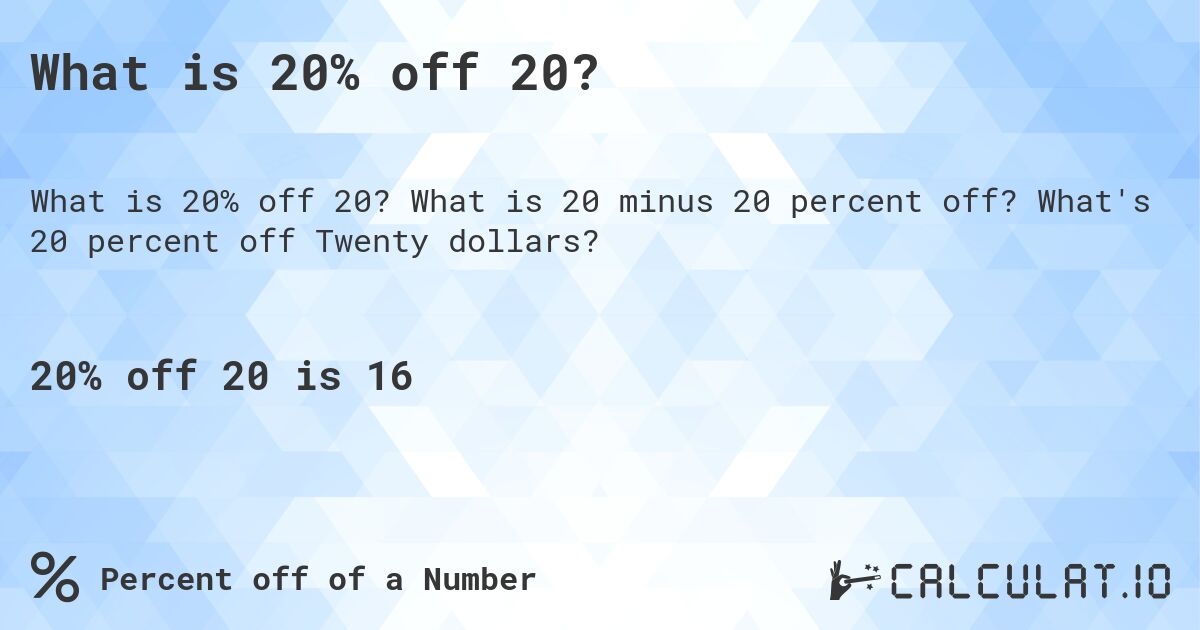
Calculate the Discount Amount: Convert the percentage into a decimal by dividing it by 100. So, 20% becomes 0.20. Then, multiply the original price by this decimal.
-
Discount Amount = Original Price × 0.20
-
Example: For an item costing $150, the discount amount is $150 × 0.20 = $30.
-
-
Subtract the Discount from the Original Price: Once you have the discount amount, simply subtract it from the initial price to find the final cost.
-
Final Price = Original Price – Discount Amount
-
Example: Using the $150 item, the final price is $150 – $30 = $120.
-
This method is easy to follow and particularly useful when you want to know exactly how much you are saving in dollar terms.
Method 2: The Multiplier Method
The multiplier method is often quicker, as it calculates the final price directly in one step. It’s based on the idea that if you’re taking 20% off, you’re essentially paying for 80% of the original price.
Step-by-step:
-
Determine the Remaining Percentage: Subtract the discount percentage from 100%.
- Remaining Percentage = 100% – 20% = 80%
-
Convert to a Decimal and Multiply: Convert this remaining percentage into a decimal (80% becomes 0.80). Then, multiply the original price by this decimal.
-
Final Price = Original Price × 0.80
-
Example: For an item costing $150, the final price is $150 × 0.80 = $120.
-
This method is efficient and ideal when you’re primarily interested in the final cost and want to minimize steps.
Method 3: Mental Math Shortcuts for 20%
For quick estimations and everyday shopping, mental math can be a powerful tool.
The “Find 10% and Double” Rule:
-
Find 10%: To find 10% of any number, simply move the decimal point one place to the left.
-
Example: 10% of $150 is $15.00 (or $15).
-
Example: 10% of $75 is $7.50.
-
Example: 10% of $23 is $2.30.
-
-
Double It: Since 20% is double 10%, simply double the amount you found in step 1 to get the 20% discount.
-
Example: Doubling $15 gives you $30 (the 20% discount for $150).
-
Example: Doubling $7.50 gives you $15 (the 20% discount for $75).
-
Example: Doubling $2.30 gives you $4.60 (the 20% discount for $23).
-
-
Subtract (Mentally): Subtract this doubled amount from the original price.
- Example: $150 – $30 = $120.
This shortcut is incredibly useful for on-the-spot calculations, helping you quickly assess the true cost without needing a calculator.
Practical Applications: Leveraging Discounts for Financial Wellness
Knowing how to calculate a 20 percent discount is just the first step. The real financial benefit comes from strategically applying this knowledge to your spending habits and major purchases.
Budgeting and Smart Shopping
Integrating discount calculations into your budgeting process can significantly enhance your financial planning. When creating a budget, anticipate potential savings from sales and allocate funds accordingly. Rather than merely setting aside $200 for clothing, for instance, a savvy shopper might budget $250 but aim to spend only $200 after utilizing discounts, effectively saving $50.
Smart shopping goes beyond just looking for a “sale” sticker. It involves:
-
Planning Ahead: Waiting for items to go on sale, especially for non-urgent purchases.
-
Comparing Prices: Even with a 20% discount, an item might be cheaper elsewhere at its full price.
-
Avoiding Impulse Buys: Just because something is discounted doesn’t mean it’s a wise purchase if it wasn’t on your original list of needs.
A 20 percent discount can make a substantial difference, particularly when combined with thoughtful purchasing decisions, reinforcing the habit of value-driven spending.
Discounts in Major Purchases
For larger investments like appliances, electronics, furniture, or even certain vehicle components, a 20 percent discount translates into hundreds, if not thousands, of dollars saved. This is where mastering the calculation methods truly pays off.
-
Appliances: A refrigerator costing $1,500 with a 20% discount saves you $300.
-
Electronics: A laptop priced at $1,200 with a 20% off promotion means a $240 saving.
These savings can then be reinvested, added to your emergency fund, or used to offset other necessary expenses, demonstrating the significant impact of percentage-based savings on substantial expenditures.
Understanding Sale Events
Major sale events like Black Friday, Cyber Monday, seasonal clearances, and anniversary sales are prime opportunities to leverage discounts. Retailers often offer 20% off sitewide or across specific categories during these times. Understanding how to quickly calculate this discount allows you to:
-
Prioritize Purchases: Focus on items where the 20% off makes the biggest difference.
-
Stay Within Budget: Rapidly determine the final cost to ensure it aligns with your allocated spending.
-
Avoid Panic Buying: Resist the pressure of limited-time offers by knowing exactly what the savings are and if they’re truly valuable.
Stackable Discounts and Coupon Strategies
The true art of maximizing savings often lies in combining multiple discounts. A 20 percent off coupon might be stackable with a store-wide 10 percent sale, or a manufacturer’s rebate. While calculations become slightly more complex (usually applied sequentially, not cumulatively as 30%), the financial rewards can be substantial.
-
Example: An item is $100. There’s a 10% store-wide sale, and you have a 20% off coupon.
-
First discount: $100 – (100 * 0.10) = $90.
-
Second discount: $90 – (90 * 0.20) = $72.
The total saving isn’t 30%, but rather $28, which is still excellent.
-
Learning to identify and utilize stackable discounts, along with loyalty points and cash-back offers, transforms shopping into a strategic financial endeavor.
When 20% Isn’t Enough: Deeper Dive into Value and Pricing
While a 20 percent discount is appealing, a truly financially literate individual looks beyond the percentage to assess genuine value. Not every discount is created equal, and some seemingly good deals can still lead to poor financial outcomes.
Is a Discount Always a Good Deal?
Crucially, a discount only represents a good deal if the original price was fair, the item is genuinely needed, and it offers lasting value. Retailers sometimes inflate “original” prices only to “discount” them, making the final price comparable to what it might be elsewhere at full cost.
Questions to ask yourself:
-
Do I genuinely need this item, or am I buying it just because it’s on sale?
-
Is the “original price” authentic, or is it an artificial markdown? (Check price history with online tools).
-
Does the quality of the discounted item justify even the reduced price?
A 20 percent reduction on an item you don’t need, or on a product of poor quality, still represents 80 percent of your money spent unwisely.
Unit Pricing and Comparative Shopping
Beyond the percentage, focus on unit pricing, especially for groceries and household goods. A large package with a 20% discount might still be more expensive per unit than a smaller, undiscounted package from a different brand or store. Comparative shopping across different retailers, both online and brick-and-mortar, is essential to ensure that even a discounted price is the best available. Use online tools and apps that compare prices across various stores to get the most accurate picture.
The Role of Loyalty Programs and Cash Back
Discounts aren’t the only way to save. Loyalty programs, credit card cash-back rewards, and gift card promotions can effectively function as additional discounts or future savings. Combining a 20 percent direct discount with 5% cash back on your credit card amplifies your savings, turning a $100 item into an effective $76 purchase after the discount and cash back. These are indirect financial tools that savvy consumers integrate into their overall savings strategy.
Avoiding Discount Traps
Beware of common discount traps:
-
“Limited Time Only” Pressure: Don’t let urgency push you into a purchase you’ll regret.
-
Excessive Inventory: Buying multiples of an item just because it’s 20% off, even if you won’t use them all before they expire or become obsolete.
-
Poor Quality: Discounts are often used to clear out items that aren’t selling due to quality issues. A cheap price isn’t a bargain if the item breaks immediately.
-
Minimum Spend Requirements: Sometimes a 20% off coupon requires a minimum spend that forces you to buy more than you intended. Calculate if the additional items make financial sense.
Financial Tools and Technology to Aid Your Savings
In the digital age, numerous tools can assist you in finding, calculating, and tracking discounts, further enhancing your financial acumen.
Smartphone Apps for Discount Tracking
-
Coupon Apps: Apps like Coupons.com or RetailMeNot aggregate digital coupons and deals, often including percentage-based discounts.
-
Price Comparison Apps: Tools like ShopSavvy or Google Shopping allow you to scan barcodes or search for products to compare prices across different retailers, helping you verify if a 20% discount is truly the best offer.
-
Store-Specific Apps: Many major retailers have their own apps that offer exclusive discounts, loyalty rewards, and early access to sales.
Browser Extensions for Automatic Savings
Browser extensions can automatically find and apply coupon codes at checkout or notify you of price drops.
-
Honey: Scans for and applies coupon codes automatically, sometimes revealing a 20% or higher discount you might have missed.
-
Rakuten (formerly Ebates): Offers cash back on purchases made through its portal, effectively reducing the final cost of an item even after a direct discount.
Budgeting Software and Spreadsheets
Finally, integrating your discount savings into your overall financial tracking is essential.
-
Budgeting Apps (e.g., Mint, YNAB): Allow you to categorize spending and see the impact of your discounted purchases on your overall budget.
-
Personal Spreadsheets: Creating your own spreadsheet lets you meticulously track how much you saved through discounts, providing a tangible measure of your financial success.
These tools, combined with a solid understanding of discount calculation, empower you to manage your money more effectively, transforming every 20 percent off opportunity into a step towards greater financial wellness.

Conclusion
The ability to calculate a 20 percent discount is far more than a simple mathematical exercise; it’s a fundamental skill in the realm of personal finance. By understanding the core concepts of discounts, mastering various calculation methods, and strategically applying this knowledge to your shopping habits, you gain greater control over your spending and accelerate your journey toward financial well-being.
From making smart daily purchases to planning major investments, leveraging discounts effectively empowers you to stretch your budget, make informed decisions, and avoid common spending traps. Coupled with the intelligent use of financial tools and a mindful approach to value, the seemingly small act of calculating a 20 percent discount becomes a powerful component of a comprehensive and successful financial strategy. Embrace this skill, and watch your savings grow, one smart purchase at a time.
aViewFromTheCave is a participant in the Amazon Services LLC Associates Program, an affiliate advertising program designed to provide a means for sites to earn advertising fees by advertising and linking to Amazon.com. Amazon, the Amazon logo, AmazonSupply, and the AmazonSupply logo are trademarks of Amazon.com, Inc. or its affiliates. As an Amazon Associate we earn affiliate commissions from qualifying purchases.