
In the realm of personal finance and investing, the Vanguard S&P 500 ETF (VOO) frequently emerges as a cornerstone holding for both novice and seasoned investors alike. Representing a slice of 500 of the largest U.S. companies, VOO offers broad market exposure, diversification, and a historically strong performance track record, all wrapped in a low-cost package characteristic of Vanguard funds. For many, investing in VOO is a direct pathway to participating in the growth of the American economy without the complexities of individual stock picking. This guide will demystify the process, providing a comprehensive, step-by-step approach to purchasing VOO and integrating it into a robust financial strategy.
Understanding VOO: The Vanguard S&P 500 ETF
Before embarking on any investment journey, a fundamental understanding of the asset in question is paramount. VOO is not merely a ticker symbol; it’s a strategically constructed financial instrument designed to provide investors with a simple, effective way to tap into the broad U.S. stock market.
What is VOO?
VOO is an Exchange Traded Fund (ETF) managed by Vanguard, one of the world’s largest investment companies. Its primary objective is to track the performance of the S&P 500 Index, which comprises 500 of the largest publicly traded companies in the United States, selected by S&P Dow Jones Indices based on criteria like market size, liquidity, and sector representation. When you buy a share of VOO, you are effectively buying a tiny proportional ownership stake in all 500 of these companies. This passive indexing strategy means that VOO doesn’t try to outperform the market; rather, it aims to replicate its returns by holding the same securities in the same proportions as the index it tracks. This approach minimizes management fees and often results in superior long-term performance compared to many actively managed funds.
Why Consider VOO for Your Portfolio?
The appeal of VOO is multifaceted, drawing investors seeking simplicity, efficiency, and robust market exposure. Its advantages often position it as an ideal foundation for a diversified investment portfolio.
Firstly, diversification is a key benefit. By investing in VOO, you automatically gain exposure to 500 companies across various sectors—from technology and finance to healthcare and consumer goods. This inherent diversification significantly reduces the idiosyncratic risk associated with investing in individual stocks. A downturn in one company or sector is less likely to severely impact your overall portfolio when spread across hundreds of others.
Secondly, VOO is celebrated for its low cost. Vanguard is renowned for its commitment to low expense ratios, and VOO is no exception. Its expense ratio is exceptionally low, meaning a minimal portion of your investment is eaten away by management fees each year. Over decades, these seemingly small differences in fees can translate into substantial differences in total returns due to the power of compounding.
Thirdly, the market performance of the S&P 500 has historically been strong over the long term, despite periodic corrections and bear markets. By investing in VOO, you are betting on the continued innovation, productivity, and growth of America’s leading companies. This long-term upward trend provides a compelling rationale for holding VOO as a core equity component in a growth-oriented portfolio.
Finally, VOO offers remarkable simplicity and accessibility. Unlike mutual funds which often trade only once a day after market close, VOO, as an ETF, trades like a stock throughout the day. This allows for real-time pricing and greater flexibility in buying and selling. For investors seeking a “set it and forget it” approach to broad market exposure, VOO is an elegant solution that requires minimal ongoing management.
The Essential Steps to Purchasing VOO
Acquiring shares of VOO is a straightforward process, but it requires navigating a few critical steps. From selecting the right platform to executing your order, each stage is crucial for a smooth and efficient investment experience.
Choosing the Right Brokerage Account
The first and most critical step is to open a brokerage account. This account will serve as your gateway to the stock market, allowing you to buy and sell ETFs, stocks, mutual funds, and other investment vehicles. The choice of brokerage can significantly impact your investing experience, so it’s vital to select one that aligns with your financial goals and preferences.
Consider reputable online brokers such as Charles Schwab, Fidelity, Vanguard (naturally, as VOO is their product), E*TRADE, or Robinhood. When choosing, evaluate factors like:
- Fees and Commissions: Many brokers now offer commission-free trading for ETFs and stocks, which is ideal for cost-conscious investors. However, be aware of other potential fees like inactivity fees, account maintenance fees, or fees for specific services.
- Platform Usability: Look for a platform with an intuitive interface, whether you prefer desktop or mobile trading. Ease of navigation and clear presentation of information are crucial, especially for beginners.
- Research Tools and Educational Resources: A good broker will provide access to robust research tools, market data, and educational content to help you make informed decisions.
- Customer Service: Responsive and knowledgeable customer support can be invaluable, especially when you encounter questions or issues.
- Account Types: Decide whether you need a taxable brokerage account (for general investment and liquidity) or a tax-advantaged retirement account like an Individual Retirement Account (IRA – Traditional or Roth) or a 401(k) if your employer plan allows for external ETF purchases or has a brokerage window. For most long-term investors aiming for retirement, a Roth IRA or Traditional IRA is an excellent choice for VOO, offering significant tax benefits.
Once you’ve selected a broker, the account opening process typically involves providing personal information (name, address, Social Security number), employment details, and financial information to verify your identity and suitability for investing.
Funding Your Brokerage Account
After your account is approved, the next step is to deposit funds into it. This is the capital you will use to purchase VOO shares. Brokers offer several common methods for funding your account:
- ACH Transfer (Electronic Funds Transfer): This is the most common and often free method, allowing you to link your bank account to your brokerage account. Funds typically take 1-3 business days to clear and become available for trading.
- Wire Transfer: Wires are faster, often available the same day, but usually incur a fee from your bank.
- Check Deposit: You can mail a personal check, but this is the slowest method.
- Rollover from Another Retirement Account: If you’re funding an IRA, you might be rolling over funds from an old 401(k) or another IRA.
Ensure you deposit enough funds to cover the number of VOO shares you intend to buy, plus any potential fractional share minimums or trading fees (though VOO is typically commission-free).
Navigating the Trading Platform and Executing Your VOO Purchase
With funds in your account, you are ready to make your purchase. Log in to your brokerage platform and locate the trading interface.
-
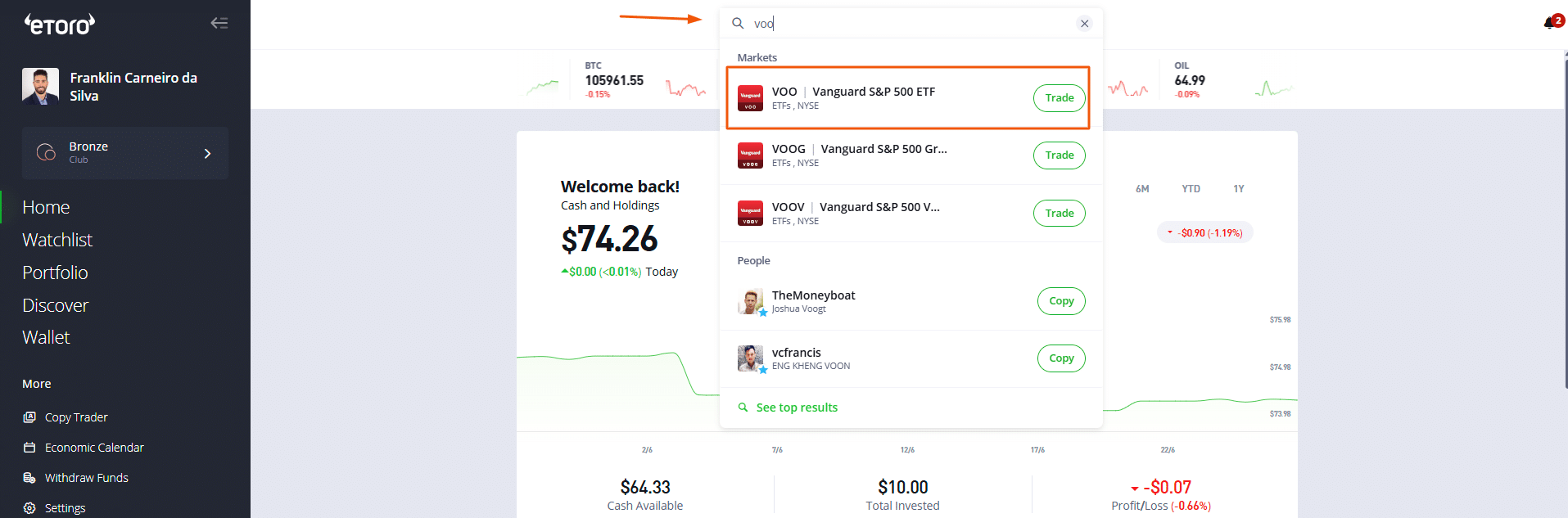
Search for VOO: In the search bar or “Trade” section, type in the ticker symbol “VOO” and select it from the search results. You will typically see current market data, including the bid (highest price buyers are willing to pay), ask (lowest price sellers are willing to accept), and the last traded price.
-
Enter Order Details:
- Action: Select “Buy.”
- Quantity: Specify the number of shares you wish to purchase. Note that the price of VOO fluctuates throughout the day, so ensure you have sufficient funds. Some brokers offer “fractional shares,” allowing you to invest a specific dollar amount (e.g., $100) instead of a specific number of shares, which can be beneficial for smaller investments.
- Order Type: This is a crucial decision:
- Market Order: This instructs the broker to buy VOO immediately at the best available current market price. While simple, the exact price you pay might differ slightly from the last quoted price, especially in volatile markets. This is generally acceptable for highly liquid ETFs like VOO.
- Limit Order: This allows you to set a maximum price you’re willing to pay per share. Your order will only execute if VOO trades at or below your specified limit price. Limit orders offer more control over the price, which can be useful if you’re trying to buy at a specific dip, but they may not execute if the price never reaches your limit.
- Stop Orders: Less common for initial purchases of VOO, these are typically used for selling to limit losses.
- Time in Force: For limit orders, you might specify how long the order remains active (e.g., “Day” for the current trading day, or “Good ‘Til Canceled” (GTC) for a longer period).
-
Review and Confirm: Before placing the order, carefully review all the details: ticker symbol, action (buy), quantity, order type, and estimated total cost. Once confirmed, submit your order. You’ll typically receive a confirmation message that your order has been placed and, once executed, another confirmation that the trade has been completed. The shares will then appear in your brokerage account.
Key Considerations Before Investing in VOO
While VOO offers many advantages, a well-rounded investment approach necessitates a clear understanding of associated costs, tax implications, and inherent risks. Prudent investors consider these factors to make informed decisions and optimize their long-term returns.
Costs and Fees

The primary cost associated with VOO, and ETFs in general, is the expense ratio. This is an annual fee, expressed as a percentage of your investment, that covers the fund’s operating expenses. VOO is renowned for its ultra-low expense ratio, typically around 0.03% to 0.05% per year. This means for every $10,000 invested, you’d pay only $3 to $5 annually, which is significantly lower than many actively managed funds. This fee is automatically deducted from the fund’s assets and reflected in the ETF’s net asset value, so you won’t see a separate charge.
Beyond the expense ratio, most reputable online brokers offer commission-free trading for ETFs like VOO. However, it’s always wise to double-check your chosen broker’s fee schedule. Occasionally, there might be small fees for options like real-time market data or specific types of customer service, but these are typically negligible for standard VOO purchases.
Taxation on ETF Investments
Understanding the tax implications of VOO is crucial, particularly for investments held in taxable brokerage accounts. The tax treatment depends on two main aspects:
- Dividends: VOO distributes dividends, typically quarterly, which are derived from the dividends paid by the underlying S&P 500 companies. These dividends are considered ordinary income and are taxable in the year they are received, unless held in a tax-advantaged account like a Roth IRA (where qualified withdrawals are tax-free) or a Traditional IRA/401(k) (where taxes are deferred until withdrawal in retirement). Qualified dividends may receive a preferential tax rate.
- Capital Gains: When you sell VOO shares for more than you paid for them, you incur a capital gain. The tax rate on this gain depends on how long you held the shares:
- Short-Term Capital Gains: If you held VOO for one year or less, the gain is taxed at your ordinary income tax rate, which can be higher.
- Long-Term Capital Gains: If you held VOO for more than one year, the gain is taxed at the lower, preferential long-term capital gains rates (which vary based on your income bracket). This is a strong incentive for long-term investing.
In tax-advantaged accounts like IRAs or 401(k)s, dividends and capital gains are generally not taxed until withdrawal (Traditional) or are tax-free upon qualified withdrawal (Roth), making these accounts highly efficient vehicles for long-term growth investments like VOO.
Risk Assessment
While VOO offers broad diversification, it is not without risk. Like all equity investments, it carries inherent market risks:
- Market Risk: The value of VOO can fluctuate significantly based on overall market conditions, economic downturns, geopolitical events, and investor sentiment. A broad market decline will inevitably affect VOO’s value, as it tracks the S&P 500.
- Tracking Error: While VOO aims to perfectly track the S&P 500, slight discrepancies (known as tracking error) can occur due to expenses, cash drag, and replication strategies. However, Vanguard’s ETFs are known for minimal tracking error.
- Liquidity Risk: VOO is a highly liquid ETF, meaning it can be easily bought and sold without significantly impacting its price. However, in extreme market conditions, even highly liquid assets can experience temporary drops in liquidity.
- Currency Risk: As VOO invests solely in U.S. companies and is priced in USD, direct currency risk for U.S.-based investors is minimal. However, a significant weakening of the U.S. dollar could indirectly impact the profitability of U.S. companies with substantial international revenue.
It’s crucial to remember that past performance is not indicative of future results. While the S&P 500 has a robust history, all investments carry the potential for loss. Investors should align their VOO allocation with their personal risk tolerance and investment horizon.
Diversification Beyond VOO
While VOO provides excellent diversification within the U.S. large-cap equity market, a truly diversified portfolio often extends beyond a single asset class or geographic region. Consider complementing your VOO holdings with:
- International Stocks: ETFs tracking international developed markets (e.g., VXUS) or emerging markets (e.g., VWO) can provide exposure to global growth opportunities and further reduce correlation risk.
- Bonds: Incorporating bonds (e.g., BND or BNDX) can add stability and reduce overall portfolio volatility, especially for investors nearing or in retirement.
- Other Asset Classes: Depending on your risk profile, you might consider small-cap stocks, real estate (via REITs), or commodities.
A well-balanced portfolio aligns with your individual financial goals, time horizon, and capacity for risk, ensuring VOO plays a foundational role rather than being the sole component.
Building a Long-Term Investment Strategy with VOO
Investing in VOO is often best approached with a long-term mindset. Adopting strategic practices can enhance returns, manage risk, and foster disciplined saving habits.
Dollar-Cost Averaging
One of the most effective strategies for long-term VOO investors is dollar-cost averaging (DCA). This involves investing a fixed amount of money at regular intervals (e.g., $100 every month or $500 every quarter), regardless of VOO’s price.
The benefits of DCA are significant:
- Reduces Market Timing Risk: Instead of trying to guess the market’s peaks and valleys, DCA ensures you buy both when prices are high and when they are low. Over time, this often leads to a lower average cost per share than trying to time the market.
- Encourages Discipline: It automates your investment process, building a consistent saving habit and preventing emotional decisions during market fluctuations.
- Leverages Volatility: When VOO’s price drops, your fixed dollar amount buys more shares, positioning you for greater gains when the market recovers.
Many brokerage platforms allow you to set up automatic, recurring investments, making DCA effortless.
Rebalancing Your Portfolio
As markets fluctuate, the asset allocation of your portfolio can drift from your target percentages. For instance, if VOO performs exceptionally well, it might grow to represent a larger percentage of your total portfolio than initially planned.
Rebalancing involves periodically adjusting your portfolio back to your original target asset allocation. This typically means selling a portion of your best-performing assets (like VOO, if it has grown significantly) and using those proceeds to buy more of underperforming assets, or simply directing new contributions to underperforming assets.
Benefits of rebalancing:
- Risk Management: It ensures your portfolio doesn’t become over-concentrated in one area, thereby keeping your risk profile consistent with your tolerance.
- “Buy Low, Sell High” Discipline: Systematically, it encourages you to trim positions that have done well and add to those that have lagged, a form of disciplined contrarian investing.
Rebalancing can be done annually, semi-annually, or when a certain percentage deviation from your target allocation occurs (e.g., if an asset class deviates by more than 5%).
VOO in a Retirement Portfolio
VOO is an excellent candidate for inclusion in various retirement accounts due to its low cost, broad diversification, and long-term growth potential.
- 401(k) / 403(b): If your employer’s plan offers a brokerage window or directly includes VOO or a comparable S&P 500 index fund, it can be a core holding for your equity allocation.
- Traditional IRA: Contributions may be tax-deductible, and growth is tax-deferred until withdrawal in retirement.
- Roth IRA: Contributions are made with after-tax dollars, but qualified withdrawals in retirement are entirely tax-free, making it an incredibly powerful vehicle for assets like VOO that are expected to grow substantially over decades.
Maximizing contributions to these tax-advantaged accounts, with VOO as a central component, is a cornerstone of effective retirement planning.
Staying Informed and Patient
The most challenging aspect of long-term investing is often psychological. Markets are volatile, and daily news can tempt investors to make impulsive decisions. With VOO, the strategy is typically to buy and hold for many years, even decades.
- Resist Market Noise: Focus on your long-term goals rather than short-term market fluctuations or sensational headlines.
- Continuous Learning: While VOO is passive, staying generally informed about economic trends, financial literacy, and your own financial plan will serve you well.
- Patience is Key: The power of compounding requires time. Let your investments grow, ride out the market downturns, and trust in the long-term upward trajectory of the S&P 500.
By understanding what VOO is, how to acquire it, its inherent characteristics, and how to integrate it into a disciplined, long-term strategy, investors can confidently harness the power of this popular and effective investment vehicle to build substantial wealth over time.
aViewFromTheCave is a participant in the Amazon Services LLC Associates Program, an affiliate advertising program designed to provide a means for sites to earn advertising fees by advertising and linking to Amazon.com. Amazon, the Amazon logo, AmazonSupply, and the AmazonSupply logo are trademarks of Amazon.com, Inc. or its affiliates. As an Amazon Associate we earn affiliate commissions from qualifying purchases.