
Investing in the stock market can seem daunting, but gaining exposure to broad market indices like the S&P 500 (often referred to as SPX) is one of the most accessible and effective strategies for long-term wealth creation. The S&P 500 represents 500 of the largest publicly traded companies in the United States, serving as a critical benchmark for the overall health of the U.S. equity market. For many investors, it’s not just a benchmark but a cornerstone of their portfolio, offering diversification across major industries and a track record of robust historical returns.

This guide will demystify the process of investing in the SPX index. We’ll explore what the S&P 500 is, why it’s a compelling investment, and the practical steps and various financial instruments you can use to add this powerful index to your investment strategy. Whether you’re a novice investor or looking to refine your existing portfolio, understanding how to effectively buy into the S&P 500 is a fundamental step toward achieving your financial goals.
Understanding the S&P 500 Index (SPX)
Before delving into the “how-to,” it’s crucial to grasp what the S&P 500 truly represents and why it holds such significance in the financial world. It’s more than just a list of companies; it’s a dynamic reflection of American corporate prowess.
What is the S&P 500?
The S&P 500 is a stock market index that tracks the performance of 500 of the largest publicly traded companies in the United States. Compiled by S&P Dow Jones Indices, it is a market-capitalization-weighted index, meaning companies with larger market values have a greater impact on the index’s performance. These 500 companies are selected by a committee based on criteria such as market size, liquidity, and sector representation, ensuring it accurately reflects the broad U.S. economy. While it’s called “500,” it actually represents closer to 70%–80% of the total market capitalization of the U.S. stock market. Its components span a wide array of sectors, from technology and finance to healthcare and consumer staples, providing inherent diversification.
Why Invest in the S&P 500?
Investing in the S&P 500 offers several compelling advantages that make it a favorite for both individual and institutional investors:
-
Diversification: By investing in an S&P 500 fund, you’re not putting all your eggs in one basket. You immediately gain exposure to hundreds of companies across numerous industries, which significantly reduces the risk associated with individual stock picking. If one company underperforms, its impact on your overall investment is mitigated by the performance of the other 499.
-
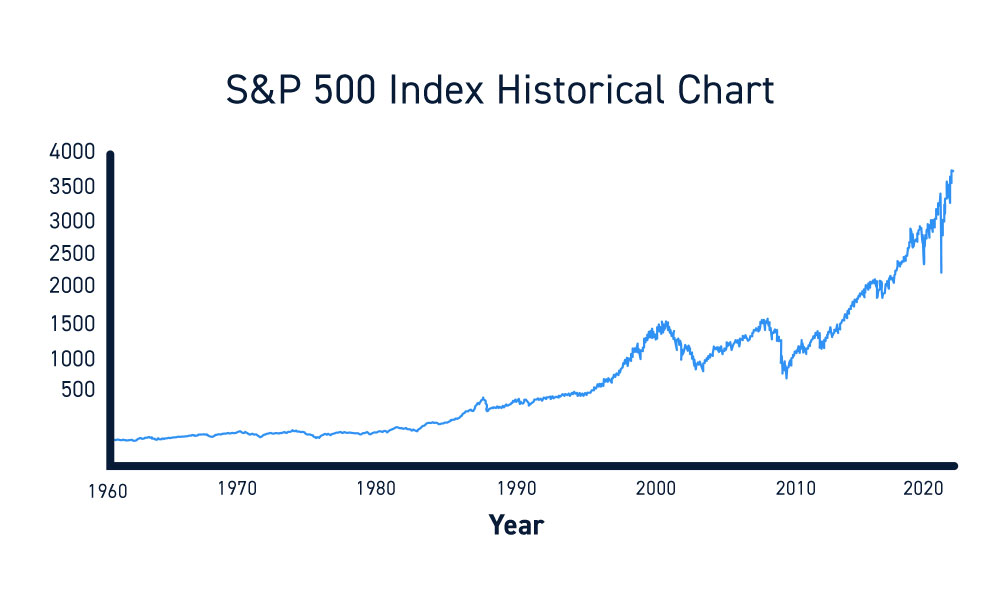
Long-Term Growth Potential: Historically, the S&P 500 has demonstrated robust long-term growth. While past performance doesn’t guarantee future results, its average annual return over decades has been impressive, making it a powerful tool for compounding wealth over time.
-
Resilience and Stability: The index comprises established, financially sound companies that have largely proven their ability to weather economic downturns. This inherent stability often makes S&P 500 investments less volatile than highly concentrated portfolios of individual stocks.
-
Low Cost and Simplicity: Gaining exposure to the S&P 500 is surprisingly cost-effective and straightforward, primarily through index funds and ETFs, which boast very low expense ratios compared to actively managed funds.
Key Characteristics and Performance
The S&P 500 is often cited as the best single gauge of large-cap U.S. equities and a leading indicator of U.S. economic health. Its historical average annual return, including dividends, has been approximately 10-12% over extended periods. It’s important to note that this return comes with fluctuations; there are years of significant gains and years of losses. The index’s market-cap weighting means that giants like Apple, Microsoft, Amazon, and Google (Alphabet) typically have the most significant influence on its day-to-day movements. Understanding this structure helps investors appreciate the underlying dynamics of their S&P 500-linked investments.
Direct vs. Indirect Investment: Methods to Gain Exposure
While you cannot directly “buy” the S&P 500 index itself (it’s a theoretical construct, not a tradable asset), there are several highly efficient and accessible ways to invest in a portfolio designed to replicate its performance.
Direct Purchase of Index Components (Impractical)
The idea of directly buying shares of all 500 companies in the S&P 500 to perfectly mirror the index is theoretically possible but practically unfeasible for most investors. It would require an enormous capital outlay, constant rebalancing to match the index’s weighting, and incur significant transaction costs. This is why financial products designed specifically to track the index were created.
Investing through Exchange-Traded Funds (ETFs)
ETFs are arguably the most popular and efficient way for individual investors to gain exposure to the S&P 500. An S&P 500 ETF is a type of fund that holds stocks of the companies in the S&P 500 index, typically in the same proportions as the index itself.
-
How ETFs Work: ETFs trade like individual stocks on major exchanges throughout the day. When you buy an S&P 500 ETF, you are buying shares of a fund that, in turn, owns a diversified portfolio of the 500 underlying stocks. The fund’s objective is to track the performance of the S&P 500 as closely as possible, minus a small expense ratio.
-
Benefits of S&P 500 ETFs: They offer exceptional liquidity, allowing you to buy and sell throughout the trading day. Their expense ratios are typically very low (often under 0.10%), meaning more of your money goes towards investing rather than fees. They also offer excellent transparency, as their holdings are publicly disclosed daily.
-
Popular Examples: Some of the most well-known S&P 500 ETFs include:
-
SPDR S&P 500 ETF Trust (SPY): The oldest and one of the largest S&P 500 ETFs.
-
iShares Core S&P 500 ETF (IVV): Another highly popular choice with a competitive expense ratio.
-
Vanguard S&P 500 ETF (VOO): Known for its extremely low expense ratio and strong tracking performance.
-
Investing through Mutual Funds
S&P 500 index mutual funds are another excellent option, particularly for investors who prefer to set it and forget it, or for those making regular, recurring investments.
-
How Mutual Funds Work: Unlike ETFs, mutual funds are typically bought and sold at the end of the trading day based on their Net Asset Value (NAV). An S&P 500 index mutual fund pools money from many investors to buy the underlying stocks in the index.
-
Actively vs. Passively Managed: When it comes to the S&P 500, you’ll almost always be looking at passively managed index funds. Actively managed funds try to beat the market, often with higher fees, while passive index funds simply aim to match the index’s performance.
-
Advantages and Disadvantages: Mutual funds can be ideal for dollar-cost averaging and automated investments. Some may have higher expense ratios than comparable ETFs, and they don’t offer the intraday trading flexibility of ETFs. However, many providers, like Vanguard and Fidelity, offer S&P 500 index mutual funds with expense ratios on par with ETFs.
-
Popular Examples:
-
Vanguard 500 Index Fund Admiral Shares (VFIAX)
-
Fidelity 500 Index Fund (FXAIX)
-
Schwab S&P 500 Index Fund (SWPPX)
-
Futures Contracts and Options (For Sophisticated Investors)
For highly experienced investors with a strong understanding of leverage and risk, futures contracts and options on the S&P 500 index (e.g., SPX options, ES futures) offer another way to speculate on or hedge against the index’s movements.
-
Brief Explanation: Futures contracts are agreements to buy or sell an asset at a predetermined price at a specified time in the future. Options give the holder the right, but not the obligation, to buy or sell an asset at a specified price before a certain date. These derivatives are complex, involve significant leverage, and carry a high degree of risk.
-
Risk Considerations: Due to the potential for substantial losses, these instruments are not recommended for beginners or most long-term investors focused on wealth accumulation. They are typically used for short-term speculation, hedging large portfolios, or by institutional traders.
Step-by-Step Guide to Buying SPX Index Funds/ETFs
Now that you understand the primary vehicles for S&P 500 investment, here’s a practical guide on how to make your purchase.
1. Choose a Brokerage Account

The first step is to open an investment account with a reputable brokerage firm. Many online brokers offer low-cost or commission-free trading for ETFs and mutual funds.
-
Popular Online Brokers: Fidelity, Charles Schwab, Vanguard, E*TRADE, TD Ameritrade (now Schwab), Interactive Brokers, Robinhood (for commission-free ETF trading).
-
Types of Accounts:
-
Taxable Brokerage Account: A standard investment account where capital gains and dividends are typically taxed each year.
-
Retirement Accounts:
-
Traditional IRA/401(k): Contributions may be tax-deductible, and growth is tax-deferred until retirement.
-
Roth IRA/401(k): Contributions are made with after-tax money, but qualified withdrawals in retirement are tax-free. These are excellent vehicles for S&P 500 investments due to their long-term growth potential and tax benefits.
-
-
2. Fund Your Account
Once your account is open and approved, you’ll need to deposit money. Common funding methods include:
-
Electronic Funds Transfer (EFT): Linking your bank account to your brokerage account for easy transfers.
-
Wire Transfer: For larger amounts, typically faster but may incur fees.
-
Check Deposit: Mailing a check to your brokerage firm.
3. Research and Select Your Investment Vehicle
With funds in your account, it’s time to choose the specific S&P 500 ETF or mutual fund you want to invest in.
-
Compare Expense Ratios: Look for funds with the lowest expense ratios, as even a small difference can impact your long-term returns significantly.
-
Tracking Error: This measures how closely a fund tracks its underlying index. Lower tracking error is better.
-
Fund Provider: While many funds track the S&P 500, some providers (like Vanguard, Fidelity, iShares) are known for their efficiency and low costs.
-
Minimum Investment (for Mutual Funds): Some mutual funds may have a minimum initial investment (e.g., $3,000 for Vanguard index funds), while ETFs can be bought for the price of a single share.
4. Place Your Order
Access the trading platform provided by your brokerage and search for the ticker symbol of the ETF or mutual fund you’ve chosen (e.g., SPY, IVV, VOO for ETFs; VFIAX, FXAIX, SWPPX for mutual funds).
-
For ETFs:
-
Market Order: Buys or sells at the best available current price. Use with caution for highly volatile assets, but generally fine for liquid S&P 500 ETFs.
-
Limit Order: Allows you to specify the maximum price you’re willing to pay or the minimum price you’re willing to sell for. This can be useful for more precise control.
-
Fractional Shares: Some brokers now allow buying fractional shares of ETFs, enabling you to invest a specific dollar amount rather than having to buy whole shares.
-
-
For Mutual Funds: You typically just enter the dollar amount you wish to invest, and the order will be processed at the fund’s closing NAV.
5. Monitor and Rebalance (Long-Term Strategy)
Investing in the S&P 500 is typically a long-term strategy. While you don’t need to constantly monitor its performance, it’s wise to:
-
Dollar-Cost Averaging: Consider investing a fixed amount regularly (e.g., monthly) regardless of market fluctuations. This strategy, known as dollar-cost averaging, can help smooth out returns over time and reduce the impact of market volatility.
-
Periodic Review: Annually or semi-annually, review your overall portfolio to ensure it aligns with your financial goals and risk tolerance. While the S&P 500 is diversified, it’s just one piece of a complete portfolio.
-
Rebalancing: If your S&P 500 allocation grows significantly larger than your target due to market appreciation, you might consider rebalancing by selling a portion and investing in underperforming assets, or by directing new contributions to other asset classes.
Important Considerations Before Investing
While investing in the S&P 500 is a robust strategy, it’s not without its nuances and potential pitfalls. Being aware of these considerations can help you make more informed decisions.
Risk Factors
No investment is entirely risk-free.
-
Market Risk: The S&P 500 is subject to overall market fluctuations. Economic downturns, geopolitical events, or widespread corporate struggles can lead to declines in the index value.
-
Concentration Risk (U.S. Large-Cap): While diversified within the U.S. large-cap segment, an S&P 500 investment is entirely focused on American equities. It doesn’t provide direct exposure to international markets or other asset classes like bonds or real estate.
-
No Guaranteed Returns: Past performance is not indicative of future results. There will be periods where the S&P 500 experiences losses.
Expense Ratios and Fees
Always scrutinize the expense ratio, which is the annual fee charged by the fund provider. Even a difference of 0.10% can amount to tens of thousands of dollars over a few decades due to the power of compounding. For S&P 500 index funds and ETFs, look for ratios well under 0.10%. Also, be aware of any potential trading commissions (though many brokers offer commission-free ETF trading).
Diversification Beyond the S&P 500
While the S&P 500 offers excellent diversification within U.S. large-cap stocks, a truly diversified portfolio often includes:
-
International Stocks: To gain exposure to global economic growth and reduce reliance on a single country’s market.
-
Bonds: To provide stability and income, especially during equity market downturns, and reduce overall portfolio volatility.
-
Other Asset Classes: Depending on your goals, you might consider real estate, commodities, or alternative investments. The S&P 500 should be a component of a broader, well-thought-out asset allocation strategy.
Investment Horizon and Goals
Investing in the S&P 500 is most effective for long-term goals (typically 10 years or more). This allows your investments enough time to recover from market downturns and benefit from compounding returns. Align your S&P 500 allocation with specific financial objectives, whether that’s retirement planning, a down payment on a house in the distant future, or funding a child’s education.
Tax Implications
Understand the tax implications of your S&P 500 investments:
-
Dividends: Dividends paid by the underlying companies are passed on to you (or reinvested) and are generally taxable in a non-retirement account.
-
Capital Gains: When you sell your S&P 500 ETF or mutual fund shares for a profit, you’ll incur capital gains taxes. These are typically lower for long-term holdings (held over a year).
-
Tax-Advantaged Accounts: Utilizing retirement accounts like IRAs or 401(k)s can provide significant tax benefits, either through tax-deferred growth or tax-free withdrawals in retirement, making them ideal for long-term S&P 500 investments.
Conclusion
Investing in the S&P 500 index offers a powerful, low-cost, and diversified approach to participate in the growth of the U.S. economy. By choosing an S&P 500 index ETF or mutual fund, you’re not just buying a stock; you’re gaining a slice of 500 of America’s most influential companies. This strategy, when combined with a long-term perspective, dollar-cost averaging, and careful consideration of fees and taxes, can be a cornerstone of a successful financial plan.
Remember, while this guide provides comprehensive information, personal financial situations vary. It’s always a good practice to consult with a qualified financial advisor to tailor an investment strategy that best suits your individual needs and goals. With informed decisions, the S&P 500 can be a robust engine for your wealth-building journey.
aViewFromTheCave is a participant in the Amazon Services LLC Associates Program, an affiliate advertising program designed to provide a means for sites to earn advertising fees by advertising and linking to Amazon.com. Amazon, the Amazon logo, AmazonSupply, and the AmazonSupply logo are trademarks of Amazon.com, Inc. or its affiliates. As an Amazon Associate we earn affiliate commissions from qualifying purchases.